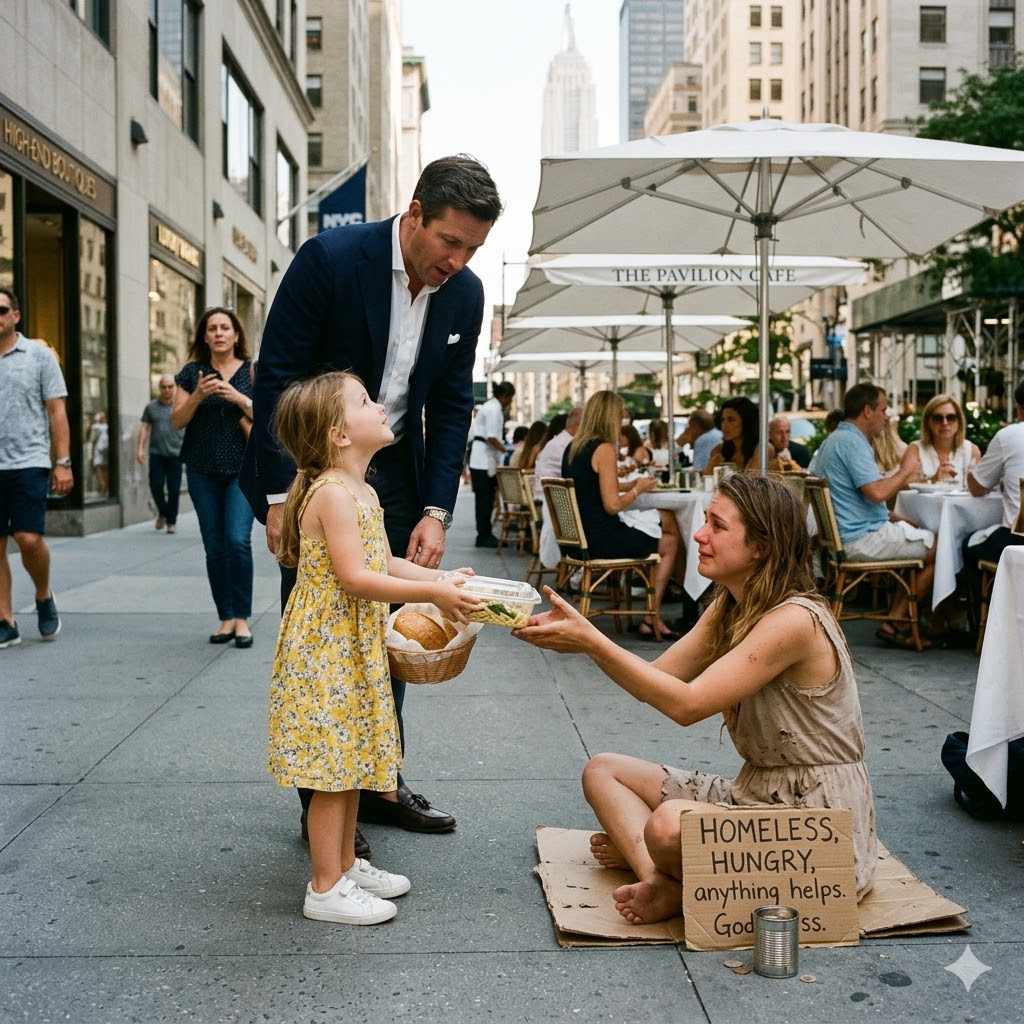
The outdoor cafe on 5th Avenue gleamed with afternoon sunlight, its white umbrellas casting elegant shadows over tables where New York’s elite gathered for leisurely lunches. James Hartwell sat at one such table reviewing contracts on his tablet while his 5-year-old daughter, Sophie, picked at a plate of pasta primavera that cost more than some people spent on groceries for a week.
At 38, James had built Hartwell Industries from a small tech startup into a billion-dollar enterprise. He’d sacrificed relationships, sleep, and countless personal moments to reach the pinnacle of success. His marriage had been one of those sacrifices. His wife had left 3 years ago, unable to compete with his obsession with work, taking nothing in the divorce except her freedom.
Sophie, thankfully, had stayed with James, though he often wondered if that was really best for her, given how much time he spent at the office. Today was supposed to be different. It was Saturday, and James had actually cleared his schedule to spend the afternoon with Sophie. Lunch at her favorite cafe, then perhaps the park or a museum.
Quality time, the parenting books called it, though James suspected he was failing at it, given how often he checked his phone for messages from the office. “Daddy, look,” Sophie said suddenly, tugging on his sleeve. “Not now, sweetheart. Daddy’s reading something important,” James replied automatically, not looking up from an acquisition proposal that couldn’t possibly wait until Monday.
“But, Daddy.” “Sophie, please. Give me 2 more minutes.” His daughter fell silent, but James could feel her attention focused on something beyond their table. When he finally looked up, irritated by the distraction, he followed her gaze to see what had captured her interest. Sitting on the sidewalk about 20 ft from their table was a young woman, probably in her mid-20s, wearing a tattered beige dress that had clearly seen better days, much better days.
Her blonde hair was pulled back in a messy bun, and her bare feet were dirty from the street. Before her sat a small tin cup with a few coins and a hand-lettered cardboard sign that read, “Homeless, hungry, anything helps. God bless.” James felt the familiar discomfort that always arose when confronted with visible poverty.
He preferred his charity at a distance, tax-deductible donations to reputable organizations, fundraising galas where he could write large checks and feel virtuous without actually encountering the people he was supposedly helping. “Daddy, she looks hungry,” Sophie said, her voice small but determined. “Can I share my food with her?” “Sophie, that’s not appropriate,” James said quietly, glancing around to see if any of the other patrons had noticed his daughter’s interest in the homeless woman. “We don’t You can’t just approach
strangers like that.” “But, you always say we should help people who need help,” Sophie pointed out with the brutal logic of childhood. “She needs help. She’s sitting on the ground, and she doesn’t have any food, and we have so much food I can’t even finish it all.” James looked at his daughter’s plate.
She’d eaten perhaps a third of the generous portion, and James knew from experience she wouldn’t eat much more. The meal had cost $35. Sophie was right. They did have more than enough. “It’s complicated,” James said, the inadequate explanation adults always offered children when they didn’t want to admit uncomfortable truths.
“There are There are organizations that help homeless people, shelters, food banks. She should go to one of those.” “Why doesn’t she?” Sophie asked. “I don’t know, Sophie. Maybe she doesn’t know about them. Maybe they’re full. Maybe she has reasons.” “Then we should help her,” Sophie said with the simple certainty of a child who hadn’t yet learned to look away from suffering.
“Because if the organizations can’t help her and we can help her, shouldn’t we?” James felt something uncomfortable twisting in his chest, shame perhaps, or the recognition that his 5-year-old daughter possessed a compassion he’d somehow lost in his climb to the top. “All right,” he said finally. “We can give her your leftovers, but I’ll do it. You stay here.
” “No,” Sophie said with surprising firmness. “I want to give it to her. You said it’s important to see people, not just their problems, to look them in the eyes and treat them like people. You said that when we gave money to the man playing violin at Christmas.” James had indeed said that during a rare moment of parental wisdom.
He’d been teaching Sophie about treating service workers and street performers with respect and dignity. He hadn’t expected her to apply the lesson quite so literally or at quite so inconvenient a moment. “Fine,” James relented. “But, I’m coming with you.” He signaled the waiter for a takeout container, then helped Sophie carefully transfer her uneaten pasta into it.
Sophie also insisted on including the untouched bread basket and the fruit plate James had ordered more out of habit than hunger. Together, they approached the young woman on the sidewalk. Up close, James could see she was younger than he’d initially thought, probably early 20s, with green eyes that held a weariness born of hard experience.
She watched their approach with the careful attention of someone who’d learned that attention from wealthy strangers could go either direction. “Excuse me,” Sophie said politely, in the careful voice she used with adults she didn’t know. “My name is Sophie. We were having lunch over there, and I didn’t finish all my food. Would you like it? There’s pasta and bread and fruit.
” The young woman stared at Sophie, then at James, clearly trying to assess whether this was genuine or some sort of elaborate cruelty. James had heard stories of people who mocked the homeless, filmed them for social media, turned their suffering into entertainment. “It’s not a trick,” James said quietly. “My daughter noticed you and wanted to share.
If you’d like the food, it’s yours. If not, no judgment.” The woman’s eyes filled with tears. “Thank you,” she whispered, accepting the containers from Sophie with shaking hands. “Thank you so much. I haven’t eaten since yesterday morning.” “What’s your name?” Sophie asked with the fearless friendliness of childhood.
“Emma,” the woman said. “My name is Emma. It’s nice to meet you, Emma,” Sophie said solemnly. “I’m sorry you’re hungry. That must feel really bad.” “It does,” Emma admitted. “But, this helps. This helps so much. You’re very kind. Can I ask you something?” Sophie said, and James tensed, uncertain what innocent but potentially hurtful question his daughter might ask.
“Why are you sitting outside? Don’t you have a house?” “Sophie,” James started, but Emma held up a hand. “It’s okay,” she said. “It’s a fair question. No, sweetheart, I don’t have a house right now. I did once, but I lost it. Sometimes that happens to people.” “Why?” Sophie asked, genuinely curious rather than judgmental.
Emma looked at James as if seeking permission to share difficult truths with a child. James nodded slightly. Sophie was asking, and she deserved honest answers, even if they were uncomfortable. “I got sick,” Emma explained simply. “I had a job and an apartment, and then I got really sick. I spent a long time in the hospital, and when I got out, I’d lost my job because I’d been gone so long.
Without a job, I couldn’t pay my rent. Without