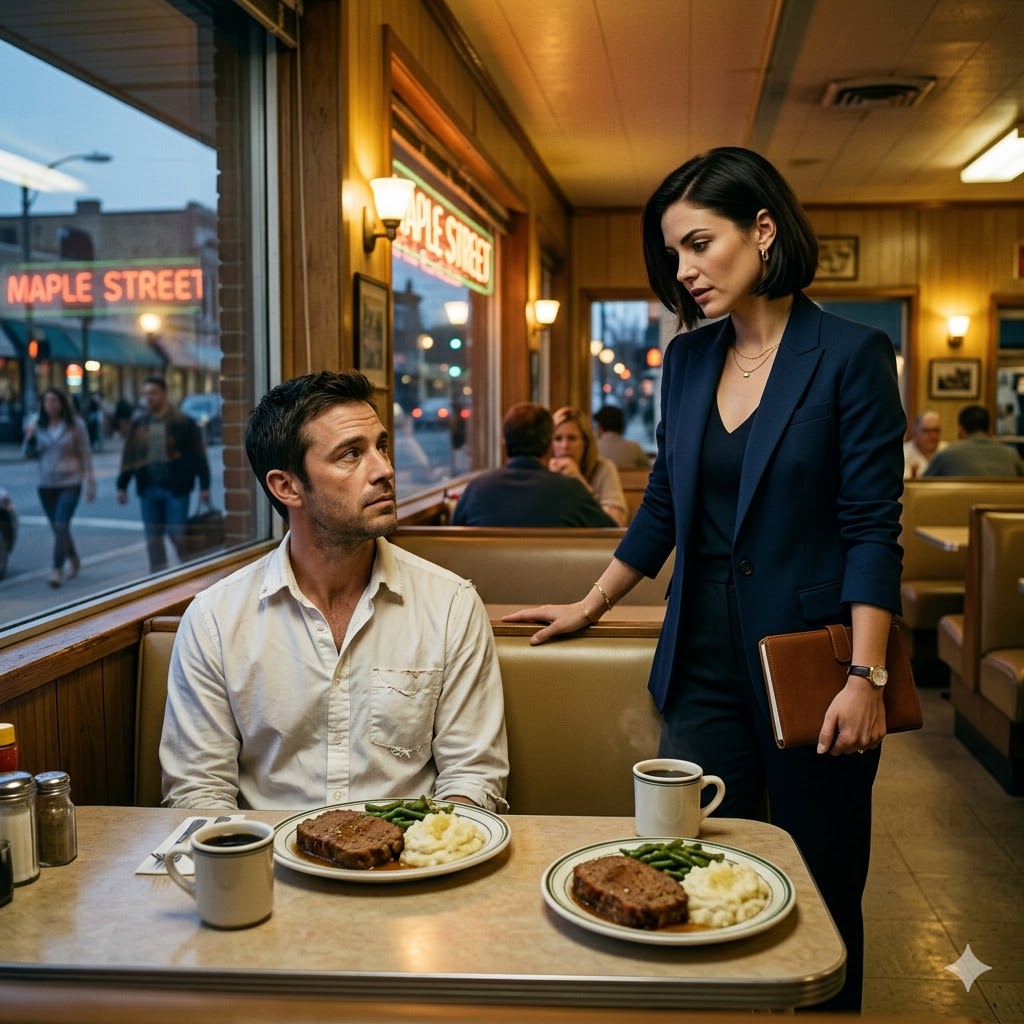
Every Friday evening at exactly 7:00, a man sat alone in the corner of an old diner. His white shirt was frayed at the collar. His worn shoes were polished to a careful shine. In front of him always sat two plates of food, one for himself and one that was never touched. Nobody knew who he was waiting for. Nobody dared to ask.
Until the night, a young CEO walked through the door and asked him one simple question. Who are you waiting for His answer would not only silence her, it would change her entire life forever. Stay until the very end of this story. The truth behind that empty chair will change the way you think about waiting. The diner was called Maple Street.
It had been there since the 1950s, and it showed the vinyl seats were cracked and patched with tape. The ceiling fans wobbled overhead in slow, lazy rotations, and the menus were laminated things stained with decades of coffee rings. The light inside was golden and low, the kind that made everything look warmer than it actually was.
It smelled of bacon grease and fresh pie crust, of burned coffee, and something faintly sweet that nobody could ever quite identify. There was a jukebox near the entrance that nobody played anymore. Its chrome casing dull, its song list faded to near illegibility. It was the kind of place that had survived not by reinventing itself, but by refusing to change.
and the regular customers loved it for exactly that reason. Wyatt Bennett arrived every Friday at 6:55, 5 minutes before the 7:00 hour, and he always chose the same booth in the far corner by the window. He was 27 years old that autumn, though most people who met him assumed he was older, he carried himself with the stillness of a man who had already made peace with something the rest of the world was still fighting.
His shoulders were broad and his posture straight. And yet there was a quality to his tiredness that went beyond the physical that lived behind his eyes. In the particular way they looked outward at things without quite landing on them. He wore the same white button-down shirt each Friday. Always clean, always pressed, though the collar had begun to fray at the seam, and the cuffs showed the ghost of yellow despite whatever he used to launder them.
His dark trousers were neat, and his leather shoes, though worn thin at the heels, were always polished until they caught the diner’s amber light. He dressed as a man who respected the occasion, even if the occasion was one only he could see. There was nothing theatrical about it. He was not performing grief or sentimentality.
He was simply dressed as a man who keeps appointments dresses with care and with intention. His son’s name was Caleb, and Caleb was 6 years old that autumn. He had his father’s dark hair and his mother’s large wondering eyes a shade of brown so light it looked almost gold in certain lighting.
Caleb was a quiet child, not in the way of sadness, but in the way of someone who listened more than he spoke, who observed before he reacted. He carried a small toy car everywhere he went. A beat up red pickup truck with a missing rear tire that he had received for his first birthday and refused to surrender to age or damage.
The truck had been repaired twice with a rubber band around the chassis, and Caleb considered these repairs to have made it better. On Friday evenings, Caleb was not at the diner. He stayed with the elderly woman next door, Mrs. Pauline, who made him coco, and let him watch nature programs until Wyatt came home.
Caleb had never once asked why his father went alone every Friday. He had simply grown up accepting it the way children accept all rituals. They do not yet have the language to question as a fact of the world. Steady and unremarkable as weather. Wyatt’s life outside those Friday evenings was structured and disciplined. He worked as a handyman through a local service company, taking whatever jobs came in leaky pipes, broken fence posts, electrical panels that needed careful reading.
He was meticulous and reliable, and his clients requested him by name, though the pay was modest, and the hours were unpredictable. He cooked breakfast before school each morning, packed Caleb’s lunch in a paper bag he folded precisely at the top, and arrived at pickup each afternoon exactly 2 minutes before the bell. He never missed a recital.
He never forgot a permission slip. He was, by every visible measure, a man living a careful life inside a narrow set of constraints, making it work because he had decided it would work, not because anyone had made it easy. The staff at Maple Street had their own quiet language around Wyatt Bennett. Linda, who had worked the Friday evening shift for 11 years, would simply nod when he came through the door and begin writing out the order before he had even taken his seat.
Two plates of the meatloaf special in autumn and winter. Two plates of the grilled chicken with green beans in spring and summer. Two glasses of water with lemon. Two cups of decaf coffee, both left black. She had learned not to ask. She had learned this early back in the first year when she had once approached Wyatt with a gentle smile and a question about whether he was expecting someone.
He had looked at her with those quiet eyes and said simply and without unkindness that the second plate was for someone who would be there soon. And then he had turned to look out the window at the parking lot. And Linda had understood without knowing precisely how she understood that the conversation was over. She never asked again.
Neither did anyone else. Wyatt had his rituals, and they were precise. When the second plate arrived, he would reach across the table and adjust the fork beside it, straightening the tines until they were perfectly parallel with the edge of the placemat. Then he would smooth a wrinkle from the paper napkin with the flat of his palm.
The same unhurried motion each time. Then he would sit back and look at the chair opposite him. A long, still unhurried look. The way a person looks at someone they are genuinely glad to see. After perhaps a minute of this, he would glance at his watch. Then, almost always, the corner of his mouth would lift in something that was not quite a smile, but was very close to one.
The expression of a man who knows the other party is running a few minutes late and finds the fact endearing rather than irritating. He never touched the second plate. He ate his own meal in unhurried bites, occasionally glancing at the window or the door, occasionally sipping his coffee, occasionally resting his forearms on the table, and simply looking across at the untouched food with an expression nobody at Maple Street could ever name, with confidence, something between love and patience, between grief and grace. He stayed
exactly 1 hour. At 8:00, he would place a folded bill on the table, enough to cover both plates and a generous tip, and he would put on his jacket and walk out into whatever the weather was that evening. It was a Saturday morning in early October when Caleb first said it out loud.
Wyatt had been buttoning the boy’s coat before school when Caleb looked up at him with those wide amber eyes and asked in the tone children use when they have been holding a question for a very long time, whether mama came to the diner on Fridays. The air in the kitchen seemed to stop moving. Wyatt finished buttoning the last button.
He smoothed Caleb’s collar with both hands, the same careful motion he used on the napkin at the diner, and he straightened up and looked at his son for a long moment. He did not answer the question. What he said instead was that Caleb was going to be late, that Mrs. Pauline had made muffins that morning, and he handed the boy his backpack and his lunch bag and his beat up red toy truck, and they walked out together into the October morning.
But Caleb, who was six and very observant, noticed that his father’s eyes were glassy until they reached the sidewalk. The woman who had sat across from Wyatt at Maple Street Diner every Friday had not appeared for 6 years. He had not missed a single Friday in all of them. Sophia Clark had not planned to eat at Maple Street Diner on the night of the third Friday in October.
She had planned, as she always planned, to work straight through the evening to take her car from the office tower downtown and drive the 30 minutes home with a podcast on and a meal delivery arriving at her door by 7:30. That had been the plan, but the meeting had gone on for 4 hours and 40 minutes, and by the time the last of her senior partners filed out of the conference room, she had what felt like a spike of iron behind her left eye.
and the thought of going home to the clean, silent walls of her apartment seemed, for the first time in recent memory, completely unbearable. She was 26 years old, and she was the chief executive officer of a logistics technology firm that had doubled its revenue in the prior year, and she had never in her professional life described herself as anything less than in control.
She did not lose her composure. She did not make decisions based on impulse or emotion. She had designed her life around the removal of variables she could not account for, and it had worked by every measurable standard extremely well. Her wardrobe was precise, her schedule color-coded, her relationships maintained with the careful regularity of assets that needed tending.
She was the kind of person who did not wander into diners by accident. So, she drove past three restaurants she had never stopped at and pulled into the parking lot of Maple Street Diner because the sign was lit and the lot was not full and her headache demanded something warm and uncomplicated and entirely ordinary.
She chose a booth midway down the aisle, ordered coffee and the soup of the day without looking at the menu and opened her phone to review an email chain that had come in during the final half hour of the meeting. That was when she first saw him. She noticed the stillness first.
In a diner where every other person was in some form of motion, eating, talking, looking at their phones, pouring sugar into cups, the man in the corner booth was simply still. He sat with both hands resting open on the table, not holding anything, looking at the chair across from him with an expression that Sophia could not immediately categorize.
He was not sad. He did not look lost. He looked, if anything, attentive like someone listening carefully to a voice in a frequency she could not hear. Then she noticed the second plate. The food on it was untouched. The fork beside it was aligned with geometric precision along the edge of the napkin.
The coffee cup across from him was full and cooling. He was waiting for someone. Sophia watched him for perhaps 4 minutes, long enough to register that no one was coming and that he did not appear to find this troubling. He ate his own food and measured bites. He glanced at the door twice, but without urgency.
Once he looked at his watch and made that small, almost imperceptible smile. Something about it bothered her in a way she could not explain. Before she had fully decided to do it, she was standing beside his table. “Excuse me,” she said. “Are you expecting someone” Wyatt Bennett looked up at her with those dark, unhurried eyes, and there was a moment of quiet assessment before he answered.
I’m waiting for a promise,” he said. Sophia blinked. She was not accustomed to answers that did not parse immediately into useful information. He did not elaborate. She looked at the untouched plate, at the carefully folded napkin, at the chair that nobody had sat in. Then she sat down, uninvited, in the empty booth beside the aisle.
“People don’t keep promises that long,” she said. “Whoever you’re waiting for, they’re not coming.” He was quiet for a moment, looking at her with an expression that was patient rather than offended. Then he said, “There are some promises that aren’t meant to be kept. They’re meant to not be forgotten.” Sophia opened her mouth to respond and found.
Unusually that she had nothing ready. She paid for her soup at the register without finishing it, drove home with the radio off, and sat in her parking garage for several minutes before going inside. She told herself it was the long day. She told herself it was the headache. She came back the following Friday. She told herself it was professional curiosity.
The same instinct that made her good at her job. The persistent rational need to understand systems and behaviors that did not immediately make sense had simply attached itself to a mildly unusual man in a diner. That was all it was. So the second Friday, she arrived at Maple Street at 7:15, ordered coffee, and sat in a different booth with a clear line of sight to his corner.
She watched him go through the same ritual with the same unhurried exactness. The fork, the napkin, the long look at the chair, the check of the watch, the almost smile, the untouched second plate. He noticed her. He said nothing. The third Friday, she arrived earlier and sat at the counter and ordered food she actually ate. By the fourth Friday, she had stopped telling herself it was professional curiosity.
What she had discovered across four weeks of observation and two conversations she had initiated and one he had in his quiet way allowed to continue was that Wyatt Bennett was not a man who had lost his grip on reality. He was, if anything, more deliberate in his grip on it than most people she had encountered in her professional life.
His apartment, she had gathered from context and small mention, was clean and organized. He cooked real meals. He tracked Caleb’s school calendar with the same precision she used for quarterly projections. He read to Caleb every night. Always had, always would. He was not romantic in the movie sense.
He did not perform his grief or wear it as an identity. He simply had an appointment he kept and everything else in his life was organized around keeping it. There was a coherence to him that she found increasingly and against her preferences genuinely impressive. What finally cracked her composure was the Thursday afternoon when she ran into him outside the hardware store near her apartment building.
She had not expected to see him there, and she had not concealed her surprise quickly enough, and so they had ended up walking half a block together while he explained without particular drama that he had come to look at a specific bracket for a shelving unit he was building for Caleb’s room. she asked without thinking whether he had been offered the contract position at the logistics firm on Milbrook.
She had heard through an acquaintance that they had been looking for experienced handymen for a renovation project, something that would have paid almost three times his current rate and run for the better part of a year. He said he had been offered it. She asked why he hadn’t taken it. He said the hours were 7 days a week and he could not be unavailable on Fridays.
Sophia stopped walking. She looked at him as if he had said something in a language she knew she should be able to translate but couldn’t. You turned down that contract, she said slowly. Because of a Friday dinner. Yes, he said as if this were the most straightforward thing in the world, Wyatt.
She said his name with the restraint of someone choosing not to say what she was actually thinking. That was a significant amount of money. I know what it was. And you walked away from it. I did. She stood on the sidewalk and watched him shift the paper bag to his other arm and wait patiently for her to finish her thought. “I don’t understand you,” she said finally.
It was the most honest thing she had said to someone in a long time. “I know,” he replied, and he sounded neither bothered by this nor particularly concerned about changing it. She watched him go, and then stood there for a moment longer, running the calculation again in her head. the contract, the money, the Friday dinner, the empty chair, and she could not make it add up in every framework she had for evaluating decisions.
The numbers didn’t balance. But the thing that stayed with her as she walked the rest of the way home was not the amount of money he had turned down. It was how little he had hesitated. It was the total absence of doubt in his voice when he said he couldn’t be unavailable on Fridays. not as if it were a sacrifice, but as if it were simply a fact about the shape of his life, as fixed and uncontestable as his name.
It was the fifth Friday evening when he told her she had arrived at 650 and taken the booth directly adjacent to his corner. And when he came through the door at 6:55, he had looked at her and then at the booth and then sat down without comment. Linda brought two plates, glanced once at Sophia, and left without saying anything. They ate in the particular silence of people who have stopped needing to perform conversation.
It was Sophia who finally spoke. “Tell me about her,” she said. Wyatt set down his fork. He looked at the untouched plate across from him for a long time. Then he said quietly and without hesitation as if he had been expecting the question and had already decided what to say. Her name was Clare. Clare Bennett.
She had been 21 when they met, 22 when they married, 23 when Caleb was born. She had been 24 years old when she died in a collision on the interstate in early January, 6 years ago this past winter, when the ice on the road had gone invisible under a passing truck’s headlights, and there had been no time to react.
They had been married for just over 2 years. In those two years, he said, they had come to Maple Street every Friday evening. It had been their tradition, not born of romance or deliberate planning, but of accident. They had stumbled in one night, because every other place was closed during a neighborhood power outage, and the food had been warm, and the light had been golden, and they had talked for 3 hours about nothing important, and then they had come back the following week, and the week after that, and it had simply become the most consistent thing in
their shared life. The last Friday before the accident, Wyatt told her they had sat in this exact booth. Clare had been talking about the spring, about wanting to take a weekend trip somewhere when the weather turned, about a small garden she had been thinking about starting in the backyard, about a name she had been considering for the imaginary second child.
They were somewhere between planning and dreaming. She had been in the middle of a sentence about something ordinary and small. When she had reached across the table and put her hand on his and said with the easy certainty of someone who could not possibly have known it would be the last time, whatever happens, I’ll always meet you here on Fridays.
Wyatt did not look at Sophia while he said this. He looked at the chair. She said it the way people say goodbye. He said light without weight. The way you say something you mean completely so completely. You don’t need to make it dramatic. He picked his fork back up and turned it in his fingers once. I didn’t think about it again until after.
until I had taken care of everything that needed taken care of. And Caleb was home and sleeping. And I was sitting in our kitchen at 2:00 in the morning, not knowing what to do. And that sentence came back to me. And I thought, “That’s where I’ll go. That’s where she said she’d be. I know she’s not here,” he said. “I’ve always known.
I’m not confused about what death means.” He paused as if choosing his next words with particular care. But she made a promise. And I decided the first Friday I came back that if I was going to raise a son, I was going to raise him in a house where promises have weight, where you keep the ones that matter.
Even when they cost you something, even when nobody’s watching, he picked up his coffee cup. I’m not waiting for her to walk through the door. I’m honoring the fact that she said she would. Sophia looked at the untouched plate, the fork aligned with perfect care along the napkin edge, the cooling cup of coffee.
She had spent the last 5 weeks constructing a framework in which this man’s behavior was irrational, a symptom of grief unresolved, an inability to move forward, a sentimental attachment to ritual that stood in the way of practical progress. She had been certain the framework was correct. It collapsed quietly in the warm gold light of the Maple Street Diner on a Friday evening in November because what she was looking at was not the behavior of a man who had failed to accept loss.
It was the behavior of a man who had decided in the deepest part of himself what kind of man he wanted to be and had organized every subsequent choice around that decision without apology or deviation. She thought about her assistant Paula, whom she had promised a promotion 8 months ago and had delayed because the quarter had been complicated.
She thought about her mother and the Sunday phone calls she had been meaning to reinstate for over a year. She thought about herself at 22 and the things she had told herself about who she was going to become. The light inside the diner was warm and gold and it made everything look softer than it was.
It was the second Friday in December when it came apart. Sophia had been leaving the office late when she drove past a pharmacy and remembered without knowing precisely why it came to her at that particular moment that Wyatt had mentioned the week before that Caleb had been coming down with something a cough at the back of his throat a slight fever in the evenings that would rise and then retreat by morning.
She had tucked the information away in the manner of someone filing a note under the category of other people’s concerns. Then she drove five blocks out of her way and knocked on his door. The lights in his apartment were on. Wyatt answered the door in his workclo with his face set in the particular expression of a managing two problems at once.
Over his shoulder, she could see Caleb on the couch under a blanket. His small face flushed the dark pink of a high fever. His toy truck was in his hand. His eyes were glassy and half closed. He’s been like this since this afternoon, Wyatt said. Has he seen a doctor He’ll be fine. It’s a fever.
I’ve been monitoring it. Sophia stepped just inside the door without being invited. It’s Friday, she said. Wyatt was quiet for a moment. I know what day it is. You’re not seriously thinking about going. I’ll make sure he’s asleep first. Mrs. Pauline, will he has a fever of what 102 101.8. Wyatt, she said his name the way she had learned to say things in difficult meetings, not as a reprimand, but as a marker.
A flag planted at the exact spot where the conversation needed to stop and reconsider. He’s sick. He needs you here. Wyatt looked at his son and then back at her. And the thing she saw in his face was not carelessness. It was a particular terrible kind of conflict. The collision of two forms of love that he had never in 6 years been forced to choose between.
because this situation had never arisen in exactly this form before. 1 hour, he said. I’ll be back in 1 hour. You are choosing, Sophia said. And she was surprised at the sharpness in her own voice. A woman who has been dead for 6 years over a living child who is sick and needs his father. The silence in the apartment was immediate and dense.
Wyatt looked at her, and for the first time in the weeks she had known him, she saw something move behind those careful, quiet eyes, something that was not patience. That, he said, and his voice had changed register, dropped lower, and taken on an edge she had not heard before, is not what I am doing.
Then explain it to me in a way that makes sense because from where I’m standing, I am keeping a promise, he said, in front of my son every single week. So that when Caleb is old enough to understand what that means, he will know. He will know because he has watched it his entire life. That a promise is not a thing you break because it gets inconvenient.
It is not a thing you cancel when something harder comes along. He stopped. He was breathing carefully. The way a man breathes when he is choosing not to let something become larger than it needs to be. I’m not going so I can sit across from a ghost. I’m going so that my son grows up in a house where a man’s word means something.
so that when he makes a promise to someone he loves, he will not think of it as optional.” Caleb coughed from the couch a small congested sound, and Wyatt turned immediately, the sharpness gone from his posture in an instant, and he crossed to the boy and put the back of his hand to the boy’s forehead and said very quietly something that Sophia couldn’t hear.
She stood in the doorway of the apartment and felt something shift inside her chest. Not dramatically, not like the breaking of something, but like the slow, quiet movement of a piece of furniture that has been in the wrong place for a very long time. She had thought the Friday ritual was about grief.
She had thought it was about an inability to let go, about a man anchoring himself to the past because the present was too hard to face alone. She had built her entire understanding of Wyatt Bennett on that premise, and she had been wrong about it in the most fundamental possible way. He was not sitting in that diner for himself.
He was sitting there for Caleb, for the six-year-old boy who would one day be a man who would one day face his own impossible choices and his own unbearable losses, and who would need in those moments a template for what it meant to hold yourself to something when every reasonable excuse to let go was available.
Wyatt was not preserving a memory. He was building a character. Sophia looked at the child on the couch, his small body tucked under the blanket, his toy truck resting against his chest, and she understood with sudden and total clarity that she had never once in her 26 years of life done anything as quietly significant as what this man did every Friday at 7:00 in a cracked seat booth at Maple Street Diner.
“I’ll stay with him tonight,” she said. Wyatt looked at her. “Go,” she said. “I’ll be here when you get back.” She stayed. Wyatt was back at 8:15, true to his 1 hour, and Caleb was asleep, and his temperature had come down half a degree. And Sophia was sitting at the kitchen table with her coat still on, her phone faced down, her coffee cup untouched.
Wyatt stood in the doorway for a moment and looked at her. “Thank you,” he said. She didn’t answer immediately. She was looking at something in the middle of the table, or maybe past it, in the way of someone whose attention is directed inward. When I was 23, she said finally, still not looking at him.
I promised my mother I would call her every Sunday. Every single Sunday, no matter what. I promised her that when I took the job in the city, when I moved 400 m away and became someone she recognized less, every time she saw me, I promised her that Sunday would always be ours, that it would never get lost in everything else. She paused.
The last time I actually called on a Sunday was 14 months ago. Wyatt sat down at the table. “There’s a woman at my company,” she continued. “Her name is Paula. She’s worked for me for two years. The day she interviewed, she told me what she wanted, not just the salary, but the title, the trajectory, what the role would look like down the line.” I told her I’d get her there.
I said those exact words. 8 months ago, I could have made it happen. I had a reason not to and I told myself the delay was temporary and I have not brought it up since. She picked up her coffee cup and set it down without drinking from it. I have spent my entire adult life in total control of every outcome I could manage.
I have been proud of that. I have described it as a skill. She finally looked at him. I never once thought about what I was trading away to maintain it. She came back to Maple Street the following Friday. She arrived at 6:45 earlier than Wyatt. And when Linda came over to take her order, she said she would wait for her guest.
Linda raised an eyebrow that Sophia chose not to acknowledge. When Wyatt came through the door at 6:55 and saw her not in the adjacent booth, not at the counter, but in the corner booth itself, sitting across from the place he always sat, his stride paused, just for a moment, just long enough for something to register. She was sitting in the empty chair.
He crossed the diner slowly and stood at the edge of the table, looking at her with an expression that held both surprise and something she could not quite name caution perhaps or the particular sensitivity of someone watching a place they have kept sacred be approached by another person. You shouldn’t sit there, he said.
I know, she said. I’m not replacing anyone. I would never pretend to. She held his gaze. But I don’t want this chair to always be empty. I think. She stopped, gathered herself. I think she’d want someone to be here with you. For a very long time, Wyatt stood at the edge of the table, and said nothing. Then he sat down.
Linda came over with two plates and sat them down and withdrew without commentary, which was as close as she would ever come to approval. They ate dinner together at Maple Street Diner on a Friday evening, and the empty chair was still, in some sense, empty. The absence it represented had not been repaired or replaced, but something in the quality of the evening had shifted.
The way a room shifts when a window is opened, and the air inside is no longer entirely still. Somewhere in the middle of the meal, when Sophia said something dry and unremarkable about the soup, Wyatt smiled small and brief, and for the first time in 6 years, the diner booth in the far corner held two people who were both fully present.
It was 3 weeks later that Sophia found the portfolio. She had not been looking for it. She had been in Wyatt’s apartment on a Thursday evening she had taken to stopping by occasionally to eat takeout with him and Caleb before the week ended, and Caleb had asked her to reach something from the top shelf, the hallway closet.
And when she opened the door, a folder had slipped from the top and landed open on the floor, spilling its contents across the hallway tiles. She picked up the papers automatically, the way you pick up papers. Then she stopped. They were technical drawings. engineering schematics of equality and complexity that could not have been produced by anything but genuine expertise, precise, annotated, layered with calculations written in a hand that moved with the fluency of long practice.
There were printouts from industry publications dense with jargon she partially recognized from her own sector and a conference presentation transcript. And at the bottom of the pile, a performance review from a company she recognized, a large engineering consultancy with offices in 12 states. She was still looking at it when Wyatt came around the corner.
He took the folder from her hands with an expression that was not quite embarrassed, but was not quite neutral. Either the look of a man who keeps something not out of secrecy, but out of a desire not to have it discussed. You were a senior engineer, she said. Structural systems, he said, infrastructure risk assessment.
Sophia stood in the hallway and thought about the number of times she had heard him describe himself as a handyman. The number of times she had watched him quote rates by the hour. Why did you stop Clare died in January. He said the project I was on required travel two weeks out of every month. I had a 4-month-old son and nobody to leave him with. I stepped back temporarily.
Then time passed. He set the folder back on the shelf with the same care he used for everything. I never went back. She might have left it there. The information was his to do with as he chose, and she was not in the habit of interfering with choices people had made about their own lives. But three days later, in a meeting she had called to address a growing technical crisis in her company’s infrastructure systems, she sat at the head of the table and listened to her team offer solutions that were each in their own way
inadequate. and she thought about those schematics, about the quality of the work, about the particular kind of mind that moves through complex systems with that level of precision and ease. She went to his apartment the following Thursday. She sat down across from him at the kitchen table while Caleb was in the other room and she laid out the situation without embellishment, the infrastructure failure her company was managing, the scope of it, the knowledge gap that was costing them days they could not afford. And then she asked him
to come on as a consultant. He was quiet for a moment. Then he said, “I can’t do something that interferes with Fridays.” She had known he would say this. She had thought about it in advance. “Then we don’t let it interfere with Fridays.” She said, “Sophia, I’m not asking you to give up anything.
I’m asking you to add something. Your schedule, your terms.” She paused. I mean it. Whatever the work looks like, Fridays are off the table. Non-negotiable. Written into the agreement. No exceptions. He looked at her across the table that long considering look she had come to recognize as the precursor to a serious answer.
That’s not how companies operate. He said it is if I say it is. He was quiet again for a longer moment. And Sophia let the silence stand which she had learned was the correct approach with Wyatt. I’d need to review the full scope of the problem. He said finally, “I know. I have conditions.” I assumed. And I need to know that Caleb’s schedule stays exactly as it is.
Nothing changes for him. Nothing changes for him. He picked up his coffee cup, turned it in his fingers, and set it down again. Send me the technical documentation, he said. I’ll look at it this weekend. Sophia nodded. She stood to go at the door. She stopped and turned back. Wyatt was still at the table, his hands resting open on the surface the way they did in the diner booth.
the way they did when he was sitting across from something that required his full and undivided attention. “Why did you agree” she asked. He looked at her for a moment. “Because Caleb needs to grow up seeing that it’s possible,” he said. “To work hard, to love something, and to not have those two things destroy each other.
” She walked out into the December evening and stood on the sidewalk with the cold air on her face and thought that she had never in all her years of business and strategy heard anyone define success quite like that. One year later, the Friday before Thanksgiving, the diner was fuller than usual. The air smelled of pumpkin and coffee, and someone had strung orange lights around the window frame, and the early dark of November had turned the glass into a mirror that reflected the warm interior back at itself.
Why had arrived at 6:55. But he was not alone. Caleb held his hand at the door, his red toy truck in his coat pocket. His 7-year-old face flushed from the cold. He had been to Maple Street Diner many times by now. Sophia had started bringing him on occasional Friday afternoons, first for pie, then for longer visits, until the place had become as familiar to him as his own living room.
He knew which seat was best for watching the kitchen. He knew that Linda brought hot cocoa without being asked. He knew that the corner booth in the far back was his father’s and that it was important. And he had never tried to understand why, only that it was, and that some things are important not because they can be explained, but because they are held carefully by someone who loves you.
Sophia was already there. She had arrived at 6:40, as had become her habit. and she sat across the table from the place Wyatt always sat in the chair that had once been Claire’s, not as a replacement, never as a replacement, but as a presence that honored the space rather than ignored it.
She had her coat on the hook and her hands around a coffee cup, and she was looking out the window at the parking lot with the relaxed expression of someone who is exactly where they intend to be. It was an expression that was new to her face in the way that all real changes are new slowly and then entirely. Wyatt slid into his seat.
Caleb unbuttoning his coat with the focused attention of a 7-year-old managing a complex task, eventually settled into the space between them, not on either side, but genuinely between in the way that children occupy the center of things without effort or intent. Linda brought four plates, one for Wyatt, one for Sophia, one for Caleb.
The children’s portion with extra green beans because he liked them and one that had always been there would always be there. The untouched plate in the corner, the fork aligned, the napkin pressed flat. Caleb ate his green beans one by one in the meticulous manner of someone who has a system.
He asked Sophia a long series of questions about an engineering concept his father had been explaining to him at home. He was at the age where he wanted to understand how things worked, how bridges stayed up and pipes held under pressure. And Sophia answered with the patience she had learned this past year. To actually feel rather than simply perform.
She was not the same person who had walked into Maple Street Diner 14 months ago to escape a headache. The difference was not dramatic or sudden. It had been slow. The way real changes are slow. A series of small corrections accumulating into a different direction. She called her mother on Sundays now without exception.
She had given Paula the title and the trajectory she had been promised with a note that acknowledged the delay without excuses. She had started noticing when she made a commitment and treating that moment as binding rather than provisional. None of this had made her less effective at her work. If anything, the clarity of knowing what she intended to keep had made everything else considerably cleaner.
The infrastructure crisis at her company had been resolved not quickly, not easily, but resolved with the thoroughess that comes from someone who actually understands a problem rather than managing its appearance. Wyatt had worked with a precision that was quiet and entirely self- assured, the kind that does not need to announce itself. He worked 4 days a week.
Fridays, always were his own. The meal was winding toward its end when Caleb set down his fork and reached into his coat pocket and placed the red toy truck, the one with the missing rear tire, 7 years old now, and held together partly by a rubber band around the chassis, carefully on the table in front of him. He looked at it for a moment.
Then he looked at the untouched plate in the corner, the one that had sat across from his father every Friday for as long as he could remember. “Daddy,” he said. Yeah, buddy. I think mama is smiling today. The diner noise continued around them. The clink of plates, the low murmur of other people’s Fridays, the coffee machine cycling behind the counter.
Wyatt looked at his son and then across the table at the empty plate. And for the first time in 7 years, the chair did not look empty to him. It looked occupied, not by what had been lost, but by everything that had been built in the space, the loss had made the boy beside him, the woman across from him, the life that had been lived in the direction of a promise rather than away from it.
He put his hand on top of Caleb’s small hand. “Yeah,” he said. “I think she is. There is a particular kind of strength that does not announce itself. It does not lift heavy things in front of crowds or speak first in a room full of people waiting for someone to speak. It does not require recognition to sustain itself, and it does not lose its shape when no one is watching.
It is the strength of a man who sits in a cracked vinyl booth every Friday evening and orders two plates of food and aligns a fork against a napkin with the care of someone who understands that the small, repeated, unhurried acts of devotion are not the footnotes of a life. They are the whole of it.
Wyatt Bennett did not wait at Maple Street Diner because he was unable to move forward. He waited because he understood something about the nature of promises that most people spend their entire lives constructing reasons not to believe that a promise is not a transaction. It does not expire when the other party is no longer present to receive it.
It is not canceled by inconvenience or by the passage of time or by the appearance of every reasonable excuse in the world to let it go. A promise is a statement about the kind of person you are choosing to be and you keep it or you do not entirely on your own. Sophia Clark had spent 26 years building an identity out of control and efficiency and the management of outcomes.
And she had been very good at it. And she had believed without examining the belief that this was the same thing as integrity. She had not understood until she watched a tired man in a fraying white shirt align a fork against a diner napkin with perfect care. That the two things are not the same at all.
Control is the management of what happens to you. Integrity is the management of what you do regardless of what happens to you. She had kept promises when they were convenient. She had abandoned them when they cost her something. She had called this pragmatism. She had called it good judgment. She had never once called it what it actually was.
What changed her was not a speech or a revelation or a single dramatic moment. It was the accumulation of watching someone live a certain way and recognizing slowly and then all at once that it was possible that a person could hold to something in the face of loss and practicality and time and the ordinary weight of keeping a life going and not be weakened by the holding that the keeping itself repeated faithfully enough becomes a form of building of constructing day by quiet day the person you said you were going to be. Caleb Bennett would grow up
having watched this. He would grow up knowing in his body the way children know things before they have words for them. That when his father said something, it was real. That the shape of a man’s word could be trusted because it had been tested every single Friday against the most uncontestable reason in the world to stop keeping it.
That child would one day make promises of his own to people he loved, to work he cared about, to the version of himself he was deciding to become. And when those promises became inconvenient, when they cost him something, when every reasonable voice assembled itself into an argument for letting go, he would remember a corner booth, a fork placed just so, the quiet expression of a man who checked his watch and smiled and stayed.
The most important things we build in this life are not the visible ones, not the titles or the outcomes or the ledger of accomplishments that can be measured and compared. The most important things we build are the templates we leave. The daily unremarkable demonstrations of who we are accumulated quietly over years witnessed by the people closest to us and carried forward into everything they become.
Wyatt Bennett left one child a template for what it means to be a man of his word. And in doing so, he left the same template to every life that child would one day touch. That is not a small thing. That is everything.