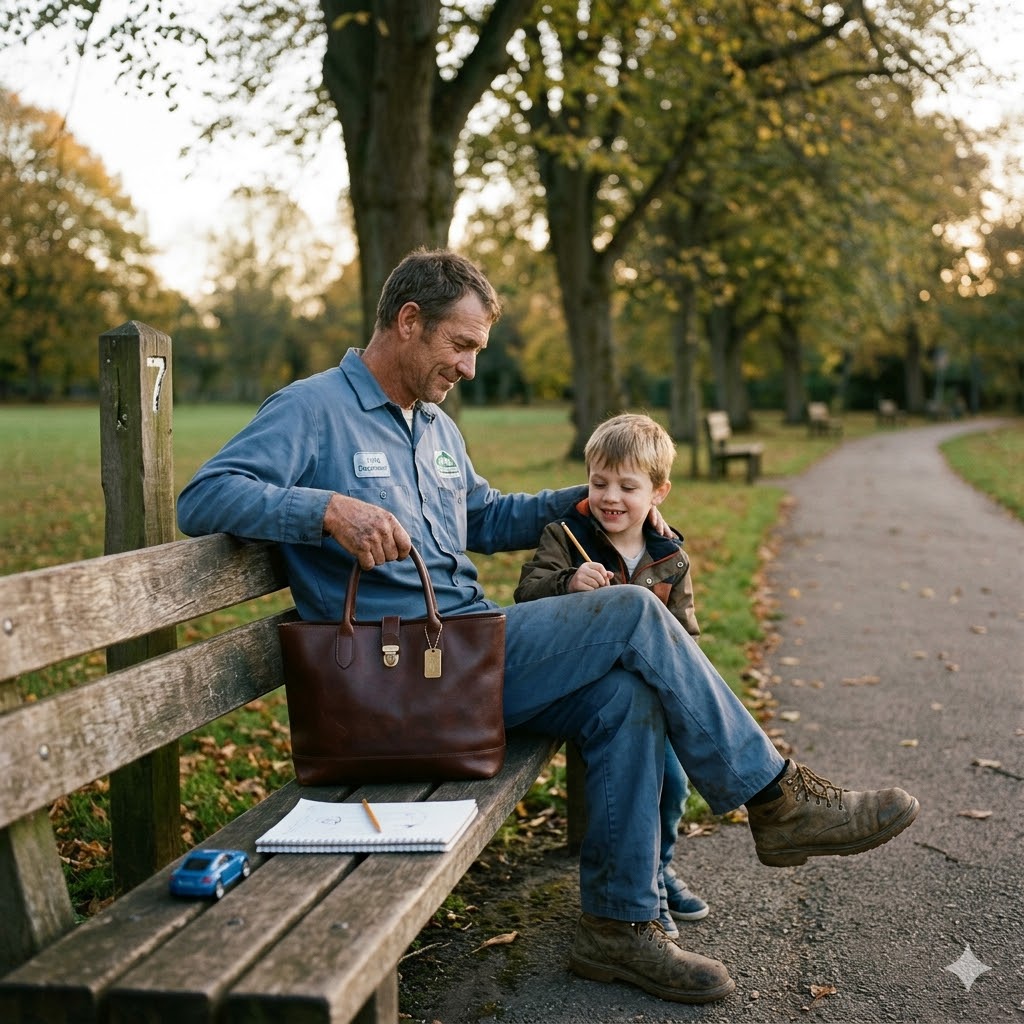
The brown leather bag sat alone on bench number seven near the East Gate of Harlow Green Park. No name tag, no address, nothing but a small gold clasp and the faint smell of expensive perfume carried on the late afternoon wind. Isaac Ward picked it up with the rough calloused hands of a man who had spent four years maintaining things other people walked past without noticing.
He had no intention of keeping it. He had no intention of opening it. He only wanted to find the right person and hand it back. But when the security guard at the Cross Meridian building asked him to open it for inspection and Isaac saw what was resting inside, he understood that this night was not going to end simply and the entire city was never going to look at Evelyn Cross the same way again.
Isaac Ward did not look like someone the city noticed. He wore the faded blue uniform of the Parks Department, work boots with thick rubber soles and a cloth handkerchief folded into his back pocket not out of habit, but because his son Eli had nosebleeds when he ran too fast and Isaac had learned to always carry something useful.
It was quarter to six on a Wednesday in late October. The last visitors had filtered out of Harlow Green Park an hour ago leaving behind empty juice boxes, a forgotten plastic shovel near the sandbox and the kind of quiet that only large outdoor spaces hold at the end of the day. Isaac moved along the eastern path with a trash picker and a canvas bag checking the lamp posts one by one the way he did every evening before logging out.
He was not hurrying. He was never hurrying. He was the kind of man who did his job fully or not at all. Eli was sitting on the low concrete step outside the small maintenance shed near the park’s back corner the way he did every afternoon after school. He was seven years old with a gap between his front teeth and a tendency to chew on the end of whatever pencil he was holding.
That afternoon he was drawing in a spiral notebook pressing hard enough that the lines showed through to the next page. Beside him on the ground rolling back and forth on the uneven concrete was a small blue toy car the same one his mother had given him the Christmas before she died. Isaac checked his watch 5:47. The corner grocery on Farrell Street closed at six.
He ran a quick mental calculation milk, bread, maybe one apple for Eli’s lunch tomorrow. He had just enough if he skipped the coffee he usually bought on the way to his morning shift. He had been making that same calculation for two years. He had stopped feeling sorry for himself about it after the first three months. There was too much else to tend to and self-pity had a way of eating the hours you needed for other things.
Diana had died on a Tuesday morning in November two years ago. A car accident on the eastbound overpass, not her fault, nothing she could have done differently. She had been 30 years old. Isaac had spent her last three months in the hospital beside her sitting in the plastic chair by the window and reading aloud from whatever paperback Eli had left on the side table and when she was gone, he had taken Eli home, looked at his son’s face in the morning light and decided that grief would have to find a place in the corners of things rather
than at the center. There was a child who needed breakfast. There was rent. There was a job to go to. You kept moving because there was someone beside you who needed you to keep moving and that was a reason as honest as any other. He had not been back to bench number seven since the afternoon. Diana sat there with Eli the last summer she was healthy watching the pigeons and drinking lemonade from paper cups.
He walked past it every evening on his final sweep. He had never once sat down on it. Some things you preserved by staying a careful distance away. That evening on his final loop before clocking out, Isaac saw the bag. It was sitting upright on the wooden slats of bench number seven positioned neatly as though someone had set it down intending to return in a moment.
A cognac brown leather tote the kind made by people who understood that real quality does not need to announce itself. A small brass tag was threaded through the handle no bigger than a business card. Isaac read the name E. Cross Cross Meridian Foundation. Below the name a phone number. He picked it up. It was heavier than it looked.
Eli appeared at his elbow. “What is that, Dad?” “Someone left it.” Isaac said. “Is there money in it?” “It’s not ours.” Isaac said simply. “So we don’t count it.” He carried the bag to the maintenance shed, logged it in the property record book with the date, time and location then tried the number on the brass tag.
It rang twice and connected to a recorded voicemail. He hung up. He found the Cross Meridian Foundation main number on a posted community notice pinned to the shed bulletin board. The foundation had donated the new water fountain near the park’s west entrance and called the general line. A receptionist answered, took down his name and the description of the item and told him in a tone that made clear she was doing him a favor by staying on the line that someone from the office would follow up in the morning and that he should bring the bag
in person to confirm his identity. Isaac thanked her. He wrote down the address. He hung up. Eli had already fallen asleep curled on the old love seat in the corner of the shed by the time Isaac finished the paperwork. The blue car was tucked under Eli’s arm. Isaac sat for a while in the quiet and looked at the leather bag locked in the cabinet across the room.
That night the main shed phone rang twice before midnight. Both times the caller left no message. The Cross Meridian building stood at the corner of Wentworth Avenue and 53rd Street. 40 stories of glass and steel that reflected the sky in a way that made it look permanent, immovable as though the city had been built around it rather than the other way around.
Isaac arrived the following morning in his one non-uniform outfit, a plain white button-down shirt black trousers with a faint crease at the knee, the leather shoes he saved for court dates and school events. He had Eli with him because the morning sitter had canceled and there was no one else. The lobby was exactly the kind of space designed to make most people feel small.
White marble floors that picked up every footstep, two security guards in dark uniforms standing with their hands clasped in front of them at angles that looked practiced, a reception desk made of a single slab of pale stone. Eli reached out and touched one of the polished columns near the entrance then pulled his hand back when the surface felt cold.
The receptionist asked Isaac his name three times each repetition slightly slower as though she was testing whether he would eventually change his answer. Then she directed him to a row of chairs near the far wall a single armless guest chair beside the lobby’s recycling station separated from the main seating area by nothing except an unspoken agreement about where people like him were supposed to wait.
Isaac sat down. Eli sat beside him. Eli began drawing on a piece of folded paper he kept in his jacket pocket. A man appeared from the elevator bank before Evelyn Cross did. He was perhaps 44 years old with hair combed flat and a Patek Philippe on his left wrist that caught the light every time he moved. His suit was dark charcoal and fit him the way expensive suits fit people who had been wearing them their entire adult lives.
He moved across the lobby with the easy authority of someone who did not need to look where he was going because people always moved out of his way first. His name Isaac would learn was Jason Holt. He held the title of Chief Financial Officer at Cross Meridian Foundation. Jason stopped in front of Isaac and looked at the leather bag then looked at Isaac.
“Thank you for coming in.” he said. The warmth in his voice was correct and precise the way warmth is when it is being performed rather than felt. “I’m the CFO. Miss Cross is occupied with back-to-back meetings this morning. I’m authorized to take receipt of her personal property.” He extended his right hand.
Isaac looked at the outstretched hand. He did not stand up. He said politely and without apology that the name on the bag was Evelyn Cross and that he had come in to return it to her directly. He was happy to wait. Jason’s smile stayed in place but something shifted behind his eyes. “You’re a city parks employee?” “I am.” Isaac said.
“And you understand where you are?” “Yes.” Isaac said. The elevator opened again. Evelyn Cross crossed the lobby in a navy wrap dress and low heels moving the way people move when their time is the most expensive thing in the room. She was 35 years old with dark hair and the posture of someone who had grown up being told to stand straight.
She looked at the bag in Isaac’s hands and then at Isaac himself and her expression gave away nothing at all. Isaac stood and handed her the bag. She took it. She said, “Thank you.” Two words her eyes already moving toward the day waiting for her and she turned toward the elevator. In the moment the bag exchanged hands the inner zipper pocket caught on Isaac’s thumb and pulled open slightly.
A folded paper slipped out and fell to the marble floor. Isaac picked it up and turned to hand it back but the elevator doors had already closed. Jason Holt held out his palm. Isaac placed the paper in it. Jason folded it once and slipped it into his jacket pocket without looking at it. But Isaac had already seen the first three words printed at the top of the page in the half second the paper lay unfolded in his hand.
Three words bold typeface all capitals confidential board audit. Eli pulled on his sleeve. “Can we go? I’m hungry.” “Yeah.” Isaac said. Let’s go. On the crosstown bus, with Eli asleep against his shoulder, Isaac stared at the window and said nothing for a long time. He was not thinking about the three words printed at the top of that page.
He was trying not to think about them. The truth was, the night before, when he had set the bag in the property cabinet, the inner zipper had already been partially open from the weight shifting during transport. He had not intended to look inside. He had reached in to secure the zipper and in doing so had seen the contents spread slightly against the interior lining.
There was a leather wallet, a secondary cell phone with a cracked screen, a sealed envelope, and a thin blue folder, not fully closed, the top page visible. He had not read the document. He had not touched it, but the page had been open and the text was right in front of him, and human eyes are not cameras with shutters.
They simply receive what is placed before them. A single line of figures. A number. $47,200,000. And beside it, in handwritten red ink, unauthorized transfer. Jason Holt authorization. He had closed the zipper and locked the cabinet. He had told himself it was not his business. He was a parks employee. He had a son. He had managed to keep a steady job and a paid rent and a child who still smiled, and he was not going to throw that into traffic over something he had seen by accident.
But on that bus, he thought about the Cross Meridian Children’s Health Initiative logo he had seen every single day for 3 years laminated and taped to the wall of the pediatric ward at St. Albans Medical Center. He remembered the morning a nurse had pulled him aside and told him, quietly, that an anonymous grant from the Cross Meridian Foundation had covered the gap in Diana’s final billing cycle.
He had never known who made that decision or why. He had only been grateful in the way that people are grateful when they have nothing left to offer in return. $47,000. From a children’s health fund. He looked at his son sleeping against his arm, the blue car held loosely in one small fist. Sometimes you see something, Isaac said quietly to no one, and you have to decide whether you’re going to pretend you didn’t. Two days passed.
Isaac returned to his shifts, raked the elm leaves from the east path, replaced a broken plank on the bridge over the drainage channel, and signed off on the October maintenance log. Eli drew more pictures in his spiral notebook and asked for French toast on Thursday morning and got it because Isaac had bought a half dozen eggs on sale.
On Thursday afternoon, a man appeared on the path near the maintenance shed. He was not wearing a suit jacket. His collar was open. He looked like someone who had dressed carefully to appear casual. Isaac recognized him immediately. Jason Holt sat down on the bench nearest the shed and waited without speaking until Isaac set down his equipment and looked at him directly.
What did you see in that bag? Jason asked. The question was conversational. That was the most dangerous part of it. I returned the bag, Isaac said. That’s the whole story. I think you might have seen something you didn’t intend to see. I’m not accusing you. I’m simply asking. Isaac said nothing. Jason produced a plain white envelope from his jacket and placed it on the bench between them.
$15,000, he said, for your household expenses, for your son. No conditions, no follow-up, no record. You don’t have to do anything. You don’t have to say anything. You simply continue your life. Isaac looked at the envelope. He looked at Jason. He did not pick it up. Jason left the envelope on the bench and leaned back slightly.
And then he said, in a quieter and more careful voice, the name of the elementary school Eli attended. He mentioned the number of the bus route Eli took home on Tuesdays and Thursdays. He noted that Isaac’s evening shift ended at 6:00 and that the maintenance shed was in a section of the park not covered by the municipal camera grid. He said none of this as a threat.
He said it the way a person recites information simply, accurately, to demonstrate that the information exists. Isaac stood up slowly. His hand was still holding the pruning shears he had set down a few minutes before. You just told me everything I needed to know, he said. Jason picked up the envelope. He left the way he had come, through the east gate, not hurrying.
After he was gone, Isaac took his phone from his pocket and looked up the Cross Meridian Foundation staff directory on the city business portal. He found the name Grace Adler listed as executive assistant to the CEO. He called the main line, asked for Grace Adler, and left a message when her voicemail picked up.
He said his name clearly. He said he needed to speak with Miss Cross. Not about the bag, about the man who had come to see him after he returned the bag. That evening, Isaac checked the door lock twice before bed. Eli was watching him from across the kitchen. Are you scared, Dad? No, Isaac said, testing the bolt a second time.
I’m being careful. There’s a difference. Grace Adler received the message the following morning and brought it to Evelyn Cross before the first scheduled meeting of the day. Evelyn read the name, read the message, set the paper down, and said nothing for a moment. Then she read it again. She had known about the audit report for 6 weeks.
She had been building the case carefully, the way you build a case against someone who has access to every system and every person inside an organization, slowly, quietly, gathering from the outside in. The blue folder she carried in her personal bag was a working copy of the internal audit, not the original, because the original was already secured offsite with the foundation’s independent legal counsel.
She had not expected to lose the bag. She had not expected anyone to find it and return it, least of all intact. When Grace came back with a background summary on Isaac Ward, Evelyn sat with it for a long time without speaking. Isaac Ward, 31 years old, city parks employee, 4 years of service, exemplary record.
Widower wife Diana Ward, deceased 2 years prior. Cause, motor vehicle collision on the eastbound overpass, November, a Tuesday morning. The other vehicle, a Cross Meridian Foundation company car, driven by a contractor returning from the foundation’s annual autumn gala. The contractor had a blood alcohol level of .14.
The foundation’s legal team had arranged an out-of-court settlement within 6 weeks. Isaac Ward had accepted the settlement. He had not pursued further legal action. The person who had processed and authorized that settlement on behalf of the foundation was Jason Holt. Evelyn sat very still. She had signed the final settlement summary document.
She remembered the document number, the date, the dollar figure. She had not known the name of the woman who died. She had not asked. It had been a line item in a quarterly risk management review, and Jason had handled everything, and she had signed. A man who had reason, real, permanent, irreversible reason to hate the name Cross Meridian had found a bag belonging to her, had returned it without opening it, and had left a message not to complain, but to warn her that someone inside her own organization had come to pressure him into silence. Evelyn told
Grace to arrange a meeting. Off calendar. Not in the office. They met at Harlow Green Park on a Saturday afternoon in the quiet open area near the west fountain. Grace stood at a respectful distance. Evelyn wore a plain wool coat with the collar turned up and her hair tied low. She looked smaller than she did in photographs.
Eli was on the swing set at the edge of the playground. Isaac stood when he saw her approaching and offered his hand. She shook it. You want to talk about Jason Holt? She said. It was not a question. I want to know if you already knew what he was doing, Isaac said. That was also not a question, and Evelyn respected him for it.
She told him the truth without preamble. She knew about the unauthorized transfers. She had known for 6 weeks. She had been building a case with external counsel, because if she moved too quickly, Jason had enough administrative access and enough contingency plans in place to redirect the evidence trail onto the department heads who had countersigned the transfer authorizations without understanding what they were signing.
She needed a witness outside the organization, someone Jason could not reach, edit, or discredit from within. Isaac listened. Evelyn said, The money came from the Children’s Health Initiative, $47,200,000 across 11 hospital programs over 18 months. Isaac looked at the swing set, at Eli’s small feet pointed at the sky. St. Albans Medical Center, he said.
Pediatric ward. Yes, Evelyn said. She watched his face. He did not look angry. He looked like a man absorbing something he had already suspected but had hoped was not true. She told him the rest. She told him about the settlement, about the company car, about the document she had signed without asking the victim’s name.
She said the words plainly and without softening them, because he deserved that. The silence between them lasted for a while. Eli ran over from the swing set, out of breath, and held up a drawing he had made in his notebook. Dad, the swing is stuck on one side. I’ll fix it in a minute, Isaac said. He went with Eli to the swing set, crouched down, examined the chain, and worked it free with two turns of his wrist. He gave the swing a gentle push.
Then he came back and sat down on the bench across from Evelyn. What do you need from me? He said. She told him, a sworn statement notarized describing what he had seen, the date, the time, the location of the bag, the contents visible when the zipper shifted, the specific text he had read. He was an independent witness with no internal stake, no professional connection to the foundation, no prior relationship with any of the parties.
Jason had already built a legal counter argument based on the claim that no outside witness existed. Isaac’s statement would dismantle that claim before it could be used. Isaac nodded once. He said he would do it. She asked if he wanted to know why she was asking someone in his position, given everything the foundation had done to his family, to help protect her.
He thought about that for a moment. He said, because it’s not about your foundation, it’s about 11 hospitals and the kids in them. I didn’t need you to be perfect. I just needed you to be trying to fix it. Evelyn Cross had not cried in front of anyone in 3 years. She did not cry then, but she was quiet for a moment longer than she needed to be.
The prepared statement took 3 days to complete with the foundation’s external legal team. Isaac sat in a conference room in the law firm’s office on a Tuesday afternoon with Eli beside him eating crackers and drawing trucks and answered every question directly and without embellishment. He stated what he had seen and only what he had seen, the position of the bag, the time it was found, the way the contents were visible when the zipper shifted, the specific figures and handwritten notation on the top page. He did not speculate about
intent. He did not characterize Jason Holt’s behavior. He described what was in front of him. That was all that was asked of him and he did it completely. Jason had anticipated this. His legal team filed a preliminary objection 2 days before the board meeting arguing that Isaac’s statement was unlawfully inspection of confidential documents by a non-party.
The argument was detailed and well constructed and would have created real procedural difficulty if it had been the only challenge facing Jason Holt that morning. It was not. The Cross Meridian Foundation emergency board meeting convened at 9:00 in the morning on the 38th floor in a glass-walled conference room from which you could see three bridges and the gray river between them.
12 voting board members were seated at the long table. Jason Holt sat on the left side flanked by his own legal counsel. He was composed and well-dressed and gave the impression of a man who believed the mathematics still worked in his favor. Isaac sat in the witness chair at the near end of the table. He was wearing the same white shirt.
He had brought nothing to hold. Jason’s attorney moved immediately. With respect to the board, the witness before you today has no relevant professional credentials, no standing in financial matters, and no basis for interpreting what he claims to have read. This testimony should be treated accordingly.
Isaac turned slightly toward the speaker and said in a level voice, I don’t need financial credentials to read a name and a number. I only need to know how to read. There was a pause at the table. One of the board members on the far end lowered his pen. Evelyn Cross stood at the head of the table and presented the evidence in sequence.
First, the complete internal audit report authenticated and certified by the external firm. Second, the records of all 47 transfer authorizations over the 18-month period, each one bearing Jason Holt’s digital signature and a secondary approval code issued exclusively from his administrative login.
Third, the backup server archive email. The email had been sent by Jason Holt to an outside financial intermediary 48 hours before Isaac returned the bag to the building. The subject line read, processing review. The final line of the message read, destroy file copies by Friday. The board chair set a printed copy of that email on the table in front of Jason Holt.
Jason did not speak. His attorney began to object, paused, and did not finish the sentence. The board chair asked Jason to step outside the room while the independent audit team began their formal review. Two building security officers positioned themselves on either side of the conference room door.
Jason walked the length of the table toward the exit. He passed the chair where Isaac was sitting. He did not look at him. He did not say anything. He walked out of the room and the door closed behind him. The story was on every news outlet by midday. The headline that spread fastest read, Cross Meridian CFO charged in $47 children’s fund embezzlement.
By evening, the number of hospitals affected had been confirmed. 11 pediatric programs across the city, three of which had already cut treatment capacity for uninsured children in the previous fiscal year due to what they had been told were budget shortfalls from the foundation. The money had moved through a series of offshore transfer accounts.
The process had been running for 18 months. Isaac’s name appeared in the coverage before he knew it would. A reporter found him the following morning in the park. He was fixing the latch on the East Gate storage box. He said he had nothing to add beyond what was already in the public record. The reporter asked if he considered himself a hero.
He thought about that for a moment then said he had returned someone’s bag and told the truth when asked. He picked up his tools and went back to work. Eli’s teacher showed the class a news article the following afternoon. She asked Eli if the man in the photo was his father. Eli said yes and continued coloring the diagram of the water cycle she had drawn on the board.
But that evening, at the kitchen table, he looked at Isaac over his cup of soup and said, You did the right thing, didn’t you, Dad? It was not a question. Isaac said, I didn’t do the wrong thing. That’s usually enough. Evelyn Cross released a public statement the same day. She announced the immediate restructuring of the Cross Meridian Foundation’s board governance, a full independent audit of all operational accounts going back 5 years, and a complete financial restoration of the Children’s Health Initiative, the entire $47,200,000 to be returned to the 11 hospital
programs within 90 days with an additional allocation to cover the treatment gaps caused by the shortfalls. Among the 11 programs listed for restoration was the Family Support Fund at St. Albans Medical Center from which $3,200,000 had been redirected under Jason Holt’s authorizations.
It was the same program that had quietly covered part of Diana Ward’s final billing. One week after the board meeting, Evelyn Cross came to the park again. Grace Adler was not with her. She wore a plain gray coat and walked in through the East Gate at 4:00 in the afternoon when the light was low and golden and the elm trees were almost bare.
Isaac was repainting the number above the bench near the East Path bench number seven with a small brush and a can of white trim paint. He heard her footsteps and turned then nodded once and went back to the number. He finished the last stroke before he set the brush down. She waited. She had learned in the past week something she had not expected to learn about Isaac Ward, that he gave people time to say what they actually meant rather than filling the silence for them.
I signed a document 2 years ago, she said. It was a settlement summary. The file came to me through Jason’s office. The victim’s name was listed by initials only. She paused. I didn’t ask for the full name. I had eight items on my agenda that morning and I signed it and moved to the next one. Isaac set his brush across the rim of the paint can.
When your assistant sent me your file, she continued, I read the accident report for the first time, all of it. Her voice was steady, but it was working to be. I did not know there was a child. I did not know you were still in the city. I did not know any of the specifics I should have known before I signed my name to a document that was supposed to close a chapter for your family.
Isaac was quiet. I don’t know how to adequately apologize for something that can’t be undone, she said. I know that what I’m saying right now doesn’t restore anything. I’m saying it because you deserve to hear it, not because it does anything useful. He looked at her for a moment. He said, I returned that bag before I knew any of this, before I knew whose foundation it was, before I knew about the accident, before any of it.
I returned it because it wasn’t mine. He picked the brush up again and turned it slowly in his fingers. I’m not telling you that so you’ll feel better. I’m telling you so you understand why I’m standing here talking to you instead of walking away. It was never about a debt. From across the playground, Eli came running with his notebook pressed flat against his chest, slightly out of breath.
He stopped in front of Evelyn and held the notebook out to her. On the open page was a drawing in blue and orange crayon, a tree, a small house, three people standing in a yard. That’s our park, Eli said. Evelyn took the notebook and looked at the drawing for a long time. Her hands did not move. She gave the notebook back to Eli.
And then she asked Isaac the question she had come to ask. She said she wanted to know what he needed, not for himself, she clarified immediately. She understood what his answer to that would be. She wanted to know what mattered. He did not ask for a job. He did not ask for money or recognition or anything with his name on it.
He said, that children’s health fund, don’t let it be a name on a plaque anymore. There are a lot of kids in this city whose parents are making the same calculations I make every week and they don’t always have the margin I have. Some of those 11 programs, make them permanent. Make the funding a condition, not a gift. She said she would.
He believed her. 3 months passed. The leaves came back to the elm trees slowly. A faint green at the edges of the branches by early March. The kind of green that looks tentative at first and then suddenly, between one Tuesday and the next, is simply there. Isaac Ward was still at Harlow Green Park. His uniform was still faded at the left shoulder seam.
His boots were still the same pair he had bought 2 years ago at the workwear discount store on Mallory Street. In February, he had been made shift supervisor for the eastern maintenance zone. Not as a reward for anything that had happened in the fall, but because he had done the job well and the previous supervisor had retired.
It was a small increase in pay. He used it to open a savings account for Eli. One morning, a new spiral notebook appeared on the concrete step outside the maintenance shed where Eli always waited in the afternoons. It was a good one, heavy paper with a forest green cover. On the inside of the front cover, someone had written in small precise handwriting, “For the kid who draws the park.
” There was no signature. Eli did not know who had left it. He accepted it without much ceremony, opened it to the first page and began drawing the duck pond near the south entrance. Isaac watched him from the doorway of the shed and said nothing. That evening, near the end of his shift, Isaac sat down on bench number seven.
The white paint on the number above the backrest was clean and bright, still visible even in the low late afternoon light. The bench was empty except for him. Eli sat beside him, rolling the blue car back and forth on the weathered wood, making a small low sound with the engine the way he always did. “Dad,” Eli said after a while. “Yeah.
” “Why did you pick up that bag?” Isaac thought for a moment. He watched the last of the evening walkers move along the far path. A couple with a dog. An older man in a red hat. “Because it didn’t belong there without someone.” Eli considered this. “That’s the whole reason?” “That’s the whole reason.” The lamps along the east path blinked on one by one as the sky dimmed the new LED fixtures Isaac had helped install the previous spring, replacing the old sodium bulbs that used to flicker in cold weather.
They came on cleanly, without hesitation, the way good work behaves when it is done right and then left to do its job. Isaac leaned back on the bench and let the light settle around them. Eli rested the blue car flat on the wood and looked up at the first lamp as it came on, then at the second, then at the third. There is nothing grand about the right thing when you are standing inside it.
No music, no crowd, nothing that announces itself. There is only the moment when you see something that does not belong and you decide what kind of person you are going to be about it. And then you act accordingly, and then you go home and make French toast and check the door bolt and watch your son sleep.
Isaac Ward had found a bag on a bench. He had returned it to the right person. He had told the truth when it cost him something to tell it. He had not asked for anything in return because the return was never the point. And in a city where $47 million had been quietly disappearing from the children who needed it most, one man in a faded blue uniform had simply refused to look the other way.
Not because he was exceptional. Not because he was brave in the way stories usually require. Because the bag was not his. And that, in the end, was the whole reason.