Orphanage Mechanic Boy Refused the Club’s Money The Bikers Repaid Him in a Way No One Saw Coming
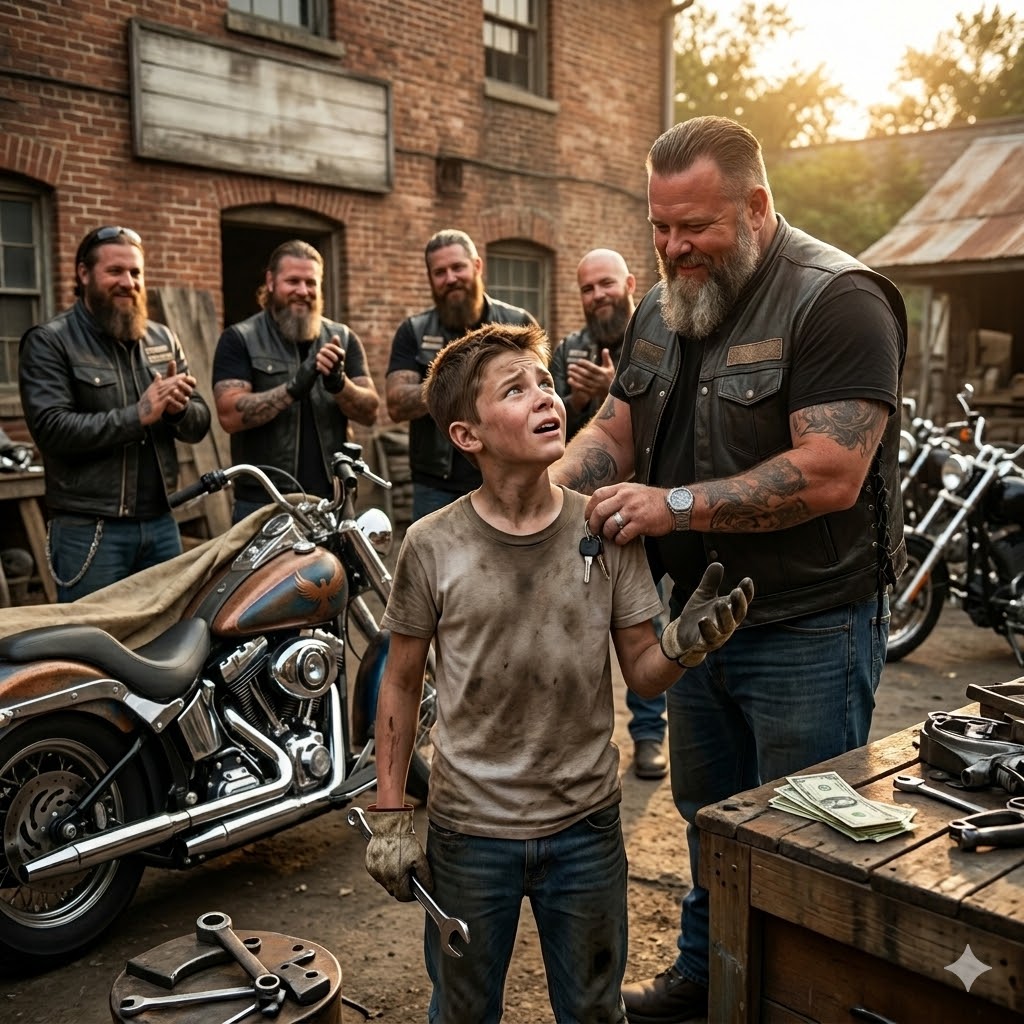
The engine coughed, then it died. Ethan Cole wiped the grease from his hands onto the thighs of his jeans, already so stained they’d forgotten their original color, and stared at the water pump like it had personally betrayed him. In a way, it had. That pump fed water to 14 kids who had no one else in the world.
And now it lay in pieces across the dirt floor of the shed, its rusted guts spread out like a confession. Two days, he told himself. I can fix it in 2 days. He was 17 years old. He had no money, no parents, and no plan beyond the next repair. But he had his hands, and he had his stubbornness. And out here in Hollow Creek, Texas, where the nearest town was 40 minutes of cracked asphalt away, that was sometimes enough.
The Sun Ridge home for children sat at the end of a gravel road like something the highway had forgotten to take with it. The paint had been peeling since before Ethan arrived at age nine. The porch sagged on its left side. The donated van in the back had a radiator that only cooperated when it felt like it.
Miss Clara, the woman who ran Sun Ridge, was 63, walked with a cane, and had the eyes of someone who had been quietly fighting the whole world for decades. She never complained. Neither did the kids, because she didn’t, and because Ethan didn’t, and somewhere along the way, not complaining had become the culture of the place. Ethan was the oldest. He had aged out of the system on paper, but had never aged out of the responsibility he felt for the younger ones.
He stayed, fixed things, kept the lights on when the wiring threw a tantrum, kept the generator alive through the winters, kept the peace when the older boys grew restless. He was not remarkable to look at, lean, quiet, with oil permanently under his fingernails, and a habit of looking at broken things the way other people looked at puzzles.
But there was something about him, a stillness like a stone in the middle of a loud river. They heard the motorcycles before they saw them. The thunder rolled up the gravel road on a Tuesday afternoon, low, rhythmic, impossible to ignore. 14 children pressed their faces against the windows.
Miss Clara stepped onto the sagging porch and gripped her cane a little tighter. There were seven of them, big men on bigger machines, their leather cuts bearing the iron patch of a club called the Iron Hollow MC. roadworn, hard-faced, the kind of men that gas station clerks watched a little too carefully. Their leader cut the engine first.
He was a large man, somewhere in his 50s, with a silver beard and the calm, unhurried movement of someone who would long since stopped needing to prove anything. The name on his cut said gravel. He removed his sunglasses, looked at the orphanage, the peeling paint, the broken gutter hanging off the roof, the vegetable garden that was barely surviving.
And then he looked at Ethan, who had come out of the shed with grease on his face and a wrench in his hand. “This Sunridge?” Gravel asked. “It is,” Ethan said. “We heard you’re running lean. Thought maybe we could help.” He reached into the inside pocket of his cut and produced an envelope thick folded. Fundraiser we did last month. Your place came up.
It’s not millions, but it’s enough to keep the lights on a while. He held it out. Ethan looked at the envelope. He looked at the man holding it. Then he put the wrench in his back pocket and crossed his arms. “I don’t take charity,” he said quietly. The other bikers exchanged glances. One of them, younger, with a patched scar along his jaw, actually smiled. Gravel didn’t move. “Son, there’s no shame.
” And I know there’s no shame, Ethan said. “That’s not why I’m saying no.” He nodded toward the shed. “I’ve got the pump half fixed. The roof on the east wing needs patching before the rains come. I’ve got a list of things that need doing, and every one of them I can do myself.
What I can’t do is take money from strangers and look those kids in the eye afterward and tell them that dignity is something worth keeping. Silence. A mockingb bird called from somewhere in the old oak by the fence. Gravel stood very still for a long moment studying the boy. Not the orphanage, not Miss Clara on the porch. The boy. Something moved behind his eyes.
something old and recognizing, like a man seeing his younger self standing in front of him in the worst and best way. He put the envelope back in his pocket. “All right,” he said simply. He put his sunglasses back on. He started his engine.
One by one, the others followed, and they rode back down the gravel road, and the dust settled, and Ethan went back into the shed. Miss Clara watched him go. She said nothing, but she pressed her lips together in the way she did when something mattered. They came back on Friday, not with an envelope, with tools. Six of them this time, plus two men Ethan didn’t recognize, who turned out to be a licensed plumber and a roofer who owed Gravel a favor.
They pulled up in a truck alongside the motorcycles, tailgate loaded with lumber, shingles, copper pipe, and a brand new water pump still in the box. Gravel climbed out and looked at Ethan. “We’re not giving you anything,” he said. “We’re just doing some work. You want to work alongside us, that’s your choice.” Ethan stared at the new pump in its box. Something tightened in his chest. Not pride exactly. Something more complicated than that.
The feeling of being seen. “I’ll work,” he said. And he did. side by side with men twice his age, learning things with his hands he’d never had anyone to teach him before. The roofer showed him how to lay shingles in overlapping courses so water would never find a gap.
The plumber let him do half the installation himself, only correcting when necessary, never condescending. Gravel worked quietly, saying little, but every so often he’d glance over at Ethan with an expression that wasn’t quite pride and wasn’t quite sadness. It was something between the two that grown men carry when they recognize something rare.
The children watched from the windows, then the porch, then gradually, carefully drifted into the yard. By afternoon, two of the smaller boys were handing tools. A girl named Rosie, aged six, had appointed herself the official water carrier and was marching back and forth with a plastic cup, deeply serious about her role. Miss Clara made lunch. The bikers ate on the porch like it was the most natural thing in the world.
What happened next, Ethan didn’t know until later. 3 days after the repairs, a man named Darren Lyall, who owned a property management company in the county seat and had been quietly pushing the county to condemn Sunridge on questionable code violations, received a visit. Not a threatening one, just a visit.
Gravel and two members of Iron Hollow sat across from him in his own office and explained in calm and precise terms that they were aware of his motivations, that several families in the county were also aware, and that the kind of attention he was drawing to himself was the kind he would not enjoy. Darren Lyle withdrew his complaint the following week. Ethan never knew the details.
All he knew was that the inspector stopped coming. The pressure that had been quietly building against Sunridge, pressure Miss Clara had been carrying alone, too proud to mention it to the children, simply stopped. He found out 6 months later when Gravel told him over coffee on that same sagging porch.
“Why didn’t you tell me?” Ethan asked. “Because you didn’t need to know,” Gravel said. “You were handling your part. We handled ours.” Over the months that followed, Iron Hollow became something that had no official name. They showed up when things broke. They appeared at the county fair with a booth that raised money for Sunridge without ever mentioning the orphanage by name.
When a teenager named Marcus, who had come to Sunridge at 13 with a history that had made him into a wool, started drifting toward a bad crowd in town, it was one of the younger Iron Hollow members, a quiet man named Dutch, who started showing up at the garage where Marcus hung around and talking to him the way someone had obviously never talked to him before. Just straight, no agenda.
Marcus didn’t join a gang. He got his GED instead. and Ethan, who had spent eight years fixing broken things in a forgotten place, who had learned that dignity was not the same as pride, and that asking for help and accepting help were two entirely different acts. Ethan began to understand something about the world that no classroom had ever taught him. that strength isn’t always loud.
That loyalty doesn’t always announce itself. That some of the best people alive are the ones the world has already decided to fear. And that sometimes doing the right thing, refusing to collapse, refusing to beg, standing up quietly in a broken shed with a wrench in your hand, sends a signal to the universe that you are worth showing up for.
On the last day of that first summer, gravel sat beside Ethan on the porch steps as the sun went down over the flat Texas land. The light came in low and gold across the fields, and the sound of children playing drifted out through the screen door. “Why’d you really come back?” Ethan asked after I said no.
Gravel was quiet for a moment. “Because you said no,” he finally answered. “There’s a million people in this world. He’ll take whatever you hand them and never look you in the eye. You looked me in the eye. That means something. He looked out at the horizon. My father ran a place not unlike this one. Small church mission out in New Mexico.
Struggled his whole life. Never asked for a thing. He paused. I wish someone had shown up for him the way we showed up for you. Ethan said nothing. He didn’t need to. The mockingb birds sang again from the old oak and the porch held paths of honor. The world doesn’t always reward quiet strength immediately. Sometimes it takes time.
Sometimes it arrives on motorcycles covered in road dust carrying tools instead of pity. But it arrives. Hold your dignity. Do your work. Stand your ground. Not out of stubbornness, but out of the deep knowledge that you are worth more than charity. You are worth respect. And respect when it comes comes not to those who begged for it, but to those who never needed to.
If this story touched your heart, share it with someone who needs to hear it today. And don’t forget to subscribe to Paths of Honor, where every story reminds us what we’re truly capable of. The power of dignity over charity. This video teaches that self-respect is a person’s greatest wealth.
No matter how difficult life gets, you should never beg or lower your dignity. Ethan shows us that working hard in silence and standing firm with honor is more powerful than accepting charity. It also teaches us never to judge people by their appearance because the most unexpected people often carry the biggest hearts. True loyalty never announces itself.
It simply shows up and does the work. And for every young person watching, the message is clear. Age means nothing. Hard work and courage mean everything. When you stand firm with dignity, the world finds its way to you.






