Hell’s Angel Heard a Strange Noise Underground What He Discovered Made Him Freeze in Shock!
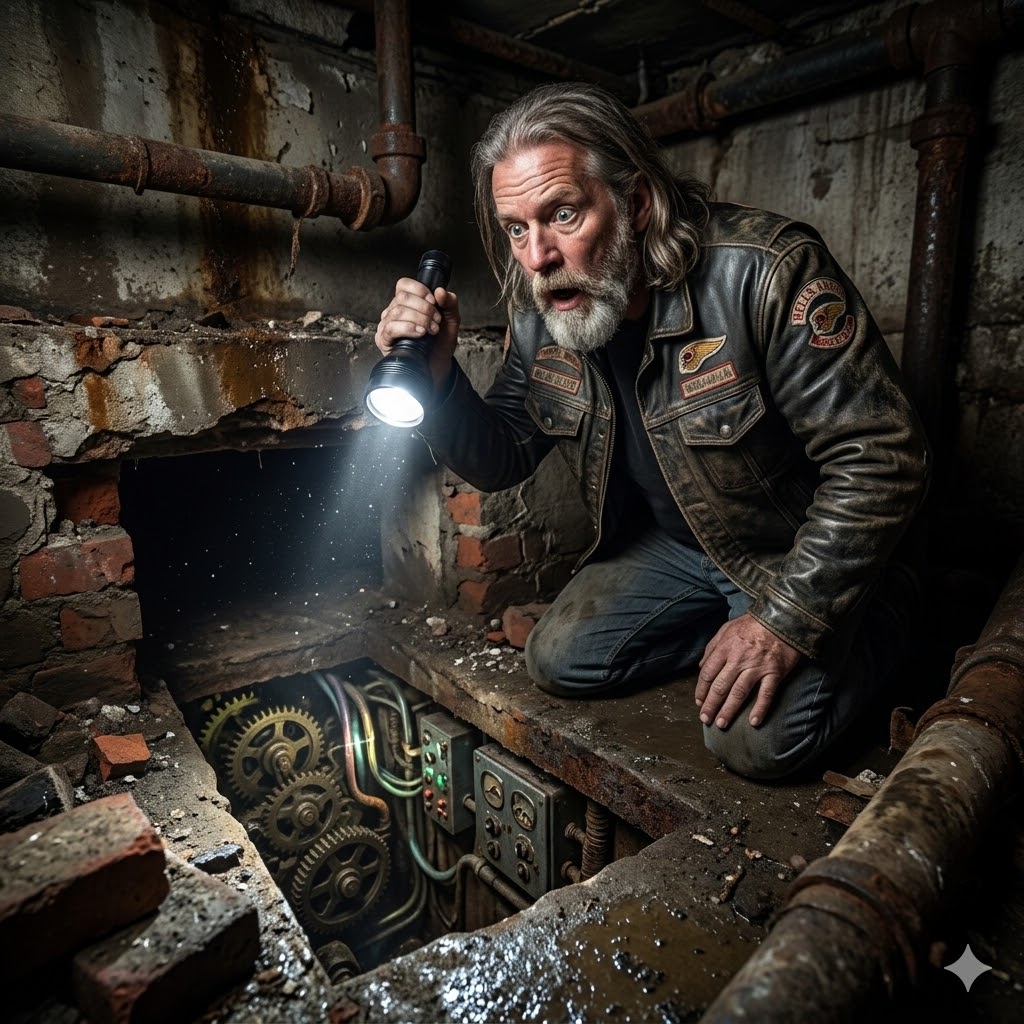
The highway outside Cole Ridge didn’t get much traffic after sundown. That suited Ryder Kain just fine. He rode alone tonight. No formation, no brothers behind him, no prospect keeping pace on the outside lane. Just him, his bike, and 60 mi of cracked asphalt cutting through country that hadn’t changed in 40 years. As president of Iron Valley MC, he didn’t get many nights like this.
Nights where nobody needed a decision made, a problem solved, a hand held steady. Nights where he could just ride and let the engine do the thinking. He wasn’t a complicated man, or at least he’d stopped pretending to be one a long time ago.
He was 43 years old, built like someone who had never once taken the easy road, and carried the quiet authority of a man whose word had weight, not because he demanded it, but because he’d earned it. Iron Valley wasn’t an outlaw club. It never had been. They ran charity rides, built wheelchair ramps for veterans, showed up when communities needed muscle, and got nothing in return. They weren’t angels, but they weren’t what people assumed either.
Ryder had learned to stop explaining that. He leaned into a long curve and felt the road through his palms the way a doctor feels a pulse. Reading it, trusting it. Out here, past the county line, where the farm spread wide and the lights of town disappeared behind the treeine, the world made a particular kind of sense. Clean, honest, no performance required.
He slowed as he reached the stretch of old farm road that connected the highway to the valley’s back properties. He took this route sometimes on night rides, not for any reason he could explain. Habit, maybe, or something older than habit. He was half a mile down the gravel road when he stopped.
Not because of a sound, because of the absence of one. Ryder had spent 20 years learning to read silence. There was the silence of empty land, and there was the silence of land holding something it wasn’t supposed to hold. They felt different, the way clean water and still water feel different under your hand. He cut the engine.
The night settled around him. Crickets, wind, the distant complaint of a barn door somewhere. Normal sounds and underneath them. Tap. He didn’t move. Tap. Tap. Low. Deliberate. Coming from the ground somewhere to his left, maybe 15 ft off the road’s edge where the grass grew tall against an old wire fence.
Ryder swung off the bike in one motion and walked toward it without hesitation, pulling the flashlight from his jacket pocket and clicking it on. The beam swept across the grass, the fence post, the dark earth beyond. He stopped, crouched, pressed one gloved hand flat against the ground. The tapping came back faster now, uneven, desperate. He stood up straight. Hey. His voice was low and even the voice he used when panic wasn’t an option. I hear you.
I’m right here. The response came immediately. Frantic alive. Ryder pulled out his phone, dialed his road captain with one hand, and started walking back to the bike for the emergency kit strapped to the rear rack. Cain. His road captain picked up on the second ring. I need you on the old Harland Farm Road, County Lineside. Bring a shovel and bring it fast.
a pause and call 911 before you leave.” He didn’t wait for questions. He hung up, grabbed the small collapsible shovel from the kit, and moved back to the spot, dropping to his knees, and driving the blade into the earth. He dug like a man who understood that every second had a cost. The ground was soft, recently turned. Someone had been here not long ago. That told him something. That told him a great deal.
His jaw set tight as he worked, shoulders driving the shovel deeper. the flashlight propped against his knee, throwing harsh light across the hole growing between his hands. He had done hard things in his life, things that required a certain kind of stillness inside, the kind that doesn’t come naturally and can’t be faked.
He’d held that stillness at bedsides, at grave sites, in rooms where the situation had already gone wrong, and the only thing left was to not make it worse. He held it now. The shovel struck wood. He stopped, set the shovel aside, cleared the remaining soil with both hands, fast, precise, until the shape emerged.
A wooden box, small, sealed with nails fitted along the top with a row of small holes, air holes. His throat tightened once, then released. He didn’t allow himself to feel it yet. Feeling came later. Right now, there was only the problem and the solution and the distance between them. “I’m right here,” he said again, louder. “Almost through.
Hold on.” He worked the shovel edge under the lid and pushed. The wood groaned. He repositioned and pushed harder. His whole weight behind it. One nail gave, then another. The sounds from inside became frantic. Small hands on wood. A thin and breathless sound that wasn’t quite a voice yet. Hold on. Final push. The lid cracked open. Ryder pulled it back and went completely still.
Inside, a little girl lay curled into herself, knees drawn to her chest, arms wrapped around her own body as though she were the only warmth left in the world. Her face was pale beneath the dirt. Her hair matted, her lips dry and cracked. Her eyes were closed for one terrible second. Then her chest rose slowly. Ryder exhaled through his nose.
He reached in with both hands, careful, no sudden movement, the way you approached something wild and frightened, and lifted her out. She weighed almost nothing. Her body was cold against his arms, her breathing shallow but present, her small fingers curling weakly against the leather of his jacket, as though reaching for something to hold. She found it. Her hand gripped the lapel of his cut.
The Iron Valley MC patch worn and soft with years and held on. Something in Ryder’s chest shifted. Not broke, shifted. The way tectonic plates move. Slow, enormous, permanent. “You’re out,” he said quietly. “I’ve got you. You’re safe.” Her eyes opened halfway, glassy, unfocused.
Then they found his face, his hard face, his scarred jaw, his eyes that had seen too much, and something in them changed. Not trust, not yet, but the very first edge of it. The question, “Is this safe?” He held still and let her read him. Whatever she found there, her eyes closed again. Her grip on his jacket didn’t loosen. He stood cradling her against his chest and looked out across the dark field.
Headlights were coming down the road, his road captain, and behind him the distant whale of sirens closing in from the county highway. Ryder looked down at the girl in his arms. Someone had put her here on a road nobody used, on land nobody watched, in a box designed to keep her alive just long enough or not. He thought about the kind of person who does that.
He thought about it for exactly 3 seconds and then he put it away. That was a problem for daylight and for people with badges. Right now there was only this child this cold night and the sound of his brothers arriving. He walked toward the lights. Her name was Lily, 7 years old, taken from a gas station parking lot 4 days ago while her mother was paying inside.
The Amber Alert had covered six counties. Her picture had been on every phone screen, every gas station window, every shared post for 4 days. She had been 3 mi from the county search perimeter. 3 miles. Ryder sat in the waiting area for 6 hours, still in his riding gear, while the brothers who had arrived after him stood in the parking lot because the waiting room was too small. Nobody told them to leave. Nobody would have dared.
When Lily’s mother finally came through the doors, still wearing the same clothes she’d had on 4 days ago, the kind of exhaustion on her face that goes deeper than sleep can fix. She stopped when she saw him. She crossed the room and didn’t say a word, just pressed both hands against his and held them, her whole body shaking with something that had been waiting 4 days to let go. He let her. They said a biker found her. She finally managed.
Yes, ma’am. Why were you out there at that hour on that road? Ryder thought about it honestly. I ride that road sometimes, he said. No good reason. Just do. She looked at him for a long moment. God had a reason, she said. He didn’t argue with that. 3 weeks later, a small drawing arrived at the Iron Valley MC clubhouse.
crayon on notebook paper carefully folded inside an envelope with his name written on the front in large careful letters. A motorcycle, a rider, and in the sky above them drawn in yellow crayon something that might have been stars or might have been something else entirely.
At the bottom, in the same careful handwriting, “Thank you for hearing me.” Ryder pinned it to the wall behind his president’s chair where he could see it every time he sat down. He still rides that road. No particular reason. Just does. A message. Paths of honor. There are people in this world who look frightening from the outside and are the safest thing in the room. Rider Cain is one of them.
A man with a patch on his back, scars on his hands, and a thousand miles of hard road behind him who stopped on a quiet night for no reason he could name and changed everything. This story is a reminder that purpose doesn’t announce itself. It doesn’t come with a schedule or a reason. Sometimes it comes as a sound beneath your feet on a road you didn’t plan to take. Stay present. Stay human. You never know whose miracle you’re riding toward.
Paths of honor because the road reveals the man. This story teaches that heroism lives in ordinary habits. paying attention, trusting instinct, showing up without knowing why. Ryder’s decades of experience and quiet discipline became the exact tools a child needed on the worst night of her life.
It reminds us that the skills we carry through hard years and hard choices are never wasted. They wait and when they are needed, they rise. It also challenges prejudice. A man who might be judged by his appearance, his patch, his lifestyle became the answer to a mother’s prayer. The story gently asks us to look beyond surface judgments and recognize that character is not found in how someone looks, but in what they do when no one is watching and nothing is required.
For younger audiences, it carries a message of safety and resilience that even in the darkest, most frightening moments, making noise, holding on, and refusing to give up can reach the right person. The lesson, stay aware, stay present, and never underestimate the person riding beside






