Abandoned Girl Took a Job at a Biker Garage—Warned to Stay Away, She Found the Family She Never Had
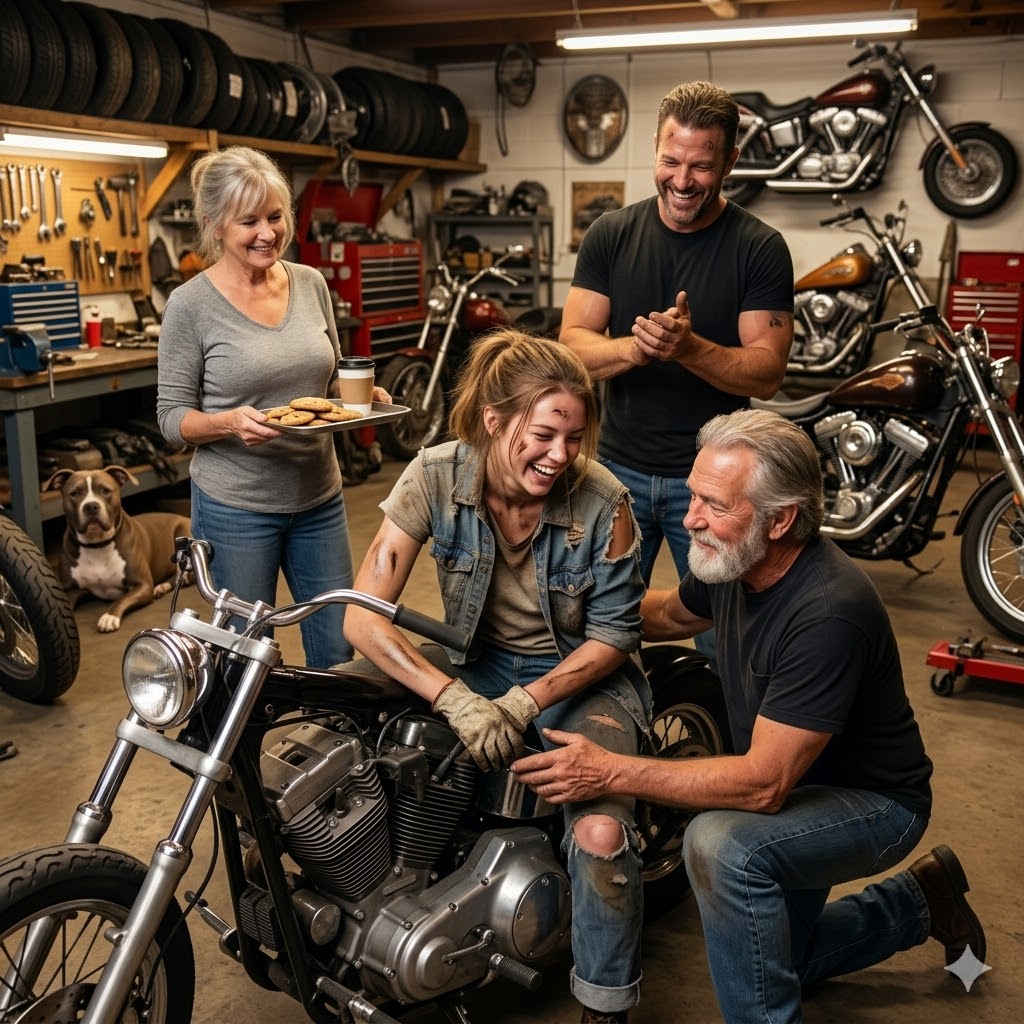
A cold November morning wrapped the city in silence. Not the peaceful kind of silence that settles after rain, or the quiet that follows a prayer. This was the silence of a city that had simply stopped caring. The kind that presses against your chest and tells you without words that you are on your own.
Ava Mitchell pulled her jacket tighter and stared at the building in front of her. She was 17 years old. She hadn’t slept in a real bed in 11 days. The worn down garage at the edge of the industrial block looked nothing like salvation. The metal shutters were scratched and dented. The sign above the door missing three letters.
The pavement outside cracked and stained with oil that had been there for years. A row of heavy motorcycles rested along the wall like silent sleeping giants. Chrome catching the pale morning light, engines cold, but somehow still carrying a presence that said, “Don’t come here unless you mean it.” People in the neighborhood had opinions about this place.
She’d heard them already in the diner two blocks over, in the gas station where she’d used the restroom and washed her face in the sink, trying to look like someone who had somewhere to be. Those men don’t trust anyone. They look after their own and nobody else. Stay away from there, sweetheart. That’s not a place for people like you. But here’s what those people didn’t know. Ava wasn’t there because she felt safe. She was there because she had run out of every other option.
11 nights in the back seat of a 2009 Honda Civic teaches you things no classroom ever could. It teaches you which parking lots have security cameras and which ones don’t. It teaches you how to eat a gas station sandwich slowly enough to feel full. It teaches you how to cry without making sound because sound draws attention. and attention when you’re alone and 17 and invisible to the world is never the safe kind.
Ava had aged out of the foster system at 16. Technically too young, but the group home she’d been placed in had closed without warning, and the paperwork that was supposed to protect her had simply disappeared. No one followed up. No one called. No one came. Her case worker, a tired woman named Mrs. Henley, had handed her a folder with some phone numbers and said, “You’re a smart girl.
You’ll figure it out.” She hadn’t figured it out. She’d tried. She had tried harder than anyone watching her story from the outside would ever fully understand. Two jobs in 3 months, one at a laundromat that shut down. One at a grocery store where the manager had let her go for being too distracted.
She’d spent 3 weeks on a friend’s couch before the friend’s mother had quietly asked her to leave. She’d called every number in Mrs. Henley’s folder. Half were disconnected. The other half put her on hold until she ran out of phone battery. The car had belonged to a woman at the group home who’d left it behind. Technically, it wasn’t Ava’s, but she had nowhere else to go, so she drove it to the edge of the city and parked it in a lot that didn’t ask questions.
And every night she stared at the ceiling of the car and wondered how long a person could survive on determination alone before determination started to crack. She was finding out. The small help wanted sign she had spotted the evening before hadn’t been fancy. It was handwritten on a piece of cardboard and taped to the inside of a garage window.
Three words, no phone number, no details, no promise of anything. But to Ava Mitchell, in that moment, those three words were the most important sentence she had ever read. She had stood outside for 40 minutes before she finally pushed the door open. The inside of the garage hit her like a wall.
The smell of oil and skill, and something she couldn’t name, something older, like decades of work and sweat and dedication soaked into the concrete floor. Every sound was louder than it should have been. Metal against metal, a radio somewhere playing something slow and raspy, the low rumble of a conversation happening in the back. Men moved around the space with the ease of people who had been doing the same thing for so long that it had become part of who they were.
Big hands, quiet focus, a language of glances and nods that Ava didn’t speak. She almost turned around. Her hand was still on the door. The cold air from outside was still touching the back of her neck. Her brain was already composing the retreat. This was a mistake. This was stupid. Nobody here is going to help you. Just go back to the car. You hear about the sign? The voice didn’t shout. It didn’t need to.
She turned. The man standing a few feet away was built the way people used to be built, wide through the shoulders with hands that had clearly never been afraid of hard work. He wore a jacket with a patch she didn’t recognize, and he was watching her with an expression she couldn’t immediately read.
Not warmth, not hostility, just attention. The full unhurried kind, the kind that doesn’t decide what it thinks about you before hearing what you have to say. His name, she would learn later, was Callum Reed, president of the Iron Hollow MC.
a man who at 43 years old had seen enough of the world to stop being surprised by most of it. He was surprised by her, not because she was young or small or clearly holding herself together with something that was close to running out. He had seen people like that before. He had been a person like that before. He was surprised because of the way she stood. Scared, yes, clearly completely bone deep scared.
But she didn’t step back. “Yes,” she said. Her voice came out smaller than she wanted it to. She tried again. “Yes, sir.” I saw the sign. He looked at her for a long moment. “You know anything about motorcycles?” “No.” “You willing to learn?” Something shifted in her chest. A small, fragile thing. “Yes.” He nodded once.
The way people nod when they’ve made a decision they aren’t going to debate. You start at 7. Don’t be late. Don’t steal. Don’t lie. That’s all I ask. He walked back toward the far end of the garage. And just like that, without an application, without a reference, without any of the paperwork that the world usually demanded before it gave you anything, Ava had a job. The first week was the hardest. Not because the work was brutal.
It was hard, yes, but Ava had never been afraid of hard. It was hard because she was terrified every single day of doing something wrong, of being the thing that got herself sent away again. She moved through the garage like someone who had learned through long experience that the best way to survive in a new place was to take up as little space as possible. She came early.
She left late. She swept floors that were already clean. She organized tools that had never been organized before, labeling them with small pieces of masking tape and a marker she’d found in a drawer. Nobody told her to do that. She just did it. The men of the Iron Hollow MC were not the kind of people who expressed themselves easily.
They didn’t make speeches. They didn’t hand out compliments. They existed in a world of action and silence where what you did meant infinitely more than what you said. But slowly, quietly, without anyone announcing it, they made space for her.
A mug of coffee that appeared on the workbench near her every morning, already made the way she took it. She never saw who left it. She never asked. Food that materialized near her station at lunchtime. Sometimes a sandwich, sometimes a container of something warm, always more than enough. No note, no expectation.
A better pair of work gloves left on top of her jacket one afternoon, her exact size. None of it came with words attached. None of it asked for gratitude. It was given the way men like these gave things. Quietly, without ceremony, in a language she had to learn to read. She was learning. 3 weeks in, something happened that changed everything. It was a Tuesday.
A bike that belonged to a man named Dex, one of the senior members, broad and tattooed and almost entirely silent, had been giving trouble for days. Something in the engine. The sound was wrong, but no one could isolate exactly where the problem was originating. Three different men had looked at it. Callum himself had spent an hour underneath it.
The frustration in the garage had settled like weather. Ava was cleaning on the other side of the room. She wasn’t supposed to be involved. She was new. She was untrained. And nobody had asked for her opinion, but she had been listening in the way she’d learned to listen. Carefully, quietly, absorbing more than anyone realized. She had also been reading every night in the back of her car.
She’d been working through a motorcycle repair manual she’d found on a shelf in the garage, not because anyone told her to, because she needed something to do with her mind in the hours between dark and sleep, and because she had decided privately, firmly, that if she was going to be here, she was going to be useful.
She saw something, a detail, small, easy to overlook. a micro fractarure in the fuel line connection partially obscured by grime in a place you’d only notice if you were looking from a specific angle. She’d read about it in chapter 7. Hairline fractures that caused intermittent pressure loss. Symptoms that mimicked half a dozen other problems.
She stood with it for a moment. The fear was immediate and familiar. What if you’re wrong? What if you embarrass yourself? What if they laugh? What if this is the thing that gets you kicked out? But then she thought about something Callum had said to her offh hand in her first week. This shop runs on people willing to say what they see. Nothing more useless than someone who spots a problem and stays quiet.
Her voice was barely above normal volume when she said it. I think I see something. The garage went a particular kind of quiet. Dex looked at her. Callum looked at her. Everyone looked at her. She crossed the floor. Her hands didn’t shake, even though the rest of her wanted to fall apart. She pointed to the connection.
She explained what she’d noticed and what she’d read. For a moment, nobody said anything. Then Dex leaned forward, looked at exactly where her finger was pointing, and exhaled slowly through his nose. “Well,” he said. He straightened up, and looked at Callum. “She’s right.” The repair took 11 minutes.
What happened after took longer to understand because from that moment forward, Ava Mitchell was no longer invisible in that garage. She was no longer the quiet girl who swept floors and didn’t ask questions. She was someone who had looked at a problem that experienced men had missed, had gathered the courage to speak up despite every instinct telling her to stay silent and had been right.
They saw her differently now. Not as a charity case, not as a risk, not as a problem someone had chosen to absorb. They saw her the way Callum had perhaps seen her from the beginning, as someone with something worth investing in. It was 6 weeks after she started that the trouble came. A man in a gray suit arrived one afternoon.
A social services coordinator named Darren’s, clipboard in hand, questions already loading behind his eyes. He’d been tracking down the case of a minor living out of a vehicle, and a report had been filed. Ava’s heart dropped through the floor. She knew what happened next in this scenario. She had lived it before. Questions that felt like accusations. Paperwork that decided your future without asking what you wanted.
Institutions that meant well, but moved in ways that left people like her with less, not more. She had been happy. For the first time in longer than she could remember, she had been happy. And now it was going to be taken away. The way everything good always was, the way the universe seemed to have decided was the correct order of things for a girl like her. She was already shutting down inside, already building the walls.
Then Callum stepped forward. He didn’t raise his voice. He didn’t threaten. He didn’t do any of the things that the stories about men like him suggested he would do. He spoke calmly, clearly, and with the quiet authority of a person who understood that the most powerful thing in a difficult moment is composure. He knew about the situation.
He had known for weeks, not because he’d pride, but because he paid attention. He had already made inquiries. He had already spoken to a legal aid organization. He had paperwork of his own, documentation of Ava’s employment, statements of her reliability in her growth, a letter from a contact who worked in youth housing services about a transitional accommodation program.
He had built a case quietly and without announcing it for AA’s right to stay exactly where she was. The conversation with the coordinator was long. There were forms. There were phone calls. There were moments where the outcome was genuinely uncertain. But Callum didn’t move. He stood beside her.
Not in front of her, not behind her, beside her, and made it clear without a single unnecessary word that Ava Mitchell was not alone. And that anyone who wanted to uproot her from this place was going to have to reckon with that fact. By the end of the afternoon, a plan was in place. transitional housing, continued employment, a support structure that was real and documented and would hold.
When the man in the gray suit finally left, the garage settled back into its normal sounds. Ava stood in the middle of it. She didn’t cry. She had learned in 11 nights in a cold car to save her tears for moments that deserved them. Instead, she breathed in and out.
And for the first time in a year, the air didn’t feel like something she was fighting against. It felt like something she could live inside. That evening, after the others had gone, Callum was locking up when he found her sitting on the steps outside. “You okay?” he asked. “I think so,” she paused. “Why did you do all of that? The paperwork, the calls. You didn’t have to.” He was quiet for a moment.
Not the uncomfortable kind. the kind where an honest answer is being located. I was 16 when someone saw something in me that I couldn’t see in myself. He said, “Old mechanic. Didn’t know me. Didn’t have any reason to care.” But he did. A pause. I’ve been paying that forward for 20 years. Doesn’t cost me anything.
Means everything to the person who receives it. He handed her the keys. Lock up when you leave. You know the alarm code. He walked to his bike without looking back. And Ava held the keys in her hand and understood completely and fully what she had found. Not just a job, not just a roof or stability or money or a place to go in the morning. She had found a community.
The kind that doesn’t advertise itself. The kind that doesn’t ask you to earn its compassion before extending it. The kind that shows up quietly in a cup of coffee left without explanation. in a pair of gloves the right size in a man who builds a legal case for a teenager he’s known for six weeks because he once sat where she was sitting and someone did the same for him.
Safety, she understood now, doesn’t always look soft. Sometimes it looks like a row of motorcycles outside a beaten up garage. Sometimes it looks like a firm voice that doesn’t ask too many questions. Sometimes it looks like a man standing beside you when every institution in your life has walked away. She locked up. She set the alarm. She walked to the transitional housing unit where for the first time in almost 2 months she would sleep in a real bed.
And as she walked, she realized something that would stay with her for the rest of her life. The door she had almost not walked through. The one that looked wrong in the wrong neighborhood in front of the wrong kind of people had been exactly the right door and she had been brave enough to open it.
On paths of honor, we believe that every person carries a story worth telling and that the most important chapters are often the ones we almost didn’t survive. AA’s story is not unique. Somewhere near you right now, someone is standing outside a door they’re afraid to open. Be the reason they don’t walk away. Subscribe. Share this story and join a community that believes in the dignity of every human being regardless of where they started.
Educational and moral significance of this story. This story carries a message that reaches a point beyond its characters and setting. At its heart, it is a story about what human beings actually need to survive. Not just food or shelter, but dignity, belonging, and the quiet conviction that someone in this world sees them as worth something.
Ava’s journey begins where so many real young people find themselves today, slipping through the cracks of a system that was supposed to protect them. She is not a fictional exaggeration. She is the face of millions of teenagers globally who age out of foster care or institutional support without any real transition plan. Handed a folder of disconnected phone numbers and told to figure it out.
Her story raises an urgent and uncomfortable question about the gaps in our social structures that allow capable, worthy young people to end up sleeping in cars simply because no one followed up on the paperwork. But the story is equally about the danger of judging people by how they appear on the surface.
The men of the Iron Hollow MC are written off by their own neighborhood as dangerous and unapproachable. And yet they are the only ones who actually show up for a girl that every formal institution failed. This is one of the story’s most important teachings. That kindness does not always arrive in the shape we expect it to. and that our assumptions about who is safe and who is not are often built on nothing more than fear and unfamiliarity.
Real character is never found in appearance. It is found in what a person consistently does when no one is watching and nothing is required of them. The story also honors something that is increasingly undervalued. The dignity of work and the power of self initiative. Ava is not saved by someone swooping in to rescue her.
She earns her place through early mornings, quiet diligence, self-education, and ultimately the courage to speak up despite every instinct telling her to stay silent. Her moment with the fuel line is not a dramatic heroic act. It is a small trembling decision to say what she sees and that decision changes everything.
This teaches something deeply important that bravery is not the absence of fear. It is the choice to act despite it. And even the quietest voice, when it carries truth, has the power to shift a room. Perhaps the most lasting lesson is carried in Callum’s quiet explanation at the end.
That someone once stood beside him the way he is now standing beside Ava and that he has spent 20 years paying that forward. This is how genuine community is actually built. Not through grand gestures or institutions or programs, but through one person deciding that the grace they were once given deserves to be passed on. Kindness, when it is real, does not end with the person who receives it. It multiplies.
It travels forward through time in ways the original giver may never fully see. And underneath all of it runs the story’s most universal truth. That every human being, regardless of where they started or how many times they have been turned away, carries an irreducible need to matter to someone.
Not to be tolerated, not to be managed, but to be genuinely seen, valued, and included. Ava does not transform because she finds a job. She transforms because she finds a place where she is no longer invisible. That distinction is crucial everything and it is a lesson that belongs equally to every parent, teacher, employer and neighbor who has ever had the quiet power to make someone feel like they belong.
Paths of honor. Stories that remind us who we are.






