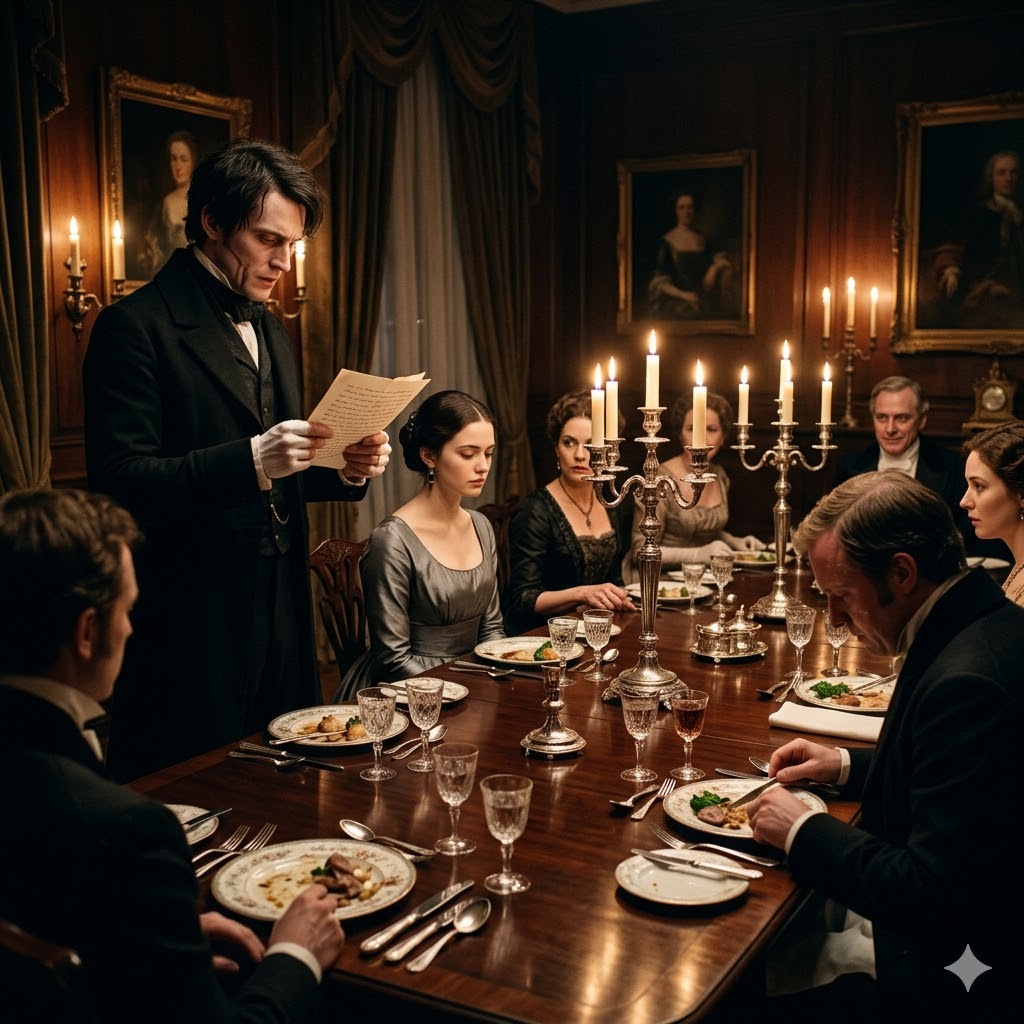
I had not meant the letter to be read by anyone. That was the whole point of writing it. I had written it on the second anniversary of my brother’s death in the small hours of a June morning by the light of a candle I had been allowed to take from the back stairs. I had used the brass letter opener Henry had sent me from Salamanca to slit a fresh sheet of paper.
I had no proper writing tools of my own, only what Lady Cerwood permitted me to take from the housekeeper’s drawer. And I had written 11 pages without stopping. And I had folded them, and I had sealed them with a stub of wax, and I had hidden them in the false back of the writing desk in the morning room behind the inkwells nobody used.
I had hidden them because I knew that if I read them again, I would burn them, and I did not want to burn them. They were the only honest sentences I had written in 4 years. I had not known that Sir Rodrik was watching me when I hid them. Or perhaps I had known and not allowed myself to think it. He waited 11 days.
On the morning of the 12th, he came down to breakfast, smiling, the smile he reserved for the moments when he was about to do something he had been planning for some time, and he announced that his aunt would be dining at his townhouse that Friday, and that he would be pleased, delighted was his word, if Miss Hallowell would consent to attend as her companion.
There will be, he added, watching me, an entertainment afterwards. Lady Cerwood, who was eating her egg, did not look up. What sort of entertainment? A reading, Mom. A friend of mine has come into possession of a most diverting piece of correspondence, and I have promised the table he will share it. It is the kind of thing one does not often have the chance to enjoy.
Whose correspondence? Anonymous, Mom. It would not be sporting to say. I knew. I knew before he had finished the sentence. I felt the cold begin in the small of my back and travel up between my shoulder blades. And I set down my cup very carefully so it did not rattle in the saucer.
And I said, “Forgive me, ma’am, but I am not certain I am well enough to dine out.” Lady Cerwood looked up at me at last. She had eyes like a sparrow, small and bright and not unkind, but not soft either. She studied me for a long moment. You will dine with me, Imagigen. She said, “I do not go to my nephew’s table without you. You know that.
” Yes, Mom. Eat your breakfast. I ate my breakfast. I did not taste it. I went up to the morning room as soon as I was free and I opened the false back of the writing desk and the bundle was gone. There was a single sheet of paper in its place with two words written on it in Sir Rodri’s hand. Friday next. I sat down on the chair and I did not move for a long time.
I had 4 days. I considered in those four days every option a woman in my position could consider, which is to say almost none. I could not flee. I had nowhere to flee to and no money to flee with. And Lady Cerwood would not give me my reference if I left without warning. I could not appeal to her.
Sir Roderick was her sister’s only son, and she had loved him since he was a child, and she would not believe me without proof. and the proof was now in his pocket. I could not steal the letter back. I had searched his rooms once already on the second night, and it was not there. He would have it on his person or with his friend until Friday.
I could refuse to attend, but Lady Cerwood would not go without me, and if she did not go, he would simply read it on another night in another house, and the only difference would be that I would not be present to know what had been said. I went to the dinner. I had one good gown, a gray silk that had been her lady ships three years before, and that the housekeeper had altered for me with surprising kindness when I first came into service.
I wore it. I wore the small jet earrings my mother had left me. I carried my fan and my reticule and the brass letter opener inside my reticule because the brass letter opener was the only thing in my possession that had been sent to me by a man who had loved me. and I wanted for the worst hour of my life to have one such thing on my person.
The mainwearing townhouse was in Grooner Square and it was lit that night for 14 at table. Sir Roderick met us in the hall. He kissed his aunt’s hand. He bowed to me with a particular care that told me everything I needed to know. Miss Hwell, you are looking remarkably composed. Sir Roderick, my friend, Mr.
Belton, is most eager to make your acquaintance. You will be seated near him. Thank you. You may not thank me later. I anticipate as much. His smile flickered. He had not, I think, expected me to come to the door of my own execution with my chin up. I would not give him the courtesy of trembling. Whatever else this evening took from me, it would not take that.
I was seated, as he had promised, near Mr. Belton, a sweating, soft-handed man with pale lashes and a habit of tucking his lower lip beneath his upper teeth when he meant to say something he found amusing. Across from me sat the Duke of Hadley. I had not known he would be there. Sir Roderick had not mentioned him.
I do not believe Sir Rodri had known until he arrived, because there was a small, startled adjustment in the host’s face when the Duke was announced, the briefest flicker of a man recalculating his evening, and then the smooth recovery of a man who has decided that the addition will not in the end alter his plan. The Duke of Hadley was 31 years old and unmarried, and he was, the Gossip Pages said, the most reluctant Duke in England.
He had inherited the title at 23 after his elder brother had died of a fever in Naples, and he had spent the 8 years since avoiding the social obligations he had not been raised to expect. He had a scar along his left jaw from a riding accident at 19, pale, thin, more visible when he was tired than when he was not, and a voice so low and quiet that whole rooms leaned forward when he spoke.
He did not waste it. He did not speak much that evening. He took his soup. He answered Lady Cawerwood’s questions about his sister’s health. He looked occasionally across the table at me with an expression I could not read, neither curious nor cold, only attentive, as though he was storing me up for some later consideration.
I did not know what he had been told. I assumed, because I had learned to assume the worst, that he had been told something by Sir Rodri that made me a figure of amusement before I had opened my mouth. I kept my eyes on my plate. The dinner went on. The fish came and the meat and the second course, and I heard nothing of the conversation around me, except the laughter at intervals, which seemed to be increasing as the wine went down.
Mr. Belton on my left asked me twice whether I was warm enough in a voice that suggested he hoped I was not. After the cloth was drawn, Sir Rodri rose. My friends, he said, I promised you an entertainment, and I am a man who keeps his promises. Mr. Belton has been good enough to bring with him a most singular document which came into his hands by an accident I shall not describe.
It is a letter anonymous though I have my suspicions and remarkable for its honesty. Mr. Belton, will you do the honors? Mr. Belton rose, smiling. He drew the bundle of pages from his coat. I recognized the wax. The lower seal had been broken cleanly. The upper had been folded back. With your indulgence, Mr.
belt and said, “I will read.” The room settled. Some of the women at table arranged themselves to listen with the patient amusement of people who had been promised a private joke. Lady Cerwood, beside me, was watching her nephew, and her small, bright eyes had narrowed in a way I had seen only once before, when a footman had been caught lying about a missing decanter.
The Duke of Hadley did not move. He was looking at me. Miss Belton cleared his throat. Henry, he began. 2 years to the day since you fell, and I have not yet learned how to live in the world without you in it. I am writing this because I cannot speak it. And I have stopped weeping because the weeping made noise that woke the household.
and I am alone tonight in a way I do not know how to bear.” The room was still amused. The opening, I think, sounded to them like the kind of sentimental girish rubbish they had been promised. Mr. Belton smiled around the table to invite them to share his pleasure, and several of them obliged him. He read on. I want to tell you what my life is like now since you are not here to ask.
I rise at 6. I dress myself because there is no maid for a companion. I sit with her lady ship from 7 until 9, which is when she takes her chocolate, and I read to her from the morning papers, skipping the parts about the war because we have an understanding about those parts. I walk her dog. I write her letters.
I am sometimes spoken to and sometimes not. I eat at the table when there is no company and in the housekeeper’s room when there is. I do not mind these things, Henry, individually. I mind them in their accumulation, the way a person minds a small stone in a shoe over the course of a long day. Someone laughed briefly. Mr.
Belton smiled. Sir Rodri’s smile had begun very slightly to fix. I want to tell you that I am brave. I am not. I am frightened most mornings. I am frightened of growing old in this house. I am frightened of the way Sir Rodderick looks at me when his aunt is not in the room, which is a way I do not have language for, but which you would have understood at once and put a stop to.
I am frightened if the day his aunt dies and I am asked to leave with my trunk and no character because she has taught me to manage her ledgers and I have begun to see numbers in those ledgers that should not be there and Sir Rodderick knows that I have seen them. The laughter around the table did not come this time.
Mr. Belton paused. He glanced at Sir Roderick. Sir Rodderick made a small sharp movement with his hand. Go on. I want to tell you what I do in the small hours when I cannot sleep. I read your last letter, the one from Salamanca with the brass letter opener inside it. You wrote that you had made a friend in your company, a Captain Brightwell, who had given you his last clean shirt when yours was past saving, and that you had thought of me when he did it because the kindness was the kind I would have understood.
You wrote that if anything happened to you, he would write to me. Nothing came, Henry. I have stopped expecting it. Perhaps he died, too. Perhaps the world is simply a place in which letters do not arrive when they are most needed. I had been looking at my plate. I looked up now. The Duke of Hadley had gone perfectly white.
It was not a slow blanching. It was the sudden total drain of a man who had received a blow he had not seen coming and had not been able to brace for. His knuckles, where they rested against the stem of his glass, had gone the color of bone. He was not looking at me. He was looking at Mr.
Belton, and the look was the look of a man who was, in his mind, already across the table. Mr. Belton, who was not a clever man, but had been long enough in society to know when a room had turned, hesitated. continue,” said Sir Roderick quietly. Mr. Belton continued, “I want to tell you what I would say if I could say one thing to you and have you hear it.
I would say that you were the best brother a girl could have had, and that I have not yet met a man who measured up to you, and that I do not believe I will.” I would say that I am angry, that is the shameful word, that I am angry with you for dying before you had taught me how to be alone. I would say that I am sorry for the times I was sharp with you over small things and that if I had known the small things were the last things I would say, I would have been kinder.
I would say that I love you. I would say it without the hesitation we always carried, you and I, about saying it. I would say it the way I should have said it the morning you rode out when I gave you the woolen scarf I had knitted poorly and you laughed and I pretended to be cross and I did not say I love you because I thought there would be time.
Mr. Belton stopped. He had gotten through three more sentences than I had expected him to. He stopped on the word time, and he stood there with the page in his hand, and his color, which had been high all evening, had drained. He looked at Sir Rodrik. Sir Rodri was no longer looking at him. Sir Rodri was looking at the Duke of Hadley, who had risen from his chair.
The Duke did not raise his voice. He never raised it. I learned over the months that followed that he could not be made to raise it. He spoke at the same lowlevel pitch he had used to ask Lady Cerwood about her sister’s health. Mr. Belton, he said, give me the letter. Your grace, I give me the letter. Mr. Belton gave him the letter.
The Duke folded the pages slowly as a man folds something he intends to preserve. He slid them inside his coat. He turned to the head of the table. “Sir Rodri,” he said, “I will speak with you alone.” Now, “Your grace, this was a private entertainment among friends. It was not now.
” There was a quality to the Duke’s voice in that moment that I will not try to describe exactly because a description would weaken it. I will say only that the room understood all at once that something had occurred which they had not anticipated and that they had been until that moment an audience to a piece of cruelty for which they would in the morning have to find a way to account.
So Rodri rose. He did not look at me. He led the juke from the room. The door closed. The silence that followed was not a comfortable silence. Several of the women looked at me with the fixed, wideeyed attention of people who are trying to determine whether they have just been part of something they will be ashamed of. Mr.
Belton sat down heavily. He did not look at anyone. Lady Cwood reached out beneath the table and took my hand. Her fingers were thin and dry and surprisingly strong. She did not let go. Imagin, she said quietly enough that only I could hear. I owe you an apology. We will discuss it when we are home. Yes, ma’am. You will not return to my nephew’s house ever.
No, Mom. She pressed my hand once hard and released it. I do not know precisely what was said in the room into which Sir Rodrik was taken. I know that they were absent for the better part of a quarter hour. I know that when the Duke returned alone, his color had not come back, but his hands were steady and he came directly to my chair. He bowed.
He did not bow the way a man bows to a companion. He bowed the way a man bows to a woman whose brother saved his honor and whose letter has just rearranged the inside of his chest. “Miss Hwell,” he said, “May I sit?” “Your grace, the chair beside me belongs to Mr. Belton.” “Mr.
Belton,” the Duke said without looking at him, “is leaving.” Mr. Belton left. The Duke sat down beside me. He did not speak for a moment. He set the folded pages of the letter on the table between us beneath his hand, as a man might set down something fragile and valuable. “Your brother,” he said very low, wrote to me about you for the last 6 months of his life. “I did not know your name.
” He called you his sister. He told me you had taught yourself Italian from a primer he had sent you, and that you had made him a scarf. you swore was poorly knitted, but which he wore until it fell apart. And that he was saving his pay because he intended, when the war ended, to take you out of the position you had been forced into, and set you up in a small house of your own, where you might keep cats and refuse callers.
I have his letters at Hadley House. I have read them every winter for 2 years. I could not speak. After he died, I tried to find you. I had only your first name and the county. I wrote three times to a Halwell family in Northland who turned out to be no relation. I had given it up at last for a failure I could not undo.
His hand on the folded pages had begun very faintly to tremble. I did not know you had been waiting for a letter that I had been trying for 2 years to write. your grace. My name is Theodore. I I cannot. You can if you wish to. I am not asking you to in this hour. I am only saying it once for the record because I have used it in my own head when I have read his letters about you.
And I should like you to know it is the name in which I have known you longer than tonight. I looked at him. The candle light caught the scar along his jaw. He was not, I thought distantly, a beautiful man. His face was too lean for that, and the scar disrupted the line. But he was an honest face and an attentive one, and I had not been looked at with attention by a man since Henry had written out 3 years before.
I am not certain what is happening, your grace. I am proposing to marry you, Miss Hwell. He said it the way he said everything else, low level without ornament, as if he had been considering it for some time and had only been waiting for the moment to be appropriate. You cannot be. I assure you I am. You have known me for the length of a dinner.
I have known you for 2 years through the only correspondence I trusted in those years. I have known you for an hour and a half by candlelight at this table. I have known you with respect to the matter on which a marriage will turn for as long as it took Mr. Belton to read three pages. He paused. I will not press you for an answer tonight.
I will not press you for an answer this month. I only wish you to know before this evening ends that the offer exists and that it does not depend on your acceptance for me to honor every other obligation your brother’s friendship laid upon me. Whether or not you marry me, you will not return to Sir Rodrik’s house. Whether or not you marry me, the income your brother intended for you will be made up by my estate because he died before he could provide it and I am the man he would have asked.
These are not conditions. These are debts. Lady Cerwood on my other side made a small sharp sound that I realized after a moment was a laugh. Your grace, she said, I have known you since you were 8 years old, and I have never heard you string so many sentences together at one sitting. Imagine, my dear, I think you will find you have made an impression.
Lady Cerwood, the Duke said, “I would not have presumed to speak in your presence had I not been certain you would already have understood.” Oh, I understand perfectly. My nephew is finished, by the way. I shall write to my solicitor in the morning. He may have the income from the Yorkshire farms, which will be sufficient for him to live on in disgrace, and not a penny more.
Mom, I began. Hush, child. I have been a poor employer to you. You will allow me to be a better one for whatever time remains of our association. I sat between them with the letter on the table beneath the Duke’s hand and Lady Cerwood’s fingers still laced through mine, and I understood that the world had rearranged itself in the last 20 minutes, and that I had no yet any idea what shape it had taken.
I did not give the Duke an answer that night. He did not ask for one. He saw us into our carriage himself, and he handed me into it with a courtesy that did not, I noticed, attempt to hold my hand for any longer than the act required, and he stood in the lamplight of Groner Square as we drove away. I cried in the carriage.
Lady Cerwood did not pretend not to notice, but she did not speak. She handed me her own handkerchief embroidered with a sea in lilac silk and she held my arm the rest of the way home. The next two months are difficult to describe in order because the order of them did not feel ordinary at the time. Sir Rodri was sent away from London by his mother who arrived from Sussex within 48 hours of receiving Lady Cerwood’s letter.
The story given out was that he had taken ill and required country air. The truth which was known within the week to everyone who mattered and to half the people who did not was that the Duke of Hadley had spoken privately to four men in three clubs and that the verdict on Sir Rodri had been delivered with the quiet finality of a sentence handed down from a bench.
He was not received. His debts came due. The Yorkshire income which had been offered to him by his aunt did not come close to covering them. By August he had retired to Calala where I am told he lives still on a stipend his mother sends him quarterly with the regularity of a woman doing penance for a son she should have raised differently.
Mister Belton did not retire to Calala. Mr. Belton retired to a small estate in Northland which had belonged to his late wife’s family where he was said by the letters Lady Cerwood received from a cousin in the neighborhood to have become a great enthusiast for the breeding of spananiels and to no longer dine in company.
I did not investigate further. I did not need to. The Duke called at Lady Cerwood’s house 3 days after the dinner. He did not stay long. He paid his respects to her ladies. He sat for the proper 20 minutes. He asked me before he left whether I would be willing to receive him again the following week. I said I would.
He kissed Lady Cerwood’s hand and bowed to me and he did not speak my name and he left. He came again the following week and the week after. The third time Lady Cawerwood pleaded a headache and left us in the morning room with the door open, which was the most unshaperoned arrangement she would permit, and which I understood to be a particular kindness.
The Duke and I sat for a quarter hour in a silence that was not awkward, and then he said, “I have brought something.” Yes. He drew from his coat a thin packet of letters tied with string. Your brother’s letters to me, he said, the ones in which he wrote of you. I have brought them because I believe they belong in some sense to you.
I have also brought them because I wish you to read what I read of you before you knew me. So that when you make your decision, you will know that the version of you I love is not a version I invented in one evening. It was assembled slowly over a long autumn and winter from a brother who was very proud of you.
I took the letters. I held them in my lap. Your grace, Theodore. Theodore. The name fit my mouth more easily than I had expected. I am not I have not had a life in which men have proposed to me. I do not know how to receive what you are doing. You are receiving it well. I do not feel that I am. You are sitting upright.
You are listening to me without flinching. You are speaking truth. Anything else is ornament. I read the letters that night. I read them twice. They were Henry’s hand and Henry’s voice. and the things he had said about me to a man I had never met made me weep in a way I had not wept since the morning the news from Waterloo had come.
Not the weeping of grief, which has its own posture, but the weeping of being known. The next time Theodore called, I told him I would marry him. He set down his cup. He did not speak. He took my hands and held them, and he closed his eyes for a moment. And when he opened them, he said, “Thank you.” That is not what one says, I think, when one is accepted.
It is what I say. I have spent 2 years failing to find you. I have tonight been forgiven for it. Thank you is exactly what one says. We were married in November at the small church in Hanover Square on a day so cold that the breath of the congregation showed in the air during the vows. Lady Cerwood gave me away.
She had insisted on it. She said that since Sir Rodderick was unavailable and my father long dead, she would do the office herself and that any minister who objected to a woman performing the duty could explain his objection to the bishop who was her cousin. No minister objected. I wore a dark green silk Theodore had chosen because I had told him I had owned only gray for 4 years and never wished to wear it again.
I carried no flowers. I carried instead the brass letter opener Henry had sent me from Salamanca because it had been with me at the worst dinner of my life, and I wished it to be with me at the best one. Theodore understood without my explaining. I am told that there were guests who thought it odd, and I am told that none of them mentioned it twice.
The wedding breakfast was at Hadley House. Theodore stood at the head of the table and he raised his glass and he made the shortest toast I have heard at a wedding before or since. To my wife, he said, whom I have read and who has read me and who has consented despite both to remain. The table laughed. I laughed.
I had not laughed at table in 4 years. Three years on, we have a daughter. I named her Henrietta after Henry because Theodore asked me to and because I had wanted to and had not been brave enough to suggest it. She is two now, and she has Theodore’s quiet and my obstinency, which her father claims is a combination he is not equipped to manage, and which I notice does not stop him from carrying her on his shoulder around the picture gallery every evening, naming each portrait for her in his low, deliberate voice, while she pulls at the hair he
does not have time to comb. The 11 pages of the letter are kept in a drawer in my private sitting room at Hadley House. I have not reread them since the night they were read at Sir Roderick’s table. I do not need to. I know what they said. I know that they were the only honest sentences I had written in 4 years.
And I know that they were not in the end my humiliation. They were my introduction. I had been waiting 2 years for a letter that did not come. and a letter I had written to a brother who could not read it had instead found its way to a man who could. The brass letter opener sits on my writing desk now where the light from the window falls on it in the late afternoon.
Theodore noticed it there. The first week of our marriage and asked me to tell him the story of how Henry had come by it. I told him. He listened the way he listens to everything, quietly without interrupting, as though he were committing it to a record he intended to keep. When I had finished, he said only.
He would have liked to know you have it still. I know. He would have liked to know you are not alone. I know that too, Imagin. Yes. Neither am I. He took my hand and we sat in the late afternoon light at the window of our drawing room. And outside the gardener was burning leaves and somewhere in the house Henrietta was laughing at something the nurse had said, and the brass letter opener caught the sun.
And I thought of the candle in the morning room four years before and the 11 pages and the false back of the writing desk and the boy I had thought no one would ever read me as carefully as. I had been wrong about that. It was the best thing I have ever been wrong






