By the time I pulled into her parents’ driveway, Mia had gone quiet, not fully asleep, just that soft, heavy kind of silence drunk people fall into when the night has finally caught up with them. Her heels were off. One of them was on the floor by the passenger seat, the other somehow under my brake pedal.
Her head rested against the window, and every few seconds she frowned in her sleep, like even unconscious, she was still annoyed at herself. Rough night,” I muttered, mostly to fill the silence. She didn’t answer. A few hours earlier, she’d been laughing too hard at things that weren’t funny and insisting she was completely fine, which is how Mia always announced she was absolutely not fine.
The whole mess had started at her friend Rachel’s engagement party. Technically, Mia hadn’t asked me to be her date. She’d asked me to come save her from making small talk with finance bros and married women who ask invasive questions. I told her that sounded less like a party and more like a psychological test. She said, “Exactly, so wear a nice shirt.
” That was us. I’m Nate Holloway and Mia Bennett had been one of my closest friends for almost 6 years. We met at a bookstore cafe when she stole the last open outlet for her laptop, looked me dead in the eye, and said, “I saw it first emotionally.” I should have found her exhausting. Instead, I bought her coffee. That was the beginning.
Since then, she’d become the person I called when my day went bad. When something funny happened. When I needed help moving a couch, when I wanted someone to tell me if I was overreacting or not reacting enough.
She knew how I took my coffee, which movies I pretended not to cry during, and exactly how to talk me out of bad decisions in under 30 seconds. I knew her in all the small ways that matter, too. When she was irritated, she tucked her hair behind her ear too hard. When she was lying, she overexplained. When she was hurt, she smiled more, not less.
And tonight, she’d been smiling all evening, because tonight had gone badly. Not at first. She looked beautiful when I picked her up. Dark green dress, gold earrings, soft curls, the kind of look that made me have to reset my face before she reached the car. But an hour into the party, some guy named Trevor showed up. Trevor was apparently the kind of man people described as promising because no one could honestly call him good.
Tall, polished, expensive watch, handshake like he thought mirrors were a personality trait. Mia had mentioned him twice before casually, which with her usually meant not casually at all. Then he arrived with another woman, not a cousin, not a coworker, not some harmless misunderstanding. He arrived with a woman in a silver dress and introduced her with the kind of smug ease that told me he’d known exactly what he was doing.
Mia laughed it off in front of everyone, then accepted a second drink, then a third. By the time we left, she was still upright, but only because I was walking half a step too close and pretending not to. I got out, came around the car, and opened her door. “Mia,” I said softly, her eyes opened halfway.
“Did we win?” “There was no competition.” “There’s always competition,” she mumbled. “That landed harder than it should have.” I helped her out of the car, and she leaned into me without thinking, one hand gripping my sleeve while I shut the door with the other.
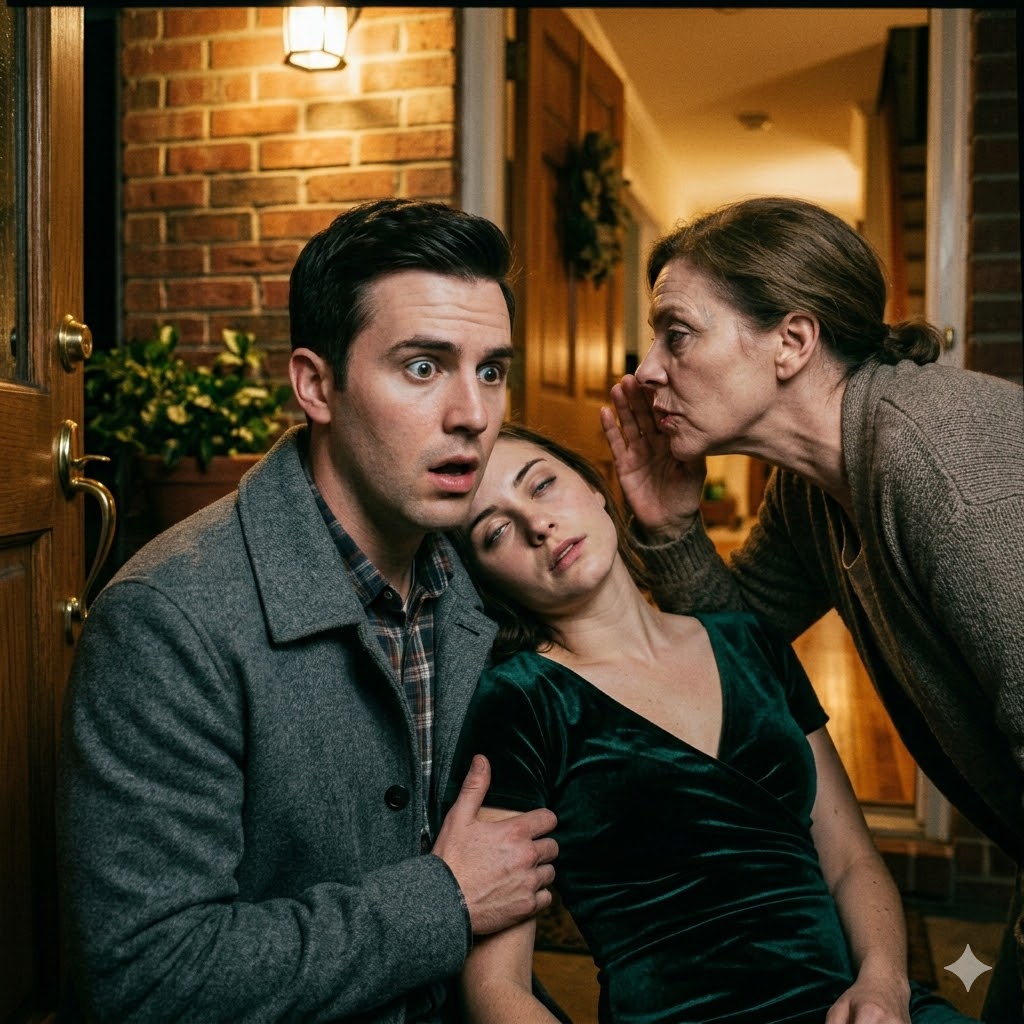
The porch light flicked on before we even reached the front steps. Her mom opened the door almost immediately. Susan Bennett took one look at her daughter draped against me, sighed with the deep weariness of a woman who had seen this emotional disaster coming from several zip codes away and stepped aside. “Oh honey,” she said gently to Mia.
Then her eyes shifted to me, and that was when she lowered her voice and said, almost like she was giving away a secret she was tired of keeping. You’re all she talks about. I actually stopped moving. Not visibly, I hope, but enough that I felt it. Susan’s face softened in that dangerous knowing mom way. I probably shouldn’t have said that, she added. No, I I swallowed.
It’s okay. I just didn’t know what to do with that. Mia made a small sound against my shoulder. Mom, I’m here, sweetheart. Susan reached out and brushed hair from her face, then looked back at me. Can you help me get her upstairs? She’ll sleep better in her own bed. Yeah, of course. The walk upstairs felt strangely unreal. Mia’s room was at the end of the hall, same as always.
I’d been in this house a hundred times, but somehow tonight everything felt sharper. The family photos on the wall, the quiet, the fact that Susan had just casually dropped a sentence into my life that was going to live there for a while. When we got to the room, I helped Mia sit on the edge of the bed.
She blinked up at me, dazed, then squinted like she was trying to make sure I was real. Nate, yeah, you came. That one simple sentence should not have hit me the way it did. I always do, I said. Her mouth curved faintly, sad and sleepy all at once. I know. Susan disappeared for a moment, probably to get water or aspirin, leaving the two of us alone in the soft yellow light of her room.
Mia was still holding on to my wrist. I glanced down at her hand. You okay? She shook her head once, honest, immediate. Then she looked up at me with that loose, unguarded expression people only wear when they’re too tired or too drunk to hide. And in a voice just above a whisper, she said, “That’s the problem.” I frowned. What is? Her fingers tightened around my wrist.
“You,” she murmured. “No one feels right after you.” For a second, I thought I’d misheard her. Not because the words were unclear, because they were drunk, sleepy, and devastatingly direct. No one feels right after you. Mia was still holding my wrist, looking up at me like the effort of keeping her eyes open was somehow easier than taking that sentence back. I crouched in front of her. Mia.
She blinked once. You’re drunk. That’s not a correction. No, it’s context. That got the faintest, saddest little smile out of her. Trevor brought that woman on purpose, she said. I didn’t answer because yes, obviously he had and because I suddenly understood that this conversation was no longer really about Trevor.
Mia looked down at my hand still in hers. I hate that I cared. That part’s human. I hate that I let him make me feel replaceable. Her voice thinned on the last word, like I was just some option he could circle back to if the better thing didn’t work out. That did it. I didn’t care about Trevor before. Now I actively disliked him. You were never that, I said quietly.
Mia’s eyes lifted to mine. You always say the right thing. No, I just say the obvious thing faster than other people. She laughed once through her nose, but the laugh didn’t hold. Then she looked at me in that loose, honest way again and said, “Do you know what the worst part is?” “I had a bad feeling I did.
Tell me.” “I kept comparing him to you,” she said, almost like she was confessing to a crime. “The whole time.” My brain stopped being useful. Mia went on anyway. Not on purpose at first, just stupid little things. She counted weakly on her fingers. How he texts, how he listens, how he laughs when people say mean things. Her mouth tightened.
How he never once made me feel safe. Her mom came back in then with water and two aspirin, and the moment broke just enough for breathing to become possible again. Susan took one look at Mia’s face, then mine, and seemed to understand she had interrupted something delicate. here,” she said, handing Mia the glass.
Mia swallowed the aspirin obediently, which was how I knew she was really wrecked. “Normally, she would have negotiated with the concept of medication for 10 minutes.” Susan pulled the blanket down and gave me a gentle look. “Would you mind staying a minute while I get her some tea?” I nodded. “Sure.” When she left again, Mia leaned back against the pillows and closed her eyes.
I should have left the conversation alone. That would have been smarter, kinder, probably. But Mia had cracked something open. And now I needed to know whether this was grief talking, tequila talking, or something that had been alive long before tonight. So I asked carefully, “Have you really been comparing people to me?” Her eyes opened again, and even drunk, she looked annoyed. That was not vague. Sorry.
No, you’re not fair. She stared at the ceiling for a second and then she said, “Do you know what it’s like when someone becomes your normal?” That hit harder than I expected because yes, I did know. I just had never planned to hear her say at first. When something good happens, she continued softly, “You’re the person I want to tell.
When something goes wrong, you’re the one I want near me. So then I go out with some man who seems fine on paper and all I can think is she shut her eyes again. He’s not you. He doesn’t feel like home. I went completely still. There are moments where you know with perfect clarity that the shape of your life has just changed. This was one of them.
Mia, I said, and my voice came out rougher than I meant it to. She frowned faintly. I know, I know. Bad timing, terrible delivery, very humiliating. No. Her eyes opened again, and this time I didn’t dodge. No, I repeated, not humiliating. She searched my face through the haze of exhaustion and alcohol like she was trying to decide whether I was being kind or honest.
Before she could ask, Susan came back in with tea, and all remaining privacy died immediately. Mia took one sip, made a face, and mumbled, “This tastes responsible.” Susan sat on the edge of the bed and smoothed her hair back. That’s because it is. I stood then, mostly because if I stayed crouched there another minute, I was going to say something I wanted to say when she was sober enough to keep. I should go, I said.
Mia looked up too fast. Don’t. One word barely louder than a breath, but it landed like a hand to the chest. Susan glanced between us and with the terrifying efficiency of a mother who had clearly decided the truth was overdue said, “You can stay downstairs for tea, Nate. I don’t think either of us should leave her alone just yet.
” That was how 20 minutes later, I ended up in the Bennett kitchen at nearly 1:00 in the morning with Susan across from me and Mia finally asleep upstairs. Susan wrapped both hands around her mug and said without preamble, “She’s been in love with you for over a year.” I looked at her. She held my gaze steadily. And before you panic, I am not asking for a speech. I’m asking whether I should be worried my daughter just embarrassed herself beyond repair. I set my cup down carefully. Then I told her the truth. “No,” I said.
“You should be worried that I’ve been trying very hard not to tell her the same thing.” Susan leaned back in her chair, shut her eyes for half a second, and whispered, “Thank God.” Susan opened her eyes again and looked at me like she was checking whether I meant that or was just being kind to a drunk girl and a worried mother at 1:00 in the morning. “I’m not joking,” I said quietly. “I know,” she said. That startled me.
She smiled a little into her tea. “Nathan, I’m her mother. I know what she looks like when she talks about a man she’s trying not to want.” Then she gave me a look over the rim of the mug. And I know what a man looks like when he’s been showing up for my daughter like it’s instinct. I looked down at the table because there wasn’t much to say to that. The Bennett kitchen had always felt warm at night.
Soft under cabinet light, the old clock above the pantry, rain finally slowing outside. I’d sat at this table a hundred times for pizza, birthdays, and family noise. But tonight, the whole room felt rearranged. Not physically, just morally. like the truth had walked in and pulled up a chair. Susan traced one finger along the handle of her mug.
She’s dated good-looking men, funny men, men with nice jobs and expensive shoes and no idea how to hold her heart without bruising it. Her eyes lifted to mine, and after every single one, she’d come home and say some version of the same thing. I didn’t breathe. She’d say, “I know it’s not fair, but he’s not Nate.” That one stayed in the room. I leaned back slowly.
You’re making this very hard to survive gracefully. Susan smiled. Good. That got a laugh out of me, short and helpless. Then she got more serious. I’m only saying this because I know my daughter. Tomorrow she’s going to wake up, remember enough to be horrified, and try to bury herself under 10 layers of charm and denial. She set her mug down. If you don’t mean this, let her do that.
If you do mean it, she held my gaze. Don’t leave her alone with the worst version of what she said tonight. That landed hard because I could already picture it. Mia waking up with a pounding head and fragments of memory. The aspirin, my wrist in her hand, her saying, “No one feels right after you.” Then panic. Then deflection.
Then that smile she used when she wanted to survive something without admitting it hurt. I stood too fast. Susan’s brow lifted. Where are you going? Upstairs. That almost made her laugh. I said, “Tomorrow.” “I know.” I dragged a hand through my hair. But if she wakes up in the middle of the night and thinks I left because of what she said. Susan pointed toward the hall.
“Guest room, two doors down from hers. Stay there. Be visible in the morning. Don’t be dramatic.” That last one feels controlling. I raised daughters. I earned it. Fair. 5 minutes later, I was in the guest room, staring at the ceiling, fully dressed, shoes off, pulse nowhere near sleep.
The house had gone quiet, but not the kind of quiet that calms you. The kind that gives every thought room to pace. I thought about the first time Mia fell asleep in my car after a bad day and reached for my sleeve in her sleep like she needed to make sure I was still there. I thought about the time I had the flu and woke up to soup on my stove and her cursing at my microwave.
I thought about every man she’d dated that I’d pretended not to judge. And I thought about how easy it would have been to misread tonight if I’d been weaker, more selfish, or just dumber. But it didn’t feel like drunken nonsense. It felt like something exhausted enough to finally stop hiding. Sometime after two, I heard soft footsteps in the hallway. Then a pause outside my door, a light knock.
I got up immediately and opened it. Mia was standing there in an oversized sleep shirt, barefoot, hair a mess, face pale with sleep and embarrassment. For one second, we just looked at each other. Then she said, “Please tell me I didn’t confess my entire emotional history to you and then make my mother serve as witness.” I stared at her. She closed her eyes. “Oh, God, I did.
Mia, no. Let me die with some structure. She pressed one hand to her forehead. I remember pieces. Trevor, the car. You carrying me upstairs. Then I remember saying something I absolutely cannot have said out loud unless the universe has become deeply vindictive. I should have answered gently. I did. You said a few things. She made the smallest, most wounded sound. That is not a merciful sentence.
I stepped into the hallway and closed the door behind me so we wouldn’t wake the whole house. Mia looked up at me with that same unguarded misery I’d seen earlier, only now it was sober. Worse, somehow. Then she whispered, “Did I ruin us?” And just like that, every safe answer disappeared. “No,” I said. Mia searched my face like she was afraid I’d say more and make it worse. So, I did. You didn’t ruin us, I said quietly.
You just said the part we’ve both been trying not to say first. That changed her expression. Not into relief. Into something shakier than that. Hope, maybe, trying very hard not to trust itself too fast. She folded her arms over herself. That sounds dangerously close to a good answer. It is a good answer.
Mia looked down at the hallway runner, then back up. Nate, I was drunk. You were, but you were also honest. That is not helping my dignity. I’m not trying to help your dignity. A weak, disbelieving laugh escaped her. What are you trying to help? I stepped a little closer, not enough to crowd her, just enough to make it clear I wasn’t retreating.
You, I said, the part of you that’s probably been awake for 10 minutes, convincing itself I left because I didn’t know what to do with what you said. Her eyes widened just slightly because that was exactly what she’d been thinking. Mia, I said softer now. I stayed. That landed hard. She looked past me at the guest room door, then back at me, and I saw the exact second that detail settled in her chest. You stayed, she repeated. Yeah.
Why? There are questions that deserve elegant answers. That one deserved the truth. because I knew you’d wake up and make this smaller than it is if nobody stopped you. She stared at me for one long second. Then she whispered, “That is a very rude way to know me so well. I’ve had practice.” That got the smallest smile out of her.
Good. The room needed one. But it faded quickly because the real thing was still waiting between us. Mia took a breath. So when I said nobody feels right after you, I know. No, I need to finish before I lose the nerve sober, too. She swallowed once. I meant it. Not because Trevor was awful. He was awful. But that’s not the point.
The point is every time I try to build something with someone else, sooner or later I realize I’m measuring it against the way I already feel with you. Her voice dropped. And that feels unfair to everyone involved. I held her gaze. Then I said, “It’s not unfair if the reason is that you’ve been choosing around the truth.” Her breath caught. “You make that sound very simple.” “It isn’t simple,” I said.
“It’s just clear.” The house was completely quiet now. No footsteps, no pipes, no TV downstairs, just us in the hall with everything finally stripped down to what it had been all along. Mia looked at me in that dangerous open way people do when they’ve stopped trying to look okay and started trying to be understood. “Then tell me something clear,” she said. So, I did.
I think I’ve been in love with you long enough that it started feeling normal, I said. And because it felt normal, I kept pretending it wasn’t a problem. Then you’d date somebody and I’d tell myself I was being mature by staying quiet. Then I’d hate every second of it and call that maturity, too. Mia laughed once through her nose, eyes bright now.
That is such an embarrassingly male strategy. Thank you. No, really. It’s terrible. I know. She took one step toward me. So what happens now? I could have kissed her right then. I wanted to. But I wanted one thing more than that. For neither of us to wake up tomorrow wondering if the whole thing had only belonged to a bad party and a worse man. So I said, “Now I ask you out properly.
” That stopped her properly. Yes. Tomorrow night dinner on purpose. No engagement party fallout. No tequila. No, Trevor. No mother witnesses unless absolutely necessary. Her mouth softened into a real smile. Then the kind I’d been in trouble over for years. That, she said quietly, is annoyingly perfect.
I’ve had 6 years to prepare. You really should have moved faster. Strong note. Taking it. Then she reached for my hand. Not dramatically, not by accident. just Mia finally deciding not to hide the motion. I laced my fingers through hers and for one suspended second the whole night seemed to exhale. “Tomorrow night,” she said.
“Tomorrow night.” She looked at our hands, then back at me. “You know my mother is going to be unbearable. Your mother has already earned that right.” “She really has.” That got us both laughing softly enough not to wake the house. Then Mia rose on her toes and kissed my cheek just once. Warm, quick, terrifyingly sweet. And because apparently she enjoyed keeping me unstable, she whispered, “That was the sober preview.
” before slipping back toward her room. I stood in that hallway for a full minute after she disappeared. The next evening, I picked her up at 7. No dress drama, no crying in parked cars, no emergency truth serum, just Mia opening the door in jeans and a cream sweater, looking nervous and happy at the same time, which somehow affected me more than the green dress ever had.
Her mother, of course, answered first. Susan took one look at me, one look at Mia behind her, and said, “Oh, good.” The adults finally arrived. Mia groaned, “Mom.” Susan kissed her cheek, looked at me, and added, “Bring her back, smiling.” “I’ll do my best.” “Do better than your best,” she said, and walked away before either of us could recover.
Dinner was easy in the most dangerous way. Not because something new had appeared, because everything that had always been there finally had the right name. A month later, she still stole my fries. I still drove her home. The only real difference was that now when she reached for my hand in the car or leaned into me on her parents’ couch, neither of us had to pretend it was an accident.