Everything. Dr. Daniel Cooper moved quietly through the ICU ward, his footsteps soft against the polished floor. At 34, he’d been practicing medicine for 6 years, but the weight of each patient’s life still settled heavily on his shoulders, especially the ones who’d been here the longest. Room 412 had held the same patient for nearly 3 months now.
The chart outside read Jane Doe, though everyone on staff knew she wasn’t really a Jane Doe. The police had identified her from the car accident scene as Victoria Ashford, CEO of Ashford Enterprises, one of the city’s most successful tech companies. The media had covered her disappearance extensively before the hospital administration had clamped down on information leaks, protecting her privacy.
Victoria had been in a coma since the accident. Her expensive car wrapped around a tree on a rainy September night. No alcohol, no drugs, just wet roads and a moment’s loss of control that had changed everything. She’d been alone, no passengers, and now lay silent in a hospital bed while her company’s board of directors waited to see if she’d ever wake up.
Daniel had been assigned to her care 2 weeks ago when her regular attending physician had gone on medical leave. He’d studied her chart extensively. 38 years old, no family listed as next of kin, emergency contact listed as her executive assistant. Brain activity present, but minimal responsiveness. Multiple injuries from the accident all healing well, but her consciousness remained somewhere unreachable.
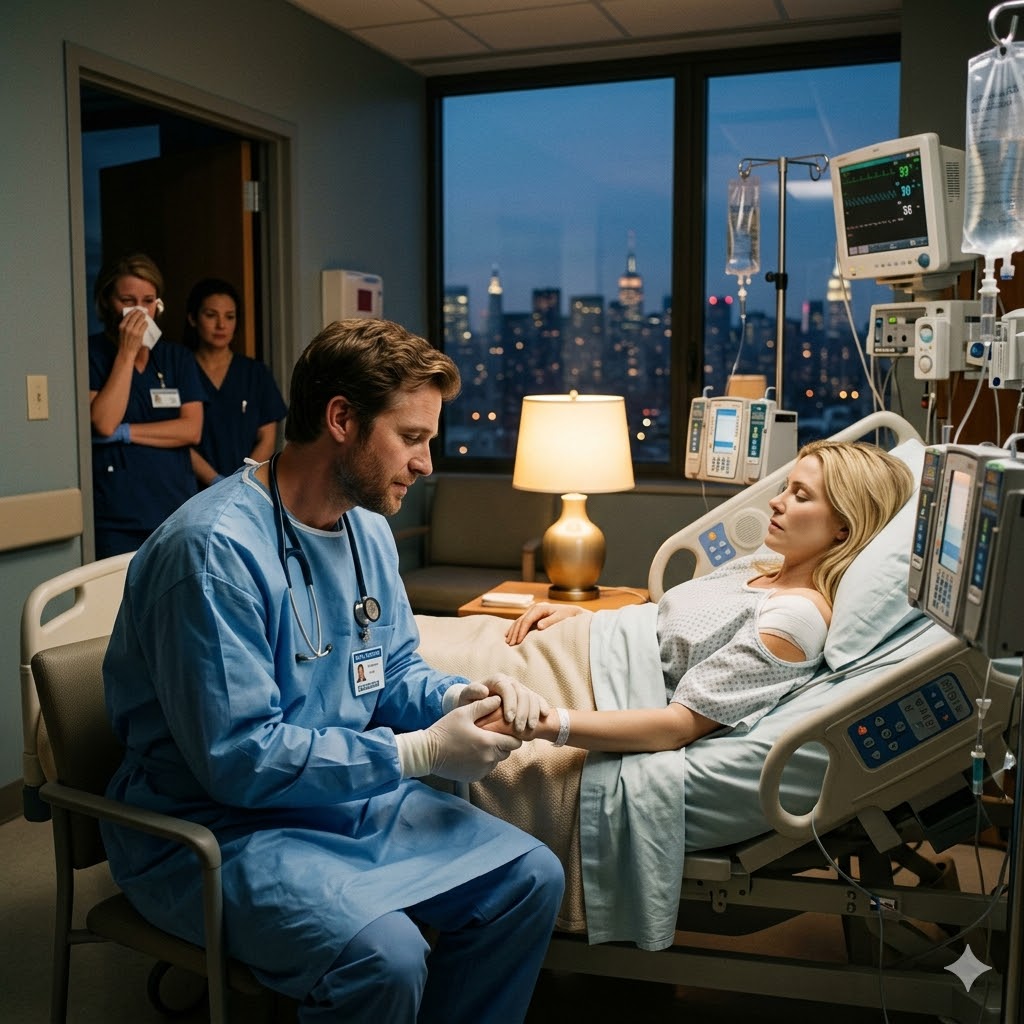
He entered her room now, noting the soft morning light filtering through the blinds. Two nurses stood near the back of the room reviewing medication schedules, but they nodded to Daniel and quietly excused themselves. Daniel approached Victoria’s bed. Even after 3 months of hospital care, she was striking.
Blonde hair that the nurses kept clean and brushed, pale skin that somehow maintained an ethereal quality despite her condition. The bandage on her shoulder needed changing, the wound from where the seat belt had cut deep during impact, an injury that had required surgery and was still healing. “Good morning, Ms.
Ashford,” Daniel said softly, speaking to her as he always did, as if she could hear every word. “I’m Dr. Cooper. I’m going to change your shoulder dressing, okay? I’ll be as gentle as I can.” He’d learned in medical school that coma patients might be able to hear even when they couldn’t respond. More importantly, his mother, a nurse for 40 years before retiring, had taught him something deeper.
“Talk to every patient like they’re fully present, Danny. Treat them with dignity. You never know what reaches them, what matters.” Daniel carefully pulled back the hospital gown exposing the bandaged shoulder. As he worked, removing the old dressing with practiced gentleness, he continued speaking. “It’s a beautiful morning today, early November, and the leaves are at their peak.
The maple tree outside your window is this incredible shade of gold.” He cleaned the healing wound carefully, his touch feather-light. “You’re healing well. Your body is strong. It’s fighting hard to recover.” As he applied the new bandage, Daniel found himself noticing small details, the slight flutter of her eyelashes, the almost imperceptible rise and fall of her breathing, the way her hand rested on the white sheet.
There was something about her that pulled at him, some quality he couldn’t quite name. Perhaps it was the sadness of her situation, so successful, so accomplished, and yet here she lay with no family listed, no visitors except her assistant, who came weekly to update her on business matters in a stiff, formal voice.
“You know what I think?” Daniel said quietly, smoothing the edges of the new bandage. “I think you’re tired. I think maybe you’ve been fighting so hard for so long that part of you just needed to rest.” He gently adjusted her hospital gown, making sure she was comfortable. “But I also think there’s something in you that’s not ready to give up.
I can see it in your vitals, in the way you’re healing. You’re still in there, Ms. Ashford. You’re still fighting.” On impulse, something he couldn’t quite explain, Daniel took her hand, holding it gently between both of his. Her skin was warm, alive, and he found himself wishing she could feel the human connection, the reminder that she wasn’t alone.
“I know you don’t know me,” he said softly, “but I want you to know that I see you. Not the CEO, not the businesswoman everyone talks about in the news. I see a person who deserves care and kindness and respect, and I’m going to keep talking to you, keep treating you like you’re here, because I believe you are.
Somewhere inside, you’re listening.” What Daniel didn’t realize was that behind him, visible in the reflection of the window, two nurses had returned and stood watching. Sarah Mitchell, the senior ICU nurse, had tears in her eyes. In 20 years of nursing, she’d seen countless doctors treat coma patients like objects, like tasks to be completed, but Dr.
Cooper spoke to Victoria Ashford like she was his own family. As Daniel gently released Victoria’s hand and made a final notation in her chart, Sarah cleared her throat. “Dr. Cooper, that was that was beautiful.” Daniel turned, slightly embarrassed to have been overheard in what he’d thought was a private moment.
“I just believe in treating patients with dignity,” he said simply. “Most doctors don’t take that much time,” Sarah observed, “especially not with long-term coma patients.” “Then most doctors are missing something important,” Daniel replied. “She’s not just a patient number. She’s someone’s daughter, someone’s friend.
She built a company, lived a life. That doesn’t disappear just because she can’t respond right now.” Over the following weeks, Daniel’s care of Victoria became something the entire ICU staff noticed. He spent extra time with her during his rounds, always talking to her, always treating her with gentle respect.
He brought in different music to play, jazz one day, classical the next, even some modern pop, trying to find something that might reach her. He described the changing seasons outside her window, told her about his day, shared stories about his own life, his younger sister’s recent wedding, his mother’s garden, the book he was reading.
He treated her not as a patient in a coma, but as a person who was temporarily unreachable, but still fundamentally present. 3 months and 2 weeks after the accident, on a Tuesday morning in late November, Daniel came in to check Victoria’s vitals. He went through his usual routine, checking monitors, examining her healing wounds, speaking to her about the first snowfall overnight.
“The whole city is covered in white,” he said, adjusting her blanket. “It’s beautiful, quiet. You’d probably love it once you get past the traffic complications.” As he reached to check the IV line, Daniel noticed something different. Victoria’s hand, which had been resting limply on the bed, twitched slightly.
His breath caught. “Ms. Ashford?” he said, leaning closer. “Victoria? Can you hear me?” Another twitch, more pronounced this time. Then, slowly, impossibly, her eyes began to flutter open. Daniel’s heart hammered as he watched consciousness gradually return to Victoria’s face. Her eyes opened fully, unfocused at first, then slowly tracking to his face.
“Welcome back,” Daniel said softly, his voice thick with emotion. “You’re in the hospital. You’re safe. You’ve been in a coma, but you’re waking up now. Can you hear me?” Victoria’s lips moved, trying to form words. Daniel gently squeezed her hand. “Don’t try to talk yet. Just nod if you can understand me.” A small nod.
Tears pricked Daniel’s eyes. “You’re going to be okay,” he assured her. “Your body has healed beautifully. Now we just need to get you back to strength. I’m Dr. Cooper. I’ve been taking care of you.” Victoria’s eyes held his, and in them, Daniel saw something that made his breath catch.
Recognition, gratitude, and something deeper. Something that suggested she’d heard him all those weeks of talking to her, treating her with dignity, holding her hand. Her lips formed words, barely a whisper. “You talked to me.” Daniel felt tears spill over. “Yes, I did. You heard?” Another small nod. “Everything,” she whispered. “Heard everything.
” The next hours were a flurry of activity. Neurological assessments, specialists called in, tests run. Victoria’s awakening was nothing short of miraculous. While she’d need extensive physical therapy to regain full strength, her cognitive function appeared intact, her spirit unbroken. As the excitement settled and Victoria was resting again, exhausted but awake, she asked for Dr. Cooper specifically.
Daniel returned to her room that evening to find her alert, sitting slightly propped up, looking at him with clear eyes. “I heard you,” she said, her voice still weak but growing stronger. “Every day, every word, the music, the stories about your sister’s wedding, the snow today, all of it.
Daniel sat in the chair beside her bed. I hoped you could. I wanted you to know you weren’t alone. Why? Victoria asked, and Daniel could hear real curiosity in her voice. Why did you care so much? I was just another patient. You were never just another patient, Daniel said simply. You were a person going through something terrifying, and you deserved to be treated with dignity and compassion.
That’s not special treatment, that’s basic humanity. Victoria was quiet for a long moment, tears sliding down her cheeks. Do you know why I was driving that night? The night of the accident? Daniel shook his head. I was leaving a board meeting where they’d told me I worked too much, cared too little about people, only focused on profits and growth.
They said I’d become cold, disconnected, HP. Her voice broke. They were right. I’d spent so many years building my company that I’d forgotten how to be human, how to connect, how to care about anything beyond balance sheets and market share. She looked at Daniel with raw honesty. And then I spent 3 months in a coma listening to a doctor I’d never met treat me with more genuine kindness than I’d shown most people in years.
You talked to me like I mattered. You held my hand. You told me about autumn leaves and first snow like those things were important. They are important, Daniel said gently. Beauty, connection, small moments, they’re what makes life worth living. I know that now, Victoria said. Lying there hearing you, I had time to think about everything.
About what I’d become, what I’d lost in. Daniel’s mother smiled. He just did what any good pursuit of success. You gave me something I didn’t know I needed. You reminded me what genuine human kindness looks like. Over the following months, Victoria’s recovery was remarkable. She worked tirelessly in physical therapy, regaining strength and mobility.
But more than that, she changed. The board members who visited her noticed it immediately. A softening, a genuine interest in people rather than just profits, a thoughtfulness that hadn’t been there before. And through it all, Daniel was there. Not as her doctor anymore, that would have been inappropriate once she was out of ICU, but as a friend.
They talked for hours about life, about meaning, about what really mattered. Daniel introduced her to his family, and Victoria met his mother, the retired nurse who taught him to treat every patient with dignity. You raised an extraordinary man, Victoria told Daniel’s mother over dinner one evening, 6 months after she’d awakened.
He gave me my life back. Not just medically, he reminded me what it means to be human. Ersin should do, he saw you. Really saw you. 2 years after the accident, Victoria Ashford returned to work at her company, but she returned as a different kind of CEO. She implemented programs for employee wellness, created a foundation for health care accessibility, and became known for her compassionate leadership style.
And every year on the anniversary of her awakening, she and Daniel would meet for coffee at a cafe near the hospital, watching the first snowfall and talking about small moments, about beauty, about the importance of seeing each other’s humanity. You know what I think about sometimes? Victoria said during one of these meetings, watching snowflakes drift past the window.
All those weeks I was in the coma, all those people who came in and out of my room, nurses, doctors, specialists, most of them were competent, professional, but only one of them talked to me like I was still there. Only one of them held my hand and told me about autumn leaves. She looked at Daniel with eyes bright with unshed tears.
You could have just changed my bandage and moved on, 2 minutes instead of 20. No one would have known the difference. You would have known, Daniel said simply. Somewhere inside you would have felt it. And that matters. Victoria nodded. It’s the small things, isn’t it? Not the grand gestures or the impressive achievements.
It’s the doctor who takes time to talk to an unconscious patient. It’s the gentle touch, the kind word, the belief that everyone deserves dignity. That’s what my mother taught me, Daniel agreed. And what you’ve taught others since you woke up. Your foundation has helped thousands of people get better health care. Your company treats employees like family now.
You’ve multiplied that small act of kindness in ways I never could have alone. We did it together, Victoria corrected. You planted the seed. I just helped it grow. They sat in comfortable silence watching the snow. Two people brought together by tragedy and transformed by the simple power of treating each other with genuine human kindness.
Because sometimes, that’s all it takes to change a life, or two lives, or thousands. Someone who sees beyond the surface to the person underneath. Someone who takes the time to speak gently, to touch carefully, to treat others as if they matter. Because they do. Every single one of them, even, especially, when they can’t speak for themselves.
That’s the lesson that rippled out from a hospital room where a young doctor changed a bandage with extraordinary gentleness and talked to a woman in a coma like she was still there. She was. And she heard. And she remembered. And the world became a little kinder because one person chose compassion when no one was watching, or so he thought.
Sometimes the most important moments in our lives happen when we think no one is paying attention, when we make the choice to be kind not because anyone will notice or reward us, but simply because it’s the right thing to do. Those are the moments that change.