There are moments in life that look ordinary from the outside, but feel enormous on the inside. A man and a woman walking down a cracked sidewalk on a warm Atlanta evening. To anyone passing by, they looked like two people taking a quiet stroll after work. Nothing unusual. Nothing remarkable. But for Ryan Whitfield, that walk was the most important thing he had done in years.
Because at the end of that sidewalk was a small weathered house in the Vine City neighborhood of Atlanta. A house with chipped paint, a sagging front porch, and a single window unit air conditioner humming in the late Georgia heat. And the woman walking beside him, Celeste Harmon, had no idea what she was about to walk into.
Not the house, the test. Ryan Whitfield had a life that most people would consider extraordinary. A six-bedroom house in Buckhead. There’s a company worth $40 million. A father who had built something real from nothing and handed his son the keys to something even larger. But Ryan had also learned something that most wealthy men learn too late.
And some never learn at all. Money does not tell you who loves you. It only tells you who shows up. His first serious relationship, a woman named Sandra, had been warm and attentive for 2 years. She laughed at his jokes, remembered small details, made him feel seen. When the company hit a rough quarter and Ryan had to scale back his lifestyle temporarily, no more weekend trips, no more dinners at the kind of restaurants that don’t put prices on the menu, Sandra became distant.
Within 3 months, she was gone. She never said it was about money. She didn’t have to. And his second relationship, a woman named Claire, lasted 18 months. Claire was smarter than Sandra about it. She never asked for anything directly. She simply stopped being interested in Ryan the man and became increasingly interested in Ryan the access.
Access to his network. Access to his connections. Access to the rooms his last name could open. When Ryan finally understood what was happening, he ended it himself. After Claire, he called his father. “I don’t know how to do this,” he said. “I don’t know how to find out if someone actually wants me.” Gerald Whitfield was quiet for a long moment on the other end of the phone.
Then he said something Ryan didn’t expect. “Then remove yourself from the equation. Not you, Ryan. The version of you that comes with everything attached. Go somewhere nobody knows the name. Live like a regular man. And see who finds you worth staying for.” Ryan thought about it for 3 weeks. Then he called his father back and said he was ready.
Gerald arranged everything quietly. Ryan was assigned to the Westside Atlanta branch of Whitfield Logistics Group under his mother’s maiden name, Ryan Cole, as a junior records and filing clerk. Standard salary. No special treatment. No corner office. No one at that branch knew who he was except the branch director, who had been sworn to silence.
Ryan moved into a small rental house in Vine City. A neighborhood that had once been the heart of Atlanta’s black community. Now slowly being eaten by development on one side and neglect on the other. The house was modest in a way that was almost severe. One bedroom. A kitchen with a linoleum floor that lifted at the corners.
At a front porch with a wooden railing that moved when you leaned on it. The kind of house that told you exactly how much life had cost the person living in it. Ryan drove a 2014 Honda Accord with 140,000 miles on it. He bought his groceries at Kroger and cooked most nights. He went to work every morning in pressed but simple clothes.
And for the first 2 months, nothing happened. He filed records. He made coffee. He answered phones when the front desk was understaffed. He was polite, quiet, and completely unremarkable to everyone in that office. Except to one person. Celeste Harmon had worked at the Westside branch of Whitfield Logistics for 3 years.
And in that time, she had become the kind of employee that every office runs on but rarely properly credits. And she was the project coordinator. Which meant in practice that she was the person who kept every deadline from collapsing. Every client from walking. And every internal miscommunication from becoming a full disaster. She did this with a kind of effortless competence that her colleagues had long since stopped noticing because it had become the water they swam in.
Celeste was 36. She had grown up in Decatur, the daughter of a high school teacher and a man who drove long-haul trucks and came home on weekends smelling like highway and coffee. She had put herself through Georgia State on partial scholarship and waitressing income. She had worked for everything she had. She was not looking for Ryan Whitfield.
She was not looking for anyone, if she was honest. Her last relationship, a man named Troy, had ended 2 years earlier in the specific way that comfortable relationships sometimes end. Not with a fight, but with a slow realization that they had both been keeping each other company rather than genuinely choosing each other.
The breakup had been civil and sad and had left Celeste with a quiet resolution to be more careful about who she let close. She noticed Ryan on his third day in the office. Not because he was remarkable. Because he was unusually still. Most new employees came in performing something. Performing confidence. Performing eagerness.
Performing competence. Ryan came in and simply worked. He didn’t try to make friends quickly. He didn’t try to impress anyone. He just did what was in front of him with a steadiness that Celeste found quietly interesting. Um she said nothing for 2 weeks. Then one afternoon, she found him in the break room eating a sandwich and reading a worn paperback copy of Their Eyes Were Watching God by Zora Neale Hurston.
She stopped in the doorway. “That’s an interesting choice,” she said. Ryan looked up. “You’ve read it?” “Three times,” she said. He smiled. The first real smile she had seen from him. “I’m on my second,” he said. “I missed things the first time.” She poured her coffee, sat down at the other end of the table.
And they talked for 20 minutes about a book. About what it means to want a life that belongs to you. About the difference between being loved and being needed. When she stood up to go back to her desk, she realized she didn’t want to. That was the beginning. Over the following weeks, um the friendship built itself in the way real friendships do.
Not through grand gestures, but through small accumulated moments. Ryan started saving the good coffee for her in the morning. She arrived earlier than almost anyone and he had noticed. Celeste started leaving the conference room booking open on Tuesday afternoons because she had noticed that Ryan used it to make quiet phone calls that seemed important to him.
They began eating lunch together twice a week, then three times. Angela Brooks, Celeste’s closest friend in the office, noticed immediately. “That man is interesting,” Angela said one afternoon watching Ryan through the glass partition as he worked at his desk. “He’s a coworker,” Celeste said, not looking up from her screen.
“Mhm,” Angela said. And in the specific tone that meant she did not believe a single word of that. “What?” Celeste said. “Nothing,” Angela said. “Just he’s very calm for someone who’s supposedly living paycheck to paycheck. I don’t know. Something about him is “Angela.” “I’m just saying.” “You’re always just saying.
” Angela smiled and went back to her desk. But she didn’t stop watching. It was Ryan who suggested it. They had been seeing each other quietly, without any official conversation about what it was, for about 6 weeks when he brought it up one evening after work. Walking to the parking lot. “I want to show you where I live,” he said.
Celeste looked at him. “Okay,” she said simply. He had given her the address a week earlier and she had driven by it once alone without telling him. She had sat outside for a moment in her car. Just looking at the small house with the sagging porch and the old window unit. And she had felt something. Not pity. Something quieter than that.
Something close to recognition. She had grown up in a house not much different from this one. On a Friday evening, Ryan drove her to Vine City. They pulled up in front of the house and he turned off the engine and sat there for a moment before getting out. Celeste noticed his hands on the steering wheel. He was nervous.
She didn’t say anything. She got out of the car and walked with him up the path to the front porch, and he unlocked the door and held it open for her. She walked in slowly. The house was small and plain, a couch that had lived at least two lives before this one. A wooden coffee table with a water ring stain, a kitchen with that linoleum floor lifting at the corners, and one framed print on the wall.
A photograph of the Atlanta skyline taken from somewhere south. The city glittering at a distance that made it look almost romantic. Celeste stood in the middle of the living room and looked around. Ryan stood near the door watching her face. She turned to him. Is this the first place you’ve had on your own? He paused. No, I’ve moved around a lot.
She nodded slowly. I like it, she said. He looked at her like he hadn’t heard correctly. You like it? It’s clean, she said. And it’s yours. That matters more than people think. Ryan sat down on the couch. After a moment, Celeste sat beside him. They were quiet for a moment. The comfortable quiet that only exists between two people who have stopped performing for each other.
You’re not what I expected, he said. What did you expect? She asked. He looked at her. I don’t know. Something different. She tilted her head. Did you bring me here because you wanted me to see it or because you were waiting to see how I’d react? The question landed with a precision that made Ryan go very still.
Both, he admitted. She considered that. Okay, she said. Well, now you know. She reached over and picked up the paperback on his coffee table. A different book this time, James Baldwin’s Giovanni’s Room, and flipped it over to read the back. Do you have anything to drink? She asked. I’ll stay for a while. Ryan stood up.
And for the first time in a very long time, the weight in his chest felt different. Not gone, but lighter. He went to the kitchen to get them both something cold. He was gone for less than 3 minutes. When he came back, the couch was empty. Ryan stopped in the doorway. He stood very still holding two bottles in his hands and looked at the empty couch.
And his chest did the thing it always did in this moment. The quiet collapse. The familiar understanding that he had been foolish to believe this time would be different. She left, he said to himself. Then he heard her voice from outside, from the backyard, coming through the kitchen window. Ryan! He turned fast. Is there a garden back here? There’s a whole overgrown garden.
Someone planted roses along this fence at some point. He stepped to the window and looked out. Celeste was standing in the backyard, hands on her hips, looking at a tangle of overgrown rose bushes along the back fence that Ryan had never once paid attention to. He let out a breath he hadn’t known he was holding. She hadn’t left. Oh, she was in his backyard looking at roses.
He opened the back door and stepped out. You scared me, he said before he could stop himself. She looked at him. Scared you how? He held up both bottles awkwardly. I came back and you weren’t He stopped. Celeste studied his face. The understanding moved across hers slowly. You thought I left, she said quietly. He didn’t answer. He didn’t have to.
She walked toward him. She stood close enough that he could see the specific expression in her eyes. Not pity, not anger, just a clear, direct sadness. Ryan, she said. How many times has that happened to you? He looked away. She reached out and put her hand on his arm. I’m not leaving, she said.
I’m standing in your backyard looking at your roses. Whoever left before, that was them, not me. He looked at her for a long moment. I know, he said. I’m sorry. Don’t be sorry, she said. Just hand me that bottle. He did. They stood in the backyard in the fading Atlanta light and drank their cold drinks and talked for an hour, and neither of them looked at the time.
Derek Shaw had been operations manager at the Westside branch for 16 years. He had a framed photo of himself shaking hands with the previous branch director at the company’s annual awards ceremony in 2019. He had a parking space with his name on it. He had opinions about nearly everything and expressed all of them freely because in 16 years, he had learned that his opinion was rarely challenged and never seriously.
He had noticed Celeste the way men like Derek always notice women like Celeste with the specific assumption that interest from him would be welcome. He had been wrong. Eight months earlier, he had asked Celeste to dinner. She had declined politely, firmly, and without explanation. Which was the part Derek had never fully accepted.
Not the no, the absence of a reason that he could argue against. Since then, he had been professionally civil to her and personally cold in the specific way that passes for neutrality to anyone not paying close attention. But Celeste paid close attention. And when she began spending time with Ryan, Derek began paying close attention, too.
He started giving Ryan additional tasks outside his job description. Small things at first, filing that could have waited, errands that weren’t Ryan’s responsibility. Ryan did them without complaint. Derek escalated. The tasks became less about work and more about demonstration. About making visible in front of the office as exactly where Ryan stood in the hierarchy.
Ryan understood what was happening. He said nothing. He had been told when he took this position that staying unremarkable was the requirement. And he intended to honor that. But it was wearing on him. One afternoon, Derek stopped at Ryan’s desk and dropped a thick stack of physical files on top of the work Ryan was already doing.
Re-alphabetize these, Derek said. All of them, today. Ryan looked at the stack. It was 2 days of work compressed into an afternoon demand. I’ll get started, Ryan said. I may need to stay late. That’s your problem, Derek said, and walked away. Angela, two desks over, watched this with her arms slowly crossing over her chest.
Later that day, she stopped by Celeste’s office. Your friend is about to get pushed too far, Angela said. What happened? Angela told her. Celeste was quiet for a moment. Ryan can handle himself, she said. I know he can, Angela said. That’s not what worries me. What worries me is the way Derek looks at him. She paused.
And the way Ryan never fully looks surprised by any of it. Like he expected it. Like he’s been through something like this before and decided the best move is to go invisible. Celeste said nothing. But she thought about it for the rest of the afternoon. It was a Tuesday. Lunchtime. The Atlanta heat outside was the kind that made the parking lot shimmer.
Ryan and Celeste were standing outside the building. Ryan had something he wanted to say. He had been carrying it for 3 weeks now. The weight of it changing shape every day. And he had decided that today was the day. Celeste, he started. There’s something I’ve been needing to tell you.
Something about who I actually The door behind them opened hard. Derek Shaw stepped out, face already carrying the expression he wore when he had decided to make a point. Cole, he said sharply, using Ryan’s undercover last name. Ryan turned. The Henderson client files, the physical copies? I need them pulled and on my desk before 1:00. I’m on my lunch break, Ryan said calmly.
I’ll pull them when I’m back. The temperature in the parking lot changed. Derek took two steps forward. Excuse me? I said I’ll pull them when I return from lunch, Ryan repeated, his voice completely even. Derek’s jaw tightened. Several employees who had been standing nearby near the entrance went still. You don’t tell me when you’ll do something, Derek said.
Mhm, I tell you. I understand that, Ryan said. And I will have them on your desk before 2:00. I’m asking for the same 30-minute lunch break everyone else in this office takes. Derek moved fast. His hand shot out and grabbed the front of Ryan’s shirt. The parking lot went absolutely silent. Let me be very clear with you,” Derek said, his voice low and tight.
“You are a filing clerk. You will do what I tell you when I tell you.” “Get your hand off him.” Celeste’s voice came from 3 ft away, flat and clear as a blade. She had stepped forward without anyone seeing her move. She was standing directly beside Ryan looking at Derek with an expression that was not angry. It was worse than angry.
It was utterly, completely calm. “Celeste, this doesn’t concern you.” “It concerns me,” she said. “Uh, take your hand off his shirt.” Derek’s eyes moved around the parking lot. Every person who had been pretending not to watch was now not even pretending. Angela had her phone out. Two other employees had gone completely still.
Derek released Ryan’s shirt. He took a step back. “This conversation isn’t over,” he said to Ryan. “Actually,” said a voice from behind them all, “I believe it is.” Everyone turned. Two black Escalades had pulled into the parking lot so quietly that no one had heard them arrive. Four men in suits stood near the vehicles.
And walking slowly and directly across the parking lot, silver-haired and unhurried, was a man that the branch director, who had just appeared in the doorway, recognized immediately. His face went pale. Gerald Whitfield, the owner of Whitfield Logistics Group. And Gerald walked across the parking lot with the specific calm of a man who has never needed to raise his voice because the room has always known exactly who he was.
He stopped 10 ft away and looked at the scene in front of him. His eyes moved from Derek’s face to Ryan’s shirt, then to Ryan. “Son,” he said, “are you all right?” The word landed in the parking lot like a stone in still water. “Son.” Nobody moved. Derek Shaw felt the blood leave his face. Several employees who had been watching began speaking to each other in the hushed, urgent tones of people rapidly recalculating everything they thought they knew.
Angela’s hand with the phone in it dropped slowly to her side. And Celeste Celeste stood completely still looking at Ryan, and something was happening behind her eyes that was not shock and was not anger. No, it was something slower and quieter and more complicated than either of those things. Ryan turned to his father.
“I’m fine,” he said quietly. Gerald looked at Derek. The look was not theatrical. It was not dramatic. It was simply the look of a man who has arrived at a conclusion. “Your name?” Gerald said to Derek. “Derek Shaw, sir. I I didn’t know “I understand that,” Gerald said. “What I want to understand is whether you would have behaved differently if you had.
” Derek opened his mouth. Nothing came out. “No employee of this company,” Gerald said, his voice carrying across the entire parking lot, “is treated the way I just watched you treat that man. Whether they are a filing clerk or the company’s owner, that is not a standard I will revisit.” He looked at the branch director, who was still standing in the doorway.
“Uh, I’ll be inside in a moment,” Gerald said. Then he looked at Derek. “You’re relieved of your duties pending a full management review. Please go home.” Derek Shaw stood in that parking lot for two full seconds, the longest two seconds of his professional life, and then turned and walked to his car without another word.
Gerald put his hand briefly on Ryan’s shoulder, held it there for one moment, and then walked toward the building. The parking lot slowly exhaled, and Ryan turned to look at Celeste. She was already looking at him. Her expression had not changed. It was still that quiet, complicated thing. Not betrayal, exactly.
Not anger, exactly. Something that contained both and was also somehow more than both. “Ryan,” she said, his real name, not Cole. “Celeste.” “Not here,” she said softly. She turned and walked back inside. And the office that afternoon was the loudest it had ever been while being completely silent. Everyone knew, or had pieced it together quickly enough that knowing and piecing together were the same thing.
The filing clerk named Ryan Cole was Ryan Whitfield. The quiet man who had alphabetized their records and made the morning coffee was the owner’s son. The man Derek Shaw had grabbed by the shirt in front of 40 employees was the heir to the company that signed their paychecks. Ryan sat at his desk for 20 minutes after the parking lot cleared, not working, just sitting.
Then he got up and went to Celeste’s office. The door was open. She was standing at her window with her back to him looking out at the parking lot. “Celeste.” She turned around. Her eyes were dry. Whatever she had felt in those first minutes, she had pulled it back somewhere deep and was operating now from a place of very careful control.
“How long?” she asked. “7 months,” he said. “I came in under a different name. Only the branch director knew.” She nodded once. “And the house?” He didn’t look away. “Mine. I rented it for this.” “The car?” “Mine.” “The whole” She stopped, started again. “All of it was constructed?” “Not all of it,” he said. “Celeste.
” “I defended you,” she said quietly. “Out there.” “I stepped in front of Derek Shaw because I believed” She stopped again. “I thought you needed someone in your corner.” “I thought” “You were right,” he said. “I did need that.” “What you did out there” “Don’t,” she said. “Don’t tell me what I did was exactly what you were hoping for.
Don’t make that the conclusion of the test.” The word landed between them. “Test.” Ryan was quiet. “That’s what this was,” Celeste said. “Not a relationship, an evaluation. And I didn’t know I was being evaluated. You took away my right to walk into this with full information.” Her voice didn’t waver. “That’s the part that hurts, Ryan.
Not who you are. Not the money. The fact that you didn’t trust me enough to let me choose.” Ryan opened his mouth. “I need some time,” she said. “Please.” He nodded. He left. That night, Ryan sat in the Vine City house for the last time. He had already called Gerald to say he would be moving back to Buckhead at the end of the week.
The experiment was over. The house had served its purpose and then some, and he didn’t need to keep living in it. But he sat on that couch for a long time first. He thought about everything Celeste had said. He played it back with the specific or painful clarity that only arrives when someone tells you the exact true thing and you have no argument against it.
She was right. The test had been his fear wearing strategies clothing. He had been so committed to protecting himself from being used that he had turned a real person, a person who had done nothing wrong, who had showed up for him with complete honesty, into a variable in his experiment. He had made her perform her goodness for a grade she didn’t know she was receiving.
He picked up his phone and called his father. Gerald answered on the second ring. “She was right,” Ryan said without preamble. “I know,” Gerald said. “You could have told me that before I did any of this.” “I could have,” Gerald said, “but you wouldn’t have believed me. You had to see it yourself.” Ryan was quiet.
“She forgave me for nothing and told me the truth for free,” Ryan said. “She didn’t need to pass any test. She was already the answer.” Gerald was quiet for a moment on the other end. “Then you know what you have to do,” he said. “Yeah,” Ryan said. “I do.” The weeks that followed were difficult. Ryan returned to his real life in Buckhead, his real office, his real car, and his real house, and his real name on the building.
He did not contact Celeste. He had told himself he would give her whatever time she needed. A week, a month, however long it took. She had earned the right to that space completely, and he intended to honor it without crowding it. Angela, however, was not waiting. Five days after the parking lot, then Angela appeared at Celeste’s apartment on a Saturday morning with coffee and the specific expression of a woman who has been patient long enough.
“You need to talk about it,” Angela said, stepping inside. “I’ve been talking about it,” Celeste said, “to myself for 5 days.” “That doesn’t count.” Angela sat down. “What are you feeling?” Celeste sat across from her. She was quiet for a moment. “I’m not angry at him anymore,” she said. “I was for the first 2 days, but then I kept going back to every single moment with him, and not one of them felt false.
He listened the way you listen when you actually care. He remembered things. He showed up consistently.” She looked at her coffee. “The situation was constructed, but what happened inside it, I don’t think that was.” Angela was quiet. “He was afraid,” Celeste said. “Not in a small way. In the way people are afraid when they’ve been hurt badly enough that they stop trusting their own judgment.
” “That doesn’t make it okay,” Angela said carefully. “No,” Celeste agreed. “It doesn’t, but it makes it human.” She looked up. “The thing is,” she said slowly, “I knew something was off about him. Not wrong, just off. Too calm, too steady for someone supposedly living on the edge. I noticed it and I stayed anyway.
” She paused. “Angela, I already chose him before I knew. And I think part of what I’m sitting with is that I’m afraid to tell him that.” Angela studied her for a long moment. Then she said, “Celeste, call him.” It was Ryan’s phone that rang first, an unknown number, but an Atlanta area code. He almost didn’t answer.
He answered. “It’s me,” Celeste said. He sat down on whatever was closest. “I know,” he said. A pause. “I want to say something and I need you to let me finish before you respond,” she said. “Okay.” “What you did was wrong,” she said. “Not who you are, not your money, the test, the withholding, the choosing for me.
That was wrong and I need you to know that I mean that completely.” “I know,” he said. “You’re right. Completely.” “But,” she said, and he heard something shift in her voice. “I also need to tell you something that I should have said in my office that day instead of asking you to leave.” She took a breath. “I already knew something wasn’t adding up.
Not what, just that something was more than what I was seeing. And I stayed. I chose you before I had the full picture, Ryan. And I think you deserve to know that. And because the test you were running, as wrong as it was, I think I passed it before you even started keeping score.” Ryan said nothing for a long moment. When he finally spoke, his voice was different.
Something had come loose in it. “I know,” he said softly. “I think I knew, too. And I didn’t trust it. That’s on me, not you. That will always be on me.” “Yes,” she said. “It will.” A pause. “So, where do we go from here?” he asked. She was quiet for a moment. “Somewhere honest,” she said. “Somewhere real. If you’re willing to do that.
” “I am,” he said immediately. “Celeste, I “Don’t say it yet,” she said gently. “Say it when you’re in front of me. Say it when it’s real.” “Okay,” he said. “When can I see you?” “Saturday,” she said. “You know where I’ll be.” He did. He came to her apartment with nothing. No flowers, no speech prepared, or no grand gesture engineered for effect, just himself.
She opened the door and they stood there for a moment in the doorway. Two people who had been through something real together and were now deciding what to do with it. “Come in,” she said. He did. They sat at her kitchen table, the small round one by the window that looked out over the street, and they talked properly.
For the first time with no performance on either side, no test being run, no version of themselves being managed for someone else’s observation. He told her everything. Sandra and Claire and the slow erosion of his ability to trust his own feelings. His father’s suggestion, the decision to try it, what he had expected and what had actually happened, which was so different from what he expected that he still hadn’t fully processed it.
“I expected to find out something about you,” he said. “Instead, I found out something about me. That I’d gotten so good at protecting myself that I didn’t know how to actually let someone in anymore.” She listened to all of it. Then she told him about Troy, about the slow, sad ending of something comfortable and ultimately hollow, about her own private resolution to be more careful, about the moment in the break room when he was reading Zora Neale Hurston and she didn’t want to leave.
“I think I already loved you,” she said, “before I had any reason to. That terrified me more than anything you did.” He reached across the table and put his hand on hers. “I love you,” he said. “That’s what I should have said in your office that day instead of standing there trying to explain myself.” She looked at him for a long moment.
“I know,” she said. “I I love you, too.” Outside, Atlanta went about its Saturday. Somebody’s music floated up from the street below. A car honked. The city kept moving the way cities do, indifferent to the enormously important small things happening inside it. The Vine City house had been sold back to the rental market.
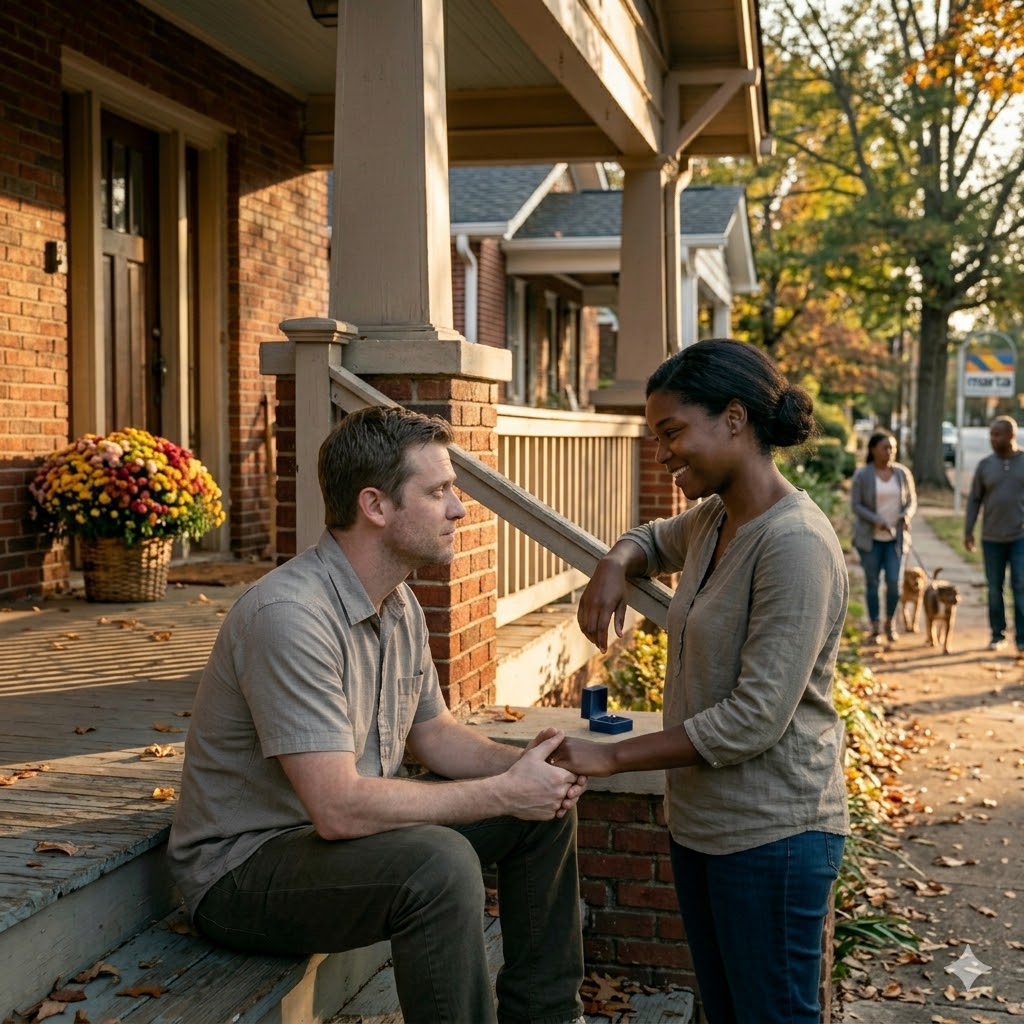
Ryan had bought a house of his own in West End, not Buckhead, not the mansion of his childhood, but a real house in a real Atlanta neighborhood where people walked their dogs in the evening and knew their neighbors’ names. He and Celeste were sitting on the back porch of that house on a Sunday evening in late October when he said he needed to ask her something.
She looked at him. He reached into the pocket of his jacket. “I’m not doing this big,” he said. “I’m not renting out a restaurant or hiring a photographer. I’ve had enough performance for one relationship.” She laughed, the real laugh, the one that came from somewhere unguarded. He opened a small navy blue box.
“I love you in the specific, ordinary, daily way that I think is the only kind that actually lasts,” he said. “You called me on every wrong thing I did and you came back anyway and you told me the truth even when it would have been easier not to. You are the best thing that happened during the worst idea I ever had.
” She was smiling, but her eyes were bright. “Celeste Harmon,” he said, “will you marry me?” She looked at the ring. She looked at him. “Yes,” she said. “Obviously, yes.” He put the ring on her finger. She leaned forward and put her forehead against his. They stayed like that for a moment, just two people on a porch in West End, Atlanta, warm with the October evening going cool around them and the city glittering faintly in the distance.
inside the house, Angela’s voice came through the screen door. “If she said yes, somebody better come tell me right now.” Ryan and Celeste both burst out laughing. “She said yes!” Ryan called back. Angela came through the door at speed, arms already open.