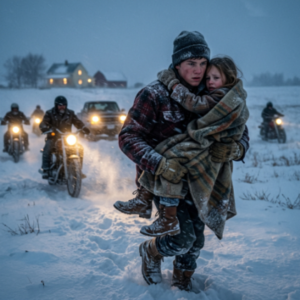
They Left Them in an Icy Creek But a Hell’s Angel Dove In Just Seconds Before It Was Too Late…
The kind of cold that kills doesn’t announce itself. It doesn’t howl or rage or warn you with thunder. It simply settles. Quiet, patient, absolute, like a judgment that has already been made. North Hollow Ridge in February was that kind of cold.
The pine trees stood like frozen sentinels, their branches bowed under the weight of ice. The road, what little remained visible of it, had dissolved into a seamless white nothing. No tire tracks, no footprints, no signs that any living thing had made a decision to be here. Only Cole Ryder had made that decision. And lately, Cole Ryder made a lot of decisions that other men wouldn’t.
He rode the way he always did, hunched low against the wind, jaw set, eyes reading the road like a language only he understood. His 2019 Road King was battles scarred and loud, the exhaust pipes breathing white fog into the frozen air. A black wool scarf covered the lower half of his face. His gloves were worn at the knuckles.
There was nothing glamorous about Cole in this moment. No leather vest with proud patches, no crew riding behind him. He had left that life two years ago after the accident on Highway 9 that took his younger brother Marcus. These days, Cole Rider rode alone, lived alone, and preferred it that way. He was heading to a storage unit in Fairchild to collect the last of Marcus’ things, a task he had been avoiding for 14 months.
His therapist, the one he saw exactly three times before stopping, had called it emotional avoidance. Cole had called it none of your business and not gone back. But today, he had finally forced himself to go. It was the kind of day that demanded something difficult of you. He was 2 mi past the hollow ridge mile marker when he heard it.
At first, he dismissed it. Wind does strange things in dense forest. It moves through branches at angles that make it sound almost human. Cole had heard what sounded like voices, laughter, crying in forests before. It was just physics, just nature playing games. But he slowed the bike anyway.
He sat there in the middle of the empty road, engine idling, listening. There it was again. Not wind, not animal, not physics. It was a child. Cole didn’t think that was the honest truth of it. There was no internal debate, no risk assessment, no moment where he weighed his own safety against the sound. He simply cut the engine, pulled the bike to the shoulder, and moved into the trees.
The slope behind the tree line dropped sharply, hidden by 2 ft of fresh snow. Cole found this out the hard way, sliding 6 ft down an embankment before catching himself on a pine trunk. His breath came in sharp bursts. The cold was immediate and personal down here, away from the windbreak of the road. It pressed against his face like a hand. He heard it more clearly now.
Not one voice, three low, exhausted sounds. The kind of crying that comes when a child has been crying so long that the sound has lost its urgency and becomes something mechanical. an instinct the body maintains even when hope is gone. He followed the sounds another 40 ft through the underbrush and then he stopped.
Before him was a shallow creek, normally perhaps 8 in deep, but the snow melt in the recent rain had swollen it to nearly 2 ft in the center. The water was moving fast, dark and cold and indifferent, and in the middle of it, wedged against a cluster of rocks and dead branches, was a baby carrier. industrial orange plastic, the kind sold in bulk, tethered to the rocks on both sides with zip ties. It had been placed there deliberately.
Inside the carrier, huddled against each other with the unconscious intelligence of young bodies seeking warmth were three toddlers. A girl, maybe 18 months, dark curly hair matted to her forehead. twin boys, slightly older, perhaps 2 years, their small faces the color of cold ash.
The water was at the level of the carrier’s base. Another hour, maybe less, and it would be inside. Cole stood at the edge of the creek for exactly 2 seconds. Then he walked in. The cold hit him like a wall. Even through his boots, through his jeans, the creek water was a physical shock. the kind that makes your lungs seize and your brain white out for a half second.
He waited to the center of the creek, the current pushing against his shins, and he reached the carrier. His fingers, already numbing, fumbled with the zip ties. They wouldn’t cut with bare hands. He pulled his keys from his jacket, used the edge of the house key like a blade, sawing at the thick plastic. His hands were shaking.
The little girl had opened her eyes and was staring at him with an expression that was somehow worse than crying. It was the expression of a child who has stopped expecting rescue and is simply waiting to see what happens next. “I’ve got you,” Cole said. His voice was strange to him, rough and low. “I’ve got all three of you.” The first zip tie snapped.
He moved to the second, fingers nearly useless now. It took longer. One of the twin boys made a sound, a small broken whimper, and Cole felt something shift in his chest that he hadn’t felt in 2 years. The second tie gave. He lifted the carrier with both arms, turned his back to the current to steady himself, and waited to the bank.
He set the carrier down on the snow, stripped his riding jacket without hesitation, and wrapped it around all three children, pulling them close to his body. They were alive, all three, but just barely. Cole’s phone showed one bar of signal, barely enough. He called 911 and gave his coordinates as best he could, then killed the call to preserve the battery. He carried the children, the carrier in his arms, the jacket bundled around them, back up the embankment to his bike. He couldn’t ride. He knew that.
Three toddlers, a frozen creek, and 9 miles to Fairchild’s nearest clinic. Instead, he sat on the ground beside his bike, back against the rear wheel, and held them against his chest. All three of them gathered inside the radius of his arms, sharing the last heat his body could produce. The twins had stopped whimpering. The girl had her small fist wrapped around the collar of his flannel shirt.
Cole sat in the snow, shaking now himself, and talked to them. He didn’t know why. He just talked. He told them about Marcus. He hadn’t talked about Marcus to anyone, not his mother, not the three visits to the therapist, not even to himself at night when the memory came.
But sitting in the snow with three strangers who couldn’t understand a word he said, it all came out. How Marcus had laughed too loud at everything. How he’d made breakfast for Cole every Sunday morning, even into their 30s. how the semi had come from the left and there had been no time, no warning, no version of events where it ended differently. He would have walked into that creek faster than me,” Cole said quietly.
“Marcus would have gone in running.” The little girl blinked at him. “Yeah,” Cole said. “He was better than me at almost everything.” 22 minutes later, the EMS unit reached the road above them. Two paramedics came down the embankment at a jog. They found Cole Ryder sitting in the snow, half frozen, holding three toddlers against his chest, all of them breathing.
The lead paramedic would later say in the official report that the children’s core temperatures had been low enough that another 30 to 45 minutes of exposure would have been unservivable. Cole had gotten there with 30 to 45 minutes to spare, not a moment more. North Hollow Ridge Memorial Hospital. 7:14 p.m.
Cole sat in a hallway chair with a thermal blanket around his shoulders and a cup of coffee he hadn’t touched. The three children were being assessed in rooms he wasn’t allowed into. A nurse had told him they were stable. He had nodded and stayed in his chair. Detective Lena Hol found him there 40 minutes later. She was a small woman with tired eyes and a notepad she held like a shield. She sat across from him without asking and looked at him for a long moment before speaking.
“You found them at approximately 2:40 p.m.” She said they were zip tied to rocks in a creek in February. “Yes. Tell me about the carrier. Was there anything else? Bag, clothing, anything left on the bank.” “Nothing,” Cole said. Whoever did it didn’t want them found. Lena wrote something down. Then she looked up. Mr.
Ryder, those children are Ava, Eli, and Noah Witmore. They belong to Preston and Diane Witmore of Clearfield Heights. Cole recognized the name in the way you recognize faces from news you’ve half watched vaguely uncomfortably. Preston Whitmore was a real estate developer, the kind of man whose name was on buildings and whose face appeared at charity gallas.
He and his wife Diane had been featured in a regional magazine the previous spring, a spread about their home, their philanthropy, their beautifully blended family. “Beautiful family,” Cole said flatly. Lena’s expression didn’t change. “Their nanny, a woman named Carla Nia, contacted us this afternoon.
She said she was fired this morning after she reported concerns about the children to the family’s private physician. She had documented 11 incidents over four months, bruising, missed meals, a fractured wrist on Eli that the family attributed to a fall. She paused. The physician never filed a report. The silence between them lasted a long time. The family reported the children missing at 6:00 p.m. Lena continued. 4 hours after you pulled them out of that creek.
Cole sat down the untouched coffee very carefully. They waited 4 hours. They reported the missing, Lena said, and the flatness in her voice told him everything about what she thought of that timeline. What happens now? Now, she said, we build a case, and I need you to stay in Fairchild for the next several days. You’re the only witness to the scene before it was disturbed.
Cole looked at the hallway at the door behind which three small people were being warmed and examined and for the first time in what he could only guess was a very long time cared for by people who had no reason to harm them. “I’m not going anywhere,” he said. What followed was not clean or simple or satisfying in the way the justice is supposed to be.
Preston Whitmore had lawyers, the kind that arrived before the arrest, the kind that carry briefcases that cost more than Cole’s bike. They challenged the chain of custody on the creek scene. They submitted affidavit from three physicians who described the children’s prior injuries as consistent with normal toddler activity. They hired a PR firm that issued a statement about the family’s devastation and full cooperation with authorities. The local newspaper ran the story on page 4. Cole testified twice.
He was precise, steady, and corroborating every detail he provided. He had taken photographs on his phone before the signal died. Photographs of the zip ties, the placement of the carrier, the water level. Those photographs became central to the prosecution’s case. Carla Mahia testified. Her 11 documented incidents, combined with medical records that the family’s physician had tried to destroy and failed because Carla had photographed them herself, formed a record that the family’s lawyers could not explain away. The physician lost his license. Preston Whitmore was charged
with three counts of felony child endangerment, conspiracy, and child abuse. Diane Whitmore, whose role the investigation determined was one of awareness without action, faced her own charges. The children, Ava, Eli, and Noah, were placed in emergency foster care. Cole was not involved in that process. He was not family.
He was not connected. He was simply the man who had been there. But on a Thursday afternoon in March, Detective Lena Hol called him. the foster family there with,” she said without preamble. “They’ve asked if you’d be willing to visit. Apparently, Ava won’t stop pointing at motorcycles on television.” Cole was quiet for a moment. “What time?” he said.
The foster home was small and warm and smelled like soup and clean laundry. Cole stood at the door in his cleanest jacket holding three small stuffed animals he had bought at a pharmacy, a bear, a rabbit, and something ambiguous that the woman at the counter had called a moon creature, and felt more nervous than he had at any point, including the creek.
The foster mother, a wide-armed woman named B, opened the door and looked at him with the particular expression of someone who already knows your whole story. They’ve been asking about the man from the snow, she said without preamble. Cole blinked. They can’t. They’re two. They were barely conscious. “Children,” Bet said, stepping back to let him in.
Remember more than we think. He heard them before he saw them. The unmistakable sound of small people in the middle of being completely alive, banging things, calling to each other, the percussion of tiny feet on hardwood. And then Ava came around the corner.
She stopped when she saw him, 18 months old, dark curls, enormous eyes. She looked at him with the same expression she had given him in the creek, that particular look of profound assessment that only very young children and very old people seem capable of. Then she walked to him slowly with great deliberateness, and she held up her arms. Cole Ryder, who had not cried at his brother’s funeral because he had not known how, who had ridden alone through 14 months of winter because it hurt less than standing still, crouched down in Beth’s hallway and picked up a child he had no claim to. And something in him,
something that had been frozen far longer than the creek, began slowly to thaw. The twins arrived at a run, colliding with his legs. He sat down on the floor, all three of them climbing over him, and he laughed. It was a strange sound, unfamiliar in his own throat, but it was real. In the weeks that followed, Cole returned every Thursday.
He brought nothing expensive, sometimes books, sometimes fruit from a roadside stand. Once, when the weather turned mild, he pushed all three of them in a stroller around the block. a six-foot leather jacketed man walking at toddler pace, earning exactly the looks from neighbors that you would expect. He didn’t care. He began talking to Marcus again, not in the dark, not with grief, but out loud, the way he might talk to someone in the next room, telling him things, asking him things, carrying him differently.
The case concluded in October. Preston Whitmore received eight years. Diane Whitmore, four, the physician 18 months and permanent disparment. Ava, Eli, and Noah were adopted together as a sibling group by a family in Dunore County whose application had been approved before Cole had known any of them existed. It was the right outcome. He knew that.
But on the last Thursday before the adoption was finalized, Bet let him take all three of them to a park. He sat on a bench while they discovered the sandbox with the intensity of scientists uncovering a new continent. He watched them and thought about Marcus and thought about the road and thought about what it means to live your life in forward motion without ever stopping to ask what you’re writing toward.
Ava walked back to the bench and handed him a fistful of sand. He accepted it like it was something precious because it was what this story carries within it. The world does not always make noise when children suffer. Abuse hides behind wealth, behind reputation, behind the silence of professionals who fear consequences more than they love truth.
This story asks us to look more carefully, not just at the dramatic rescues, but at the smaller signs we walk past every day. A nanny like Carla Mahia, who documented what she saw and spoke up even when it cost her everything, is as much a hero as the man who walked into the creek. Courage does not always arrive on a motorcycle.
Sometimes it arrives with a notepad and the willingness to be the person no one believes. Cole’s story also carries a quieter truth. That grief, when left alone in the dark, does not heal itself. It is the unexpected weight of other people’s need that sometimes calls us back into the world.
And the legal failure at the heart of this story, a physician who buried what he knew, a system that looked away, is not fiction. It is a pattern that child welfare organizations document every year. The children in our lives deserve adults who choose witness over convenience, truth over comfort, and action over silence. Regardless of whose name is on the building, if this story stirred something in you, share it.
One share might reach someone who needed to hear it today. Subscribe to Paths of Honor for stories that don’t look away from the truth. And leave a comment below about someone in your life who showed quiet courage when it mattered most. Paths of honor.