The Christmas Miracle 200 Bikers Created for a Girl Her Family Disowned
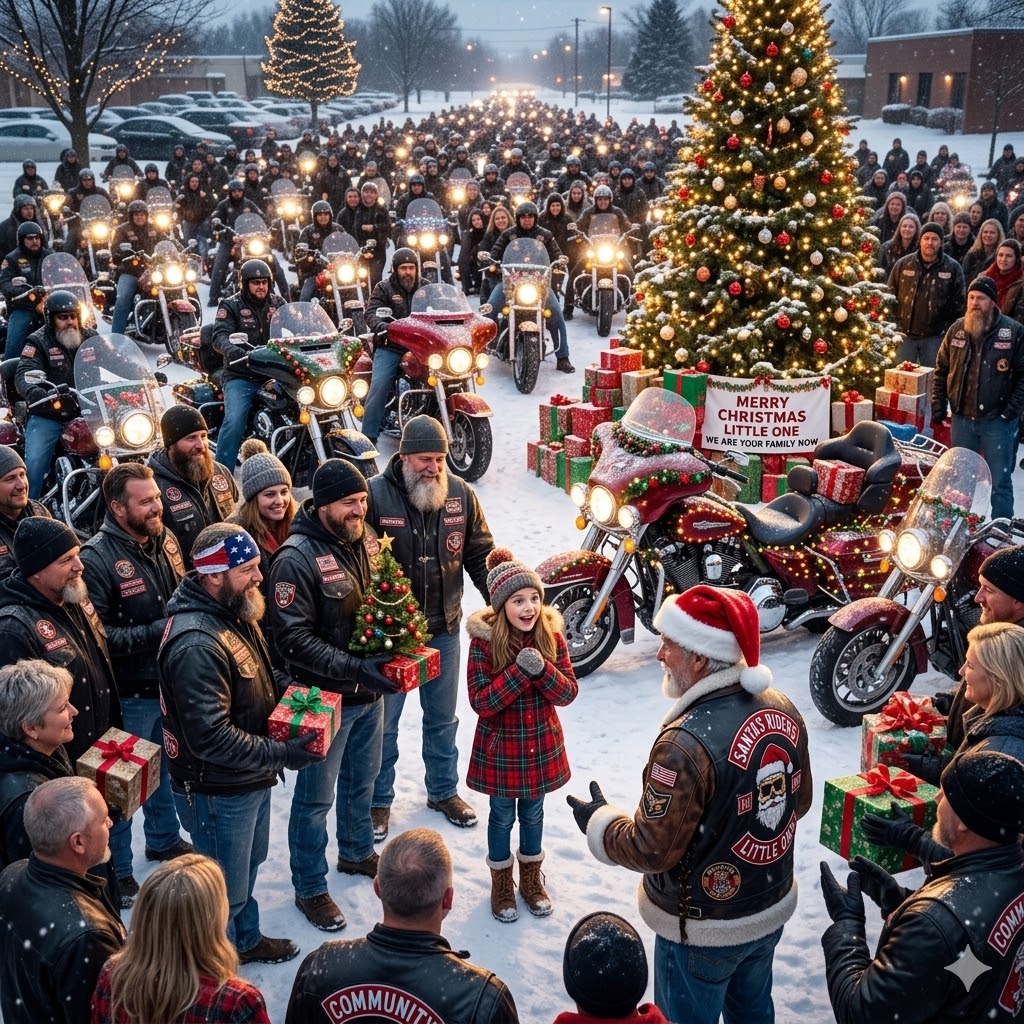
The snow had been falling since noon, and by Christmas Eve, it had buried Colorado’s little town of Milbrook under a silence so deep it felt holy. Every window glowed amber. Every chimney breathed smoke into the purple sky. From inside warm houses came the muffled music of carols, the clinking of glasses, the high-pitched laughter of children tearing open gifts they had circled in cataloges for months. It was the kind of night that made the world look kind.
But the world is not always what it looks like from a window. On the edge of Milbrook, near the old grain mill road, where street lights flickered and nobody much bothered to look, a small figure moved through the dark, slowly, unsteadily, leaving tiny footprints in the snow that the wind erased almost as quickly as they were made, as if even the earth was trying to pretend she had never existed.
She was 9 years old. She wore a thin white dress meant for indoors, no coat, no boots, only a pair of worn out shoes that had soaked through an hour ago. Her name was Lily Harper, and she was completely, terrifyingly alone. She did not cry. She had forgotten how. Or perhaps she had simply learned that crying changed nothing.
So she walked in silence, arms wrapped around herself, chin tucked against her chest, each breath coming out in a small white cloud that dissolved before it could become anything real. The cold was not just cold anymore. It had become something heavier, a weight pressing down from the sky, pressing in from every side, trying to fold her in half.
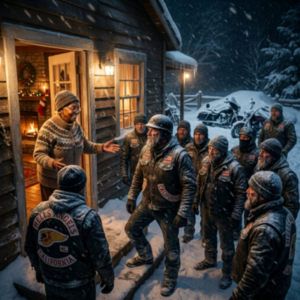
She stumbled once, caught herself on a mailbox, kept walking. She did not know where she was going. She only knew she could not stop. 3 mi away, in a converted warehouse on the south end of Milbrook, the Iron Brotherhood MC had claimed Christmas Eve the same way they claimed everything, loudly, warmly, and without asking anyone’s permission.
The place was decorated with a chaos only they could love. Strings of colored lights hung from exposed ceiling beams. A lopsided tree in the corner held ornaments that included a tiny motorcycle, a set of miniature handcuffs, and inexplicably a ceramic pineapple. Someone had put a Santa hat on the iron eagle above the door. There were 23 of them tonight. Big men with scarred hands and soft eyes.
Veterans, mechanics, fathers, a few who had once been none of those things and had come to brotherhood the long hard way. They grilled ribs. They played cards. They laughed the kind of laughter that doesn’t need a reason. At the center of it all sat Marcus Ghost Reyes, 52 years old, silver temples, a scar running from his left ear to his jaw, and the quietest voice in any room he entered.
Ghost had founded the Iron Brotherhood 11 years ago after losing his daughter in an accident he spent years trying not to blame himself for. The club had been his way of rebuilding. Not just himself, but something bigger, something that could hold people. Beside him was Danny Twostep Callaway, 38, red bearded, the kind of man who laughed first and asked questions later, but who also happened to be a licensed EMT and the most reliable person in the chapter when things went wrong.
And sitting near the door, nursing a cup of coffee and watching the snow through the small window, was Jake, 26, the newest member, still learning what it meant to belong somewhere. He had grown up in foster care and had a habit of watching exits that he was only just beginning to unlearn. It was Jake who heard it first. Not a knock, more like a sound the wind shouldn’t have made. a soft broken weight against the bottom of the door.
He set his coffee down slowly. “Hey,” he said to no one in particular. “Did anyone?” He was already moving toward the door. What Jake found when he opened the door would stay with him for the rest of his life. A little girl collapsed on the step.
dark hair matted with snow, lips the color of a sky before a storm, eyes halfopen and unfocused, looking up at him with an expression that wasn’t fear and wasn’t hope. It was something more exhausted than either. It was the face of someone who had stopped expecting anything at all. “Oh god,” Jake breathed. “Oh god, Marcus.” The room went quiet in the way that rooms do when something real enters them.
Ghost was across the floor in four steps. He crouched in the doorway, one hand already reaching for the child, voice instantly calm in the way that only people who have survived great grief know how to be calm. “I’ve got you,” he said. “Hey, I’ve got you. You’re okay.” Lily did not respond. Her body had made its decision. It had found a door and now it was done. Twostep was already there with a blanket. Someone turned down the music. Someone else added wood to the fire.
In 30 seconds, without a word being spoken, 23 men reorganized themselves entirely around one small unconscious girl. They carried her inside, wrapped her in two blankets, and laid her near the fireplace. Twostep checked her vitals with practice deficiency. Pulse weak, but present. Body temperature dangerously low. No visible injuries beyond the cold itself.
She’s hypothermic, he said quietly. We need to warm her slowly. No sudden heat. Should we call an ambulance? asked Jake. ghost looked at the girl’s face, the thin dress, the soaked shoes, the complete absence of any adult anywhere near her. “Call it,” he said, “and then someone find out who left a 9-year-old child alone in the snow on Christmas Eve.
” Lily woke up slowly, the way you wake from a dream when you’re not sure whether the dream was better. The fire was the first thing, the warmth on her face. Then the smell, oil and pine, and something cooking. Then the sounds, low voices, the occasional scrape of a chair, far off laughter.
She opened her eyes and saw the ceiling of a place she didn’t recognize, a Santa hat on an iron eagle, colored lights, the lopsided tree. She sat up quickly and immediately regretted it. Hey, hey, easy. Jake was beside her, not too close. voice careful. You’re safe. You’re okay.
Lily stared at him, then at the room, then at the large leather jacketed men who were all studiously pretending not to stare at her with the unconvincing concentration of people who were absolutely staring at her. Where? Her voice came out cracked and small. Milbrook South Warehouse. We’re the Iron Brotherhood. Jake paused. We’re uh we’re bikers, but the good kind mostly. He seemed to reconsider. We’re the kind that found you in the snow. Anyway, Ghost pulled a chair close and sat down.
He had removed his leather jacket and in a plain gray sweater, he looked less like the president of a motorcycle club and more like someone’s grandfather, which was in its own way exactly the right thing to look like. My name is Marcus, he said. Can you tell me your name? A long pause. Lily. Lily. Good name. He said it like he meant it.
Lily, we’ve called an ambulance just to make sure you’re all right. But while we wait, can you tell me where you live? We’d like to get you home. Something moved across her face. Not quite pain. Something older than pain. I don’t have a home, she said. The room, despite all efforts, went very still. I was staying with my aunt and uncle, she said it flatly.
The way children say things they have rehearsed because saying them with feeling costs too much. But they they put me outside. Ghost’s jaw tightened. He kept his voice level. On Christmas Eve? Yes. In a dress? Yes. He nodded slowly. Okay, he said. Okay, Lily, you’re not going back there tonight. I promise you that. It was Twostep who made her hot chocolate.
He appeared from the kitchen holding a mug that said world’s okayest biker and presented it with absurd ceremony like a butler in a very rough establishment. Lily almost smiled. Almost. She drank it slowly, both hands around the mug. And somewhere in that small action, the grip of cold fingers around something warm, she began very cautiously to believe that she was not still dreaming. Ghost did not pepper her with questions.
He simply sat nearby, present without being intrusive, letting the warmth and the noise of the room do its work. One by one, the other men found small ways to acknowledge her without overwhelming her. Someone set a plate of food near her without comment. Someone put on a Christmas movie volume low.
A large man named Bear, who in complete fairness looked exactly like his name, sat down on the floor several feet away and began building something out of wooden matches, because apparently that was his hobby, and the normaly of it was oddly soothing. It was Jake who finally asked. He sat across from her, coffee cup in hand, and said simply, “Do you want to talk about it?” Lily looked at him for a long moment.
I’ve been with my aunt and uncle since I was five, she said. Since my mom and dad, she paused. They died in a car accident. I don’t really remember them much anymore. I try to, but I can’t always. Jake nodded. He did not say he was sorry because she had heard that word so many times it had become hollow. He just listened.
My aunt and uncle, they have their own kids, two of them, and every Christmas they get things, and I sit and watch. She said this without accusation, which somehow made it worse. I’m not complaining. I know they didn’t have to take me in. You’re 9 years old, Jake said quietly. You don’t have to earn Christmas. She looked at him.
Something in her face shifted. Not breaking exactly, more like a wall developing a crack that let in light. Tonight, I asked if I could open just one gift. I didn’t even care what it was. I just, she stopped, looked at the fire. My uncle yelled, and my aunt said I was ungrateful.
And then the door was open and I was outside and it was, she glanced at the snow-covered window, cold. Ghost had been listening from across the room. He stood up slowly, walked to the tree in the corner, the lopsided one with the ceramic pineapple, and crouched in front of it. He reached behind it, and pulled out a box wrapped in brown paper. He carried it to Lily and placed it in her lap. She looked up at him.
“It was meant for a toy drive,” he said. “For kids who didn’t have gifts. Seems like we found the right kid after all.” Lily looked down at the box, her hands moved to the edges of the paper with the extreme concentrated delicacy of someone who has not opened a gift in a very long time and wants to make it last.
Inside was a stuffed bear, brown, soft, buttoneyed. She held it for a moment. Then she pressed her face into it, and for the first time that night, for possibly the first time in a very long time, Lily Harper cried. Not from sadness, from something she didn’t have a name for yet, relief, maybe, or the particular ache of kindness arriving after too long in absence.
Every man in that room found something extremely important to look at on the floor. The ambulance arrived at 9 and the paramedics cleared Lily. Her temperature had stabilized. No lasting damage done by the cold. But their presence also brought a police officer, a young deputy named Torres, who was clearly not thrilled about paperwork on Christmas Eve, but who understood his duty. He took Ghost aside while Twostep stayed with Lily. She says she was put out of the house, Torres said lowvoiced.
You know what that means? Child services tonight. Holiday skeleton crew. Best case she ends up in an emergency placement with a family she doesn’t know. I know what it means. Ghost said. Torres studied him. He had heard of the Iron Brotherhood. He’d never had a call involving them.
Not for anything bad, but reputation was reputation. You’re not thinking of keeping her here. I’m thinking, Ghost said carefully. that a 9-year-old girl who just survived hypothermia should not spend Christmas in a stranger’s house processed through a system when she could spend it somewhere warm with people who already know her name. Torres was quiet for a moment.
You have anyone here who’s licensed, foster certified? Anything? Ghost looked across the room to where Twostep was showing Lily something on his phone, probably pictures of his twins, and she was watching with wide, cautious eyes. “Make some calls,” Ghost said. “I’ll make some calls. We’ll do this right. But she doesn’t leave here tonight without someone she trusts.
” Torres looked at the room, at the lopsided tree, at Bear still building his match sculpture, at the Santa hat on the eagle. He looked at Lily, who was holding her stuffed bear with both arms and had almost almost smiled at something Twostep said. “I’ll make some calls,” Torres said.
What followed in the next hour was an act of collective determination that no one in the Iron Brotherhood had planned. And all of them simply did. The way you do things when they are obviously right. Ghost called his sister Angela, a licensed social worker in Denver who had fostered three children over the years and explained the situation in four sentences. She was in her car within 10 minutes.
It was Christmas Eve and she drove 2 hours without being asked twice. Twostep’s wife arrived with bags of food and a change of clothes that fit Lily almost perfectly. Their youngest daughter was nine, too, and Twostep had thought to ask.
Jake sat beside Lily and talked to her not about her situation, not about what would happen next, but about things. The name of Bear’s match sculpture. He called it The Eagle’s Dream and was very serious about this. Which Christmas movie was objectively the best? Jake said Home Alone, and Lily said she’d never seen it, and the room collectively gasped as if she had said something shocking. They put it on.
They sat together, 23 bikers and one small girl, and watched Kevin Mallister defend his house. And somewhere in the middle of it, Lily laughed. a real laugh surprised out of her. The kind that happens before you can decide whether to allow it. Ghost heard it from across the room and had to look away for a moment because it sounded like his daughter’s laugh.
It sounded like something he had been carrying the absence of for 11 years. And he understood sitting there in a converted warehouse hung with crooked Christmas lights that grief does not disappear. It transforms if you let it. If you build something around it that’s big enough to hold other people. When Angela arrived just after midnight, she did not look like a social worker.
She looked like someone’s aunt, which she was. She sat with Lily for a long time, just talking. And then she looked up at Ghost and nodded. She’ll stay with me tonight, Angela said, and for as long as it takes to sort out something real. Ghost crouched in front of Lily one last time. You’re going to be okay, he said.
You hear me? Not just tonight. We’re going to make sure of it. Lily looked at him with those careful eyes. the eyes of a child who had been disappointed so many times she had turned disappointment into a resting state and said something that went through every person in that room like a current. “Why are you helping me? You don’t even know me.
” Ghost was quiet for a moment. “We know you’re cold,” he said. “We know it’s Christmas. We know you deserve better than what tonight gave you.” He paused. That’s enough. That’s more than enough. Angela Harper, she insisted Lily could keep the name, began the process of formal fostering in January. It moved faster than these things usually move.
Partly because Torres filed his report with care and precision, and partly because Ghost knew people who knew people, and partly because the universe occasionally cooperates. By February, Lily had a bedroom with a window that looked out at the mountains. By March, she had started school, made two friends, and decided that she would like someday to become a doctor.
The Iron Brotherhood did not disappear from her life. They showed up appropriately in the careful way that people show up when they want to be present without being overwhelming. Angela brought Lily to the warehouse the following summer for a cookout, and the men who had sat with her on Christmas Eve greeted her like she was someone they had been waiting to see again, which they had been. Bear had finished his match sculpture.
He had named it the Eagle’s Dream and had placed it in a glass case. Beside it, on a small card in his large, careful handwriting, he had added a subtitle for the little girl who found her way to the light. Life lesson, educational and moral values. This story carries truths that go far deeper than its surface warmth.
At its heart, it is a story about what real community looks like. Not the kind that forms because people share a background or a name, but the kind that forms because people choose to see each other. Lily was invisible to the people who were supposed to love her. She became visible to the people who chose to see her. Strangers who had no obligation to care. That contrast is not accidental.
It is a reminder that family is not always defined by blood and belonging is not always found where we are told to look for it. The story also speaks honestly about the way the world misjudges people. The bikers are feared by reputation and gentle by nature and that tension asks us to examine our own assumptions before we make them permanent. For younger audiences, Lily’s courage is a quiet but essential lesson.
The act of walking toward a light when you have nothing left is itself a form of bravery. For adults, ghosts response to grief, transforming personal loss into communal purpose, models what healing in service of others can look like.
And in both Jake and Twostep and every man in that room, the story holds up ordinary human decency as the most extraordinary thing there is. Not grand gestures, not heroism, but the simple radical act of making space for someone who has run out of places to go. If this story reached something in you, if Lily’s quiet courage or the brotherhood’s unannounced kindness reminded you of something you believe about the world, then you are exactly who Paths of Honor was made for. This channel exists because stories like this one matter.
Because in a world that moves fast and forgets easily, we believe in slowing down long enough to feel something real and then carrying that feeling back into your own life. Subscribe to Paths of Honor if you haven’t already. Share this story with someone who needs to hear it tonight. Leave a comment telling us who in your life showed up for you when you least expected it.
Because every great story begins with someone deciding that another person’s pain is worth stopping for. And that decision, that simple human decision, is where honor lives. Paths of honor, stories that stay with you, values that guide you.