Little Girl Finds Biker Hanging Upside Down from a Tree What She Did Next Shocked Everyone
The morning Lena Carter saved a man’s life. She was looking for a blue butterfly. That was all she had set out to do. Find the morpho butterfly she had spotted from her bedroom window 3 days ago. The one with wings the color of a summer sky. The one her grandfather had told her existed, but that she had never believed until she saw it with her own eyes. She had her notebook. She had her pencil.
She had the small red compass her grandfather had pressed into her palm 3 months before he died. and she had his voice somewhere deep inside her chest, steady and warm, telling her what it had always told her. Panic is just energy that hasn’t found its purpose yet. Little Sparrow, you find the purpose, you’ll be fine.
Lena was 8 years old, small for her age, with dark braids that her mother tied every morning, and a habit of watching things very carefully before she decided what she thought about them. Her teachers called her quiet. Her classmates called her strange. Her grandfather had called her the sharpest mind he’d ever met, and he had been an army medic for 22 years, so she figured he had met quite a few. She wasn’t supposed to be this deep in the forest.
She knew that. But the butterfly had gone this way, and the path had seemed clear enough, and then the path had become less clear, and then it had disappeared entirely. And now Lena stood in a part of the Milhaven Forest she had never entered before, surrounded by old oak trees so tall their tops disappeared into the gray September sky, and a silence so complete it had its own weight. She checked her compass. North was that way. Home was north. She would go home in a few minutes.
But first she heard something. Not an animal, not wind, not the creek she could hear faintly somewhere to her left. A sound that was somewhere between a groan and a breath. Wet, painful, human. Lena stood very still. She looked toward the sound. Her heart was doing something loud inside her chest, but she breathed through it the way her grandfather had taught her. In for four counts, out for four counts.
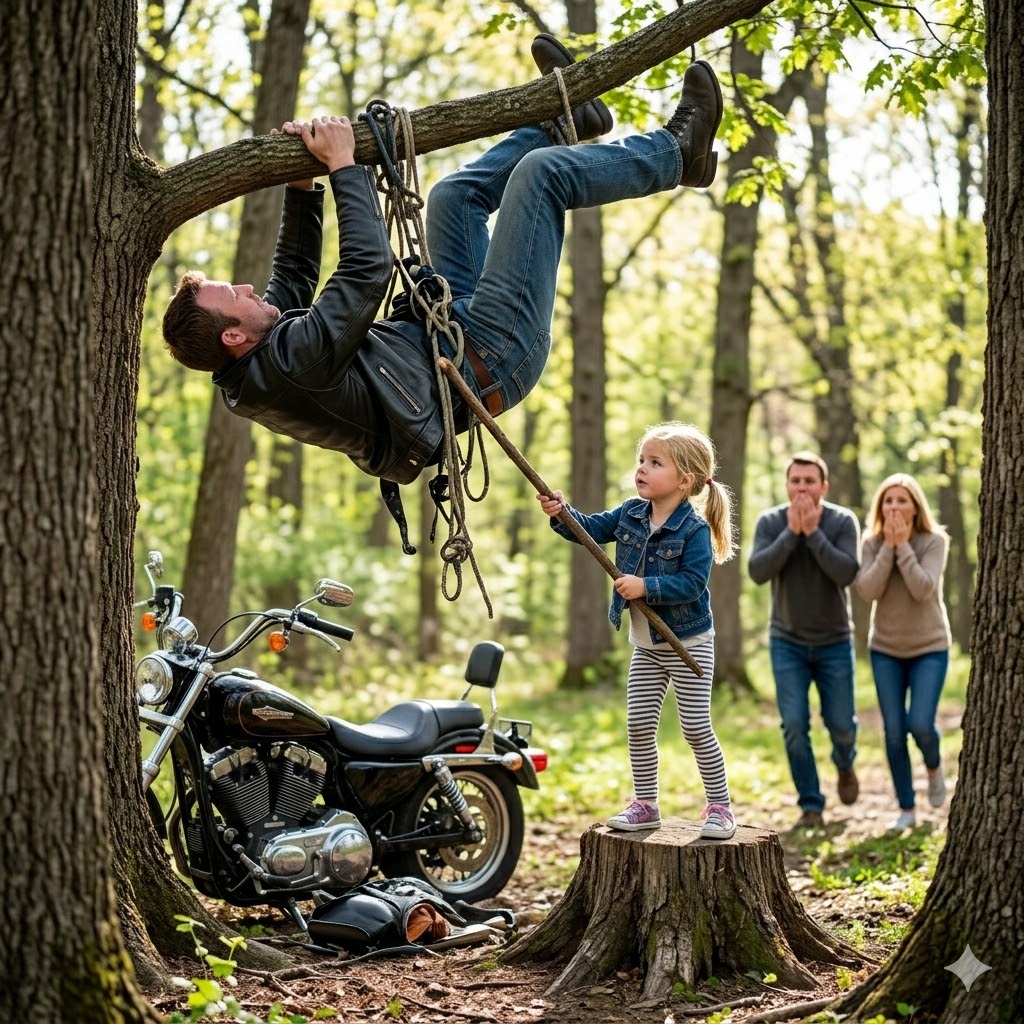
and she walked toward it because that was what you did when someone might need help. She found him 30 seconds later. He was the kind of man people cross the street to avoid, even hanging helplessly from a tree branch, even with his head slumped and his body exhausted. Marcus Webb looked dangerous. He was large, broad shoulders, thick arms, covered in tattoos that wound from his wrists all the way up and disappeared under a torn leather vest.
On the back of that vest, barely visible through the dirt and damage, was the patch of the Iron Brotherhood MC. His dark jeans were torn at the knees. His heavy boots barely touched the forest floor, just enough to keep his full weight from pulling his shoulders apart, but not enough to stand, not enough to rest.
His wrists were bound with thick rope above his head, looped over a heavy branch 8 ft off the ground. There was dried blood along his left temple, and fresh blood still seeping from a cut above his collarbone. His chest rose and fell, shallow, labored, but alive. Lena stood at the edge of the clearing and looked at him for a long, full moment. She did not scream. She did not run. She counted his breaths, maybe 12 per minute.
And she looked at the rope and she looked at the branch and she made a list in her mind the way her grandfather had taught her. What do you know? What do you need? What do you have? What must you do first? What she knew? The man needed his weight off that rope before his shoulders gave out. The rope was knotted at the base of the tree, low enough for a child to reach.
what she had. Her notebook, her pencil, her compass, and in the front pocket of her jacket, her grandfather’s small folding knife, the one she had used a hundred times on knots during those Sunday afternoon lessons on his porch. “Nots are conversations, Little Sparrow. You have to understand what they’re saying before you could answer back.
” She understood this knot. It was a cleat hitch, rushed and tight. She had untied dozens of them. Hello, she said because it seemed right to announce herself. The man’s head lifted, dark brown eyes, bloodshot, struggling to focus. His lips moved. Kid, kid, you need to run. The coming back.
Who is coming back? Lena asked, already moving toward the base of the tree. Already opening her grandfather’s knife. Two men. They did this. He coughed, wet, labored. Said they’d come back when it was dark. “Kid, please run.” “My name is Lena,” she said. “I’m going to get you down first, then we’ll talk about running.
” She started on the knot. The rope was thick and the knot was tight, and her hands were small, but Lena Carter had spent four summers learning to untie things. She worked with calm, methodical focus. The focus of someone who understood that panic cost time, and time was not something this man had to spare. While she worked, she talked to him.
What’s your name? Marcus. A pause. Marcus Webb. Okay, Marcus. Bend your knees a little. Take some weight off the rope. Yes, like that. Good. She felt the tension ease. Her fingers found the first loop. How old are you? Marcus asked, trying to stay conscious, trying to stay with her. Eight. She worked the second loop free.
My grandfather was an army medic. He taught me things. Your grandfather sounds like a good man. He was the best man I ever knew. The third loop came free. He died in March, but I still hear him. He tells me what to do. the rope released. Marcus dropped just a few inches, but his legs buckled and he went down onto his knees in the dirt.
For one terrible second, she thought she had hurt him. Then he made a sound that was both a groan and a laugh and said, “I’m okay. My hands.” She went to work on his wrists immediately. The rope had left deep raw marks on both. Can you feel your fingers? Starting to burns. That’s good. circulation is returning.
She opened her notebook and tore out several pages, folding them firmly. This isn’t a real bandage, but it’s pressure, and pressure is what counts right now. She wrapped his wrists and tied them with the cord from her jacket hood. Marcus Webb stared at her. There were tears on his face. She didn’t think he knew they were there.
“How do you know all this?” he whispered. “I told you,” she said simply. my grandfather. She helped him sit against the base of the tree. He was too weak to walk far. The swelling around his temple worried her. Possible concussion, she said quietly. Stay awake. Don’t close your eyes. Lena, his voice was very serious. How far are we from the road? She checked her compass.
Maybe 20 minutes north. I can’t make 20 minutes. Not yet. She nodded. Can you make five? Maybe. Then we move 5 minutes north. I find you cover. Then I run the rest of the way and get help. She looked at him. What time did they leave? Marcus looked at the sky. Maybe an hour ago. The light was still midday gold. They had time, but not as much as she wanted.
Okay, here’s what we’re going to do. She helped him to his feet. He leaned heavily on her shoulder. a large tattooed biker and a small eight-year-old girl moving together through ancient trees. She navigated by compass. He used the trunks for support when the ground allowed.
She kept him talking, name again, year, season, the way her grandfather had taught her to keep a concussed person conscious. She kept her voice level. She counted her steps. 4 minutes and 30 seconds from where they started, she found the hollow between two fallen logs, deep shadow, invisible from more than 10 ft away. Here, she said.
She helped him down and gave him the red compass to hold because her grandfather had once told her that giving people something to hold gave them something to hold on to. “Stay completely still,” she said. “Don’t make a sound. They’ll go to the tree first. By the time they figure out what happened, I’ll have help here, Lena. His voice broke. What if they see you? They won’t. She looked at him one last time.
A big, dangerous looking biker who was frightened for her, not for himself. That made her trust him completely. Don’t fall asleep, she said. I’ll be back soon. And she ran. She ran the way she had learned, not crashing through undergrowth, but flowing around it.
Feet finding soft places between roots, body low when branches were low, breathing through her nose, always north. She heard them before she saw them. Two voices coming from the east, parallel to her path. She dropped flat behind a wide oak and pressed herself into the earth. She heard boots on dead leaves. One of them laughed. She waited until the sound was fully gone. Then 20 seconds more.
Then she ran again. She hit the forest road at a dead sprint and screamed for help with everything she had. The third car that passed was a woman named Diane who pulled over immediately when she saw the small girl with the dark braids and the absolute certainty in her 8-year-old voice.
There’s a man hurt in the forest, she said. And two men who hurt him are going back. Call the police right now. I know exactly where he is. Diane called the police. Lena gave them the exact route, precise, ordered, without anything extra, just the way her grandfather had taught her. Marcus Webb was exactly where she had left him. Quiet in the hollow, the red compass pressed between both bandaged hands, eyes open, alive.
The two men were found at the tree 20 minutes later, confused when they found nothing but a severed rope. The police had been waiting for them. Lena sat on the back bumper of the ambulance and watched the paramedic’s work. She held her grandfather’s compass, the paramedic had gently returned it, and she didn’t cry until Diane put a blanket around her shoulders and said, “You did good, sweetheart. You did real good.” Then she cried, not from fear, not from relief, but from something she couldn’t name yet.
Something that had been pressing against the inside of her chest since March, since the day she stood at her graveside and felt the silence where his voice used to be. She cried, then she stopped. Then she looked at the compass in her hands. Panic is just energy that hasn’t found its purpose yet, Little Sparrow.
She had found the purpose. 3 weeks later, a Harley-Davidson rolled slowly down Lena’s street and stopped in front of her house. Marcus Webb stepped off the bike, moving carefully, wrists still healing. He had left the Iron Brotherhood patch behind. In its place was a simple leather vest, clean and unadorned.
He carried a box of pastries and wore the expression of a man who had reconsidered everything he thought he knew about the world. He talked to her mother for a long time. Lena sat at the kitchen table and listened.
When he was done, he sat across from her, elbows on the table, the way adults do when they want to talk to you as an equal, and said, “I want you to know something. I’m not a man who cries very often.” But I cried in that hollow because I had given up. I had decided I was done. And then you showed up. Lena considered this. “You told me to run,” she said. I know that was a kind thing to do even when you were the one who needed saving.
Marcus looked at her for a long moment. Then he nodded slowly as if something had settled into place. Your grandfather, he said, “Tell me about him.” So she did. She told him about the compass and the knots and the Sunday afternoons and the voice that lived between her ribs. She told him about the blue butterfly that had led her so deep into the forest.
She told him what her grandfather had said about panic being energy without purpose. Marcus Webb listened to every word. When she finished, he was quiet. Then he gave you everything he knew. Everything that mattered. “Yes,” Lena said. “And you used it?” “Yes.” He reached across the table and shook her hand firmly, properly. The way you shake hands with someone you respect, not a child’s handshake, an equals.
Thank you, Lena Carter, he said. She shook back. The lesson within the story. This story is a testament to the power of intentional love. That the greatest inheritance a person can leave is not money or property, but knowledge, calm, and the belief that you are capable. Lena’s grandfather invested in her quietly, patiently, week after week, teaching her not just skills, but a way of meeting difficulty with breath, with thought, and with purpose.
She was 8 years old, alone in a forest, facing something that would have broken many adults. And she did not break because someone had spent years making sure she wouldn’t. The question this story leaves behind is not what would you do in a crisis, but what are you giving the children around you right now before the crisis comes? If this story moved something in you, you’re exactly where you belong.
Subscribe to Paths of Honor, where courage wears quiet faces and the smallest people carry the largest hearts. Share this story with someone who needs to believe in human goodness today. Paths of honor, stories that stay with you.