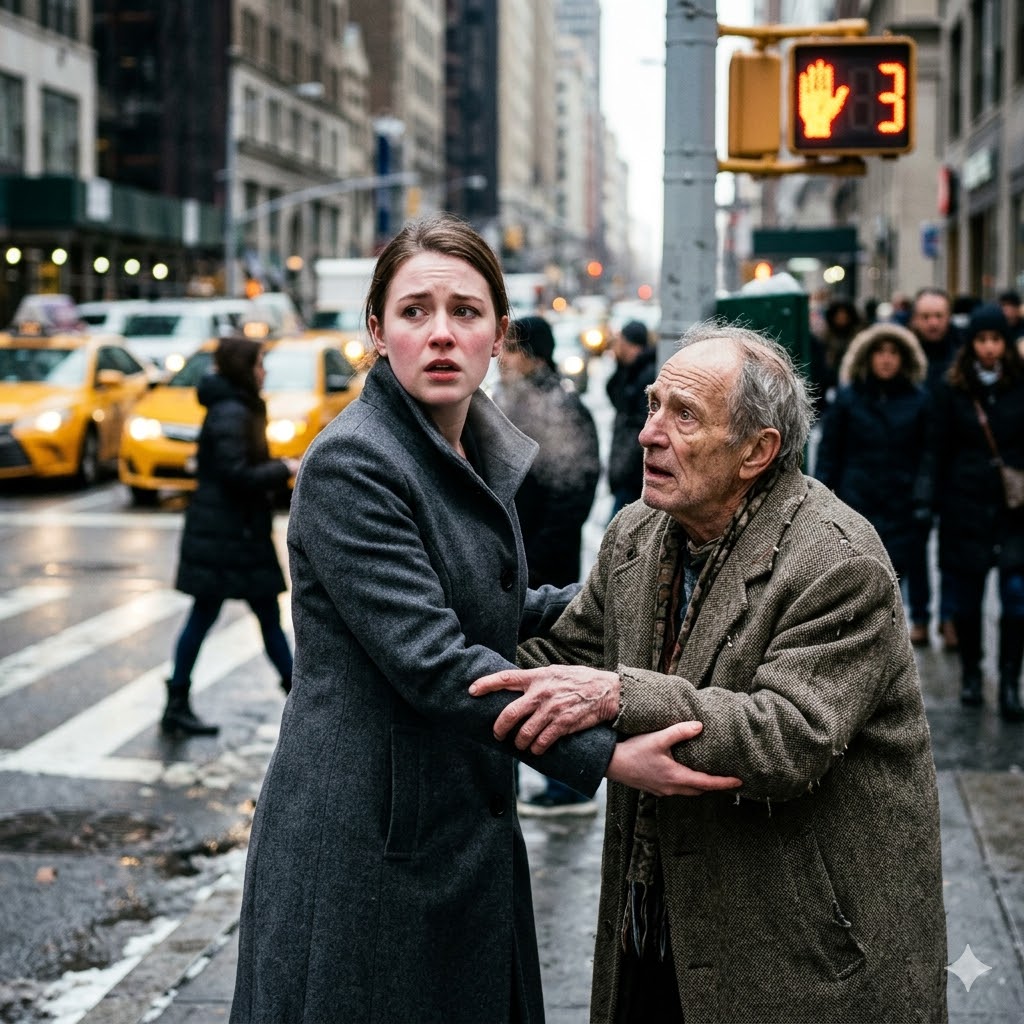
The young intern was late for a meeting, but an old man asked for help crossing the street. She had no idea who he was. The freezing winter wind howled through the towering glass canyons of Manhattan. It was exactly 8:53 in the morning. At the intersection of Fifth Avenue and 42nd Street, the city was a relentless blur of yellow cabs, screaming sirens, and rushing corporate suits.
The avenue seemed utterly indifferent to the overwhelming panic rising in a young woman’s chest. Sarah, a finance intern, is on her final day of her trial period to determine her permanent position. Above her, the pedestrian crosswalk sign began its unforgiving digital countdown. 12 11 10 Sarah stood at the very edge of the curb.
She was breathing heavily, her chest rising and falling in sharp, erratic rhythms. Her fingers gripped her smartphone so tightly that her knuckles turned a pale white. She stared at the glowing screen. The notification stared right back at her, making her stomach drop into an endless void. Eight missed calls.
Miller, she was supposed to be inside the Vanguard company building right now. She was supposed to be setting up the presentation that would define her entire career. Instead, she was stuck out here on the freezing concrete. This morning, she overslept because she stayed up too late last night editing the report and was feeling anxious preparing for today’s presentation.
To make matters worse, a pale brown coffee stain ruined the crisp collar of her only professional white shirt. She did not have the time to go back. She certainly did not have the money to buy a new one. Sarah did not cry. She did not panic. She reached into her heavy coat pocket and pulled out a plain white adhesive band-aid.
With a swift, aggressive motion, she peeled off the backing and slapped the bandage directly over the coffee stain on her collar. It was not perfect. It looked slightly absurd, but it covered the mess. It made her look like she was in control. She was a survivor. You had to be if you wanted to make it in this city. The crosswalk timer hit 8 seconds.
Sarah shifted her weight to her toes, ready to sprint the moment the traffic cleared. Suddenly, a freezing, trembling hand clamped down on her wrist. Sarah gasped and spun around. Standing right beside her was an old man. He looked to be well over 70 years old. His eyes did not focus on her.
They were cloudy, darting around the intersection in sheer terror. He looked completely disoriented, visibly overwhelmed by the deafening roar of the morning traffic. His grip on her wrist was desperately tight, like a man holding on to a lifeline. Could you? The old man’s voice was incredibly fragile, almost swallowed entirely by the noise of the street.
Could you help me cross? He pointed a shaking, frail finger toward the opposite side of the avenue. I just wanted to go over there to buy flowers for my wife. Sarah snapped her gaze down to her wristwatch. It was 8:54. Her heart hammered violently against her ribs. If she did not run right this exact second, she would be late.
She would miss the pitch. She stared at the old man’s fragile hand gripping her coat. And then for one agonizing silent second, a cold and ruthless thought flashed through her mind. I have waited 4 years for this opportunity. What if I just let go of his hand right now? What if I just run? It was a dark thought, an incredibly selfish thought.
But she was not a villain. She was simply a human being who was terrified of failing. Her family back home was drowning in debt. The rent for her tiny apartment was 3 weeks past due. If Vanguard company did not hire her today, she was finished. She would have to pack her bags, leave New York, and admit total defeat.
This was not just a good opportunity. This was her only way out. The digital timer above them ticked down relentlessly. 5 4 3 No one would judge her if she ran. No one would even notice. Sarah stared into the old man’s cloudy, desperate eyes. She closed her eyes for a fraction of a second and ground her teeth together.
The survival instinct begged her to leave. Her conscience, however, anchored her feet to the pavement. “Okay.” Sarah finally spoke. Her voice was tense, strained, and laced with rising panic. “Okay, but we need to move now.” She did not let go. Instead, she adjusted her grip, wrapping her hand firmly and protectively around the old man’s arm.
Sarah stepped off the curb and descended into the chaotic street. She knew exactly what she was doing. As the cold wind hit her face, she knew with absolute certainty that she had just made the most important morning of her life infinitely harder. The asphalt of the crosswalk feels like an endless freezing ocean.
They are only halfway across the white zebra stripes. Arthur’s steps are microscopic. He shuffles his worn leather shoes forward, one agonizing inch at a time. His grip on Sarah’s sleeve is heavy, pulling her down like a physical anchor. Sarah’s eyes dart frantically away from him. She stares at the towering glass facade of the vanguard company building across the avenue.
The morning sun reflects off the revolving doors. It is right there, just 50 yards away. But at this speed, it feels like a 100 miles. Her breath hitches. The cold wind bites at her cheeks, yet a cold sweat trickles down her spine. “Please,” Sarah whispers. Her voice shakes. It is thick with suppressed panic, begging both the old man and the universe itself.
“Please, sir, I am betting my entire month’s rent on these next 5 minutes.” Arthur does not reply. He doesn’t seem to hear her over the roar of the city. He only grips her arm tighter, staring blankly at the ground. Then the pedestrian countdown hits zero. The light blinks solid red. The avenue immediately erupts into chaos. The traffic light snaps to green.
A chorus of deafening engines roars to life. A battered yellow taxi cab surges forward from the front of the line. The tires screech against the pavement as the driver slams on the brakes. The massive metal grill of the car halts mere inches from Arthur’s fragile knees. The harsh smell of exhaust fumes chokes the freezing air.
The taxi driver violently rolls down his window. He is a heavy set man. His face flushed bright red with morning rush hour rage. Hey, move it. The driver barks, waving his arm aggressively out the window. I don’t have all day. Get out of the road. Sarah flinches. Her heart hammers violently against her ribs.
She forces herself to stand tall. She tries to manage the crisis just like she was trained to do in the corporate world. Your horn isn’t helping him walk any faster. Sarah calls back. She forces a soft pleading tone trying to deescalate. It’s only making him more scared. Please just give us a little space. The driver scoffs loudly.
He does not care about space. He cares about the ticking meter on his dashboard. He slams the heel of his hand heavily against the steering wheel. A long, deafening, continuous blast of the horn rips through the intersection. The sound is agonizing. It feels like a physical blow. Arthur gasps. His entire frail body jolts backward.
He freezes completely, paralyzed by the sheer volume and the aggressive machine bearing down on him. His hands shake violently against Sarah’s arm. He cannot take another step. In that exact second, Sarah’s phone vibrates aggressively in her pocket. She pulls it out with a trembling hand. The screen lights up with a harsh glare.
Three new missed calls. The presentation is starting. She is officially late. Something deep inside. Sarah shatters. The fragile thread holding her anxiety together completely snaps. The crushing weight of her family’s debt. The fear of eviction. The utter humiliation of failing before she even walks into the boardroom. It all twists together.
But it does not turn into sadness. It turns into something hot, ugly, and furious. She is not trying to be a noble hero saving a helpless old man. She is a young woman pushed to the absolute breaking point. She desperately needs a target to unleash her terror. Sarah rips her arm away from Arthur. She steps fiercely in front of him.
She places her own body directly between the terrified old man and the taxis bumper. She raises her glowing smartphone high in the air. She points the camera lens squarely at the driver’s face, holding it steady like a loaded weapon. Sarah snars. Her voice is no longer pleading. It is ice cold and razor sharp.
Taking a picture of your license plate and posting it online is a lot easier than standing here arguing with you. The sheer unhinged intensity in her eyes makes the driver freeze. He is looking at a woman who has absolutely nothing left to lose. He mutters a string of curses under his breath, but he takes his hand off the horn. He shifts the car into reverse and backs up a few feet. Sarah turns around.
She grabs Arthur’s arm with a sudden forceful grip. Let’s go. She hisses through her teeth. They stumble the rest of the way across the avenue. Finally, Arthur’s shoes hit the safety of the concrete sidewalk. The very second they are safe, Sarah lets go of him. The anger instantly evaporates. The terrifying reality of her ruined morning crashes back down on her shoulders.
Are you okay? She gasps, her chest heaving. She doesn’t even look at his face. She doesn’t wait for him to answer. Sarah turns her back on the old man and sprints blindly toward the towering glass doors of Vanguard Company. The heavy glass doors of Vanguard and Company hissed open, sealing out the chaotic, unforgiving roar of Manhattan.
Suddenly, the world became a sterile, crushing vacuum of silence. The lobby was a cathedral of polished black marble and floor to ceiling windows that looked out over the city Sarah was currently losing. It felt like stepping into a massive, expensive refrigerator. The air was thin, smelling of high-end floor wax, cold coffee, and filtered oxygen.
Sarah’s heels clicked loudly against the stone floor. Click, click, click. The sound echoed upward into the high, cold ceilings, announcing her failure to the entire building. She reached the elevator bank. Her finger jabbed the up button three times hard, as if the force could make the machinery move faster.
Come on. Come on. she whispered, her eyes darting to the digital clock above the doors. 8:59 a.m. The doors slid open. She stepped inside the stainless steel box. It was empty. Sarah turned to face the mirrored back wall. She recoiled at her own reflection. Her face was flushed a blotchy red from the windchill and the frantic sprint through the traffic.
Her hair was a windswept mess, sticking to her damp forehead, and the white band-aid on her collar, the one she had desperately used to hide the coffee stain, was peeling at the edges. It hung crookedly, looking pathetic and unprofessional. It was a cheap, desperate fix for a life that felt like it was crumbling in real time. She reached up with trembling fingers, pressing the adhesive back down, trying to straighten it with shaking hands.
You look like a disaster, she hissed at the girl in the mirror. Get it together now. The elevator chimed. Floor 45. The doors open to a hallway of thick sound dampening carpet and muted expensive lighting. Sarah ran. She didn’t care about looking professional or composed anymore. She just needed to be in that room.
She reached the massive frosted glass doors of conference room B. Through the glass, she could see shifting shadows of the board members. The blue light of a projector screen flickered against the walls like a warning. The presentation had already started. She grabbed the heavy silver handle. She took one deep ragged breath, trying to steady her racing heart.
She pushed. The door opened with a soft, heavy sigh. Every head in the room turned at once. The blue light of the projector bathed the faces of 12 senior analysts. They looked like statues carved from ice, silent, cold, judging. At the head of the long mahogany table sat Miller. He didn’t move. He didn’t even blink.
He just stared at her over the rim of his glasses, his face an unreadable mask of corporate indifference. The silence lasted an eternity. You’re late, Miller said. His voice wasn’t angry. anger would have been human. His voice was surgical. It was the sound of a final verdict being read in a hollow, empty courtroom. Mr. Miller, I am so sorry.
Sarah started, her voice cracking under the pressure. She stepped into the room, her hands shaking as she clutched her laptop like a shield. There was an emergency on the street. An old man. He needed help crossing. Sara Miller cut her off without raising his voice. He didn’t even look away from the projected screen.
There is always a reason, he said, his tone flat and final. The world is full of reasons, but Vanguard does not pay for reasons. We pay for results, and results require being in the room when the clock strikes 9. I have the data, Sarah pressed, her voice rising in desperation. I can start right now. I prepared the entire emerging markets analysis myself.
Sit down, Miller commanded. It wasn’t an invitation. It was an order given to a disobedient pet. But I am supposed to lead this section, she whispered, her face burning with shame. Sit down. Sarah sank into a chair at the back. She felt small. On the screen, Marcus stood up and smoothed his tie.
He didn’t even look at her. He clicked the remote and Sarah’s work filled the screen. Her research, her hours of grueling labor. Marcus used her words, highlighting her findings as if he had discovered them himself. Sarah looked down at the band-aid on her collar. It was peeling again. The corporate machine was moving.
It was efficient. It was fast. It didn’t care about the girl who stopped to help an old man cross the street. She looked at the final chart. It didn’t belong to her anymore. The meeting ends. The room empties. Sarah stands alone in the hallway, clutching her laptop. Her hands are ice cold. Sarah, a word.
Miller is standing by the floor to ceiling window. He doesn’t look at her. He looks at the skyline. Sarah walks over her heart throat high. Mr. Miller about the presentation. I can explain the strategy for stop. Miller says. He finally turns. His face is a blank wall. This isn’t going to work. Sarah freezes. I I don’t understand. It’s simple.
Miller’s voice is quiet, devoid of any anger. Vanguard is an elite machine. We don’t have room for people who get distracted by the noise on the street. Today it was an old man. Tomorrow it will be something else. It was 15 minutes. Sarah whispers. My work was perfect. You used my data. Marcus used the data.
Miller corrects her. Marcus was here. You weren’t. Go to HR. Your belongings will be couriered to your apartment by 5. You’re firing me. I’m ending an error. Miller says. He turns his back. Goodbye, Sarah. He walks away. No shouting, no drama. Just a door closing forever. Sarah walks toward the elevators.
She passes the wall of excellence, a massive marble slab engraved with the names of the firm’s top earners. Success, power, perfection. She stops. She looks at her reflection in the polished stone. The band-aid on her collar has finally fallen off, revealing the ugly brown coffee stain. “You’re an idiot, Sarah,” she mutters to herself. Her voice is a dry rasp.
Kindness doesn’t pay the rent. She isn’t a victim of the system. She is a victim of her own choice. She steps out of the revolving doors. The Manhattan wind hits her sharper than before. She doesn’t cry. There is no energy left for tears. She just stands on the sidewalk feeling completely empty. The city keeps moving.
The taxis keep honking. She is just another person who didn’t make it. Sarah sits at a rusted metal table outside a cheap corner diner. Across the avenue, the Vanguard building looms like a giant glass tombstone. Her open folder lies on the table. The brilliant charts, the flawless resin. All of it is just useless paper now.
The icy wind bites at her cheeks, but she feels completely numb. A shadow falls over her table. Sarah slowly looks up. It is him, the old man, Arthur. He is still shivering in his oversized coat. In his trembling hands, he clutches a single wilted red rose. The petals are bruised, turning black at the edges. You found your flowers, Sarah says.
Her voice is hollow. Exhausted. There is no anger left to give. Arthur looks at her. His cloudy eyes seem a little clearer now, anchoring onto her face. May I sit?” he asks quietly. Sarah nods. “What does it matter now?” Arthur lowers himself into the metal chair. It screeches against the pavement.
He places the dying rose incredibly carefully on the table between them. “I didn’t buy it,” Arthur murmurs. He points a shaky finger toward a small concrete park across the street. “I picked it from the bush near the corner bench.” Sarah frowns. Her tired mind tries to process his words. That bench is where I met my Evelyn, Arthur says softly.
He gently touches a bruised petal. 50 years ago today, she is gone now, but I go back to that bench every year. It is her grave to me, the only one I can reach in this loud city. Sarah stops breathing for a second. She stares at the old man. She didn’t just help a confused pedestrian run an errand. She helped a grieving husband keep his final sacred promise to a ghost. Arthur talks.
He doesn’t talk about money or efficiency. He talks about Evelyn. He talks about the brutal sacrifices they made and how in the end the only currency that mattered was time. I am so sorry I made you late, little flower, Arthur says. His voice trembles with genuine guilt. Sarah looks back at the vanguard building.
the elite machine that just threw her away without a second thought. Then she looks at the broken man sitting in front of her. The anger evaporates. It is replaced by the crushing, absurd irony of life. Sarah lets out a dry, jagged laugh. She reaches into her canvas bag and pulls out a cheap plastic wrapped egg salad sandwich.
It was supposed to be her celebratory lunch. Now it is just survival. She rips the plastic open. She tears the sandwich exactly in half. Don’t apologize, Arthur, Sarah says. A tired, cynical smile tugs at the corner of her mouth. It is a dark, bitter humor, the kind you only find at rock bottom. I just lost my job, she says, sliding half the sandwich across the metal table toward him.
So, I guess we are sharing the last lunch of a professional. Arthur looks at the squashed bread. He looks at the fierce, broken girl, offering him her only meal. He reaches out with both hands and takes it. “Thank you, little flower,” Arthur says. A gentle, knowing warmth suddenly fills his eyes. “This world, it moves far too fast for old men like me.
” Sarah picks up her half of the sandwich. She stares at the relentless city traffic, tearing down the avenue. It moves too fast for all of us,” she whispers. They sit in silence. Two outcasts eating a cheap lunch on a freezing sidewalk while the corporate world races on without them. Mr.
Miller stands before the floor to ceiling window, a glass of wine in his hand, looking down at the stream of traffic like ants beneath his feet. He has just wrapped up a high performance morning. One intern eliminated, one project handed over. Everything perfectly according to procedure. Suddenly, the phone on his desk vibrates violently. Miller frowns.
It is the secure line reserved exclusively for the board of directors. He sets his wine glass down and hurriedly picks up the receiver. Miller speaking. On the other end is the voice of the head secretary, trembling. Sir, the firm’s largest anonymous shareholder is in the building. He is coming up to your office right now.
Miller shoots up from his chair. Cold sweat beads on his forehead. What? Why wasn’t I notified? Who is he? We don’t know. He hasn’t appeared in 10 years. Click. The heavy oak doors of the office swing wide open. Miller holds his breath. He straightens his tie, forcing his most professional smile, but the smile freezes instantly on his lips.
A man steps inside. Gone is the tattered old coat. Gone is the trembling, fearful demeanor. He is wearing a customtailored gray suit, perfectly crisp. His polished leather shoes strike the marble floor with steely, commanding beats. But those eyes, the cloudy eyes, are now as sharp as a hawks.
Miller stammers, taking a step back. You You’re the man from the intersection this morning. The old man does not look at Miller. He walks straight to the chairman’s seat and sits down with absolute authority. His private driver stands rigidly behind him. “My name is Arthur Vanguard,” the old man says. His voice is low, full of power, echoing throughout the massive room.
Miller slumps against the edge of the desk, his face completely drained of blood. Mr. Vanguard, I I didn’t know. I was only protecting the company’s discipline. Arthur raises a hand, cutting him off. He stares intently at Miller, his gaze piercing right through the man’s flashy facade. This morning’s termination list. Arthur orders, “Give it to me.
” Miller frantically opens his computer and prints out a sheet of paper. His hands are shaking so badly that the paper rustles loudly. Arthur takes it, his eyes skimming over the name Sarah, marked with a stark red line. He leans back in the chair, looking out at the spinning New York skyline outside. “Skills can be taught,” Miller, Arthur says slowly.
“But a spine cannot.” He pauses, his gaze shifting to the wilted rose he has carefully placed in the breast pocket of his suit. “This world is running too fast, and I am looking for someone. someone who knows how to stop when everyone else chooses to rush by. Arthur taps his finger lightly on Sarah’s name on the list. Call her back here immediately.
Sarah walks down the silent carpeted hallway of the 50th floor. Her cardboard box is in her arms. She was called back up here for one final humiliation. Signing her official termination papers. She reaches the heavy oak doors of the executive boardroom. She takes a deep ragged breath. She pushes them open.
The room is massive. 12 senior board members sit around a sprawling mahogany table. The air is thick, suffocating, but no one is looking at the projector screen. Everyone is staring at the head of the table. Sarah freezes. The box nearly slips from her grip. Sitting in the chairman’s seat, the absolute throne of Vanguard and Company, is the old man from the crosswalk.
He is not wearing the tattered coat. He is wearing a custom-tailored charcoal suit. His posture is rigid. His cloudy eyes are now sharp, commanding, and fixed directly on her. Standing right beside him is Miller. Miller is no longer the cold surgical executioner from this morning. His face is the color of ash. A visible bead of sweat rolls down his temple, soaking into his expensive collar.
“Come in, Sarah,” the old man says. His voice is deep, echoing with absolute authority. Sarah steps forward, her mind spinning. Arr. Arthur Vanguard. He corrects gently. Please step forward. Arthur turns his piercing gaze slowly toward Miller. The temperature in the room seems to drop 10°. Miller, Arthur says, his voice dangerously low.
Explain it to me again. Tell the board exactly why you terminated this young woman. Miller swallows hard. His hands are trembling violently against the edge of the table. Sir, Vanguard protocol is strict. She was late to the most critical pitch of the quarter. We operate on pure efficiency. We cannot afford distractions.
Distractions? Arthur repeats the word as if it is poison. Have you heard her explanation yet? He asked the question with a more reproachful tone than one of skepticism. He stands up. The entire board seems to shrink back into their heavy leather chairs. A human life, Arthur says, his voice rising, cutting through the silence, is not a distraction.
I stood outside my own building this morning. I watched hundreds of our efficient employees rush past me. They looked right through me like I was a ghost. Arthur points a steady, furious finger at Miller. You have built a machine here, Miller. A cold, ruthless machine. You fire the one person who stops to help and you reward the ones who blindly run the rat race.
That is not the vanguard I built. Miller opens his mouth to speak, but no sound comes out. He looks down at his polished shoes, completely destroyed. Arthur turns away from him. He walks around the massive table and stops right in front of Sarah. He looks at her stained collar where the band-aid used to be.
He looks at her exhausted, battleworn eyes. Mr. Vanguard. I Sarah starts her voice shaking. Quiet, Arthur says softly. He turns to his head secretary standing rigidly by the door. Tear up her termination papers, Arthur commands. Sarah is no longer an intern. As of this exact second, she is my new strategic assistant. She reports directly to me.
Set up her office on this floor. Gasps ripple through the boardroom. Miller looks like he might faint. It is an impossible leap. A junior intern bypassing a decade of corporate climbing in 10 seconds. Sarah stares at him, utterly paralyzed. Because I helped you cross the street. Arthur shakes his head.
He steps closer, lowering his voice so only she can hear the absolute truth. I am not hiring you because you are kind, Sarah, Arthur says, his eyes locking onto hers. Simple kindness is a fairy tale. I am hiring you because you raised your phone, stepped in front of a moving taxi, and dared to stand up to that driver to protect your principles, even when you were terrified.
He smiles, a sharp, knowing expression. This company needs people with a spine, not just people who know how to run on time. The freezing wind of Manhattan still howls. The yellow taxis still blare their horns. The city never stops running. Sarah is standing right at the old street corner. She wears a tailored navy coat.
Her posture is taller, her gaze sharper. She is visibly more mature, but her success was not a magic trick. There was no fairy tale ascension to the top. The past 12 months were a brutal grind. She worked grueling 14-hour days. She survived silent panic attacks in empty bathrooms. She almost broke under the crushing weight of Vanguard’s relentless expectations.
But she survived because she never gave up. She never let go. Just like that morning when she refused to let go of Arthur’s hand, even when her own was shaking terribly, she learned how to hold on. The pedestrian light blinks red. Sarah waits at the edge of the curb. Beside her, a young man in a cheap, ill-fitting suit shifts his weight nervously.
He checks his smartwatch every two seconds. He is sweating despite the cold. He is terrified. He is the exact ghost of who she was one year ago. Suddenly, a sharp cry cuts through the noise of the traffic. A little girl trips over the concrete curb. Her knees hit the pavement hard. Her school papers scatter across the dirty sidewalk.
The morning crowd of suits and bankers walks right past her. They sidestep the crying child without breaking their stride. Their eyes locked on their phones. The young man checks his watch again. He takes a deep breath. His hands are shaking. Do I run or do I stop? He slides his phone into his pocket.
He steps out of the rushing crowd, kneels on the freezing concrete, and begins gathering the little girl’s scattered papers. He gently helps her to her feet. Sarah watches him. A profound quiet warmth spreads through her chest. She smiles. The cold, ruthless machine is changing. The culture of empathy she planted is taking root.
Kindness is no longer a fatal corporate flaw. It is a cycle, a quiet revolution happening right here on the pavement. The pedestrian light clicks to green. The young man stands up, his face pale with panic as he prepares to sprint toward the glass towers. Sarah steps off the curb. She doesn’t run. She walks with a steady, unshakable rhythm.
As she passes the young man, she meets his panicked eyes. “Breathe,” Sarah says softly. “You are doing just fine.” He looks at her stunned. Sarah looks ahead at the towering skyline, the spinning world, and the endless horizon of the city. Sometimes, Sarah whispers, her voice carrying clearly through the roar of Manhattan.
Slowing down is the fastest way to reach your destination. The world moves fast, but the moments that define us happen when we dare to stop. Thank you for watching. If Sarah’s journey resonated with you, you are not alone. At Soul Stirring Stories, we explore the quiet struggles, difficult choices, and the profound beauty of real human experiences. We do not tell fairy tales.
THE END