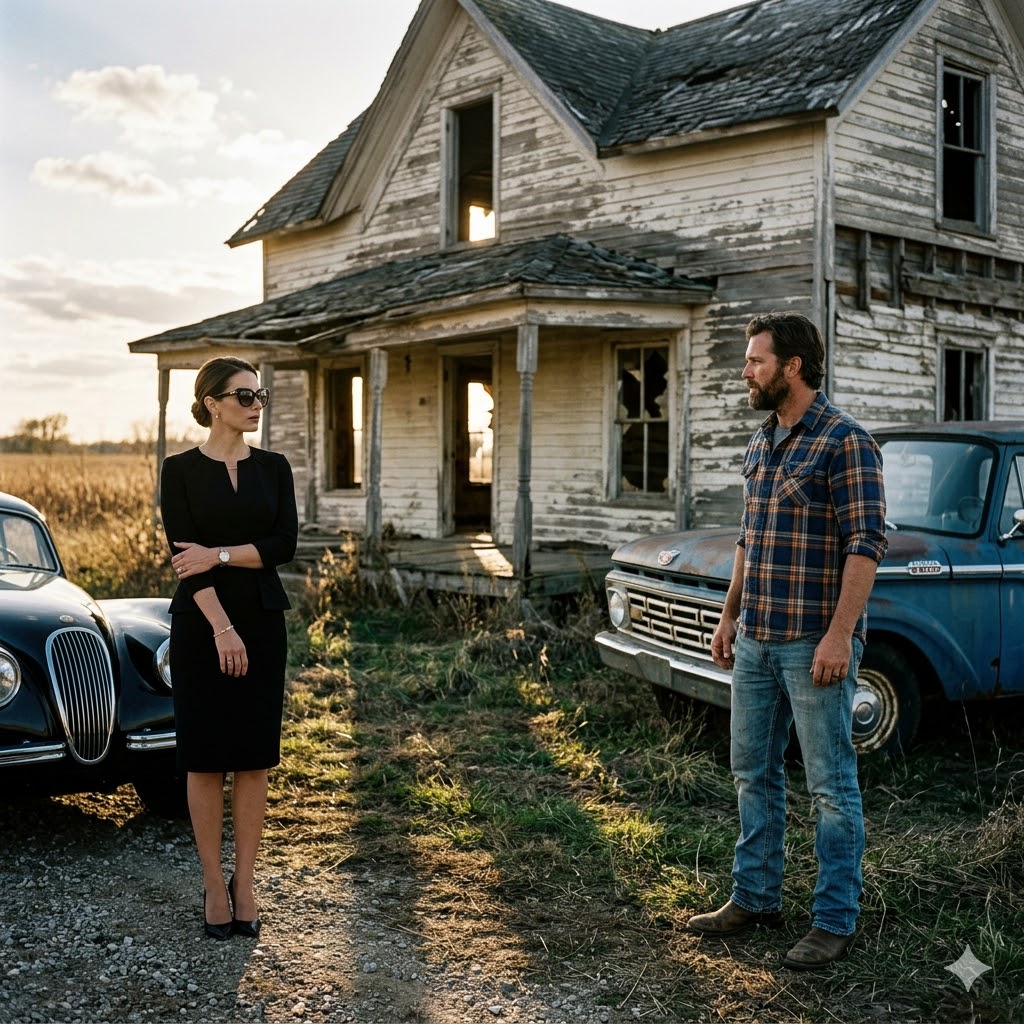
Eleanor Whitmore drove Caleb Hayes down a cracked country road past dead fields toward a house no one had lived in for 20 years. She told him it was hers. She watched his face waiting for the look she already knew, the quiet calculation, the soft greed dressed up as interest. Every man before him had shown it within minutes.
Caleb stepped out of the car, looked at the sagging porch, and said one sentence. It was not what she expected. 3 months before that afternoon on the porch, Eleanor Whitmore did not know Caleb Hayes existed. She ran Whitmore Equity out of a glass tower in the financial district, 42 floors above a city that had never given her anything she did not negotiate for.
At 35, she controlled a portfolio worth nine figures and a reputation that opened every door worth walking through. She also controlled with the same precision the distance she kept from anyone who might want something back from her. The first time she saw Caleb, he was on his knees beside her car. A flat tire on the shoulder of Route 9.
Rain coming down in a slow gray curtain. Every other driver going past without slowing. He pulled over in an old pickup, got out without being asked, and had the spare on before she could finish calling roadside assistance. He refused the $100 she offered him. He said his name not at once, and drove off into the rain without looking back.
She found him because she wanted to. A small detail on the truck, the name of a construction company stenciled on the door, and a single phone call to her assistant. 3 days later, she was sitting across from him in a diner he chose drinking coffee that tasted like it had been on the burner since morning. Caleb Hayes was 38.
He built things with his hands for a living, lived in a small house on the edge of town, paid his bills on time, and did not ask her what she did until she told him. He listened the way a man listens when he has nothing to sell. That was the part she could not explain to herself. Every other man she had met in the last 10 years had leaned forward when she talked about her work, the way a hunter leans toward a sound in the grass.
Caleb leaned back. When the check came, he paid it before she could reach for her card, and the bill was less than $20. And somehow, that small thing stayed with her for a week. They began to see each other. Not often at first, at dinner at a place he could afford, then a walk, then a longer walk. She told her assistant Margaret Doyle to stop scheduling Friday evenings.
Margaret, who had worked for her for 11 years and had watched two long relationships end in ways that left scars, asked no questions. Eleanor was the one asking them silently to herself, because underneath the calm she felt with Caleb, there was an older voice. And that voice had been right before. It had been right about Daniel the investor, who spent 2 years telling her he did not care about her money, and then tried to take a controlling interest in her firm during the divorce.
It had been right about the one before Daniel, and the one before that. Every time she had ignored that voice, she had paid for it, and the price had not been in dollars. The price had been a part of her she never got back. So, she watched Caleb the way she watched a ledger. She noticed what he ordered, noticed when he did not look at the price, noticed the cuffs of his work shirts clean, but worn, and the way he talked about his job without ever complaining about what it paid.
She noticed that he never asked to see where she lived. 2 months in, she drove him past her building once on the way to somewhere else, and his eyes did not linger. None of it reassured her. If anything, it made the old warning louder. A man that steady, the voice in her head said, is a man who has learned to wait.
Margaret saw it happening before Eleanor said a word. She had known Daniel at least from the other side of a desk. She had carried the folders during the settlement. She had seen how thin Eleanor had gotten that year, and how much thinner the smile had become after it was over. So, when Eleanor began leaving the office at 5:00 on a Friday, Margaret watched without being told to watch.
That was the kind of assistant she was. On a Tuesday morning, going through the week’s calendar, she set a folder down on Eleanor’s desk and kept her hand on it. She told Eleanor carefully that she seemed lighter lately, and that she hoped Eleanor was being careful. She did not mention Daniel by name. She did not have to.
It was the kindest thing Margaret could have said, and it landed exactly like a warning. That night, Eleanor could not sleep. She sat at the long window of her apartment and looked out at the lights of the city, and tried to remember the last time she had trusted someone without an exit plan. She could not. What she could remember was Daniel’s voice.
The soft and reasonable voice he had used when he explained to the court why half of what she had built should belong to him. She remembered signing the settlement at a table much like the one in her own office, and promising herself in the elevator afterward that she would never again mistake patience for love.
Caleb was patient. That was the thing. By morning, she had made a decision, and the decision had the clean shape of a business move, which was the only shape she fully trusted. She would not keep guessing. She would not keep watching and hoping. She would put him in a room with something worth wanting, and she would see what his face did.
Her grandfather had left her a property 30 miles outside the city. 12 acres of flat open land, a farmhouse that had been empty since the early 2000s, a line on the county record she had quietly renewed every year for two decades. The land was worth, by the last appraisal, close to $2 million. A developer had offered more the previous fall. She had not sold.
She had not even mentioned it to Caleb. She mentioned it now over dinner on a Thursday, the way a person mentions the weather. An old place her family still owned. Falling apart. She was thinking of driving out to take a look. Would he want to come along? She kept her voice flat and her hands on her wine glass, and she watched him the whole time she asked.
Caleb said yes the way he said most things, without any particular weight. On the drive out, she let the silence work. She told him half an hour in that the land had been appraised recently, and she named a number close to the real one. She watched the side of his face. He nodded the way a man nods at a fact that does not concern him, and kept his eyes on the road signs for her.
Somewhere between the last gas station and the turnoff, the old warning in her head went very quiet, almost hopeful. And that was when she knew she could not trust the quiet either. She had come too far with that voice to let it go on a single afternoon. The cracked country road came up.
The dead fields opened on both sides. Ahead, the sagging porch of the farmhouse leaned into its own shadow. Eleanor slowed the car, gravel popping under the tires, and told herself she was ready to see whatever he showed her. She was not. Eleanor parked beside a leaning fence post and killed the engine. The farmhouse sat a 100 feet ahead.
The front porch tilted at an angle a carpenter would call dangerous. The silence outside the car was the heavy kind, the kind that had been there a long time. She did not get out right away. She watched Caleb, who was looking at the house the way most men looked at a woman across a crowded room. He said the sentence that would stay with her.
He said the porch had been a beautiful piece of work once, and that whoever built it had cared about it. Then he opened the door and stepped into the weeds. Eleanor sat another moment behind the wheel trying to place what she had just heard. It was not a compliment to her. It was not a comment on value. It was a man speaking about a stranger’s craftsmanship the way another man might speak about a song.
She caught up with him at the porch steps. He was already crouched, running a thumb along the edge of a joint where two boards met. He told her the wood was oak, probably cut from the property itself, and that a nail set had been used instead of a hammer head, which was how you could tell the man had respect for his own work. He said this without looking at her.
He said it the way people pray in empty churches out of habit and without expectation. Inside, the air smelled of dust and old paper, and a little of animals that had passed through and left. Sunlight came in through a broken window in the kitchen and laid a pale stripe across the floor. Caleb walked through the rooms, slowly touching door frames, testing a stair tread with the weight of his boot.
Eleanor followed three steps behind him and watched his face for the expression she had driven 30 miles to see. It did not come. What came instead, in the back bedroom, was something she had not prepared for at all. He found a wooden chair with a broken rung in the corner by the window. He picked it up, turned it over, and set it back down on its three good legs.
Then he went out to his truck without a word and came back with a small roll of tools he kept under the seat. He sat on the floor of a house that was not his in the clothes he had worn to dinner with her the night before and he began carefully to fix the chair. Eleanor stood in the doorway. She did not know what to do with her hands.
She had come here with a plan as sharp as any deal memo and the plan required him to look at the land and calculate. He was not calculating. He was not even looking at the land. He was looking at a broken chair and he was mending it with the same quiet attention a surgeon might give to something much more important.
He worked for close to an hour. When he was done, the chair sat evenly on all four legs. He did not announce it. He wiped his hands on a rag, put the tools back in their roll, and moved on to the kitchen sink where a faucet had come loose from its base. Eleanor drifted after him through the house like a guest in her own life.
At one point she opened her mouth to ask why he was doing any of this and she did not ask because she could already hear the answer and the answer was that he did not know how to be inside a wounded place without trying to help. They stayed until the light began to go. On the drive back, she did not say much.
Caleb did not fill the silence. He looked out the side window at the dead fields, then at the first lights of the exits coming up, and once he said softly that someone had loved that house. That was all. When she dropped him off in front of his small house on the edge of town, he thanked her for the afternoon and closed the door gently and the warning she had counted on for 10 years didn’t say anything at all. Three days passed.
Eleanor went to work and ran two meetings and signed a document that moved $40 million from one account to another and none of it reached the part of her that was still standing in that back bedroom. On Wednesday morning, Margaret Doyle came into her office with a folder and a careful face.
The careful face Eleanor had known for more than a decade. Margaret set the folder down. She said she had not been asked to do this and she knew she had not been asked. She had done it anyway because 11 years of working for Eleanor had taught her what Eleanor asked for and what Eleanor actually needed. She said she had run a quiet check on Caleb Hayes the way she ran quiet checks on any man who came too close.
Nothing invasive, only public records, the kind of thing anyone could pull with a library card and an afternoon. Margaret said she had found something that morning that Eleanor should probably know about. Caleb Hayes had been on the county assessor’s website twice in the last week.
He had pulled the record for the property outside the city. He had looked at the parcel map. He had looked at the zoning file. Eleanor did not move. She thanked Margaret in a voice that came from very far away. When Margaret left, Eleanor closed the folder without opening it and she sat in her chair for a long time and the voice that had been silent for 3 days came back all at once and it was very loud and it was saying what it had always said.
A man that steady is a man who has learned to wait. She did not call him that night. She did not call him the next morning. When his name came up on her phone on Thursday evening, she turned the phone face down on the marble counter and went to bed. On Friday, she sent one message brief saying she was traveling for work.
She was not traveling. She was sitting in her apartment at the long window looking out at the city lights feeling the exact thing she had felt the night she decided to set up the test. Caleb called twice more and then stopped calling. A week went by. She told herself she was handling it the way she should have handled every one of them clean early before anything could be taken from her.
But there was a weight in her chest that had not been there with Daniel or with the one before Daniel and the weight did not lift. She began to lose sleep in a way she had not lost sleep in years. At work, she caught herself reading the same paragraph of a contract three times and the third time the words still would not arrange themselves into meaning.
On the 10th day, Margaret came in again. She closed the door behind her, which she almost never did and she stood in front of Eleanor’s desk without sitting down. She said she had something else. She had kept watching on her own the same way she had started watching on her own. She said Caleb had not been pulling the parcel map for the reason Eleanor thought.
He had been pulling historical records. He had been looking for what used to be on the property, specifically the original garden layout from the 1960s back when the grandfather who left Eleanor the land had still lived there. Margaret set a printout on the desk. It was an email Caleb had sent to a county archivist polite and plain asking whether any photographs of the old garden might still be on file.
He wanted to know what had grown there. He was asking, the email said, because he wanted to put it back. He had included a sentence at the end about not wanting to spend money on the wrong plants. Eleanor read the message twice. The second time her hands were not quite steady. She sat with the paper in her lap and understood in a way she could not negotiate with that she had done something she could not undo by being right about it.
She had been wrong and the person she had been wrong about had already stopped calling. Margaret stood there another moment, then said quietly that she was sorry for the part she had played in the misreading. She said she had brought the first folder in too fast. Eleanor shook her head. The first folder had not been the problem.
The lens Eleanor had used to read it had been the problem. She said thank you and she meant it and Margaret left the office and closed the door behind her without another word. Eleanor kept the printout on her desk for two more days before she did anything with it. She read it again in the morning and again at night and each time the same small sentence moved through her chest like a slow crack in a wall.
He wanted to put it back. She had spent 10 years training herself to hear what men wanted from her and she had trained so hard she had stopped being able to hear when a man wanted nothing at all. The truth of it settled on her slowly. The problem had never been Daniel. The problem had not been the one before Daniel either.
Those men had been real and the damage had been real but the damage had hardened into something she now carried into every room. She had taken the wound and made it into a lens and the lens had begun to bend straight lines. She had not tested Caleb. She had tested herself and she had failed because the test had been rigged from the start.
On Sunday morning, she drove to his house. She had been past it once months before without stopping. Now she stopped. It was a small white house with a narrow porch and a pickup in the drive and it looked exactly like what it was, which was the home of a man who did not owe anyone an explanation. She sat in the car for several minutes before she made herself walk up the steps and knock.
Caleb opened the door in a work shirt and did not smile. He did not look angry either. He looked like a man who had finished being surprised. He held the door open just enough to say he was willing to listen and not an inch wider. Eleanor stepped into a small front room that smelled of coffee and sawdust and said the thing she had come to him she had taken him out to the farmhouse on purpose.
She told him the land was worth close to $2 million and that she had mentioned the number on the drive to see what his face would do. She told him that her assistant had pulled a background report on him and had been watching the county records and that the second report was the reason she was standing in his front room at all.
She did not soften any of it. She did not explain Daniel because Daniel was not his problem. When she was finished, she sat with her hands in her lap and waited. Caleb looked at the floor for a long moment. When he spoke, his voice was lower than she had heard it before. He said the part about being watched was harder to hear than the part about being tested.
He said a man could forgive being measured. Being investigated was a different thing. Eleanor said she knew. She said she wasn’t going to argue with any word of it. He said he had figured out most of the rest on his own somewhere around the second week of silence. He said he had seen women do smaller versions of the same thing before and he had always walked away.
He said he had almost walked away this time, too. Eleanor asked him why he had not. Caleb said he did not know yet. He said he had been thinking about it every day and the only answer he had was that the person who had dropped him off in front of his house that night had not looked like a woman running a test.
She had looked like a woman who was afraid of the test working. That was the part he said that had kept him from throwing away her number. She did not argue with him. She did not have the equipment to argue with that. Instead, she said she was sorry and she said it the way a person says it when they understand the word is very small for what it is trying to carry.
Caleb nodded once. He said he believed her. Then he said something she had not expected, which was that an apology was not the same thing as a plan. He told her quietly that respect had to go both ways, or it did not go at all. He said he was not interested in a relationship where he was the one being measured, and she was the one holding the ruler.
If they were going to keep going, she was going to have to give up the ruler. Not for a week, not as a gesture, for good. He said it without heat. He said it like a man stating the only terms he was willing to accept. And Eleanor understood that he meant every word. She agreed. She agreed because it was the first honest thing anyone had asked of her in a long time.
She did not promise him she would be good at it. She promised him she would try. And she promised him she would tell him when she was failing. And that was the promise he took. On Monday morning, she went into the office and told Margaret there would be no more reports. Not on Caleb. Not on anyone Eleanor might see from this point forward.
Margaret listened without expression, then said she was glad to hear it, and went back to her desk. It was the closest thing to a celebration either of them allowed themselves. They drove out to the farmhouse the following Saturday. They did not talk about tests or land values on the way. Caleb had a list of supplies in his pocket, and a second roll of tools in the back of the truck.
Eleanor had brought work gloves that still had the tag on them, which she tore off in the parking lot of the hardware store while he was inside. She did not want him to see the tag. It was the first small private thing she had ever hidden from him for an honest reason. They worked on the house for weeks after that on Saturdays, and on the occasional weekday evening when she could leave the office early.
He taught her how to hold a pry bar so she would not hurt her wrist. She taught him without meaning to what it looked like when she was tired and pretending not to be. They rebuilt the porch. They replaced the broken kitchen window. They pulled up the rotted boards in the back bedroom, where the chair with the mended rung still stood against the wall.
A local man who had known the property in the 1960s came by one afternoon and stood in the side yard and pointed out where the roses had been, where the herb beds had been, where the two apple trees had stood. His name was Walter, and he had been the grandfather’s neighbor for a long time. He stayed for 2 hours drinking coffee Caleb made on a camping stove, telling them things Eleanor had never been told about the man whose name was on her deed.
Caleb put the garden back the way Walter described it, piece by piece across one long spring. Eleanor helped. She was not good at it at first. She got better. Somewhere in the middle of April, kneeling in dirt she had once thought of as an asset, she understood that the farmhouse had stopped being a property on a balance sheet. It had become the place where she was learning late and slowly how to be a person who did not flinch at being loved.
Margaret came out one Saturday to drop off papers Eleanor had to sign. She stood at the edge of the yard for a while and watched them work. And when she came over to the porch, she only said that the place looked different. Eleanor said she knew. Margaret touched her shoulder once the way she had never done in 11 years of working together, and got back in her car and drove away down the cracked country road that no longer looked cracked in the same way.
On a Sunday in early June, with the first of the roses just starting to open along the south fence, Caleb came and sat down beside Eleanor on the rebuilt porch step. He was holding a small ring in his palm. It was not an expensive ring. It had belonged, he said, to his grandmother, who had lived in a house not much bigger than this one, and had been married for 51 years.
He did not kneel. He did not make a speech. He asked her simply if she would marry him. Eleanor said yes without looking for a catch. That was the part that startled her most afterward when she thought about it. The warning that had lived in her head for 10 years did not speak. It had not spoken in a long time.
She slid the ring onto her finger and sat on the porch step beside him and looked out at the garden they had put back together. And she understood that she had been tested after all on that first afternoon. She had been the one taking the test, and she was only now, months later, beginning to pass it.