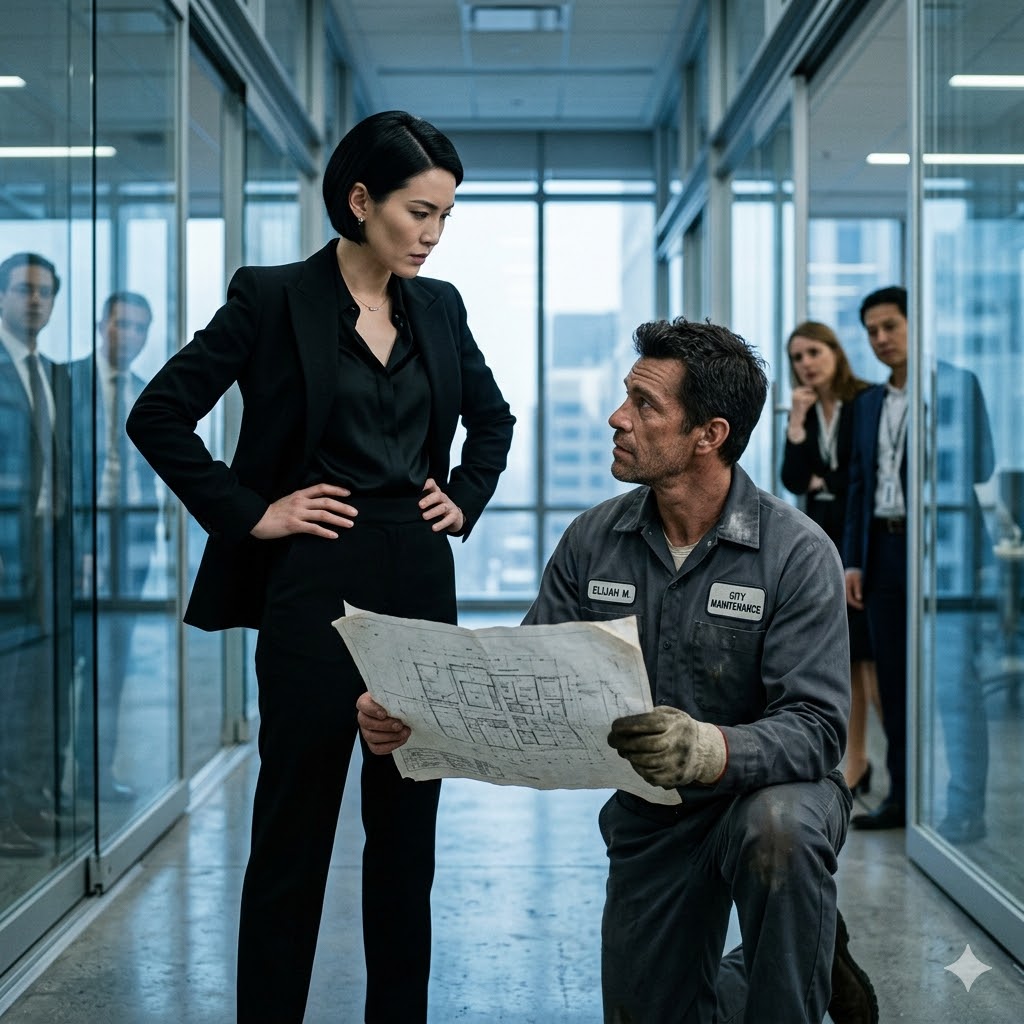
Evelyn fired him right there in the hallway in front of everyone on the 14th floor over a single sheet of paper he had picked up off the floor. No investigation, no questions worth answering, just one cold look and a sentence that landed like a door being locked from the outside. Pack your things and go. Elijah didn’t argue. He didn’t beg.
He pulled off his work gloves, folded them with the kind of quiet precision that made the moment even harder to watch, and he walked away in silence. But exactly 5 minutes after he stepped into that elevator, 5 minutes, the conference room door flew open, and Evelyn walked out with all the color gone from her face.
A $47 million contract was collapsing in real time, and the only person in the building who could save it had just been sent home. What she didn’t know yet was who that man really was and what he had chosen to leave behind. The 14th floor of Meridian Group’s Chicago headquarters was a different world. At 6:15 in the morning, no voices, no phones, just the low hum of ventilation and the sound of wheels rolling across polished concrete.
Elijah Monroe pushed his cleaning cart past the row of glasswalled offices, working the way he always did methodically, without hurry, without noise. He had learned long ago that invisibility was a kind of freedom. Nobody watched the man with the mop. Nobody asked him questions. That suited him perfectly.
He was 34 years old, broad- shouldered, with calloused hands and eyes that took in more than they let on. He had been working the early shift at Meridian for just over a year, 6:00 in the morning until 2:00 in the afternoon, 5 days a week. By 2:30, he was at the school gate waiting for Isaac. That was the whole architecture of his life. And he had built it that way on purpose.
Not out of lack of ambition, out of something harder to explain to people who hadn’t earned the understanding of it. Isaac was 7 years old and thought his father hung the moon. He had his father’s jawline and his mother’s way of laughing at things that weren’t meant to be funny.
Every morning before Elijah left, the boy was still asleep at the neighbor’s apartment. Tucked under a blanket at Margaret’s place, two doors down, a stuffed dog named Ren pressed under his arm. The dog was missing one button eye and had been repaired twice with black thread, but Isaac refused to consider a replacement. Some things, he had explained to his father with complete seriousness. You just kept. Elijah had agreed without adding anything to that.
Margaret had three grandchildren of her own and treated Isaac like a fourth. Elijah paid her what he could. She accepted it without making him feel small. He was grateful for that more than he ever said aloud. He was grateful for a lot of things he didn’t say aloud. Down the hall, the design team’s workspace was littered with the organized chaos of people who had been working around the clock.
Meridian Group was in the final stretch of its most important project in a decade. The Halo account, a full brand identity overhaul for Vantage Industries, a logistics conglomerate with offices in 11 states, was worth $47 million over a 4-year engagement. The final presentation was scheduled for 2:00 the following afternoon, 32 hours away. Carter Wade had run the creative department for 12 years.
He was 41, polished, the kind of man who wore confidence like a well-tailored jacket. When the board had promoted Evelyn Nash to CEO 18 months ago, passing over Carter without so much as a conversation, something behind his eyes had shifted. He had never forgiven it. He had also never shown it not openly. He was far too careful for that.
Evelyn arrived at 7:30 on the dot as she always did. 32 years old, sharp and deliberate in everything she did. Still quietly aware that half the board had voted against her appointment, she carried a black coffee and a tablet and walked like someone who had already solved three problems before the elevator doors opened. She had not slept well.
Carter had flagged a concern the night before a possible leak in the Halo design files, a security risk he couldn’t fully explain. She had spent two hours turning it over in her mind without arriving at anything solid. She came up the stairwell that morning instead of the elevator, burning off energy. She pushed open the door to the 14th floor and stopped.
Elijah was standing at the edge of the design team’s workspace near the cluster of drafting tables where the Halo core team had been working. He was holding a piece of paper in both hands. Gloved fingers turned up to keep the sheet flat. He was looking at it. Evelyn’s mind made the connection in under a second. A leak, Carter’s warning. A cleaning employee, someone with unrestricted after hours building access, standing over the design department’s most sensitive materials, reading them.
She crossed the floor in 12 steps. What are you doing with that? Elijah looked up without flinching. His voice was level. It fell off the table. The air conditioning kicked on and it went to the floor. I picked it up. Did you look at it? He held her gaze for a beat. There was no guilt in his eyes.
There was also no performance of innocence, just the plain unhurried honesty of someone who had nothing to hide and saw no reason to pretend otherwise. Yes, I looked at it to see if it was something important before I put it back. That pause, that single beat of honest hesitation before he answered, was what undid him, because Carter Wade stepped off the elevator at precisely that moment, briefcase in hand, and took in the scene with the practiced calm of a man who had been expecting it. He walked over slowly.
He examined the sheet, his brow pulled together with exactly the right degree of concern. “Evelyn,” he said, voice low and measured. That’s the Halo Master concept. The typography architecture. That page has never been printed outside the core team. It shouldn’t exist anywhere near this area of the floor. He didn’t say Elijah had stolen it.
He didn’t need to. He simply placed the words in the room and let them settle. Evelyn looked at the sheet, then at Elijah, then at the sheet again. By now, the first wave of staff had begun filtering in. The hallway was no longer empty. There were witnesses which meant there was an audience and Evelyn Nash did not hesitate in front of audiences.
Hesitation looked like weakness and weakness was something she could not afford. Not with the board watching. Not 24 hours before the most important presentation in the company’s recent history. I don’t know if you picked it up or took it, she said. Her voice was not cruel, but it was absolute.
What I know is that I cannot have any risk inside this building right now. Pack your things and leave the building.” Elijah looked at her. The look lasted perhaps two seconds. It was not anger. It was not pleading.
It was the look of a man who had learned a long time ago that the world operated according to its own logic and that sometimes that logic had nothing to do with what was true. He understood what she was seeing. He understood why she was making the call she was making. He did not agree with it, but he was not surprised by it. He pulled off his work gloves. He folded them with slow, deliberate care, and set them on top of the cleaning cart.
Understood, he said. Two words, nothing more. He collected his personal items from the supply room, a water bottle, a small notebook, a photograph of Isaac tucked inside the front cover. He nodded his jacket at his waist, and walked down the hall toward the elevator. Around him, colleagues looked at their phones, at their shoes at the middle distance.
No one spoke. Grace Callaway, the senior executive assistant who had worked on this floor for 6 years, stood near the copy station and watched him go. Her mouth opened. Evelyn’s eyes from 30 ft away, closed the conversation before it started. The elevator arrived. Elijah stepped inside. Just before the doors met, his phone buzzed in his pocket. He looked at it. A text from Margaret.
Isaac wants to know if you’re coming home early today. He wants to practice reading with you tonight. Elijah looked at the message for a long moment. Then he put the phone away and the doors closed and the floor indicator above the elevator began counting down. Evelyn watched the number drop.
Then she turned back toward the conference room. There was work to do. She pushed the discomfort down to somewhere she could deal with later. Carter fell into step beside her, already talking about contingency timelines. She had exactly 5 minutes of certainty left. The conference room held seven people. Evelyn Carter, Logan Pierce, the digital lead, and four members of the Halo design team.
The wall screen was lit with the project dashboard. Carter was midway through his final prep walkthrough when Logan opened the primary server folder and went still. The silence lasted 3 seconds before anyone noticed it. Logan. Evelyn’s voice was a prompt. Logan’s face had the particular blankness of someone whose brain was refusing to process what it was seeing.
He turned his laptop so the room could view the screen. The Halo Master folder was open. The typography system, the core of the entire visual identity, the framework from which every deliverable cascaded was gone. Not corrupted, not moved, gone. The backup flagged in the cloud had also been deleted. Logan pulled up the server log with hands that were not entirely steady.
The deletion had been executed at 3:47 that morning. He read the access credentials aloud. He read them a second time because the first time felt like a mistake. The account belonged to Carter Wade. Carter’s response arrived immediately and smoothly. The way a prepared answer always sounds different from a true one. His account had been compromised. A targeted intrusion from a competitor.
He had been suspicious for weeks. He had meant to escalate it, but had not wanted to cause panic before the presentation. His voice carried absolute conviction, and if Evelyn had been listening only to the surface, she might have accepted it, but she was also watching his hands. Carter’s hands were perfectly still. The hands of a man who was not afraid because things were unfolding the way he had intended. The room turned to the backup problem.
Logan found a local offline copy manual from a week prior. He opened it and immediately knew it was unusable. 60% of the final revisions were missing. The version gap was too large. Presenting it to Vantage Industries would be worse than presenting nothing at all. Because at least nothing could be explained.
An incomplete, outdated deck suggested that Meridian Group did not know what it was doing. The room went quiet with a specific kind of quiet, the kind that comes when professionals realize that no ordinary solution exists. Grace had been standing near the door throughout. She was the kind of person who listened more than she spoke. And when she spoke, it was worth the wait.
She said it carefully, looking at the table rather than at Evelyn, the man who was just let go. Elijah. 3 weeks ago, he was in the server room doing his shift, and Logan mentioned a font system error that the team had been trying to fix for 2 days. Elijah looked at it for about 20 minutes and resolved it. Logan came and told me afterward because he was I think the word he used was unsettled.
Evelyn looked at her unsettled because of how fast it happened and because of how clearly Elijah understood what he was looking at. Logan said it was like watching someone read in a language the rest of them were still learning. The room was very quiet. Evelyn sat back in her chair.
On the conference table in front of her was the empty space where the Halo design sheet had been resting for the past few minutes before she had set it aside. The sheet that had fallen from the drafting table. The sheet that a man in work gloves had picked up from the floor set back on the surface and looked at not to steal, not to photograph, not to leak, just to know whether it was worth handling carefully. She had fired him for that. She stood up and picked up her phone. The call went unanswered.
She tried a second time, the line disconnected, which meant it had been declined. She set the phone down on the table and looked at Grace. Grace was already at her desk pulling up the HR database. The employee file for Elijah Monroe was light. A contract hire, not permanent staff, minimal paperwork. The education field read simply, “Col unspecified.
” His home address was listed in the west side, a neighborhood that was neither wealthy nor destitute, just quietly workingass, the kind of place where people went about their lives without much theater. Grace moved to a professional network search. The profile came up quickly, though it had not been updated in 4 years. No photograph.
The employment history was short but specific. Senior visual identity designer at Aldrich and Crane Brand Studio, New York. From 2014 to 2019. Aldrich and Crane was not a name that required context. Everyone in the room who worked in design knew what it was one of the most respected brand studios on the East Coast. The kind of place where a career meant something. Grace scrolled to the next line. Principal designer and founder Monroe Design Lab.
From 2019 to 2020, Evelyn did not move. Grace searched the firm name. A short article from Design Quarterly archived from November 2020 came up near the top of the results. The headline was spare and factual. Monroe Design Lab closes following founders personal tragedy. She read it aloud. She did not read all of it because some of it was not relevant.
The relevant part was this. Elijah Monroe’s wife, Diana Monroe, had been killed in a traffic accident in September of 2020. She had been 4 months pregnant with their second child. In the weeks that followed, Elijah had dissolved the studio, liquidated its assets, and returned to Chicago, where he had grown up.
His son Isaac was 3 years old at the time. At the bottom of the article, there was a brief direct quotation from a short statement Elijah had released at the time. It read, “I need work I can count on, hours I can plan around, and enough time at the end of each day to be the father my son needs.” The conference room was silent.
Nobody spoke for a long moment. Logan was looking at the wall. Grace had her hands folded on the desk in front of her, looking at nothing. The room held the particular weight that comes when a group of people simultaneously realizes it has misjudged something irreparably. Evelyn looked at the address on the file. West Side, a walkup building.
a man who had stood at the front of a studio bearing his own name in New York City, who had worked at one of the most respected agencies on the East Coast for five years, building a reputation that took a decade to earn, and who had come back to Chicago and taken a cleaning contract because it gave him reliable hours and allowed him to pick up his son from school every 15 afternoon. He had not put his education or his career history on his HR intake form.
He had not asked for any accommodation. He had simply shown up at 6:00 in the morning and done what he was paid to do and gone home to Isaac. Carter was looking at the table. His expression was unreadable. But it was not the expression of a man who was surprised. He had known.
Evelyn could see it now, laid cleanly over everything else she had seen that morning. He had known who Elijah was, and he had made sure to be walking off that elevator at exactly the right moment. The sheet of paper had not fallen from the table by accident. It had been placed near the edge of a surface that sat directly below the air conditioning vent in the exact spot Elijah cleaned every Tuesday and Thursday morning. On the morning before the most important presentation in the company’s recent history, Carter had built a trap out of an innocent man’s
routine, and Evelyn had walked into it on his behalf. Evelyn stood up. She told Grace to have security escort Carter from the building. She said it without drama, in the same tone she used for every operational decision. Carter rose from his chair in the unhurried way of someone who had a plan B and knew it. At the elevator, he turned and looked at her from down the hall.
He said that this was not over. She told him she knew, but that for tonight it was. The doors closed and he was gone. She picked up her phone and her car keys. The westside address was a low wide apartment building on a street with old trees growing through the sidewalk. A laundromat on one corner, a bodega on the other. Children’s bikes locked to the stairwell railing.
Evelyn pulled up in front of it just after noon. Grace in the passenger seat. Both of them walking up the front path in the particular silence of people who are aware they are on someone else’s ground. She saw them before she reached the door. Elijah and Isaac were sitting on the front steps of the building.
Isaac had a chapter book open across his knees, following the words with one finger the way children do when they are still making friends with reading. Elijah was next to him, forearms on his knees, a coffee mug in both hands, looking at the street with the focused emptiness of a man letting his mind rest.
He was not surprised to see her. He did not look like a man who was surprised by very much anymore. Isaac looked up first. He studied Evelyn with the direct unself-conscious curiosity of a seven-year-old. “Dad,” he said. “Someone’s here for you.” Elijah looked over. He looked at Evelyn, then at Grace, then back at Evelyn. He waited. “Elijah,” she started. “You can skip the setup,” he said. His voice was not unkind. It was simply accurate.
“You need me because of the project. I understand. That’s a reasonable thing to need. Just say it straight. Evelyn stopped. In 18 months as CEO, she had sat across from board members, hostile clients, institutional investors, and a managing director who had once thrown a binder at the wall during a budget meeting. None of them had knocked her off her footing the way this man did by asking her to be honest.
“You’re right,” she said. “That’s true, but it’s not all of it.” She paused. And when she spoke again, the corporate register was entirely gone. I made a decision this morning without enough information and without giving you a fair chance to explain yourself. I want you to know that I know that. Isaac had stopped reading.
He was watching the adults with the polite attention of a child who has learned that adult conversations are sometimes important. Elijah looked at his son for a moment. He set down his coffee mug. Give me a few minutes,” he said. He went inside and knocked on Margaret’s door and came out 2 minutes later, pulling on his jacket. They sat on the building’s front steps together, Evelyn and Elijah. And the negotiation that followed was the most direct conversation Evelyn had conducted in years. He asked her what she needed.
She told him the complete Halo visual identity system rebuilt from brief presentable to a sophisticated client by 2:00 the following afternoon. She named a figure 10 times his monthly contract rate with a performance bonus on top. He said he didn’t need the money at that level. She waited. He told her three things. First, Isaac came with him.
The boy would have a quiet room, Wi-Fi, and a place to sleep if the night ran long. Elijah would not leave his son alone overnight. That was not a preference. It was a condition. Second, Carter Wade did not come near the workspace Elijah would be using. He did not want an explanation on the record. He simply required it.
Third, when the project was delivered, the creative credit in the Vantage Industries contract documentation would carry his name, Elijah Monroe, designer of record, not hidden inside the company attribution. His name visible. Evelyn heard the first two conditions and agreed to them without hesitation. The third one she heard differently. She looked at him for a moment, and what she saw was not a man making a demand. It was a man quietly reclaiming the thing he had spent four years folding up and putting in a drawer. “Done,” she said.
Then she asked him about Carter, why Carter specifically needed to be excluded. Elijah’s answer was quiet and direct. Because that paper didn’t fall off the table on its own, a long pause. The street outside was going about its afternoon business. The sound of a delivery truck, someone calling to a neighbor two floors up.
Evelyn looked at the sidewalk for a moment. then back at him. She believed him completely. She was not sure when during this conversation that had become true, but it had. They were back at the building by 6:30. Isaac sat across from his father at the workstation on the 14th floor. Chapter book traded for a tablet with headphones, legs swinging from a chair that was slightly too tall for him.
By 7:00, he was fully absorbed in a documentary about deep sea fish that Grace had found for him. By 8, he was asleep on the small sofa in the corner of the room, covered with Elijah’s jacket, one arm around Ren, the stuffed dog that Grace had had the foresight to retrieve from Margaret’s apartment. Elijah worked. Logan had been prepared to assist, and found himself within the first 20 minutes, mostly observing.
Not because Elijah shut him out. He answered every question Logan asked clearly and without condescension, but because the speed and certainty of what was happening didn’t leave much room for collaboration. It was like watching someone navigate a room they had designed themselves. Logan had 8 years of professional experience and considered himself competent. Watching Elijah work was a different category of experience entirely.
It was the difference between someone who has learned a skill and someone for whom the skill had become a form of thinking. Elijah did not try to reconstruct what had been deleted. Reconstruction would have taken longer and the result would have been approximate.
Instead, he went back to the brief, to the original client documentation, to the mood board from the earliest pitch meeting. He stripped away everything that had accumulated on top of the actual problem and started from the first principle. What did Vantage Industries need to communicate and what was the clearest visual language for that communication? They don’t want complicated, he said at one point, not to Logan specifically, just to the room. They want trustworthy.
Those look completely different and someone along the way confused them. Logan looked at the brief again after Elijah said that and saw it too the way the design had drifted incrementally toward visual complexity because complexity could be mistaken for sophistication and sophistication looked good in internal reviews.
Elijah was unwinding all of it and finding the original thread underneath. By 10:00 the new framework was taking shape. By midnight it was structurally complete. The remaining hours were refinement, spacing, weight, the particular calibrations that separate professional work from excellent work.
Elijah worked with a steadiness that had nothing to do with urgency. He was not racing. He was simply present in the work in a way that made haste unnecessary. Around 11, Isaac stirred on the sofa and sat up with the confused expression of a child who is woken somewhere other than his own bed. Elijah was at his side before the boy could fully come to terms with his surroundings.
He sat down on the edge of the sofa, spoke quietly, and Isaac leaned against his father’s arm, blinking slowly. Elijah stayed there until the boy’s breathing deepened again. Then he went back to work. Evelyn watched this from the glasswalled conference room across the hall where she had set up a secondary workstation. She had not gone home. She had told herself it was because she needed to be present if anything came up. She did not examine that justification too closely.
Grace brought coffee at some point and sat across from her. They looked out through the glass at the lit workstation at the man working and the small shape asleep on the sofa. After a while, Grace said that she had tried to speak up that morning in the hallway. Evelyn said she knew.
Grace said she should have tried harder. Evelyn said that was her own responsibility, not Grace’s. Then she said it again quietly to herself, her own responsibility. At 11:30, she locked Carter’s system credentials, at which point his email access was suspended. His draft email to the Vantage Industries representative composed but not yet sent, designed to cast doubt on Meridian’s internal stability and delay.
The presentation was discovered in the activity log during the security review. The log was enough. Evelyn authorized a formal HR investigation and had security remove him from the building within the hour. It happened without theater or confrontation.
Carter took his coat and his briefcase and stopped once at the elevator to look back down the hall at Evelyn who was standing at the far end of the corridor. He said it wasn’t over. She agreed and said, “Tonight it was.” The elevator opened. He stepped in. The floor was quiet again. By 2 in the morning, the work was done. By 3, after final output checks, Elijah packed up his station and gathered Isaac, who woke just enough to wrap both arms around his father’s neck and go immediately back to sleep. They left the building. Grace called them a car. Evelyn stood at the
window and watched the tail lights until they were gone. The Vantage Industries team arrived at 1:55 the following afternoon. Adrien Walsh led the client delegation. Vantage’s vice president of brand, mid-50s. Precise and experienced, the kind of man who had sat through enough presentations to detect hollowess from the first slide.
He shook hands around the table with the courteous efficiency of someone for whom this was Tuesday. He looked at Elijah with a brief non-committal assessment. No tie, clean shirt, steady eyes. He looked at Evelyn with the same question behind his expression that everyone had when they saw Elijah in that room. Evelyn introduced him without preamble. This is Elijah Monroe. He designed the Halo system you’re about to see. Nothing else. No titles, no defensive context.
Elijah stood up and the presentation began. He spoke the way he worked without hesitation, without performance. He explained each decision in the language of the problem it solved, not in the language of design theory. He talked about Vantage’s core value proposition, not what they sold, but what they guaranteed.
And he walked the room through the visual logic that expressed that guarantee without relying on the viewer to interpret to it. Every element had a reason. The reasons were clear. The system held together at every scale he demonstrated, from a business card to a billboard to a digital interface. When he finished, Adrien Walsh was quiet for 8 seconds. The people who knew Walsh understood this silence. It was not dissatisfaction.
It was the particular stillness of someone whose mind was running to catch up with what his eyes and ears had just delivered. The people who did not know him began to shift in their seats. Then he said, “I have sat through a great deal of brand presentations. This is the first time in recent memory that I finished one without finding a single thing I felt compelled to push back on.
” He looked at Evelyn. Who did you say this was? Elijah Monroe, she said. Walsh looked at Elijah again. Something passed across his expression, the recognition of a professional who has just encountered another professional operating above the waterline he had expected. I’d like Mr. Monroe’s name on the contract documentation, he said.
As designer of record, Evelyn did not look at Elijah when she answered. She was already smiling slightly, looking at Walsh. That was already part of our terms, she said. The contract was signed in that room before the Vantage team left the building. In the hallway outside, Elijah checked his phone. A message from Isaac sent from Margaret’s tablet.
Dad, are you done yet? I’m hungry. The corner of Elijah’s mouth moved. Not a performance, just the small real thing that only happens when a person forgets for a moment to be guarded. Evelyn came out into the hallway. Mr. Monroe. She started. Elijah, he said. She adjusted. Elijah. She looked at him straight. I want to say something that isn’t about the company or the contract. He waited.
I looked at you yesterday morning and decided what you were before I asked you a single thing. I knew better than to do that. I did it anyway. She paused. I’m sorry. Not on behalf of Meridian. On my own behalf. Elijah held her gaze. The silence was not uncomfortable. It was the kind that exists between two people who are being exact with each other. I accept that, he said. That was all.
No attached conditions, no performance of magnanimity, just the plain closure of a man who didn’t need to make other people’s accountability into a longer story than it needed to be. 2 days later, a formal offer arrived. Evelyn had written it herself, which Grace noted was unusual. The position was creative director at large project-based engagement. No mandatory daily presence.
No routine meetings unless relevant. Full-time schedule autonomy. The compensation matched what Carter had been earning. Every Meridian portfolio piece generated through the engagement would carry his name on the design credit. No exceptions. There was a cover note at the top typed not formatted through the HR system.
It read simply, “No standard terms were changed.” The only thing we added was the last clause about pickup and child care flexibility. That was our idea, not yours, because we should have thought of it first. Elijah read the offer at the kitchen table after dinner.
Isaac was doing his reading homework across from him, running his finger under each sentence, lips moving slightly. When Isaac finished his page, he looked up and saw his father looking at papers. “Is that about a job?” It might be, Elijah said. Do you like it? Elijah thought about that for a second.
Not the long kind of thinking that avoids an answer, but the short kind that’s actually looking for one. I think I might. Isaac considered this with great seriousness. Will you be home on time? Yes. Everyday, most days. And when I’m not, you’ll know ahead of time. Isaac seemed to weigh this against some internal standard. Then he nodded and went back to his reading. Elijah signed the offer the following morning.
The HR investigation concluded 3 weeks later. The evidence against Carter, the file deletion timestamps, the suspended draft email, the access logs was sufficient for termination for cause. There was no dramatic hearing, no confrontation in a glasswalled room. There was a letter. There was a meeting with HR and legal.
And then, as is usually the case with people who believe they are too essential to be removed, he was removed. The floor felt different afterward in the way that rooms do when something that has been quietly generating pressure is finally turned off. On the first morning, Elijah came back to the 14th floor as a member of the design staff.
He came through the main entrance of the Meridian building at 8:45. He had a backpack on one shoulder. Isaac was beside him, walking with the particular alertness of a seven-year-old encountering a new environment, head moving, eyes tracking, taking inventory of everything. It was a school holiday, and Margaret had a family thing, and Elijah had mentioned it to Grace 2 days earlier. Grace had made a room available without being asked twice.
At the front desk, the receptionist looked up with the professional pleasantness of someone who cross references a name. Can I get your name, please? Alia Monroe. She looked at her screen and her expression shifted slightly, the way it does when a name appears with more attached to it than expected. Of course, Mr. Monroe.
Elevator 31 14th floor. They’re expecting you. He guided Isaac to the elevator with one hand lightly at the back of the boy’s shoulders. Isaac stepped in and looked up at the floor numbers above the doors with the wideeyed focus that buttons and mechanisms always inspired in him. On the 14th floor, the doors opened.
Evelyn was at the far end of the hallway, standing near the corridor that led to the senior office wing, tablet in hand, speaking quietly to one of the project managers. She looked over when the elevator opened. She looked at Elijah. She looked at Isaac, who had stepped out of the elevator and was looking down the length of the hallway with the expression of someone taking serious architectural inventory. She looked back at the project manager and finished the sentence. she had been in the middle of.
Then she turned and walked toward the interior office. And just before she cleared the glass partition, something happened to her face. Not a formal expression, not a professional one, just the quiet, private kind that people make when they don’t think anyone is watching. She was through the door before it fully settled.
Behind her, Isaac had pulled on Elijah’s sleeve. “Dad,” the boy said, not in a whisper. “How come your desk is bigger than everyone else’s?” Elijah looked down the hallway toward the workstation that Grace had set up for him, wider than the standard configuration, positioned near the natural light.
“Exactly as he had asked, because I need the space,” he said. Isaac looked at it again with focused consideration. “Or is it because you’re more important?” A sound came out of Elijah, then small, unguarded. the particular laugh of someone who hasn’t used it in a while and has almost forgotten what it feels like. “Ask me later,” he said. He started walking down the hall toward his desk.
Isaac fell into step beside him, and the morning light through the long windows lay itself across the floor in the straight, unhurried lines of something that had finally decided to day.