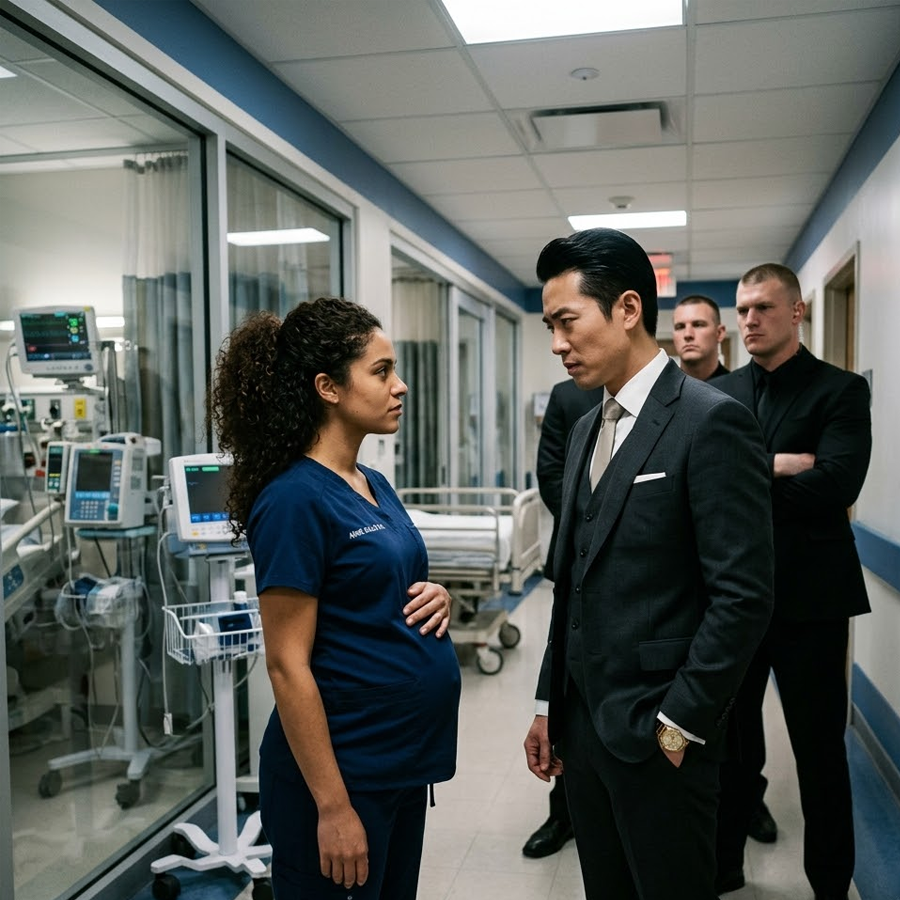
Do you know who I am? The sound hit before the pain did. Sharp, flat, wrong. The kind of sound that doesn’t belong in a hospital. Annie staggered. One hand went to her face. The other went to her stomach. Nobody moved. Not the nurses. Not the doctors. Not one single person in that hallway because nobody hits a pregnant nurse in the middle of an ICU.
Nobody does that. And yet the clipboard was on the floor. Annie’s eyes were wet. and CO Jin Wu was still standing there fixing his cufflink like he hadn’t just changed everything. That’s when the doors at the end of the hall opened, slow, quiet, deliberate. One man walked in.
No suit, no guards, no noise, just presents. And the most powerful man in the room forgot how to breathe. The ICU never slept. Machines hummed, monitors beeped. The air smelled like antiseptic and urgency. Every second in here meant something. Every decision had a consequence. Annie Dello knew that better than anyone. 6 years on this floor, 12-hour shifts, 7 months pregnant.
Still the first person called when everything went wrong. Still the one who stayed calm when nobody else could. She didn’t talk about her family. Didn’t mention her last name unless she had to. Didn’t let that world anywhere near this one because she had worked too hard for this life. built it herself with her own hands.
Her own sacrifice away from the shadows she grew up in. But some shadows don’t disappear. They just wait. The doctors rushing past her didn’t know. The nurses who leaned on her didn’t know. The hospital chief cashing donor checks definitely didn’t know. And the man who just walked through her ICU doors, powerful, untouchable, used to getting everything he wanted. He didn’t know either.
He looked at Annie and saw a pregnant nurse. soft, alone, unprotected. He had no idea who her brother was. Her feet hurt. Not the kind of hurt that goes away after a sit down and a cup of coffee. The deep kind, the kind that lives in the bones. Annie had been on shift for 9 hours. Three more to go. She hadn’t eaten since the granola bar she’d shoved in her pocket at 6:00 a.m.
She pressed one hand to the small of her back, grabbed a chart off the rack with the other, and kept moving. Because that’s what you did here. You kept moving. Room 4 needed vitals. Room 7 needed a medication update. The patient in room 11, Mr. Ady, 63, post bypass, stubborn as a wall, needed someone to sit with him for 5 minutes and pretend the numbers looked better than they did.
Annie was good at all of it. Had been since her first year, before the pregnancy, before the backachches and the swollen ankles and the way her scrubs didn’t sit right anymore. 7 months. She touched her stomach without thinking. A reflex now like breathing. Her daughter moved. A small slow roll. Still here. Still okay. That was enough.
Her badge caught the fluorescent light as she turned the corner. Annie Dio. I see you. R. And she tucked it back against her chest like she always did. Old habit. The Dio name meant something in this city. Not the kind of something you put on a hospital badge. The kind you whispered.
The kind that made men in expensive rooms go quiet and careful. Her brother had built that piece by piece, year by year, in rooms Annie had never visited and never asked about. She had made her choice at 22. Nursing school, night shifts, a life that was hers alone. Malik had respected it. Never called unless she called first. Never showed up, never let the two worlds touch.
She had a number saved in her phone under a single letter. She hadn’t dialed it in 4 years. She didn’t plan to. Annie clipped the chart, straightened her back, and walked toward room 4. She had patience. She had a job. She had 3 hours left on a shift that wasn’t going to finish itself. She didn’t have time for anything else. At 2:09 p.m.
, the elevator at the end of the hall dinged. She didn’t look up. She should have. She heard him before she saw him. Not shouting, not yet. Just the kind of voice that expected everything around it to stop. I don’t wait. Annie looked up from room four’s chart. At the end of the corridor, three men had stepped off the elevator. Then a fourth.
The first three were big, quiet, positioned, not walking beside their employer, but around him, like parentheses around something valuable. They weren’t hospital security. They weren’t family. They were something else entirely. The fourth man was Sio Gene Wu. She knew the name. Everyone in the city knew the name.
His face was on the side of two buildings downtown. His donations paid for the new cardiac wing three floors below her feet. He wore a suit that cost more than her rent. Dark, perfectly cut, not a wrinkle on it. His watch caught the light. His expression caught nothing. He was already talking to the charge nurse at the station.
A young woman named Priya, who had been on the job for 4 months and was not prepared for this. I need a room, Gene Wu said. Now, Priya blinked. Sir, this is the ICU. We only admit. I didn’t ask what you admit. He set his right hand flat on the counter. A white bandage wrapped his palm. Clean, barely spotted with blood. A kitchen cut, maybe glass.
Nothing that needed an ICU bed. Nothing that needed this floor at all. Annie clipped the chart and walked over. Slow, steady, the way she always moved when something was about to go wrong. Mr. Gene Woo. Her voice was calm. I’m Annie Dallo, charge nurse on this floor. Can I take a look? He turned, looked at her the way people like him always looked, starting at the badge, moving to the belly, ending somewhere that wasn’t her face.
Deciding in about two seconds, that she didn’t matter. I want a room with a door, he said. Private, and I want a doctor, not a nurse. Behind him, one of the three men shifted his weight just slightly. Just enough. Annie had worked this floor for 6 years. She had dealt with terrified families, grieving spouses, drunk men who swung first and apologized later.
She knew how to read a room, and this room was telling her something very clearly. This man had never once been told no. Room 6 was the only private room on the floor. It had a door, a window, a chair for family, and a 67year-old man inside it whose heart had stopped twice in the last 18 hours. Mr. Okapor was not stable.
He was not improving. He was alive because Annie and her team had not left his side since yesterday morning. Gin Wu pointed at the door. That one. Annie stepped between him and the door without thinking. Not dramatically. Not with a speech. Just stepped. That room is occupied. She said critical patient postcardiac arrest.
He can’t be moved. Gene Wu looked at her the way you look at a door that won’t open. Confused first, then annoyed. Move him somewhere else. There is nowhere else. and he said, “Every bed on this floor is occupied by someone fighting to stay alive. Your hand needs cleaning, a few stitches, and a bandage change.
The ER downstairs can do all of that in 20 minutes.” Silence. The three men behind Gene Wu didn’t move, but something in the air shifted the way it does right before weather turns. Gene Wu reached into his jacket slowly, deliberately, like he was giving her a chance to change her mind. He set a checkbook on the nurse’s station counter, uncapped a pen, wrote something, turned it around.
The number had a lot of zeros for the hospital, he said. For whatever fund needs it most in exchange for one room, 1 hour. Annie looked at the check, then back at him. Mr. Okafor has a daughter, she said quietly. She drove 4 hours to get here this morning. She’s sitting in the family room right now because I told her we were doing everything we could.
She let that land. I’m not moving him. Not for that number. Not for any number. Gene Wu capped the pen, set it down on top of the check. Very carefully, when he looked up, something behind his eyes had gone flat. Not angry, not loud. Worse than that. Decided. You have no idea, he said softly.
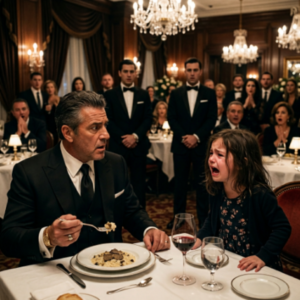
What you just did? Annie held his gaze. Steady, tired, unmoving. Neither do you. He didn’t yell. That was the thing nobody would talk about later. He didn’t even raise his voice. He just moved one step forward, arm out, open hand, like swatting something small out of his way. The sound cracked through the corridor. Sharp, flat, final.
Annie’s head snapped sideways. The clipboard left her hand. She didn’t feel it go. She just heard it. The corner catching the floor, papers sliding out. The metal ring binder ringing once against the tile like a small bell. Her back hit the wall. Her hand went to her stomach. Instinct, pure and absolute. The baby moved. Still there. Still okay.
She pressed her palm flat and breathed. Nobody moved. Priya had both hands over her mouth. Dr. Msa, halfway out of room 9, stood frozen with one hand still on the door. Even Gene Wus men were still. Gene Wu fixed his cufflink. That was it. That was all. Like nothing had happened. Like she was furniture he’d bumped on the way past.
Give me a different nurse,” he said to no one in particular. Annie’s cheek burned. Her eyes were wet. Not crying, just the body’s automatic response to shock and impact. She would not let them fall. Not here. Not in front of him. At the far end of the hallway, past the nurse’s station, past the supply room, half hidden in the shadow where the corridor bent toward the stairwell, a man in a dark coat stood completely still.
He had been there for 11 minutes. Nobody had noticed him arrive. Nobody had asked him to leave. He watched Annie’s hand press against her stomach, watched the clipboard on the floor, watched Gene Wu turn his back like the whole thing was already forgotten. Then he reached into his coat pocket, pulled out a phone, typed without looking down for words, he pressed send, slid the phone back into his pocket, and waited.
Two floors below, in the parking structure, seven black cars sat idling. They had been there since 1:50 p.m. Also waiting. On the floor, Annie’s papers spread out around the fallen clipboard like scattered wings. Room assignments, patient notes, medication charts, everything she had been carrying. She pushed off the wall, bent down slowly, picked up the clipboard, then the papers.
One by one, her hand was shaking. She made it stop. She had three patients who still needed her. Dr. Harlon Cole had been chief of medicine for 11 years. In that time, he had fired six nurses. He did not enjoy it, but he was very good at it. He didn’t look at Annie when she walked into his office. He was looking at his desk, at a folder, at his hands, anywhere but her face.
That told her everything before he said a word. Annie, he cleared his throat. What happened on the floor today? He hit me, she said. Flat, simple, a fact. Cole nodded slowly. I know, and that’s that’s not something we take lightly. He hit a pregnant nurse in the middle of the ICU, she said in front of six witnesses.
Silence. He opened the folder, slid a single page across the desk toward her. Didn’t meet her eyes. Mr. Gene Wus legal team contacted the board 40 minutes ago, he said quietly. They’re framing the incident as a a response to provocation. That you refused care, that you were aggressive. I was doing my job. Annie, I was protecting a critical patient. I understand that.
He finally looked up and the worst part, the part that would stay with her was that he did understand. She could see it. But his donations fund 40% of this floor’s operating budget. The board met an hour ago. They’ve made a decision. She looked at the paper. Termination of employment. Effective immediately. Pending investigation into conduct and patient care protocols. Conduct. Her conduct.
6 years. She said, “Not to him. Not really.” She stood, didn’t sign the paper, didn’t touch it, walked back to the ICU one last time to collect what was hers. A spare pair of shoes, a cardigan she kept in the bottom drawer, the small frame photo she taped inside her locker. Her and her mother years ago, the day Annie got her nursing license.
Priya tried to say something in the hallway. Annie shook her head gently. Not now. Security walked her to the front entrance. Professional apologetic following procedure. The door slid open. The rain hit her face before she’d even taken a step. Cold, heavy, indifferent. She stood on the top step with a paper bag against her chest and 7 months of life pressing against her ribs from the inside.
She didn’t look back at the building. She already knew what it looked like. She had given it 6 years. It had given her a paper bag in the rain. She made it home before she stopped moving. set the paper bag on the kitchen counter, took off her shoes, stood in the middle of her apartment in wet socks, and didn’t do anything else for a long time.
The rain tapped the window. The refrigerator hummed. The rest of the world kept going, indifferent and steady, the way it always does. She checked her phone out of habit. Three missed calls from a number she didn’t recognize. A voicemail from someone identifying themselves as council for Coin Wu International Holdings. She didn’t listen to it.
She already knew what it would say. She opened her banking app instead and went still. Her main account frozen. Her savings frozen. A legal hold, the screen said, pending civil litigation. Pending investigation into conduct and patient care protocols. Her words back at her turned into a weapon she hadn’t seen coming.
She sat down on the kitchen floor, not the chair, the floor. Back against the cabinet, knees up, one hand on her stomach. Rent was due in 9 days. Her prenatal appointment was Thursday. She had $40 in cash in her coat pocket and a half empty box of crackers in the cupboard above the stove. She thought about her mother, about what she would say, about the particular way she used to hold Annie’s face in both hands when things got bad and say, “You are not alone, baby. You are never alone.
” The apartment was very dark. She hadn’t turned on a single light. Her phone was still in her hand. She turned the screen on, scrolled slowly. Past contacts she hadn’t called in months. Past names she didn’t have the energy for tonight. She stopped at a single letter. M. She had saved it 4 years ago.
After their mother’s funeral, when Malik had pressed his phone into her hand and said, “Just in case, you never have to use it, but it’s there.” She had transferred the number to every new phone since without ever asking herself why. Her thumb hovered. The baby kicked hard, insistent, like she already knew. Annie closed her eyes, took one breath, then another, then she pressed call.
It rang once, just once. Gene Wu woke up to 17 missed calls. That had never happened before. His head of finance, his legal team, three board members whose names appeared on buildings, all calling, all at once, all before 6:00 a.m. He sat up in bed and opened his trading app and stared. Gin Wu Holdings was down 31%.
In a single night, no news cycle, no earnings report, no market event that could explain it, just gone. He called his finance director. No answer. Called again. Voicemail. He moved to his laptop, pulled up the offshore accounts, four of them spread across three countries, the kind that don’t appear on any public filing. Empty. All four.
Zeroed out with a cleanliness that felt almost surgical. No trace, no transfer record, no error message, just white space where the numbers used to be. He was still in his robe when his head of security knocked. Came in without being told to. That was the first sign. The man said, an envelope on the desk. Ivory, thick paper, no stamp, no return address, just a single black seal pressed into the back flap.
A wolf’s eye. Gene Wu looked up. His security chief, a man who had worked for him for 9 years, a man who had done things that could not be written down, was already stepping back toward the door. “What are you doing?” Gene Wu said, “Leaving,” the man said simply. “I’ll double your rate.” The man shook his head, not negotiating, not hesitating. “Just done.
There isn’t a number,” he said quietly. “Not for this.” He glanced at the seal on the envelope. “Not for him.” He left. Within the hour, for more followed. By noon, Gene Wus penthouse floor, usually staffed by 12, held exactly two people. Him and a lawyer too young to know better. Gene Wu opened the envelope.
One page inside, no letter head, no signature, just a time, a location, and four words at the bottom of the page. Come alone or don’t. He read it twice. Then he sat very still in his very expensive chair in his very empty penthouse. And for the first time in 15 years of having everything, Cio Gene Wu was afraid. The location was a restaurant closed, empty, the kind of place that seated 200, but tonight held exactly too. Gene Wu had arrived first.
He told himself that was a choice. Malik Dio walked in at exactly the time the note had said. Not a minute early, not a second late. He was not what Gene Wu expected. No entourage, no visible weapon, no performance. Just a tall man in a dark jacket who moved through the empty restaurant like he owned it. Because Gene Wu would later learn he did.
He sat down across the table, didn’t order, didn’t speak, just looked at Gene Wu with the particular patience of someone who already knows how the night ends. Gene Wu broke first. He always would have. You’ve made your point, he said. Name a number. We settled this quietly and Malik set a tablet on the table, turned it to face him, pressed play. I see you footage.
Time stamp 2:14 p.m. Crystal clear every angle. Annie with her clipboard. The refusal. The check Gene Wu had slid across the counter and then the slap. Her head snapping sideways. Her hand going to her stomach. The clipboard on the floor. Gene Wu fixing his cufflink. The footage kept playing. Annie bending down in the hallway, picking up her papers one by one, hand shaking, making it stop. Malik pressed pause.
Let the silence do its work. “I don’t want your money,” he said. His voice was quiet, unhurried, the kind of calm that takes years to build. “I don’t want a settlement. I don’t want an apology,” he slid a document across the table. “Fick, bound, already prepared. Every page tapped, every line marked.” “You hit my sister,” Malik said. 7 months pregnant.
In the middle of doing her job, he leaned forward slightly. Just slightly. Sign it. Gene Wu looked at the document. His holdings, his properties, the hospital donation portfolio, everything with his name on it, offered back to the world without him. And if I don’t, Malik glanced at the frozen frame on the tablet. Annie’s hand on her stomach.
That footage goes to every desk that matters, he said simply. every regulator, every partner, every journalist who has ever wondered where your money comes from. And then I come back. He didn’t elaborate. He didn’t need to. Gene Wu picked up the pen. His hand didn’t shake. But his eyes, when he finally looked up, were the eyes of a man who understood too late the difference between power and protection.
He had built one. Malik had always had the other. She weighed 6 lb 4 oz. had a full head of dark curls and her grandmother’s nose and the loudest cry Annie had ever heard in 20 years of being near hospitals. Annie held her against her chest and didn’t say anything for a long time. Just breathed, just listened. The room was warm.
The monitors were soft. Outside the window, the city moved in its usual way. Indifferent, alive, unbothered. But this hospital was different now. The name on the building had changed 3 weeks ago. quietly. No press conference, no ribbon cutting, just new signage one morning and a memo to staff that said under new ownership effective immediately.
All existing patient care staff to be retained at increased compensation. Priya had called Annie crying. Dr. Mensah had left a voicemail he clearly didn’t know how to end. Even Cole, Dr. Harlon Cole, chief of medicine for 11 years, had sent a single text that said only, “I’m sorry, Annie. I should have done better. She hadn’t replied yet.
Maybe she would, maybe she wouldn’t. She had time now. The door opened quietly. Malik came in the way he always moved. Without announcement, without noise. He stopped at the foot of the bed and looked at the baby the way big men sometimes look at small things. Carefully, like he was afraid of getting it wrong. Annie held her daughter out.
He sat down, took her in both hands, and the man who had emptied four offshore accounts and cleared a penthouse floor without raising his voice went completely soft. “She looks like mama,” he said. “I know,” Annie said. They sat with that for a while. Across the city, in the same rain that had met Annie on the hospital steps 3 weeks ago, Sio Gin Wu stood outside a building that no longer had his name on it.
No coat, no car waiting, no men in suits behind him, just him and the rain and the particular silence of a man who had spent his whole life buying rooms and had finally run out of buildings. He looked up at the new sign, read the name, stood there a moment longer than he should have. Then he turned up his collar against the cold, and walked away into the same rain that had no interest in him whatsoever.
Back in the warm room on the fourth floor, the baby made a small sound, settled deeper into her uncle’s arms, and slept. She had no idea what her last name would mean. One day, she would learn. And that is where Annie’s story ends. A woman who asked for nothing but to do her job. Who protected a stranger’s life when it would have been easier to look away.
Who held herself together on a kitchen floor in the dark and made one phone call that changed everything. She never needed saving. She just needed her brother to find out if this story hit different. If you felt every single chapter, do me a favor.
THE END