The note was written in a hurry. Anyone could see that from the handwriting alone — not the careful, deliberate letters Victoria used when she signed permission slips for school trips, but something uneven and slightly tilted, the script of a person who had made a decision and was moving before the decision could be questioned.
She stuck it to the refrigerator at 5:48 in the morning. She held it there with a piece of tape until it stayed. She did not look at the family photos on the mantel, or the drawings held up by magnets on that same door. She picked up her suitcase, walked to the waiting car at the curb, and drove away into the gray Chicago dawn.
Behind her, in three separate bedrooms, her children slept.
Liam was nine. Ivy was six. Paul was three.
The note said she couldn’t do it anymore. That she needed a different life. That one day, they would understand.
There were no apologies. There were no instructions on what to do next. There was no phone number. There was nothing that said: here is how you feed your brother when the milk runs out, or here is what you tell your sister when she wakes up asking where I am.
There was only the note, and the sound of a car engine receding into the distance, and the silence it left behind.
Liam woke at six. He lay in bed for a few minutes with the particular alertness of a child who had learned to read his home the way a sailor reads a sky. No coffee smell. No radio. No sound of floorboards. He got up, his feet cold against the hardwood, and walked to the kitchen.
He read the note once. Then twice. Then a third time, as if repetition might change what the words said.
From the next room came the sound of Paul crying — the sharp, insistent cry of a three-year-old who woke up hungry and didn’t yet have the language to be patient about it. The sound reached into Liam’s chest and pulled him upright the way nothing else could have in that moment. He folded the note with trembling fingers, pressed it deep into the pocket of his pajamas, and went to get his brother.
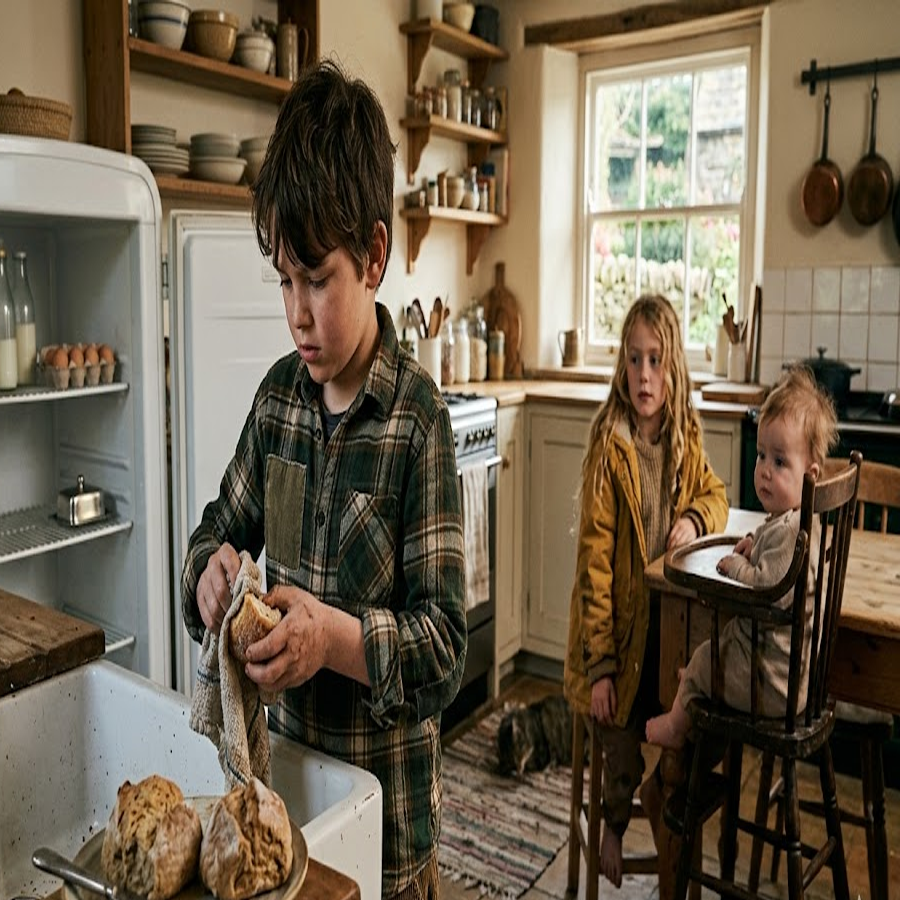
He carried Paul to the kitchen. He found cereal. He fed the baby one piece at a time so he would eat slowly and the box would last. He thought about inventory — the bread was getting hard at the edges, the milk was low, the pantry had cans at the back that he couldn’t fully assess yet. He was nine years old and he was already doing the math of survival.
When Ivy appeared in the doorway, rubbing her eyes, asking where Mommy was, he told her she had gone out early for an errand.
The lie tasted like copper. Ivy believed it without question. She sat down at the table and ate her dry cereal with the trusting ease of a child who had never been given a reason to doubt the people who loved her. Liam watched her eat and understood, in the specific way of children who are forced to grow up too fast, that the world was going to break her heart at some point and he could not stop it. He could only delay it.
He kept them home from school. He told Ivy it was a special holiday, just for the three of them. He cleaned the kitchen. He inventoried what they had. He heated canned soup standing on a chair to reach the burner, burned his finger on the side of the pot, put it in his mouth without making a sound, and kept stirring. He gave Paul and Ivy the most. He ate what was left at the bottom.
That first night, after they were asleep, he sat in the dark living room with the lights off — afraid of what it might signal to the outside world if someone saw activity and asked questions — and watched the front door. He held the note in his pocket and did not let himself cry, because crying was for after, and there was no after yet. There was only now, and the next hour, and the hour after that.
In apartment 4B, the one that shared a wall with theirs, Rose was awake.
She was sixty-eight years old. A widow for twelve years. She had raised four children in this building and had lived on this street long enough to know every sound it made — the particular creak of the third-floor staircase, the way the wind changed pitch when it came around the east corner, the specific quality of the silence that meant something was wrong.
She had seen Victoria’s car leave in the dark before six in the morning. She had noticed, as Tuesday passed into afternoon and then into evening, that no one had left for school and no car had returned. She pressed her ear to the shared wall once, briefly, and felt the unnatural stillness on the other side of it.
She sat in her recliner that night and thought about what she had heard — and what she hadn’t heard. She thought about the line between minding your own business and being responsible for the world immediately around you. She had spent a long time on that line. She was sixty-eight years old and she had lived long enough to know which side she had to be on.
The second day, she heard the crying start.
Not the ordinary crying of children — the bumped-knee cry, the refused-cookie cry. This was something else. Rhythmic and grinding down, a wail that had been going for too long and was running out of fuel. She went to her window. She stood at her phone with her thumb over three digits. She hesitated.
She went to the door.
The third day, just before sunset, she knocked.
Liam was on the kitchen floor, his back against the oven, feeding Paul cold beans from the last can in the pantry. Ivy was at the table with her head on her arms, staring at a fixed point on the wall. She hadn’t spoken in hours. The light in the kitchen was dim, the single bulb throwing more shadow than illumination.
The knock was soft at first. Liam froze. He did not breathe. He calculated whether they could get down the hall before another knock came, whether a toddler and a six-year-old could believably be somewhere other than the kitchen, whether silence was still an option.
Then Paul made a sound. Small and thin and completely unmanageable.
Liam stood up, set Paul in the high chair, and walked to the door. He turned the deadbolt. He opened it a crack.
Rose looked at him.
She looked at the dark circles under his eyes and the stained clothes and the way he was physically blocking the view of the apartment behind him and the plastic spoon still in his hand with a single bean clinging to the edge of it. She looked at this nine-year-old boy who had been holding everything together for three days on four hundred calories and no sleep and no help.
She did not ask for permission. She did not wait for an invitation. She pushed the door open gently and walked in.
“When did she leave?” she asked. Her voice was low and without judgment.
Liam reached into his pocket. He held out the note like a white flag.
Rose read it. Her jaw tightened once. Then she walked back to her own apartment, left the door ajar, and returned four minutes later with her arms full of groceries. Bread. Eggs. Milk. Ham. She set the bags on the counter and began to cook.
The sound of butter sizzling in the pan was, Liam would later say, the most beautiful sound he had ever heard in his life.
Ivy lifted her head. Paul’s eyes tracked Rose’s movements with total, riveted attention. Liam stood in the doorway of his own kitchen and watched a stranger cook eggs for his family at six in the evening and felt the thing he had been holding in his chest for three days begin to crack.
Rose served them. She sat them at the table. She made sure each child had a glass of milk and enough on their plate. She didn’t push them to talk. She watched them eat with the ravenous, concentrated intensity of children who had been hungry for too long, and she did not allow herself to cry until she was turned toward the stove so they couldn’t see her face.
When Liam’s plate was empty, she put more on it without asking. He started to say something about the others needing it. She put her hand on his shoulder.
That was the moment. That single, quiet gesture of: you are allowed to be fed. You are allowed to need something. You are nine years old and you do not have to be in charge of this anymore.
Liam began to sob — hard, shaking sobs that came from somewhere deep and had been stored there for three days. Rose pulled him into her lap and rocked him the way she had rocked her own children, and she held him until the shaking stopped.
That night, Rose bathed the children, found clean pajamas in their drawers, and put them to bed. She sat in the living room afterward and looked at the phone for a long time. She knew what she had to do. She also knew the risk.
DCFS. A caseworker. The system. The possibility that they would be taken to a shelter, separated, placed with strangers in different parts of the city. She had seen it happen. She knew the arithmetic of an overwhelmed system.
She waited until she was certain all three children were deeply asleep. Then she made the call.
The caseworker, Sarah, arrived the next morning. She tracked down Robert, the father. The trucking company told her he had quit two days before Victoria left and hadn’t been seen since. He had vanished into the highway network of the American Midwest, a man who had decided the road was easier than what waited at home.
The children were officially abandoned.
Sarah looked at the three of them. She looked at Rose standing protectively behind Liam. “They’ll have to go to a shelter,” she said. “Until we can find permanent placement.”
“No,” Rose said. Her voice was the voice of a woman who had made her decision before the caseworker arrived. “They are not going to a shelter. I have a three-bedroom apartment next door. I have the resources and the time. I want to apply for emergency kinship status. They know me. They are not going to a shelter.”
Sarah looked at the older woman and the children clustered around her and made a series of phone calls. She spoke to her supervisor. An emergency hearing was arranged. Because of the circumstances, Rose’s clean record, and the simple fact that the shelter system was overwhelmed and a stable, willing adult was standing in the room, the judge granted temporary emergency custody.
The move happened that afternoon. It was forty feet down the hallway. It felt like a different world.
Rose’s apartment smelled like lavender and old books. It had comfortable chairs and the kind of order that came from decades of a person knowing exactly where everything belonged. It was the opposite of the silence they had been living in — it was the silence of a home that was at rest rather than a home that had been emptied out.
She rearranged her guest rooms. She bought new clothes and new books and established a routine with the consistency of someone who understood that children needed to be able to predict the next hour. Breakfast at seven. School. Dinner together. Every night. No exceptions.
The first months were hard.
Paul woke up screaming. Ivy became so clingy she would not let Rose leave a room without following her. Liam watched Rose’s decisions with the wary, assessing eye of a boy who had learned not to trust the stability of any arrangement, who had learned that everything could change at five in the morning without warning.
It took time — months of it — for him to slowly, incrementally understand that he was allowed to be nine. That the food would be there tomorrow. That he did not have to stand guard. That someone else was holding the captain’s wheel now, and that person was not going anywhere.
As the months became a year and the year became two, the temporary arrangement stopped feeling temporary. Victoria did not call. She did not write. She did not send a birthday card for Liam’s tenth birthday or Ivy’s seventh or Paul’s fourth. She did not appear in any legal proceedings when the state of Illinois moved to terminate parental rights, a process that was slow and heartbreaking and entirely necessary.
Rose sat in the courtroom holding Liam’s hand when the judge signed the papers.
She was no longer just the neighbor.
The transition from Mrs. Rose to Rosie to something that didn’t have a name but functioned like Mom happened in the small, unannounced moments that family is actually made of. It was in the way she helped Ivy with math at the kitchen table at nine o’clock on a Tuesday. The way she was the loudest person at Liam’s Little League games. The way she held Paul after he scraped his knee on the stairs, and the way he pressed his face into her shoulder and let himself be held by someone who always, reliably, stayed.
Liam grew into a tall, serious teenager who excelled in school and decided early that he wanted to be a lawyer. Not for the prestige. For the children who were lost in the cracks of the system. For the ones who needed someone to argue on their behalf in rooms where decisions were made by people who had never sat on a kitchen floor feeding cold beans to a toddler.
Ivy became the creative heart of the family. She wanted to be a teacher. She wanted to build a classroom that felt as safe as Rose’s living room — a place where no child ever had to perform stability they didn’t feel. She was the one who remembered birthdays and made cards by hand and made sure Rose always knew she was appreciated, because Ivy understood what appreciation cost and what it was worth.
Paul, who had no memory of his biological parents at all, grew up assuming that the world was the way Rose had made it — consistent, warm, full of books and the smell of lavender and someone in the next room who would answer when you called. He became a biologist. He studied the way ecosystems were connected, the way living things sustained each other across distances they couldn’t see. He didn’t know it, but he was studying the principles of the life he had been given.
Victoria found them online when she was in her late fifties.
She had spent years with Henry, the man she left with, until he left her the same way she had left her children — without a note, without warning, one morning while she was at work. She spent the decade after that drifting through cities she didn’t belong to, working jobs that didn’t sustain her, carrying a guilt that grew heavier with every year she failed to turn toward it.
She found Liam’s name on a Chicago law firm’s website. She found Ivy at a school awards ceremony. She found an article about Paul’s research on local ecosystems. Seeing them as adults — successful, full-formed, living — was like looking at a life she had been excised from. She saw the woman in the background of their photos. Silver hair. Steady posture. Her children leaning into her. She recognized the neighbor.
She bought a bus ticket to Chicago. She walked the old streets. She climbed to the fourth floor of the building and stood in front of Rose’s door for a long time before she pressed the buzzer.
Rose answered. She was eighty-six now, her face carrying the weight of all the years she had put in, but her eyes were still sharp and clear. She looked at the woman in the hallway and did not immediately recognize her. Then she did.
She didn’t scream. She didn’t slam the door.
“I know who you are,” Rose said. “What do you want?”
The three of them came within the hour. Liam in his suit from a morning meeting. Ivy pale, her hands trembling. Paul straight from his lab, his expression one of confusion rather than pain.
Victoria looked at her children across the room. She looked at the people they had become — the width of Liam’s shoulders, the curve of Ivy’s jaw, Paul’s eyes — and she felt a pride that was entirely without the right to be called pride, because she had played no part in it.
Liam spoke first. His voice was level and cold with the specific coldness of a man who had been a boy with cold beans and a plastic spoon.
“You left a note on the fridge. You said we would understand one day.” He stood. “I’m twenty-eight. I still don’t understand how you could leave a three-year-old, a six-year-old, and a nine-year-old with nothing but a can of beans and a note that offered nothing.” He looked at her directly. “You didn’t just leave us. You stole our childhood.”
Ivy’s voice was a whisper. “I forgive you,” she said. “Not because you deserve it. Because I can’t carry the weight of hating you anymore. It’s too heavy.” She looked at Rose in her armchair. “I already have a mother. Rose is the one who brushed my hair. Rose is the one who went to my parent-teacher conferences. Rose is the one I call when I have good news.”
Paul was last. He looked at Victoria with the polite curiosity of someone looking at a stranger. “I don’t remember you,” he said. “I have no memory of your voice or your face. You can’t be angry at someone who never existed in your world. My life is full. It’s been full since the day Rosie knocked on our door.”
His words were perhaps the most devastating of all.
Victoria looked at the three of them and understood, finally and completely, that she had come seeking a reunion that did not exist. The story had been written without her. She was not the protagonist of this story. She was a footnote.
She stood up. “I understand,” she said. “I’ll go.”
Liam stepped forward. No hug. No handshake. “I hope you find some peace,” he said. “But don’t come back. We’ve built something beautiful here, and it doesn’t have a place for you.”
She nodded. She walked to the door. She heard it click behind her. She went down the stairs and out into the cold Chicago afternoon and walked away — not running this time, not chasing anything. Simply gone. For the first time in twenty years, she wasn’t moving toward something or away from something. She was just alone with what she had done and what it had cost her, and the knowledge that the people she had hurt had not needed her to survive it.
In the apartment, the four of them sat together after she left. Paul went to the kitchen and made coffee. The beans grinding, the water boiling, the ordinary sounds of a life continuing. Ivy sat on the floor by Rose’s feet, her head resting on Rose’s knee. Liam stood at the window looking out at the city he had made his own.
Rose reached out and stroked Ivy’s hair. Her hand trembled slightly with age.
“You did well,” she said. “All of you.”
The sun set over the Chicago skyline. Golden light moved across the living room. They sat together and talked about small things — Paul’s research, Ivy’s students, Liam’s case — and the shadow of the past was acknowledged and faced and laid to rest.
They were not the abandoned children in a silent apartment anymore.
They were the architects of everything that had come after.
THE END