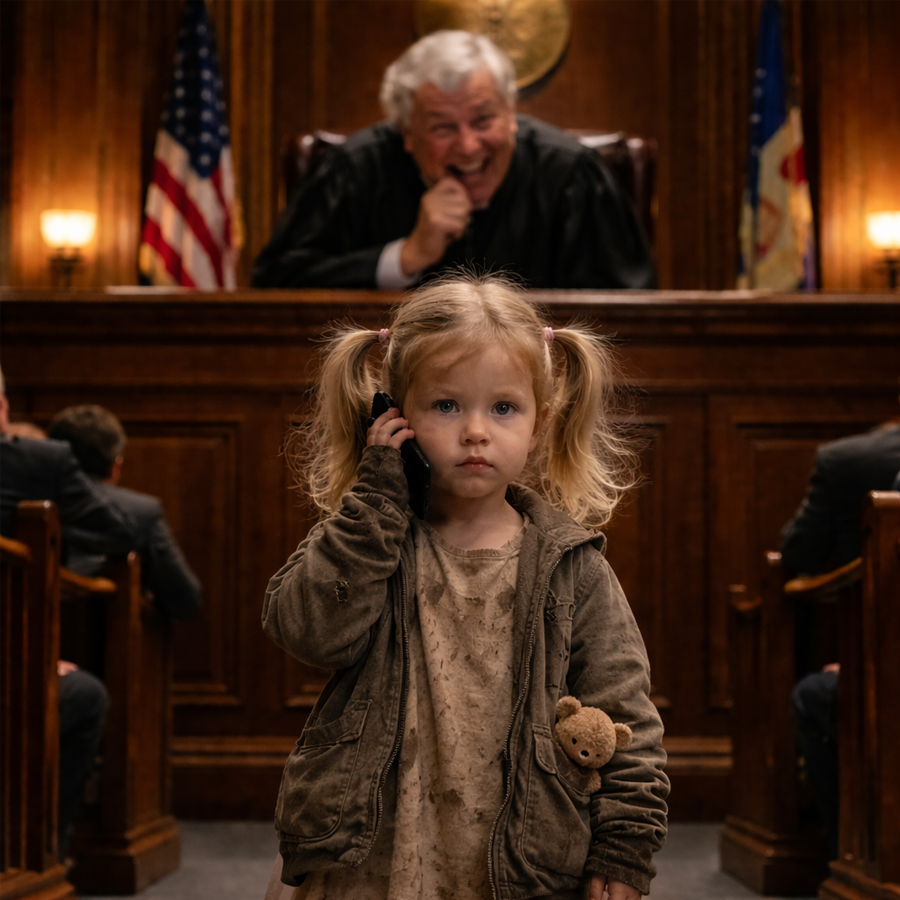
The laughter of Judge Henry Miller echoed through the grand oak-paneled courtroom like a sudden roll of Georgia thunder. It was one of those rare, uncontained bursts of mirth, the kind that escapes before a person of high standing can remember their dignity. He leaned back in his high-backed leather chair, his face reddening as he slapped his palm against the polished surface of the dark mahogany bench.
The lawyers in the front rows, accustomed to his stern demeanor and sharp tongue, exchanged bewildered glances. The bailiff, a man named Benjamin with a back as stiff as a pine tree, stared toward the high ceiling as he always did when the judge veered off the tracks of formal protocol. And then, there was the tiny girl in the pastel pink dress, standing right in the center of the well of the court.
She held a black smartphone to her ear, yet as serious as a stone, completely oblivious to the waves of laughter and confusion she had just unleashed upon the room. She did not blink, nor did she waver under the weight of a dozen staring eyes. She was perhaps four or five years old, with her blonde hair tied into two bouncy pigtails secured by pink ribbons that swayed slightly every time she tilted her head to listen to the dial tone.
There was an expression on her face that only children can truly master. The absolute, unshakeable conviction that what they are doing is the most reasonable and necessary thing in the entire world. Her name was Mia, and she had just performed a feat of silent agility that would have impressed a seasoned spy.
During a break in a particularly grueling custody hearing, she she had slipped away from her grandmother in the gallery and approached Claude Foster, a 52-year-old attorney known for his expensive suits and cold efficiency. With the quiet grace of a shadow, she had lifted his phone from his coat pocket and retreated toward the judge’s bench. She hadn’t run or hidden.
She had simply stood there and dialed a number with the calm deliberation of a master strategist. Judge Henry Miller had been the first to notice the movement out of the corner of his eye. He had watched the small human in pink navigate the sacred space between the public and the law. When he heard the faint digital beep of a keypad, he looked down over his spectacles.
“What are you doing there, little lady?” the judge had asked, unable to keep the corners of his mouth from twitching into a smile. “Calling,” she replied, but her voice small but remarkably steady. “Calling who?” the judge pressed, amused by the sheer audacity of the child. “Whoever I want,” she said. And that was when the explosion of laughter occurred.
That was when Benjamin sought solace in the ceiling tiles, and the lawyers realized the gravity of the courthouse had been momentarily suspended. Even Claude Foster, the owner of the stolen phone, opened his mouth to protest, closed it, and decided it was more prudent to remain silent in the face of such pure, childish defiance.
“Call whoever you want,” Judge Henry said, his voice still thick with amusement as he wiped a tear of laughter from his eye. “Call whoever you want, little lady.” He gestured with a wide hand, inviting the courtroom to witness the spectacle of a child exercising her right to speak. The room waited, all caught in a rare moment of levity.
But then, the phone was answered on the other end, and the laughter died.
It didn’t die all at once, like a candle being blown out by a gust of wind. Instead, the mirth drained away like a fire being denied its fuel, slowly, as the judge realized that something profound was shifting in the air. Henry Miller’s smile faded into a thin line, his bushy eyebrows rose toward his hairline, and the entire hall, which a second ago had been filled with the most spontaneous joy those walls had heard in years, fell into a suffocating silence.
Someone had answered, and the voice that came through the speaker was clear enough to vibrate in the stillness. It was a voice that Judge Henry Miller knew better than his own heartbeat. It was the voice of his daughter, Isabella. “Mia?” “Mia? Baby? And is that you?” The name of the child, the voice of the woman who hadn’t spoken to her father in over two years, the daughter who had moved to another state and blocked his number on every device she owned.
The judge sat frozen, his hand still suspended in the air where he had been gesturing, like an actor who had suddenly forgotten every line of the play. The eyes of the room were now fixed on him as much as they were on the child. Isabella had told him, the last time they spoke, that she never wanted to see him again until he understood the gravity of his failures.
Now, her voice was filling his courtroom, brought there by a child he barely knew. Mia held the phone with both hands now, her eyes fixed on the judge with a look of total, unwavering attention. “Mommy!” Mia cried out, and in that single word, and the courtroom understood that this was no longer a comedy.
To understand what was happening in that Savannah courtroom on a Tuesday in October, one had to go back several years. One had to go back to Judge Henry Miller’s private office on a sweltering afternoon in August, when the humidity was thick enough to choke a person, and the air conditioning had chosen that exact moment to fail. Isabella had been standing in front of the window, her arms crossed tightly, her face a mask of cold fury and exhaustion.
At 31 years old, she was a respected pediatrician, but in that room, she felt like a child begging for a scrap of justice from a man who dealt in nothing but cold statutes. She had come back to her hometown to plead with her father about the custody of Mia. Her ex-husband, Robert, had been using the child as a bargaining chip, uh violating every agreement they had made, keeping the girl for weeks without notice, and refusing to answer calls.
Henry had listened to his daughter with the same expression he used for every stranger in his court, closed, evaluative, and detached. When she finished, he had told her that the situation was delicate, that there were two sides, and that he could not take a side because it would damage his judicial credibility.
He told her Robert was a man he had known for years in the legal community, and that things had to be handled through the proper channels. Isabella had stared at him for a long time, the silence stretching until it felt like it would snap. “You’re telling me you won’t help me?” she whispered. “I’m telling you that you need to follow the law, Isabella,” he had replied.
Sir, her voice had then cut through the heat like a shard of ice. “Mia is 3 years old, Dad. Three. She spent the last week sleeping in a car because Robert didn’t pay the rent on the apartment he takes her to. 3 years old, sleeping in a car, and you’re talking to me about channels?” That was the day the silence began, the day she walked out and left him with nothing but his precious credibility.
The silence of the last 2 years had been a heavy, physical thing for Henry Miller. It started as a temporary rift, a stubborn standoff between a father who believed in the letter of the law, and a daughter who believed in the spirit of protection. But as the months turned into years, the silence grew thick and calcified, and becoming a third person that sat between them at every dinner he ate alone, and every holiday he spent in his quiet house.
He had tried to reach out in the beginning, sending messages through a cousin, writing physical letters that were returned to sender, unopened and unread. He had felt the weight of that silence in his shoulders, a dull ache that followed him into the courtroom every morning. And then, there was Mia.
He had only seen her three times in her entire life. Once when she was born, once during a brief, tense visit before the rift, and once from a distance on a street corner, when Isabella had seen him and quickly turned the stroller in the opposite direction. The girl in the pink dress now standing before him was that same baby, grown into a small person with her mother’s stubborn chin and her mother’s fierce, odd intelligent eyes.
As Henry looked at his granddaughter, the realization began to dawn on him with the slow, agonizing crawl of a truth that refuses to be ignored. How did this child know to call this number? Why would Isabella’s private cell phone number be stored in the contacts of Claude Foster, Robert’s attorney? The answer to that question would take him the rest of the afternoon to fully piece together.
And when he finally understood, it would change every assumption he had made about his life and his career. But for now, in the immediate present, there was only the sound of Isabella’s voice and the sight of Mia who was holding the phone out toward him. Mommy, I’m in a big room. Mia said into the phone, her voice echoing.
There’s a man in a black robe up front. He was laughing. She paused, listening to the frantic and muffled sounds of her mother on the other end. He stopped laughing now, Mia continued. The courtroom, which had been silent, seemed to hold its breath. It was the kind of silence that has a texture to it. Dense, charged, and unforgettable.
Henry closed his eyes for just 1 second. In that heartbeat, he wasn’t a magistrate with 23 years on the bench. He wasn’t the man whose reputation was feared by lawyers. He was just a 61-year-old man whose granddaughter was saying his name in a room full of strangers. When he opened his eyes, Mia was watching him.
She didn’t look afraid. She looked at him with that piercing, unfiltered evaluation that children use to judge the souls of adults. She didn’t have the social graces to hide her curiosity or her judgment. She simply looked at him and decided what he was. Oh, are you Grandpa Henry? She asked. The question was a land mine.
There was the legally correct answer. And then there was the truth. I am, he said, his voice coming out more rugged and broken than he had intended. Mia considered this for a long moment. Her pigtails bobbing as she nodded to herself. She turned back to the phone. Mommy, it’s him. There was another pause, a long stretch of electronic static, and the sound of someone crying softly on the other side of the country.
Yes. Okay. Mia extended the phone toward the judge, her small arm reaching across the gap between the child and the law. She wants to speak to you. Benjamin the bailiff, who had been looking at the ceiling, suddenly found his own shoes very interesting and turned away toward the window. And the lawyers in the front row became deeply fascinated with their legal pads, scribbling nonsense just to avoid being witnesses to the human heart breaking open in public.
Judge Henry Miller did something then that no one in that courthouse had ever seen him do. He descended from the bench. He walked down the three steps that separated his high seat of judgment from the level of the people. He moved with the deliberation of a man who knew he was walking toward a cliff and had decided to jump.
He crossed the few feet of floor that separated him from the girl in the pink dress. He was a large man, his hair silver, and his face lined with the stresses of a thousand cases. And he knelt before her until they were eye to eye. He took the phone from her small, warm hand. Isabella, he whispered. The voice that came back was hers.
Suddenly, it was different, deeper, more controlled, laced with the kind of exhaustion that comes from fighting a war on too many fronts at once. Dad, she said. Just that one word, but it contained 20 years of history. It contained the heat of that August afternoon and the coldness of the letters he hadn’t been allowed to deliver. It contained the birthdays he had missed because he was too busy building a legacy of paper.
Isabella, he repeated because it was the only word he had left in his vocabulary. What is happening, Dad? Why is Mia in a courtroom? And that was when the final piece of the puzzle fell into place. Henry looked out into the gallery, past the lawyers and the curious spectators, to a woman with graying hair sitting in the second row.
She was clutching a large handbag and wearing an expression that was a volatile mix of guilt and fierce determination. It was Elizabeth, his ex-wife, a woman he hadn’t spoken to since their own divorce was finalized years ago. She was the one who had brought Mia here. She was the one who had watched him from the shadows of the gallery, waiting for the moment when the man of law would have to confront the man of flesh and blood.
Isabella, what is this about a treatment? He asked, his voice trembling. There was a silence on the other end, a different kind of silence this time. It wasn’t the silence of anger, but the silence of someone deciding how much of their soul to reveal. Cancer, she finally said. Breast cancer, stage two. I’ve been in chemotherapy for 4 months.
The courtroom seemed to get even quieter, but which Henry hadn’t thought possible. He sat there, a judge on the floor of his own court, with his hands shaking so violently he had to grip the phone with both of them. When were you going to tell me? He managed to ask. When you understood what was more important, she replied.
The phrase hit him like a physical blow. It was the same thing she had said to him 2 years ago, but now it carried the weight of a life-and-death struggle. Mia stood beside her grandfather, watching him with a strange, quiet empathy. Children have a way of sensing when the adults around them are shattering, even if they don’t understand the mechanics of the break.
She reached out and touched the sleeve of his black robe, her small fingers tracing the heavy fabric. Grandpa, she said softly. He looked at her, his vision blurred by tears he hadn’t shed in decades. Can you tell Mommy to come here? In that moment, Judge Henry Miller made a decision that would likely be the talk of the Savannah legal community for the next 10 years.
He looked up at Benjamin and told him to suspend the hearing indefinitely. He told Claude Foster and the other attorneys to wait in a separate room with their clients. He asked everyone else to leave the courtroom. When the heavy doors finally clicked shut and the room was empty of everyone but him, Mia, and Elizabeth, Henry stayed on his knees.
He opened his arms, and after a moment of careful evaluation, Mia stepped into them. She smelled like strawberry shampoo and the faint scent of crayons. She was small and light, but to Henry, she felt like the heaviest responsibility he had ever carried. And he buried his face in her hair and finally let the sobs come. Ugly, racking sobs that tore through his chest and laid him bare.
Mia didn’t pull away. She wrapped her tiny arms around his neck and waited with a patience that he would spend the rest of his life trying to deserve. The phone call was still active, the line open between Savannah and a hospital room hundreds of miles away. Isabella listened to her father cry, and for the first time in 2 years, the wall of ice between them began to show its first cracks.
Life, Henry realized, was not like a court case. You couldn’t just issue a ruling and expect the matter to be closed. Life was the messy, painful process of discovery. The long nights of testimony that didn’t always make sense. And the realization that justice and mercy are often the same thing. Later that night, though after Mia had fallen asleep in a guest room at Elizabeth’s house, Henry sat in his ex-wife’s kitchen drinking a cup of coffee that tasted like regret.
Elizabeth was a woman who solved problems with caffeine and silence, and she sat across from him, watching him with a guarded but not unkind expression. They had been married for 18 years before the career and the ego had pushed them apart. You knew, Henry said, looking at the dark liquid in his mug. I knew she was sick, yes, Elizabeth replied.
And I didn’t tell you because she asked me not to. She wanted to see if you would ever look up from your bench on your own. She wanted to see if you even knew who your granddaughter was. Henry looked at his hands, the hands that had signed thousands of orders, but hadn’t held his daughter in years. I failed her, Elizabeth.
And I failed them both. You did, she agreed, offering him no easy comfort. But you got off the bench today. That’s more than most men like you ever do. Isabella called back around 11:00 that night. They talked for 3 hours. It wasn’t an easy conversation. It was a brutal excavation of 2 years of silence and 30 years of neglect.
Henry didn’t try to defend himself this time. He didn’t talk about his reputation or the proper channels. He just listened. He listened to her talk about the fear of the diagnosis, the sickness from the chemo, and the terror of Robert trying to take Mia away while she was too weak to fight. “I erred,” he said, the words feeling heavy in his mouth.
“Not just in August. I erred when I thought my legacy was the law and not you. I built a name in this city and let my family crumble. And I told myself it was a fair trade because someone had to do the hard work. It wasn’t a fair trade.” There was a long silence on the other end. “I know you know that now,” Isabella whispered.
“But you always knew, Dad. That was always the problem. You knew it was wrong and you did it anyway because it was easier than changing. The truth of her words stung, but it was a clean pain, the kind that precedes healing. He asked her about her prognosis, and she told him the doctors were optimistic. The stage two cancer was responding well to the treatment, and she had two more months of chemotherapy before the surgery.
The chances of a full recovery were high, but the journey was exhausting. “I want to help,” Henry said. “I don’t know how, but I want to be there.” Isabella didn’t answer immediately. The silence stretched, but this time it wasn’t a wall. It was a bridge being built, one brick at a time. “Mia liked you,” she finally said.
“She called you because she found your name in Claude’s phone. Do you know why your number was in his contacts?” Henry closed his eyes. “Because he’s Robert’s lawyer, and Robert is suing for full custody while you’re sick.” “Yes,” Isabella said. “And the only reason she knew the name Grandpa Henry is because I never stopped talking about you, even when I was angry.
I wanted her to know she had a grandfather, even if he was a man who lived in a stone building.” The next morning, Henry went to the courthouse early, but not to sit on the bench. He went to the clerk’s office and filed the paperwork to recuse himself from every case involving Robert or Isabella. And he knew that his involvement was now a conflict of interest, and for the first time in his career, he didn’t care about the gossip it would cause.
He then spent several hours in the archives, a dusty subterranean level of the building where the history of the county was stored in boxes and binders. He was looking for the records of Robert’s past cases, looking for the patterns of behavior that he had ignored for years because Robert was a friend of the court.
He found exactly what he expected, a trail of broken promises, unpaid debts, and a manipulative streak that used the legal system as a weapon against the vulnerable. Henry didn’t use his power to change the files. He simply organized the truth so that whichever judge took over the case would see it clearly. While he was in the archives, he ran into an old man named Gerald.
Gerald had been the archivist for nearly 30 years, a man who lived among the ghosts of old lawsuits and forgotten crimes. He watched Henry working with a quiet curiosity. “You’re looking for something you can’t find in a book, Judge,” Gerald said, leaning against a stack of boxes. Henry looked up, his eyes tired. “I’m looking for the parts of the story I missed because I was too busy looking at the law.
” Gerald nodded slowly. “The law is a map, sir, but the map isn’t the territory. Sometimes you have to fold the map up and just walk the land.” He told Henry about his own children, two daughters and a son, and how he had missed their graduations because he was down here filing papers. “I thought I was being a good provider,” Gerald said.
“But children don’t want a provider. They want a witness. They want someone to see them grow.” Henry took those words with him when he left the archives. He realized that for 23 years, he had been a provider of justice, but a witness to nothing. He had seen the world through the lens of a magistrate, categorizing people into plaintiffs and defendants until he forgot they were human beings with hearts that could break.
He walked out of the courthouse and stood in the small courtyard looking at an ancient oak tree that had stood there since before the Civil War. Its roots were deep, gnarled, and hidden, but they were the only reason the tree could withstand the Georgia hurricanes. He realized he had spent his life polishing the leaves of his career while letting his own roots rot in the dark.
He decided that day that he would retire at the end of the year, and he had enough of a pension, and there was a daughter in another state who needed a father, and a granddaughter who needed someone to read her bedtime stories. The weeks that followed were a blur of travel and transition. Henry flew to see Isabella three times during her final cycles of chemotherapy.
The first visit was awkward and filled with the kind of tension that exists between two people who are trying to speak a language they both forgot. They sat in her hospital room, the hum of the machines providing a background for their tentative conversations. But Mia was there, and Mia didn’t care about the tension.
She demanded that her Grandpa Henry draw pictures of dragons and help her solve puzzles. She treated him as if he had always been there with the effortless grace of a child who hasn’t learned how to hold a grudge. And by the third visit, the ice had melted. Henry and Isabella found themselves laughing over a memory of a childhood camping trip, and for a moment, the hospital room disappeared, replaced by the warmth of a shared history that was being reclaimed.
On the final day of his third visit, Isabella was resting after a particularly difficult session. Henry took Mia to a nearby park. It was a beautiful afternoon, the kind where the sun feels like a warm blanket on your back. Mia ran through the grass, her energy seemingly limitless, while Henry sat on a wooden bench and watched her.
He felt a sense of peace that he hadn’t known in decades. He wasn’t thinking about his legacy or his reputation. He was just a grandfather watching his granddaughter play in the sun. Mia came running back to him, her face flushed and her eyes bright. She was clutching something in her hand. “Grandpa, look,” she said, opening her palm to reveal a small, smooth, gray stone.
It was an ordinary stone, the kind you could find by the thousands in any park in the country. But to Mia, it was a treasure. “It’s for you,” she said, pressing it into his hand, “to keep you company when I’m not there.” Henry looked at the stone in his palm. It was cool to the touch, worn smooth by years of wind and water.
He realized it was the most valuable thing he had ever owned. It wasn’t a trophy or a plaque. It was a gift of pure, unadulterated love from a child who had seen him for who he was and decided he was worth keeping. “Thank you, Mia,” he said, his voice thick with emotion. “I will keep it forever.” He tucked the stone into his pocket, where it felt like a heavy, grounding weight.
He looked at Isabella, who was walking toward them from the parking lot, looking pale but stronger than she had in weeks. She smiled at him, a real, genuine smile that reached her eyes, and he knew that while they still had a long way to go, they were finally on the right path. The legal battle for Mia’s custody eventually came to an end.
With Henry’s recusal and the evidence of Robert’s neglect properly organized, a new judge, a woman known for her fairness and her focus on the welfare of children, ruled in Isabella’s favor. Robert was given supervised visitation, but the primary custody remained with Isabella. The proper channels had finally worked, not because Henry had forced them, but because he had stepped aside and let the truth speak for itself.
Isabella finished her treatment and went into remission. And the surgery was successful, and the doctors were confident that the cancer was gone. She moved back to Savannah to be closer to her mother and her father, and Henry found himself living a life he never could have imagined. His retirement was not a quiet withdrawal from the world.
Instead, it was a grand entrance into a new one. He spent his mornings in his garden, growing roses and tomatoes with the same meticulous attention he used to give to his legal opinions. His afternoons were spent with Mia, picking her up from school and taking her to the library or the park. He became a fixture in her life, the man who was always there, the witness to her growth that Gerald had talked about.
He taught her how to ride a bike, how to fish in the salt marshes, and how to tell the difference between a good story and a true one. Aunt and Isabella was there, too. Her health restored and her relationship with her father rebuilt on a foundation of honesty and shared vulnerability. One Saturday morning, when Mia was 7 years old, she was sitting at the kitchen table with her grandfather, eating a bowl of cereal and coloring a picture of a sea turtle.
She stopped and looked at him, her expression becoming that familiar serious mask she had worn in the courtroom years ago. “Grandpa, do you remember that day when I called Mommy from the big room?” she asked. Henry smiled, the memory still vivid in his mind. “I remember it every single day, Mia.” “Why were you laughing?” she pressed.
Henry leaned forward, resting his chin in his hand. “Because I thought I was the most important person in that room,” he said softly, “and you reminded me that I wasn’t. Or you reminded me that being a grandpa is much more important than being a judge.” Mia nodded, as if this was a perfectly logical explanation.
“I’m glad I called,” she said, returning to her coloring. “Me, too, Mia. Me, too.” As Henry watched her, he thought about the thousands of people who had passed through his courtroom over the years. He thought about the lives he had changed with the stroke of a pen and the families he had impacted with his decisions.
He realized that for most of those years, he had been a man of paper and ink, living in a world of abstractions. But now, he was a man of flesh and bone, living in a world of smiles and tears and small gray stones. He realized that the greatest judgment he had ever made was the one he made on that Tuesday in October, when he decided to stop being a judge and start being a human being.
And it was a judgment that had saved his life and the lives of the people he loved the most. The sun began to set over the marshes of Savannah, casting a long golden light across the kitchen. Henry stood up and began to clear the breakfast dishes, his movements slow but steady. He felt the weight of the years in his joints, but he also felt a lightness in his heart that he wouldn’t trade for all the prestige in the world.
He looked out the window and saw Elizabeth pulling into the driveway, coming over for their weekly family dinner. They were no longer husband and wife, but they were friends, bound together by the shared history of their daughter and granddaughter. They had found a way to be a family again, in a way that was different, but no less real than before.
Isabella arrived a few minutes later, all looking vibrant and full of life. She hugged her father, a long, tight embrace that spoke of a thousand unspoken apologies and a million shared hopes. “How was she today?” Isabella asked, nodding toward Mia. “She’s a genius, as always,” Henry joked. “She’s currently working on a masterpiece of a sea turtle.
” Isabella laughed, a sound that was music to Henry’s ears. They began to prepare dinner together. The kitchen filled with the sounds of chopping vegetables and the smell of roasting chicken. It was a simple, ordinary scene, but to Henry, it was a miracle. It was the legacy he was finally building, one dinner and one hug at a time.
As the family sat down to eat, Henry looked around the table. He saw Elizabeth, the woman who had never given up on him, even when he had given up on himself. He saw Isabella, the daughter who had been brave enough to demand more from him than just a paycheck. And he saw Mia, the little girl who had stolen a phone and changed the course of history.
He felt a profound sense of gratitude for the little lady in the pink dress who had dared to call whoever she wanted. She had called him back to himself, and in doing so, she had given him the greatest gift a person can receive, a second chance to get it right. After dinner, as the stars began to poke through the velvet sky of Georgia, Henry sat on the porch swing with Mia.
They swung back and forth in a gentle rhythm, the crickets providing a nocturnal symphony. “Grandpa,” Mia whispered, leaning her head against his shoulder. “Yes, Mia.” “I love you.” Henry closed his eyes, feeling the warmth of her small body against his. “I love you, too, Mia, more than all the books in the world.
” He realized then that life wasn’t about the grand proclamations or the high-profile victories. It was about these quiet moments of connection, these small threads of love that weave themselves into a tapestry of a life well lived. He reached into his pocket and felt the smooth gray stone. He had carried it with him every day for 2 years, a constant reminder of what was truly important.
He realized that the stone was like love itself, simple, durable, and capable of being found in the most ordinary of places if you were only willing to look down from your high bench. He smiled into the darkness, a man who had finally found his way home. The judge was gone, but the father and the grandfather were finally fully present.
And as the swing moved in the quiet night, Henry Miller knew that he had finally understood what it meant to be a man of justice, not the justice of the law, but the justice of the heart. As we navigate the long, winding road of our later years, we often find ourselves looking back at the structures we built, the careers, the reputations, the houses, and the accolades.
We tend to measure our worth by the height of the walls we raised and the weight of the titles we carried. But the true essence of a human life, the part that remains when the titles fade and the walls crumble, is found in the quality of the silence between us and those we love. For many of us, especially those of us who came of age in a time when work was the primary definition of a man’s soul, we often confused providing with being present.
We thought that by building a name, we were building a future for our children. When all they really wanted was for us to look up from our desks and see them. We traded the messy, unpredictable beauty of family for the controlled, sterile perfection of professional success, and we called it a fair trade. But as the shadows lengthen and the noise of the world begins to dim, we realize that you cannot hug a reputation, and a legal opinion will never hold your hand when you are afraid.
The story of the judge and the little girl is a reminder that it is never too late to descend from our own personal benches. We all have them, those high seats of judgment where we hide behind our pride, our grievances, and our proper channels. We tell ourselves that we are being neutral or principled, when in reality, we are often just being cowards who are afraid of the vulnerability that love requires.
We wait for the other person to make the first move, to apologize, to break the silence, while the years slip through our fingers like dry sand. We forget that the most powerful thing we can do is to simply show up, to appear at the birthdays, to listen without judging, and to admit when we have erred. We forget that the proper channel for love is never a document or a protocol.
It is the direct, unmediated connection between one heart and another. To the older adults who may be carrying a heavy silence of their own, let this be an encouragement. The walls we have built are not as thick as they seem. They can be breached by something as small as a child’s laugh or as simple as a phone call.
Redemption does not require a grand performance or a total erasure of the past. It only requires the courage to be honest about our failures and the humility to accept the grace that is offered to us. Sometimes we have to let our laughter die so that our hearts can live. Sometimes we have to lose our credibility in the eyes of the world so that we can find our dignity in the eyes of our family.
The legacy we leave behind will not be found in the archives of a courthouse or the records of a company. It will be found in the memories of a child who knew that when they reached out, we were there to catch them. In the end, we are all just travelers looking for a place to belong, for a kitchen table where we are known, and for a porch swing where we are loved.
The titles we held and the battles we won will eventually be forgotten. And but the way we made people feel, the warmth of our presence and the sincerity of our apologies, will echo through the generations. So, if you are sitting on a bench of your own making, look down. Look at the people standing in the well of your life waiting for you to see them.
Do not wait for a child to steal a phone to remind you of who you are. Descend the steps, open your arms, and realize that the most important thing you will ever do is not to judge the world, but to love the small corner of it that has been entrusted to you. For in that love, we find the only justice that truly matters, and the only peace that will ever follow us into the dark.
It is the simple, profound truth that we are not defined by what we do, but by who we are to those who call us father, mother, or grandpa. And that, in its purest form, is the only legacy worth leaving .

Related Posts

The Woman Who Saved His Children Took a Bullet—And Stole the Mafia Boss’s Heart
The Woman Who Saved His Children Took a Bullet—And Stole the Mafia Boss’s Heart They told her the job was simple. Watch the kids, keep your head…

Nobody Believed the Little Girl’s Warning… Until the Mafia Boss Checked His Food
Nobody Believed the Little Girl’s Warning… Until the Mafia Boss Checked His Food The restaurant went silent the moment the mafia boss lifted his fork. Sylvio Romano,…

The Hells Angel Was Feared by Everyone—Until a Little Girl Asked One Heartbreaking Favor
The Hells Angel Was Feared by Everyone—Until a Little Girl Asked One Heartbreaking Favor Please, pretend you’re my dad. Those six words cut through the diner like…

An Elderly Black Grandmother Sheltered 9 Hells Angels During a Blizzard — They Never Forgot Her Kindness
An Elderly Black Grandmother Sheltered 9 Hells Angels During a Blizzard — They Never Forgot Her Kindness The blizzard hit Detroit like a sledgehammer. Through frosted glass,…

The Biker Chief Thought He’d Lost His Daughter Forever—Then a Farm Boy Appeared
The Biker Chief Thought He’d Lost His Daughter Forever—Then a Farm Boy Appeared The wind screamed like a dying animal across the mountain pass. But inside the…

Her Fiancé Humiliated Her in Public—Then the Mafia Boss Claimed Her as His Own
Her Fiancé Humiliated Her in Public—Then the Mafia Boss Claimed Her as His Own One man wouldn’t let me be humiliated anymore. But what was the price?…