They Gave Her Ammo Duty 48 Hours Later, the Rookie Ended the Siege With One Shot
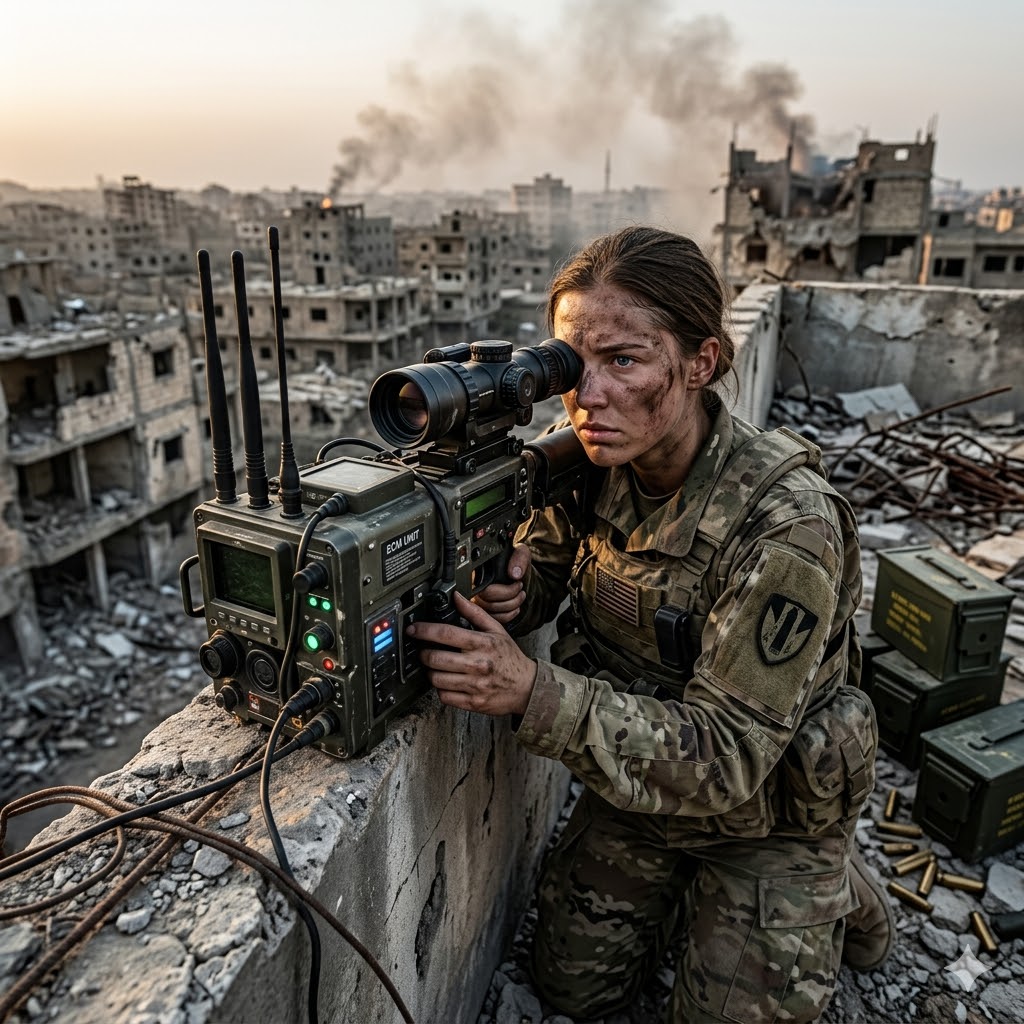
The sun hit the sand at a low angle that morning, and it lied. It made the desert look almost gentle amber light pooling across the dunes. Long shadows stretching from the watchtowers like dark fingers. Sergeant Dale Hutchkins stood at the perimeter fence with a cup of coffee that had gone cold an hour ago, and watched the truck roll through the gate. It was a routine supply run.
It always was, but riding in the back, wedged between cases of MREs and two pallets of 7.62 mm ammunition, was the new transfer. Hutchkins squinted. Young female duffel bag slung over one shoulder. Rifle case in the other hand. Though why she bothered dragging, that was anyone’s guess. She wouldn’t be using it here.
He already knew her name from the manifest. Specialist Norah Voss, 26 years old. Previous posting 10th Mountain Division, a cold weather unit. Before that, two years as a designated marksman candidate at Fort Benning. Her scores had been exceptional 98th percentile in long range qualification, top of her cohort in wind reading and trajectory adjustment.
And now she was here at FOB Alcott reporting for ammunition management duty. Boss, he called out as she dropped from the tailgate. She looked up, blue eyes, calm face. The kind of calm that comes not from confidence, but from having learned to put everything behind a wall where it can’t be touched. Sir, I’m Hutchkins.
I run logistics on this base. He looked her up and down, not unkindly, but not warmly either. You had a meeting with Major Prescott about your reassignment. I was informed by email. Then you know why you’re here. To manage ammo inventory, sir. Distribution, cataloging, security. That’s right. He took a sip of the cold coffee, grimaced, looked out at the dunes.
Leave the rifle case in the armory. You won’t need it. She didn’t argue. She didn’t react at all. Just nodded and walked past him, boots crunching in the packed sand behind Hutchkins. Lance Corporal Tommy Briggs watched her go. He was 22, freckled, had been at FOB Alcott for 11 months, and considered himself something of an institution.
Ammo girl, he said quietly with a grin that he didn’t bother hiding. Corporal Jesse Pharaoh, standing next to him, chuckled. She’ll last a week in this heat. The temperature that morning was 43° C. By noon, it would be 47. FOB Alcott sat in a depression between two ridgeel lines, a layout that offered partial shelter from the wind, but made aerial surveillance harder from the inside.
It had been established 14 months earlier, expanded twice, and now housed roughly 80 personnel support staff, a quick reaction force, three sniper teams, a signals unit, and the logistics section where Norah Voss would spend her days counting rounds. The base was not glamorous. Sand got into everything. Machinery broke.
The water recycler ran at 60% capacity and the desalination backup was held together with a part that had been on back order for 3 weeks. The mess tent leaked when it rained, which was almost never. The air conditioning units in the medical bay had priority. Everyone else sweated. Norah’s quarters were a cot in a partitioned section of a storage unit shared with three other women who were all part of the comm’s team.
They were polite but preoccupied and asked no questions. She unpacked in silence, made her caught tight enough to bounce a coin off, and sat with her hands in her lap for a moment. Through the corrugated metal wall, she could hear voices male, indistinct, laughing. She picked up her notebook, opened it to the page she’d been keeping.
Numbers, mostly wind charts. Atmospheric data she’d been recording for 8 months across different postings, not because anyone asked her to, because it was how she understood the world in measurable increments, in data she could hold and translate and trust. She closed the notebook and went to start her shift.
The ammo depot was a reinforced bunker set into the northeast corner of the base. Norah’s job was inventory control, signing rounds in and out, reconciling counts, flagging anomalies, keeping everything organized. It was meticulous work that required attention to detail. Most people found it stupifying. She didn’t mind it.
What she minded was the way men looked at her when they came to sign out rounds. Some were professional. Most were curious in the way that registers as dismissal, looking past her rather than at her, treating the interaction as a formality performed on their way to the real work. Staff Sergeant Reed Callaway was the exception only in that he was openly contemptuous.
He was the lead sniper for team 1, mid-30s, jaw- like a piece of machinery, a manner that suggested he had been told he was the best at something important and had decided to organize his entire personality around it. He came in on the second afternoon needing to sign out. 338 Laauoa for a training exercise. He glanced at her name tag, looked at her, looked at the rifle case she put on the shelf behind the inventory desk.
That yours? Yes, Sergeant. Bring it with you from your last post? Yes. He took the rounds she slid across the counter without signing for them immediately. Word is you were in a marksman program. Designated marksman candidate. Yes. Didn’t finish. It wasn’t a question. No, he signed the form, pushed it back.
Smart ammo duty is a better fit. He said it pleasantly. The way people say things, they mean as cuts, but can deny if challenged. Then he walked out. Norah looked at the form, looked at the signature, filed it in the correct folder. The temperature outside was 47° C. The air in the depot was slightly less because of the thick walls.
She opened her notebook, and recorded the wind reading she’d taken that morning. It had shifted 3° from the previous day. unusual for this time of year. She noted the direction, the duration of each gust cycle, the intervals between changes, no reason, just in case. 3 days into her posting, the drone started having trouble. It was subtle at first, brief signal interruptions, a few minutes of dead feed before reconnecting.
The UAV operators chocked it up to the heat warping transmitter performance. Temperatures above 45° C created thermal interference that could scatter signals unpredictably. common problem in desert deployments. But the interruptions were getting longer. On the fifth day, Nora was on her midday break, sitting on the shaded side of the depot with a water bottle and her notebook when she noticed the flag at the comm’s tower.
It was a small thing, just a strip of orange fabric attached at eye level to help calibrate visual wind direction. The flag had been shifting northeast since she’d arrived. All weak, consistent, then it shifted just for a moment. A brief reversal, almost imperceptible. Then back northeast, she wrote it down. That evening, she mentioned it to Corporal Angie Reyes, one of the comm’s operators who shared her bunk space.
Reyes was sharp and took her job seriously, which Norah respected. “The wind is cycling,” Norah said. “There’s a reversal pattern about every 70 to 90 minutes, depending on thermal shifts. It’s been getting more pronounced each day.” Reyes frowned. “What does that mean for us for comms? The signal disruptions are probably correlating with the reversal periods.
The interference isn’t random. She paused. I don’t know what’s causing the reversal pattern specifically could be natural. A heating differential off the western ridge, but the timing is getting more regular. Reyes looked at her. You want me to take this to Hutchkins? Just flagging. It might be nothing.
Reyes did take it to Hutchkins. Hutchkins mentioned it at the briefing that evening. It was noted, logged, and the drone operators were told to schedule their surveillance runs outside the suspected interference windows. Nobody asked Nora how she’d figured it out. Nobody connected it to the fact that reading environmental patterns was what snipers spent years training to do.
She went back to counting ammunition. On the seventh day, the intel report came in. Norah didn’t have access to it directly. But at FOB Alcott, information had a way of moving through the base via the particular texture of people’s behavior. The way a briefing could make the air inside the mess tent feel heavier.
The way men who just heard bad news stood differently when they walked back to their posts. She pieced together what she could from fragments. Enemy movement in the vicinity. Not confirmed, but suspected. A pattern of vehicle signatures on the outer thermal feeds that was inconsistent with civilian traffic, and the drones, already struggling with the interference, were providing incomplete coverage.
That night, she sat with her notebook and ran the numbers she’d been keeping. Wind cycle 74 minute average. Reversal duration 8 to 12 minutes. Origin consistent with western ridge. thermal signature, if she was reading it correctly, consistent with vehicle exhaust buildup on a hard pan surface, which meant sheltering, not transit.
They weren’t moving through. They were waiting. She wrote it up. Neat. Measured with annotations. Two pages. She took it to Hutchkins the next morning. He read it. Read it again. Looked up at her. You calculated this from wind observations. Wind and thermal pattern. The reversal suggests something on the western side of the ridge is generating heat and disrupting the natural flow.
The intervals are too regular to be random terrain features. He was quiet for a moment. I’ll pass it to the intel officer. The timing of the reversal windows also matches the drone outages almost exactly. Another pause. Noted. Voss. She walked back to the depot. That afternoon, Captain Dennis Harrove, the base intelligence officer, sent a request for additional drone coverage of the western ridge.
The request went up the chain. Response time estimated 12 to 24 hours. Callaway passed the depot at 1,600 hours. He glanced in, saw Nora at the inventory desk. “Here you’ve been doing some amateur meteorology,” he said. “Wind reading. It’s part of sniper assessment. You never finished assessment.” She didn’t answer. He walked on.
14 hours later, they hit at 330 in the morning. The first RPG hit the comm’s tower. Norah was awake. She usually was in the hours before dawn, lying still in the dark, listening to the wind. She heard the incoming round a fraction of a second before impact. A distinctive whisper through the air that most people never learn to distinguish from ambient noise.
She was on the floor before the explosion. The blast was close enough that the shock wave rippled through the corrugated wall and knocked everything off the shelf above her cut. She was already moving, grabbing boots, grabbing the notebook out of habit, tucking it into her vest. Outside, chaos had the specific quality of a plan being disrupted.
Shouting in multiple registers, boots on sand, the flat crack of small arms opening up from the perimeter. She ran toward the depot. Behind her, the comm’s tower was burning. Through the smoke, she could see muzzle flashes coming from two directions simultaneously, northeast perimeter and the southern access track. A two-pronged approach, which meant they’d done reconnaissance.
They’d mapped the base. This wasn’t opportunistic. Inside the depot, she pulled on her vest and helmet, went to the back wall, pulled open the heavy lock on the secondary cache. Her rifle case was on the shelf above the inventory desk. She looked at it for a moment, left it there. She picked up an M4 from the rack and moved to the depot door, which had a narrow observation slit.
Through it, she could see the open ground between the depot and the operations building. Two men down, not moving. Three men running, returning fire. The muzzle flashes from outside the wire were coming from elevated positions. The ridge line to the northeast and a depression to the south. The elevated positions were the problem. Anyone on the open ground was exposed.
She keyed her radio, got static. The comm’s tower was gone and the backup hadn’t kicked in yet or it had been targeted too. She looked at the M4 in her hands, looked at the rifle case on the shelf, put the M4 down, took the case off the shelf, opened it, checked the action out of pure muscle memory. the way she’d done it thousands of times in the dark, in the cold, in the rain.
The rifle was a Seikko TRG 42 338 Lapoa Magnum scope zeroed at 800 m with personal adjustments she’d made to the turrets in the months before her reassignment. She needed to get high. The depot had a roof access hatch. She’d noted it on her first day because she noted everything that gave elevation. She took two boxes of 338 from the rack, dropped them in her vest pouch and went up.
The roof of the depot was flat, sandcoated, and roughly 3 m above the base floor, not enough for observation across the ridge line, but enough to clear the blast walls and see both the northeast and southern approaches. She came up through the hatch on her belly, staying below the parapit. The noise was tremendous. Small arms, RPGs, men yelling in two languages.
The base’s QRF was returning fire from the operations building, but their angle was wrong for the elevated position on the northeast ridge line. They were shooting uphill in the dark and hitting nothing that mattered. Norah moved to the northeast corner of the roof, got flat, and put the scope on the ridge line. It was dark.
The scope was a Night Force NXS, low light capable, but there was dust in the air from the explosion and thermal heat rising from the burning tower. The image shimmerred. She breathed steadied there. Muzzle flash 400 m to the northeast slightly elevated maybe 30 ft above base level which put the shooter on a rocky shelf she’d observed on her second day.
Good position they’d chosen well. The problem with the cold bore shot the first round fired through a cold barrel was that the bullet would land slightly differently than subsequent shots because the barrel expansion from heat changed the harmonics. Every shooter knew this. Most compensated with a.3 of a minute of angle adjustment depending on the barrel. She knew her barrel.
She’d fired enough cold bore shots to have calibrated the difference precisely. She adjusted two clicks down, added a half click of windage. The wind had reversed again, was pushing left to right at the moment, and the reversal cycles were shorter now, maybe 40 minutes, maybe less. She exhaled slowly, settled into stillness, watched the muzzle flash return.
2 seconds, another flash, then a pause. The shooter was moving between shots. Smart, but the shelf was only so large. The movement had a pattern. She waited. Flash. Pause. 2 seconds. Another flash. She aligned on the space between flash. She waited for the two count. At 1.8, she broke the shot. The recoil pushed her back.
She worked the bolt, reacquired through the scope. The northeast ridge line went quiet below her. The weight of the firefight shifted not noticeably to most people, but the QRF firing from the operations building was unimpeded now from that angle. She heard the rate of return fire increase. She turned to the south.
The southern position was more complex. The depression made it harder to locate the shooter precisely, and there were at least two firing from there, their muzzle flashes overlapping in the dust. She watched them for 3 minutes, cataloging the positions, estimating distances. The backup radio came on a crackle.
Then Hutchkins voice, all personnel, this is Hutchkins. Comms are up on emergency frequency. Report status. Multiple voices broke across the channel. QRF reporting. Medical reporting casualties. Signals reporting partial capacity. We have an unknown shooter in elevated position northeast appears to be neutralized. That was Sergeant Pharaoh near the operations building.
He’d seen the effect if not the cause. Whoever took that shot speak up. Nora keyed her radio. Voss depot rooftop. A pause. Hutchkins. Voss. Are you armed? Yes, sir. I need clear to fire on the two positions in the southern depression. Approximately 310 and 340 m respectively. Another pause. Longer. She heard Callaway’s voice break in who authorized Hutchkins cutting him off. Voss, you have clear to fire.
Confirm your status. I’m set. She put the scope back on the southern depression. By 0530, the initial assault had been repelled. The cost, four wounded, one critical. The comm’s tower destroyed. The northern water system hold by shrapnel and draining into the sand. Two of the three QRF vehicles disabled and the base was still surrounded.
The enemy had pulled back to the ridgeel lines and the surrounding high ground, settling into positions that were beyond effective range for most of the base’s weapons. From their elevated vantage points, they could observe everything that moved on the open ground. Any vehicle that tried to leave would be visible for a kilometer before it cleared the perimeter.
The QRF couldn’t push out without air support. Air support required comms that could reach the forward operating base 40 km south. The emergency satellite relay was functioning at reduced capacity. They could send text bursts, short messages, low bandwidth, but not the sustained communication needed to coordinate a response. The response was coming.
It was just a question of when. Hutchkins was precise about it at the 0700 briefing. Earliest realistic extraction or reinforcement window is 32 hours. Could be up to 50. We hold the base. We conserve water. We keep casualties to a minimum. He looked around the room. We do not take unnecessary risks.
Norah sat in the back. Callaway was in the front. He’d looked at her twice since she’d come in the first time with something unreadable. The second time with something she recognized as recalculation. He’d fired 220 rounds in the initial engagement. She’d fired two. Both had connected. After the briefing, he found her outside, stood beside her, both of them looking out at the ridge lines through the blast wall slit.
“Where’d you learn windreading like that?” he said. “Not hostile, analytical, Bort Benning. Then I kept doing it on my own time. You quit the program. I was removed from the program. He let that sit. You see anything from the roof this morning? Positions. Dispositions. She pulled out the notebook. Seven firing positions.
Two confirmed neutralized. Five still active. Here, here. Here. She pointed at her sketch. And two more. I’m estimating based on trajectory analysis from the rounds that hit the water system. He studied the page. You drew this during the engagement. After from memory, he handed it back without a word and walked toward the operations building.
That was the closest Reed Callaway came to a compliment in the first 12 hours. The water situation was the most immediate problem. With the northern sistern gone, they were drawing from the southern reserve, which held approximately 1,800 L. 80 people at minimum survival consumption in 47° C heat. The math wasn’t comforting.
Norah had volunteered for the first watch rotation since she hadn’t slept before the assault and wasn’t going to sleep now. She was positioned on the depot roof again, which had become, by informal consensus, her station. Nobody had officially assigned her. Nobody had officially unassigned her either. She was simply there, and the logic of her presence was difficult to argue with.
The morning was the worst time. Heat came off the sand in visible waves by 0900, and the scope image shimmerred and swam with thermal distortion. Long-range shooting in these conditions required constant mental compensation. Reading the air, estimating the density gradient, feeling for the moments when conditions aligned just long enough to take a reliable shot.
She didn’t fire, conserved ammunition, watched. At 1,100, Briggs came up with water and a ration pack. He sat down next to her with the particular quiet of someone who had recently rearranged their opinion of another person. “How far was that shot this morning?” he asked. Northeast in the dark with dust in the air. The dust was light at that distance.
The thermal signature was the main issue. He was quiet. I said something when you arrived. I know. I was. I know. She said again. Not harsh, just final. She was looking through the scope. He left the water and went back down. By late afternoon, the enemy had started probing, testing the perimeter with single rounds at intervals, measuring response, mapping the defender’s positions.
standard pre-assault methodology. They were learning the base’s defensive geometry. Callaway’s team one was down to Callaway himself. Both his spotters were in the medical bay. One with shrapnel in the leg, one with a concussion from the blast. He was working without a spotter, which was not how sniper work was meant to function.
He found Nora at 1,600. I need a spotter, he said. You have the wind knowledge. You understand trajectory calc? Yes. I need verification on two positions. I can’t confirm from the west wall. I’m seeing movement but no positive ID. Before I engage, I need confirmation. I can do that.
He looked at her for a moment, then come with me. They worked together for 90 minutes. Norah with binoculars and the notebook. Callaway at the scope. She called wind, distance, positional changes. He shot twice. Both connected. Afterward, they sat with their backs against the wall, not talking, drinking water slowly.
Why were you removed from the program? He said eventually. He didn’t answer immediately. The sun was moving toward the western ridge. The heat beginning its slow retreat toward merely brutal. There was a mission, she said. Urban engagement. I was on a building with an angle on a confirmed hostel, but there was a child in the adjacent window.
The angle of fire required. She stopped. The math was close. Too close? You didn’t shoot. The hostel relocated 4 minutes later. Someone else engaged. She was looking at her hands. The review board said I’d hesitated unnecessarily. That the shot was clean, but you didn’t think so. I thought the probability of civilian harm was within my personal threshold of acceptable risk.
She looked up which is not how the review board calculates it. Callaway said nothing for a long time. The review board isn’t always wrong. He said finally. No, she said neither am I. Norah Voss had been shooting since she was 16. Her father, Harold Voss, had been an army ranger who’d come home from two deployments with bad knees and a belief that his daughter should understand firearms.
the way she understood mathematics as a system with rules, logic, and consequences. He taught her on a 22 in the fields behind their property in central Montana in the early mornings when the air was cold and the light came flat across the high grass. She’d learned to read the grass. That was the first thing he taught her.
Not how to aim, not how to breathe, but how to read the grass because the grass told you what the air was doing, and the air was the variable no scope could compensate for. The air was the thing that turned a precise mechanical calculation into something more like a conversation. She’d kept the notebook since the second year of the Marksman program.
17 months of wind data, atmospheric readings, range observations. Not because anyone required it. It was entirely personal, a habit that had started as an exercise and become a form of memory. Every environment she’d been in, she’d recorded it. Montana fields, Fort Benning ranges, high altitude training areas, the deployment before this one, and now the desert.
the strange cycling winds off the western ridge. The thermal interference, the pattern she’d noted from the beginning that nobody had asked about until it was almost too late to matter. The notebook was in her vest pocket. She touched it sometimes, not consciously a habit like checking that a door is locked.
What the review board had called hesitation. She had experienced as clarity. She had seen the child in the window. The shot angle was what it was. The math was what it was. And she had looked at the probability and said, “Not today.” not because she was afraid or uncertain, but because the calculation had resolved clearly, and the answer had been no.
The board hadn’t been wrong that the shot was technically executable. They’d been wrong that execution was the only correct response to technical executability. She’d never argued the decision, hadn’t filed a grievance, packed her things, and accepted the reassignment. But she’d kept the notebook. The second night was harder than the first.
The enemy was patient, which was in some ways more frightening than aggression. They didn’t assault again. They maintained their positions, kept the base under observation, made occasional harassing fire to deny sleep and wear down the defenders. It was a siege methodology designed to erode capacity before a final push. The water level dropped.
The wounded were stable but consuming resources. The medic, a young woman named Doc Clare Ingram, was operating on 2 hours of sleep and doing it with a competence that Norah found quietly remarkable. She moved between patients with no wasted motion, calm in a way that wasn’t performed. Norah slept for 3 hours in the early morning, woke before dawn, and went back to the roof.
The wind had changed again. She noted it in the notebook. The reversal was now occurring every 38 minutes on average, and the duration of the eastern flow was shortening. The pattern was shifting. A weather front coming in from the northwest, she estimated, which would mean reduced visibility, dust, possibly a temperature drop of 8 to 10°.
desert thunderstorm. Maybe also a crosswind component she hadn’t accounted for previously. At distance over 1,000 m, a 10 km perph crosswind required roughly 6 minute of angle correction. The displacement at 1,500 m would be nearly a meter. Shots taken in the normal condition window needed to be recalibrated.
She updated her calculations and waited for the light. The water ran out at 2,200 on the second night. Not entirely. There was an emergency reserve sealed in the operations building enough to keep people functional for another 24 hours at strict rationing. But the psychological effect of the sistns running dry was different from the logistical one.
It changed the quality of the silence on the base. Hutchkins announced it plainly without drama. He was good at that. Delivering bad news in a way that gave people the information they needed without taking their ability to function. Norah respected plain speech. It was economical and true. Two of the younger soldiers privates, whose names she hadn’t learned yet, were showing signs of heat exhaustion. Dr.
Ingram had them on strict rest protocols. The QRF was at 40% capacity. Callaway’s team was effectively just Callaway, and he’d been on the scope for 16 of the last 20 hours. She found him at the west wall at 2,100. You need to rest, she said. I’ll rest when they do. They won’t rest before the final push, which means you won’t rest at all. She paused.
I can hold this position for 4 hours, rest, and come back. He looked at her. Something moved in his face that wasn’t quite concession, but was the shape concession makes in a person who’s bad at it. There’s a problem, he said. Come look. He led her to the northeast corner where he’d set up an observation point behind a reinforced blast wall.
Through the gap, she could see the ridge line and he handed her the binos. Third position from the left, he said, between the two rock formations. You see movement? She saw it immediately. Slow, deliberate. someone on the ridge line moving between covered positions in a way that was specific methodical repositioning, always maintaining cover, never exposing for more than a second.
That’s a sniper, she said. Yes, not the same as the others. No, the others fire in patterns. This one hasn’t fired around in 12 hours. He paused. But every time we expose anyone on the open ground, they take a casualty. He lowered the binos. He’s been using the others fire as cover to observe the assault tonight. when it comes and it will come.
He’ll be the one holding this base pinned while the ground assault closes. If we can’t take him out first, we won’t be able to move. She raised the binos again. Watch the movement. The figure was good, professional. The kind of movement that said this person had been trained by someone who knew what they were doing and had spent years practicing it until it was as natural as breathing.
What’s the distance? She said. Best estimate is 1,400 m, possibly more. There’s a thermal layer at 900 that’s making ranging inaccurate. 1,400 m in desert conditions with a cycling crosswind and thermal distortion. When did he position there? Probably the first night, which means he’s been watching us for 36 hours.
He knows our firing positions, our response patterns, everything. She handed the binos back. Give me until dawn, she said. I need to study the approach. The thing about patience that most people misunderstood was that it wasn’t passive. It was the most active possible state, a continuous expenditure of attention and will toward the singular purpose of not acting until the moment was precisely right.
Norah spent four hours on the roof before dawn watching. She wasn’t watching for him. She was watching the space around him. The way the air moved across the ridge line. The way the heat rose and shimmerred and receded. The way the wind from the western ridge met the air coming off the hard pan and created those brief anomalous reversals she’d been tracking for days.
In her notebook, she sketched the terrain between her position and the ridge line. The depression at 600 m, where the hard pan gave way to looser sand, that was where wind behavior would change most significantly. Any round crossing that depression would be affected by a different air mass than the one at the firing position.
She’d need to account for two separate wind environments in the same shot. Not impossible, complicated. The sniper across the ridge line had, she estimated, positioned himself behind a rock formation that gave him cover from the south and west, but left a small exposure angle from the northeast, which was exactly where she was. He didn’t know she was there.
He knew the other firing positions because he’d been watching those for 36 hours. He didn’t know about the depot roof because it had no obvious military utility and she hadn’t fired from it during daytime. That was the one advantage she had. One distance, terrain, wind, thermal interference, degraded equipment, fatigue, no spotter all against her.
One advantage, she intended to use it once. Callaway came back to the roof at 040. He’d slept 2 hours. He looked at her notebook and said nothing for several minutes. You think you can make that shot? He said, I think I have one window one. The wind reversal creates a period of about 8 to 12 minutes where both air masses are moving in the same direction.
brief alignment during that window. The two environment problem reduces to approximately a single environment calculation. She paused. The thermal layer at 900 meters is the other issue. It’ll deflect the roundup by approximately half an inch at range. I can compensate for that at this end. The variable is the timing.
He studied the notebook. Your data on the reversal cycles. How reliable is it? I’ve been recording for 7 days. The pattern has been consistent to within 4 minutes. 4 minutes is not nothing at this range. No, but the window is 8 to 12. 4 minutes of variance still gives me a 4 to 8 minute window to work with. He was quiet.
She could feel him running the math the way she ran it herself. Not just the numbers, but the human calculation underneath them. The weight of what happened if she was wrong and the target identification, he said in low light. I need a positive behavioral confirmation. I can’t shoot at a shape behind a rock. I need to see him act. He’ll act when the assault starts.
I know, which means you’re on a timer. Yes. Callaway folded the notebook closed, handed it back. You’ll have Briggs as a backup communicator, he said. And I’ll be on the west wall if anything comes from that direction. She nodded. Boss, he stopped for a moment. He seemed to be working out how to say something that didn’t have a practiced form.
The shot you didn’t take in the program. She looked at him. I read the review board transcript. He said, “After you got the manifest, she was still. You were right.” He said the angle was too close. He said it simply without drama. Then he went down the ladder. She sat with that for a moment. Then she opened the notebook to a fresh page and began her final calculations.
The assault came at 0512. It announced itself not with sound but with absence of sound. A sudden sessation of the background noise of the perimeter as if the desert had drawn a breath. Then the first mortar round hit the south wall. Norah was already in position. She’d been flat on the depot roof for 90 minutes watching the ridge line through the scope.
The temperature had dropped to 38° C before dawn. Relative coolness that the body registered as relief before remembering it was still dangerously hot. The air was dry and thin and tasted of dust. She’d recalculated the wind three times in the last hour. The reversal cycle was running at 42 minutes now, longer than expected.
The weather front she’d estimated was pushing slower. She adjusted her prediction window accordingly. The scope was on the rock formation. She watched in the valley below the ridge line. She could hear the assault group moving motors, boots, the metallic sounds of weapons being checked. Hutchin’s voice on the radio, controlled and steady, directing the QRF to positions.
Callaway’s voice, brief, clipped, confirming the west wall was clear. She breathed. The figure at the rock formation moved. Not much, just the shift of someone transitioning from observation to firing position. A small forward movement, the adjustment of posture, but it was enough. It was the behavioral confirmation she’d been waiting for.
She saw the rifle long barrel suppressor fitted, which was why he’d been firing without muzzle flash. A suppressor didn’t eliminate the sound, but it degraded it enough that precise locating was difficult, especially at range. She aligned the scope on the narrow exposure angle, left shoulder, partial head, maybe 12 in of visible target at 1,400 m.
The wind was running northeast, 14 kmh. Her calculation put the correction at 8 MOA right, which at this distance meant a physical adjustment of 3.3 in on the turret. She’d already made the adjustment, the thermal layer. She’d added 1.4 MOA elevation to compensate the crosswind variable from the depression at 600 m.
She’d split the difference, a compromise that wouldn’t be perfect, but was the best available with one shot. She had one shot. The assault was beginning. The radio was loud with voices. Somewhere behind her, glass broke. A mortar round impacted near the medical bay and she felt the vibration through the roof surface. She breathed out, half out, then stop.
In the scope, he was still, he was aiming. Somewhere below, one of her people was about to be in his reticle. She didn’t close her eyes. That was something that happened in stories. In reality, you kept your eyes open. You looked at the thing. The wind was northeast. Then it shifted. This was the reversal.
She watched the flag on the antenna. The wind had turned. Both air masses were now moving in alignment west to east. The two environment problem had collapsed to one. The window was open. She put the crosshair on the exposure angle 12 in left shoulder partial head. In her mind, she heard her father’s voice. Read the grass.
There was no grass here. There was sand and heat and 100 m of superheated desert air between her and a man who would not give her a second chance. She squeezed, not pulled, not jerked. Squeezed as if she were asking something politely from the mechanism, coaxing rather than commanding. The recoil came. She worked the bolt, reacquired.
The rock formation was still. Then the figure behind it slowly in the unmistakable way that a body accepts what has been given to it stopped moving. The effect was not immediate. It took 40 seconds. 40 seconds during which the assault continued. The radio continued. The base continued to take fire from the lower positions.
40 seconds in which Norah lay flat on the roof and breathed and did not move. Then the communications traffic from the enemy position went silent. Not their radios, the tactic. The ground assault, which had been moving with confidence toward the southwest wall, slowed. Stop the fire from the ridge line. All the other positions, the ones that had been coordinating their rate of fire with the snipers overwatch became disordered.
No longer coordinated, just noise. A sniper is not a trigger. A sniper is a system. remove the systems intelligence function and the body keeps firing but without purpose. Hutchkins saw it over the radio. His voice did something it hadn’t done in 48 hours. It accelerated. QRF push southwest.
They’re disorganized move now. She heard the vehicles, the ones that still worked. She stayed on the roof, watched the ridge line, ready, but there was no more coordinated fire. Just individuals making decisions and individuals without coordination are manageable. The QRF broke the assault. It took 11 minutes. By 070, the perimeter was secure.
The enemy had pulled back beyond effective range. And at 0840, the first helicopter appeared on the southern horizon. A dark shape moving low across the desert. Then the sound arriving behind it like a sentence completing itself. Norah climbed down from the roof. She walked to the depot, put the rifle back in the case, locked the case.
Outside, people were moving, treating wounded, clearing debris, directing the helicopters to the landing zone. Hutchkins was talking to the aircraft commander. Dr. Ingram was guiding the critical casualty to the medevac stretcher. Nobody called her ammo girl. Nobody said anything at all at first. The base had the quality of a held breath released.
Then Briggs walked over. He stood next to her for a moment, looked at the ground, looked up. 1,400 m. He said in pre-dawn light with a cycling crosswind. She didn’t answer. I calculated it afterward. He said with the thermal layer and the two air mass problem, the margin for error in your adjustments was he stopped.
How did you know the reversal window would hold long enough? I didn’t. She said, I read the pattern. The rest was a commitment. He nodded slowly, like someone absorbing something that required time to settle. Callaway appeared at her left. He didn’t say anything immediately, just stood there looking at the Ridgeline, the way people look at places where something has been decided.
Then he reached into his vest. He held out a set of sniper team credentials, a laminated card, and a paired authorization chip. Team one, designated position one. That’s mine, he said. I’m seconding you as lead until further notice. He paused. It requires you to carry your own rifle. She looked at the credential card.
What happened to you won’t need it, she said. Something that might have been a smile moved across his face. I was wrong. Plain without ceremony. The same flat economy he used for everything else. She took the card. Hutchkins held the debrief at 1,000 in the shade of the operations building. Everyone who could stand was there.
He went through the engagement systematically. Losses, equipment status, water situation now resolved with the resupply communication restoration timeline. He was precise about what had happened and honest about what had gone wrong. He credited the QRF push. He credited Dr. Ingram’s management of casualties. He credited Reyes for the early wind analysis that had, though it hadn’t been acted on in time, correctly, identified the tactical problem.
Specialist Voss, he said she looked up from the notebook she’d been updating. Engagement assessment noted four confirmed targets, including the primary command asset, at approximately 1,400 m. The pre-dawn shot under those conditions, will be documented in the engagement report. He paused. I made an error in assignment when you arrived.
She said nothing. The debrief continued. Later, one of the younger soldiers, private first class Amy Sutherland, 19 years old, who’d been in the medical bay for the last 12 hours with a minor shrapnel wound, found Norah sitting by the northeast wall with her notebook. Were you scared? Southerntherland asked.
Norah thought about the question. She looked at the ridge line, which was inert now, emptied of intent, just sandstone and shadow. Not scared, she said. Just careful. Southerntherland seemed to find that answer insufficient and simultaneously exactly right. She nodded and went back to help with the cleanup.
The second helicopter came at 1,400, bearing the major from the forward base 40 km south along with a signals team, water reserves, and a replacement communications tower. The major walked the base, talked to Hutchkins, talked to Callaway. Then he came to find Norah, who was in the depot, returning it to its normal function.
He was older than she expected, had the look of someone who’d been doing this work long enough to stop being surprised by it, and had found a way to stay interested anyway. Walk me through the primary engagement, he said. She walked him through it. Wind data, positioning, the decision to use the roof, the cold boore shot, the identification of the command sniper, the calculation, the timing window, the shot. He listened without interrupting.
When she finished, he was quiet for a moment. The wind data, he said. You’d been collecting that independently, not as part of an assigned task. Yes, sir. Why? Because environments change and the change usually follows a pattern. If you understand the pattern, you can make better decisions.
He looked at the notebook. May I? She handed it over. He leafed through it carefully, looked at the sketches, the notations, the daily readings. This is 17 months of data. Yes, he handed it back. Sergeant Callaway’s second stands. We’ll be filing a formal reassessment of your removal from the marksman program. He paused.
I should tell you the review board decision. The case file I saw didn’t include the full angle calculations. I don’t know if they were submitted incorrectly or omitted. She absorbed this. Omitted, she said, he nodded once carefully. That will be part of the reassessment. He left. She sat in the depot with the notebook in her hands. The afternoon heat was subsiding.
The desert settling into its brief period of tolerance before night fell. She opened the notebook to a new page. Date, temperature, wind direction, wind speed. The desert was the same desert it had been 48 hours ago. The sand was the same sand. The sky was the same enormous flat blue.
What had changed was almost invisible. A shift in weight in the way certain words would be used. In the credential card in her vest pocket, the kind of change that doesn’t announce itself, but that you can feel. The way you can feel the reversal in the wind before the flag moves. She recorded the data, closed the notebook.
Outside, the base was returning to something like normal. The sound of work, of logistics being managed, of systems being restored, the rhythm of a place that had been tested and had held. She left the depot and walked to the perimeter, stood at the northeast corner, where she could see the ridge line in the amber light of the afternoon.
The rock formation where he’d been positioned was just rock again. She looked at it for a long moment, not with triumph, not with grief, with something more specific and less dramatic than either a form of recognition, the acknowledgement of a calculation that had come out correct, and the knowledge that correctness was not something you could rely on every time, only something you could work toward with the best information available, and the patience to wait for the right window, she breathed.
The wind was northeast.






