There are people who save lives with training and equipment and the full weight of professional preparation behind them. And then there are the other kind — the ones who save lives simply because they happened to be there, and because something in them did not know how to look away. Nancy was five years old. She had a fever of 103 degrees. She had followed her mother down a mansion hallway on legs that were barely holding her upright. She did not know what an asthma attack was. She only knew that a man was on the floor and that the thing on the table might help him, and that helping was something she understood how to do.
She picked up the inhaler. She walked to him. She knelt down beside him and pressed it into his shaking hand and said: Take it.
That was all.
That was enough.
Matthew Calloway had been rich for most of his adult life, which meant he had been insulated from most of the world’s ordinary difficulties, and completely unable to be insulated from the specific difficulty that had broken him. Money could not have kept the plane in the air. Money could not have brought his wife and daughter back from wherever people go when they leave so suddenly there is no preparation for it, no goodbye, no last conversation that you can choose to be the one you hold onto.
The crash had happened four years ago. He still could not think of the specific date without the same sensation — the floor dropping away beneath him, the world contracting into a point of light that extinguished itself before he could reach it. He had sold three of his properties after. He had given away things that his wife had loved because looking at them cost too much. He had kept the mansion because the mansion was the last place she had stood before they left for the airport, and there was a corner of the upstairs hallway where if the afternoon light hit a certain way it fell at exactly the angle she used to stand in, and he was not ready to give that up.
He was not ready. He was not sure he would ever be ready.
So he stayed. He moved through the rooms like a man navigating a place he had memorized but stopped belonging to. The floors reflected the light perfectly. The chandeliers scattered softness across every surface. The paintings were exactly where they had always been. Everything was maintained, cleaned, preserved. The house was impeccable and utterly empty, and the only reason it was still running was Ada.
Ada had come eighteen months after the accident. She was the seventh person he had hired for the position, and unlike the six before her, she did not seem to need the house to be anything other than what it was. She did not try to fill the silence with conversation. She did not react to his moods with anything more than a steady, quiet recalibration. She cleaned. She cooked. She maintained the machine of the house without requiring the machine to give her anything back. He respected this without ever saying so, which was the only way Matthew currently knew how to respect anything.
He did not know, for a long time, that she had a daughter.
Ada had not intended to tell him. There was a daycare arrangement that usually covered her hours, and a neighbor who served as backup, and a system of small accommodations that she had assembled over the years the way a person builds a wall without mortar — carefully, brick by brick, hoping it holds. The neighbor moved away in October. The daycare called in November to say they were closing their morning session. Ada spent two weeks rebuilding the arrangement and then Nancy got sick and the arrangement collapsed entirely.
The fever appeared on a Tuesday. By Wednesday morning it was high enough that Ada sat at the kitchen table of their small apartment for a long time without moving, trying to calculate a path through the day that didn’t exist. She could not leave Nancy alone. She could not afford a caregiver on short notice. She could not call in sick — she had used her emergency days in September when Nancy had a respiratory infection, and Matthew’s household manager had been clear about the policy, clear in the precise way of a man delivering someone else’s words.
Ada packed a bag for Nancy. She packed carefully — medicine, a light cloth, a small cup for water, the soft toy the girl had slept with since she was two. She told Nancy they were going to the big house and that Nancy needed to rest quietly and not bother anyone. Nancy, even at five and even with a fever, understood the specific tone in which her mother said things that were not negotiable.
“I’ll be good,” Nancy said.
“I know you will,” Ada said.
She settled Nancy in a small room off the back corridor, a room used for storage that had a narrow daybed from some previous arrangement. She covered the girl with the cloth, gave her medicine, made her drink half a cup of water, and pressed her lips to her forehead. Still hot. Not worse, but not better.
“I’m close,” she said. “If you need me, you call.”
Nancy nodded. Her eyes were already closing.
Ada went back to work.
She was changing the linens in the third-floor guest room when she heard the crash.
It came from Matthew’s room at the end of the hall — not a sharp sound, not breaking glass, but a heavy, dense impact, the sound of something large and irregular hitting the floor. Ada was already moving before she had processed what it was. Her slippers were nearly silent on the corridor. Her heart was not.
She pushed open the door.
Matthew was on the floor beside the bed, one knee bent at an awkward angle, one hand pressed flat against his chest. His other hand was extended toward the nightstand, fingers stretched, unable to reach the last eighteen inches. His face was the color of old paper. His breathing — she could hear it from the doorway — was the sound of a man fighting for air through a passage that was closing.
“Sir—” she said.
She crossed the room. She needed to get to the nightstand. She could see the inhaler there — a blue cylinder, sitting precisely where it always sat, closer to the lamp than the edge, just beyond where he could reach from the floor without being able to stand.
A small hand reached it first.
Ada stopped.
Nancy stood beside the nightstand. She was wearing the same clothes she’d been sleeping in, her hair loose and tangled, her skin still carrying the flush of fever. She must have heard the crash — or perhaps she had heard the silence before it, the absence of the ordinary sounds of the house that even a sick child registers without knowing she is listening. She had come down the corridor by herself. She had found the room.
She had found the inhaler.
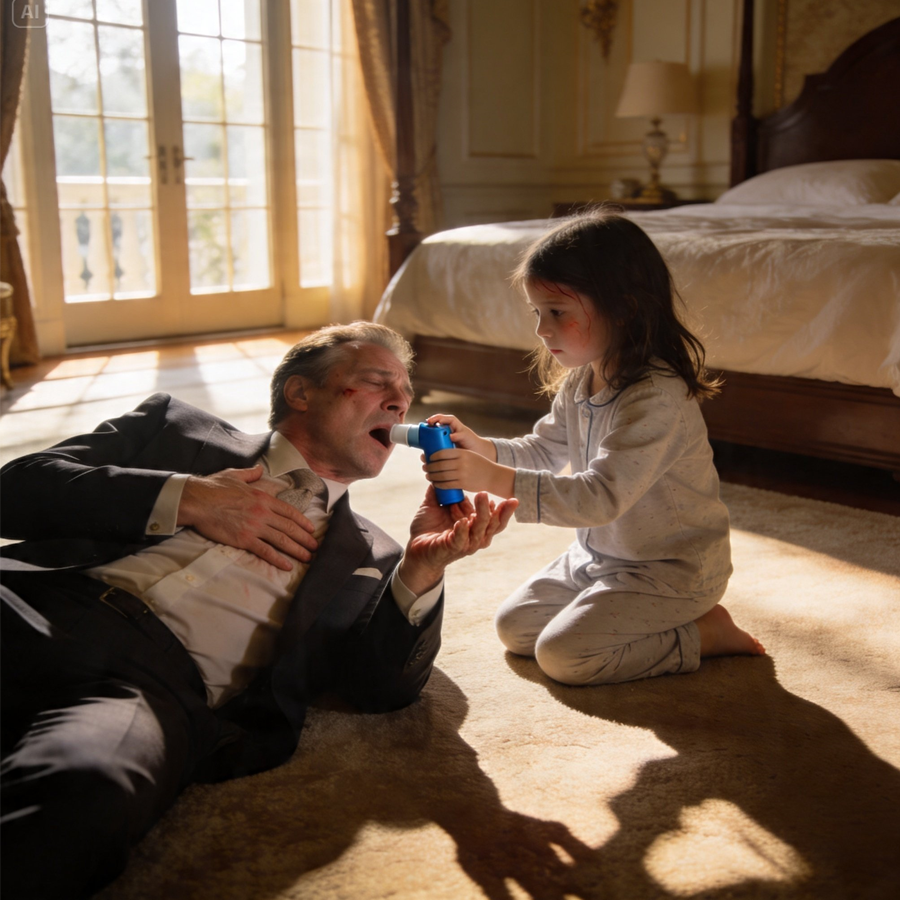
Ada started to say her name, started to say something about going back to bed, but the words dissolved. Nancy was already moving. Her steps were not steady. She placed one foot carefully in front of the other with the deliberate concentration of someone navigating difficult terrain, but she didn’t stop. She crossed the space between the nightstand and the man on the floor without hesitation or hurry. She knelt down on the carpet beside him, her small knees folding under her, and she placed the inhaler into his outstretched hand.
“Take it,” she said. Soft. Simple. The voice of someone who has learned to say the necessary thing without addition.
Matthew’s fingers closed around the cylinder. His hands were shaking badly. He managed the mechanism after two attempts, and then: a breath. Broken at first, the sound of it half-catching. Then another, more full. Then another, settling into something that moved his chest with actual purpose. The terrible color in his face began to change, a slow return, blood coming back to the surface.
Nancy stayed beside him. She did not move away. She watched him breathe with the focused attention of a child who has decided that the watching is part of the helping, and she kept watching until she was sure.
Then she closed her eyes and said a small prayer.
Ada heard it. The words were simple and direct, spoken to God the way Nancy spoke to everyone — without performance, without uncertainty, as if the conversation had already been established and this was simply an update.
Matthew opened his eyes.
The first thing he saw was Nancy.
Not Ada. Not the room. Not the ceiling or the inhaler in his hand. The girl kneeling on the carpet beside him, her fever-flushed face entirely calm, looking at him the way a person looks when they have been watching over something and are relieved to see it still here.
He looked at her for a long time.
Something moved in him. Not something dramatic — not a revelation arriving with light and music. Something quieter. The specific shift that happens in a person who has been braced against the world for so long that they have forgotten what it feels like when something real passes through the defense, not forcing it, just finding a gap that had always been there.
“You helped me,” he said. His voice was barely more than a sound.
Nancy gave a small nod.
“Thank you,” he said.
She nodded again. Then, carefully, she stood up, steadied herself, and walked back toward the door on the same deliberate, patient steps she had come in on.
That evening, Matthew called Ada to the living room.
She came expecting termination. That was the only category her mind would build from the available materials — she had brought her child to his house without permission, the child had been in his room, she had violated every professional boundary of the arrangement. She stood in the center of the living room and kept her hands still at her sides and waited.
“Your daughter is sick,” Matthew said.
“Yes, sir.”
“She’ll see a doctor tomorrow. A proper one. I’ll make the arrangements.”
Ada looked up.
“And your position here,” he continued, “is changing. You’ve been maintaining this house alone for over a year. You’ll have help from now on. And your pay reflects what the work actually requires, not what I initially offered.”
“Sir, I—”
“Don’t,” he said. Not unkindly. “Don’t thank me. I’m the one who has been underpaying you and pretending not to notice.” He was quiet for a moment. “Thank her,” he said, and his eyes moved briefly toward the door through which Nancy had disappeared to sleep. “She’s the one who deserves it.”
Nancy saw a specialist three days later. Tests, blood panels, a course of proper antibiotics, a pediatrician who spent forty-five minutes with her instead of the seven minutes that Ada had previously managed to afford. The fever broke on day two. By day four Nancy was sitting up in the clinic bed eating crackers and asking the nurse what her stethoscope was for.
Ada sat in the chair beside the bed and held her daughter’s hand and cried in the specific, exhausted way of a person who has been holding something very tightly for a very long time and has finally been given permission to put it down.
At the mansion, things changed slowly and then all at once. Matthew began to come out of his room. Not dramatically — he did not announce a transformation or make a ceremony of returning to the parts of the house he had been avoiding. He simply began to appear in them. In the hallway. In the kitchen. In the living room where he had not voluntarily spent an afternoon in almost four years.
Nancy, when her health returned and she was brought to the mansion again, moved through the house with an ease that surprised Ada and seemed to surprise Matthew most of all. She did not treat the expensive surroundings with either intimidation or reverence. She treated them the way children treat most environments — as background for the things that actually interested her. She played on the floor. She asked questions. She brought her colored pencils and set herself up at the low corner table in the sitting room as if she had always worked there.
Matthew would sometimes stop in the doorway and watch her.
“What are you drawing?” he asked one afternoon.
She held up the paper. Three figures in front of a large house. Simple lines, the specific shorthand of a child’s draftsmanship — round heads, stick arms, enormous eyes.
“This is you,” she said, pointing to the tallest figure. “This is Mommy.” She pointed to the second. “And this is me.” She smiled at the third.
He looked at the drawing for a long time. Long enough that Nancy looked at him to check if something was wrong.
“It’s beautiful,” he said.
He kept the drawing. He did not tell Ada this. He simply folded it carefully and put it in the drawer of the desk in his study, the same drawer where he kept the last photograph of his wife and daughter, the one taken at the airport before the flight. He put Nancy’s drawing beside it and left them there together.
Six weeks after Nancy’s fever, Matthew called a meeting with his lawyer.
The following week he called Ada and Nancy into the sitting room.
Nancy sat on the floor. Ada sat on the edge of the chair. Matthew sat across from them both and explained, in the calm, clear language of a man who has made a decision and is no longer uncertain about it, what he intended to do. Nancy would be formally adopted. Her education, her healthcare, every opportunity he could provide — these things would be hers, legally and completely. Ada would remain in the household, not as staff but as family, with all that entailed. A formal arrangement, documented, permanent.
Ada was crying before he finished the second sentence.
Nancy listened to all of it. She turned it over in her mind with the careful consideration of a child who takes information seriously. Then she stood up from the floor and walked to where Matthew sat.
“Does that mean you’ll be my daddy?” she asked.
He looked at her. The same way he had looked at her on the floor of his bedroom on the day she had knelt beside him and pressed the inhaler into his hand. As if he was seeing something he had not been expecting to find and was still processing what it meant.
“Yes,” he said. “If you’ll have me.”
She wrapped her arms around him. Small arms, the specific narrow warmth of a child’s embrace, and she held on with the uncomplicated thoroughness of someone who has decided that this is right and that deciding is enough.
Matthew put his arms around her.
He closed his eyes.
For the first time in four years, the weight that had been sitting in the center of his chest since the day of the crash shifted. Not gone — that was not how grief worked, and he understood that better than most. But shifted. Changed in its nature. Carrying it still, but not only that. Carrying something else alongside it now, something warm and present and entirely alive.
The papers were signed on a Thursday morning in February. Matthew’s lawyer was efficient and kind, which was a combination that Matthew had not always managed to find in a single person. Ada signed where indicated. Matthew signed where indicated. Nancy was given a pen and shown where to write her name and did so with enormous care, pressing hard into the paper the way children do when they want the letters to last.
That evening, for the first time in four years, Matthew sat at the dining room table for a meal that was not eaten alone. Ada brought the food. Nancy set the table with the specific enthusiastic incorrectness of a child learning which side the fork goes on. Matthew did not correct her. He moved the fork to the right place after she’d moved on to the spoons and said nothing about it.
They ate together. Nancy talked about what she was going to name her fish when she was allowed to have one. Ada laughed at something Nancy said. Matthew smiled — a small, unpracticed smile, the kind that takes a moment to arrive because the muscles have forgotten their arrangement, but arrives regardless.
The mansion was still the same house. Still the same floors, the same light, the same corner of the upstairs hallway where the afternoon fell at an angle he recognized. He had not lost those things. He carried them still, and would carry them as long as he was standing.
But he was not standing in the same place.
Nancy had done that. Had done it without meaning to transform anything, without knowing that placing an inhaler in a stranger’s hand and saying take it would change the architecture of his life. She had simply done what was in her to do — the uncomplicated kindness of someone who has not yet learned that the world does not always reward you for noticing that someone needs help.
He had been given back something. Not what he had lost — nothing could do that, and he did not ask it of the world. But something. A reason that belonged to the present instead of only to the past. A daughter again, and a household that sounded, in the mornings, like a place where people lived.
He had wasted four years being absent from his own life.
He did not intend to waste any more.
THE END