Blood is thicker than water, but money is the acid that dissolves them both. You hear stories about trust fund kids getting a slap on the wrist, losing their credit cards for a weekend before crawling back to the mansion. This isn’t one of those stories. This is about a man who lost his name, his family, and every dime to his name in a span of 3 minutes, only to spend his last $400 on a rusted piece of junk that held a secret capable of tearing a billionaire empire to the ground.
Stick around because by the end of this, you’ll realize the greatest fortunes aren’t found in bank vaults. They’re buried under three decades of rust and a false bottom. The mahogany doors of Charles Wellington’s study were notoriously heavy, soundproofed not just to keep the noise of the Connecticut estate out, but to keep the screaming in.
Edmund stood in the center of the Persian rug, his hands trembling slightly, though he fought to keep his jaw locked and his posture straight. Behind the massive oak desk sat his father, Charles, a man whose presence consumed the room. Charles was the CEO of Wellington Global Logistics, an empire built on ruthless efficiency and a terrifying lack of empathy.
Standing by the fireplace, nursing a glass of 20-year-old scotch, was Edmund’s older brother, Conrad. Conrad wore the smug, razor-thin smile of a man who had just watched his only rival step into a bear trap. You went to the compliance board. Charles’s voice was dangerously quiet, a low rumble preceding an earthquake.
He wasn’t asking a question. He was stating the charges of treason. I had to, Dad. Edmund replied, his voice cracking just a fraction before he steadied it. The shell companies in the Caymans, the misreported hazardous waste shipments off the coast of Maine. It wasn’t just unethical. It was illegal. If the EPA found out, the fallout would destroy the company.
I thought I was protecting us. Protecting us? Charles stood up, leaning his heavy knuckles on the desk. You arrogant, naive little boy. You think you understand the machinery of this world? You think billion-dollar logistics networks run on sunshine and morality? You went behind my back. You tried to sabotage the Miller-Hayes acquisition.
I tried to stop a federal indictment. Edmund shot back, stepping forward. Conrad chuckled, taking a slow sip of his scotch. The only one getting indicted here is you, little brother. Dad already had the legal team scrub the compliance records. Your little whistleblower report? It never existed. But your signature is mysteriously all over the preliminary authorizations for the very shell companies you claim to hate.
Edmund felt the blood drain from his face. He stared at his brother, then back to his father. They had framed him. In the 3 days since he filed the internal report, they had completely isolated him, transferring the digital paper trail to make Edmund the sole architect of the illegal dumping scheme. You’re a liability, Charles said, his tone turning to ice.
A weak link. The Wellington name requires iron, and you are made of glass. You’re my family, Edmund whispered, the betrayal suffocating him. He looked toward the door, expecting his mother, Beatrice, to walk in and stop this madness, but he knew she wouldn’t. She was out at a charity gala, perfectly content to look the other way, just as she had done her entire life.
Family is a business arrangement, Charles corrected coldly, and I am terminating your contract. Effective immediately, your trust fund is frozen. The penthouse in Manhattan is being cleared out by my security team as we speak. Your credit cards are canceled. Your car belongs to the company. You can’t just erase me, Edmund said, panic finally bleeding into his anger.
Watch me, Charles snapped. You have exactly 5 minutes to get off my property. If you ever contact the press or the authorities, the documents Conrad prepared will be handed to the district attorney. You will spend the next 20 years in a federal penitentiary. Now, get out. Two men in dark suits stepped out from the shadows near the bookshelves.
They were Charles’s personal fixers. They didn’t touch Edmund, but their presence was a physical wall pushing him toward the door. Edmund walked out of the study, out of the sprawling marble-floored foyer, and out the massive front doors of the estate. He had the clothes on his back, his smartphone, and his wallet.
As he walked down the half-mile driveway, thunder cracked overhead. A torrential freezing autumn rain began to fall, soaking his designer suit within seconds. Under the dim light of the estate gates, Edmund pulled out his phone. He opened his banking app. A red error message flashed across the screen. Account suspended.
He tried his secondary account. Zero balance. The legal team had been brutally thorough. At 28 years old, Edmund Wellington, heir to a billion-dollar throne, was entirely, hopelessly broke. He pulled his soaked collar up against the biting wind and began the long, agonizing walk toward the highway. Three months later, the smell of stale grease and burnt coffee had completely replaced the scent of luxury cologne in Edmund’s life.
New Haven was unforgiving in the dead of winter. Edmund lived in a cramped, drafty motel room on the edge of town, the kind of place where the neon sign buzzed erratically and the wallpaper was peeling like sunburned skin. He worked the graveyard shift at a 24-hour diner, wiping down sticky tables and pouring coffee for long-haul truckers and insomniacs.
His hands, once manicured and soft, were calloused and covered in tiny burns from the industrial dishwasher. Every ounce of his previous life felt like a fever dream. He had tried reaching out to his old friends, the heirs, the socialites, the Ivy League alumni, but Charles had poisoned the well. Edmund was officially a pariah, a toxic asset no one wanted to touch.
Survival was a brutal math equation. Rent was $600. Groceries were 100. Bus fare ate into his miserable tips. He had managed, through sheer starvation and exhaustion, to save exactly $415. He kept it in a rusted coffee tin under a loose floorboard in his motel room, terrified that the establishment’s shady manager would steal it.
Edmund needed a car. The diner was a dead end, but there was a managerial position opening up at a warehouse two towns over. It paid double, offered health insurance, and could be his ticket out of the gutter. But the warehouse was inaccessible by public transit. Without wheels, he was trapped.
On a freezing Tuesday morning, after a brutal 10-hour shift, Edmund sat at a booth in the diner, nursing a cold coffee. He saw a crumpled flyer left behind by a patron. Holloway Impound and Tow, public police auction, abandoned and seized vehicles. Saturday at 9:00 a.m. Cash only. Edmund stared at the paper. It was a long shot.
Impound auctions were notoriously chaotic, filled with scrap metal buyers, used car lots looking for inventory, and desperate people. Good cars went for thousands. Junkers went for parts, but he had no other option. Saturday morning, Edmund stood in the gravel lot of Holloway Impound, shivering in a thin thrift store jacket. The sky was the color of bruised iron, threatening snow.
The lot was a graveyard of twisted metal, shattered glass, and forgotten lives. Dozens of people milled around, kicking tires and peering under hoods. Frank Holloway, a large man with a beard that looked like steel wool and a voice like a cement mixer, stood on the bed of a tow truck with a megaphone. All right, listen up.
Frank bellowed over the wind. Vehicles are sold as is. No warranties, no crying, no returns. You bid, you buy. You tow it out of my lot by sundown, or I charge you 50 bucks a day for storage. Lot number one, 2005 Honda Civic. Runs, but the transmission slips. The bidding started.
Edmund watched in despair as the Civic went for $1,200. A beat-up Toyota truck went for two grand. A minivan smelling heavily of wet dog went for 800. Car after car, the prices soared past Edmund’s pathetic $400 budget. The cold seeped into his bones. Defeat tasted like ash in his mouth. He was going to lose the warehouse job. He was going to die in that motel room.
By 11:30 a.m., the crowd had thinned. The decent cars were gone. Only the absolute bottom of the barrel vehicles remained, cars that looked like they had been dredged from the bottom of a lake. Lot 42, Frank shouted, wiping his nose with a greasy rag. 1987 Ford Crown Victoria, seized from a deceased estate, sat in a collapsed barn for God knows how long. No keys.
I haven’t even popped the hood. If it doesn’t run, it’s a hell of a heavy paperweight. Let’s start the bidding at 200 bucks. Edmund looked at the car. It was a massive, boat-like vehicle, originally dark blue, but now mostly a mosaic of oxidized rust and peeling clear coat. The tires were flat. The driver’s side mirror was duct-taped on.
It looked like a motorized coffin. Silence stretched across the lot. Nobody wanted it. The scrap guys didn’t even want the hassle of towing it for the metal. Come on, 200, Frank yelled. It’s a classic, sort of. Someone give me 200. Edmund felt his heart pounding against his ribs. It was desperate. It was stupid.
The car probably didn’t even have an engine block left, but the instinct to fight, the stubborn refusal to let his father win, flared up inside him. He raised his freezing hand. I got 200 from the skinny kid in the back.” Frank pointed the megaphone at him. “Do I hear 250?” “Looking for 250.” A burly man in a Carhartt jacket, a known scrapper who had been outbidding people all morning, grunted and raised a finger.
“250 from Big Mike.” “Do I hear 300?” Edmund gritted his teeth. “300.” He shouted, his voice cracking in the cold air. Big Mike glared at Edmund, clearly annoyed by the resistance. “350.” The scrapper barked. Edmund’s stomach dropped. “350.” If he bid 400, he would have exactly $15 left to his name.
No gas money, no food money. Just him and a dead car. “350 going once.” Frank yelled. “Going twice.” You are made of glass. His father’s voice echoed in his head. “400.” Edmund screamed, stepping forward, his fists clenched in his pockets. The crowd went completely silent. Big Mike looked at Edmund, saw the sheer unhinged desperation in the younger man’s eyes, and held up his hands in surrender.
“Kid wants the junk that bad, he can have it. 400 going once, twice.” “Sold to the kid with the bad coat.” Frank slammed his hand against the side of the tow truck. Edmund walked up to the folding table, his hands shaking as he pulled the crinkled 10 and $20 bills from his pocket. He counted out $400, pushing it across the table.
Frank handed him a bill of sale and a title smeared with grease. “She’s all yours, kid. Better get a tow truck and a tetanus shot.” Edmund walked over to the Crown Victoria. He placed his hand on the freezing rusted hood. He had nothing left. He had bet his entire existence on a dead piece of steel.
Getting the Crown Victoria off the impound lot cost Edmund his final $15 and a massive favor. He called the only person in New Haven who hadn’t treated him like garbage, Sarah Jenkins. Sarah was a foul-mouthed, brilliant mechanic who ran a struggling independent garage near the docks. Edmund had helped her unload heavy shipments of brake pads during his off hours at the diner in exchange for a free cup of coffee and some conversation.
Sarah arrived in her battered flatbed tow truck an hour later. She stepped out, wiping grease from her cheek, and took one long, horrified look at the Ford. “Edmund.” She sighed, shaking her head. “Tell me you didn’t pay money for this. Please tell me you won this in a cursed poker game.” “$400.” Edmund said defensively.
“It’s a tank. The police engine. If we can get it running. If we can get it running, I’m declaring myself the Pope.” Sarah muttered. But she hooked up the winch anyway. “I’ll tow it to my back lot. But you owe me. Big time. Like washing my floors for a month big time.” By the time they dropped the heavy Ford into the gravel behind Sarah’s shop, it was late afternoon.
The cold was piercing. Sarah brought out a portable battery jumper and a master key set she used for lockouts. It took her 20 minutes to pick the door lock. The interior smelled like a cocktail of mold, stale cigarettes, and decaying vinyl. Edmund slid into the driver seat. The springs groaned in agony beneath him.
Sarah popped the hood, coughing as a cloud of dust billowed out. “Well, the engine is actually in here. That’s a plus. V8. Belts look like beef jerky, but the wiring hasn’t been completely chewed by rats.” She hooked up the jumper cables and bypassed the ignition switch, handing Edmund two exposed wires. “Touch them together when I tell you.
” Edmund held his breath. “Now.” She yelled. He touched the wires. The starter motor whined a high, pathetic screech, but the engine didn’t catch. Again. He tried again. “Rer. Give it some gas.” Sarah yelled, spraying something heavily into the carburetor. Edmund pumped the heavy pedal and sparked the wires. Suddenly, with a sound like a shotgun blast, the engine backfired.
A massive cloud of black soot erupted from the tailpipe, and the heavy V8 engine roared to life. It was rough, violently shaking the entire chassis, sounding like a washing machine full of rocks, but it was running. Edmund let out a laugh, a loud, genuine, hysterical laugh. “It works, Sarah. It works.” “Don’t celebrate yet, hotshot.
” She yelled over the deafening rattle. “It’s misfiring on at least two cylinders. The exhaust is rotted through, and I’m pretty sure the transmission is held together by rust and prayers. Cut the engine before we suffocate.” Edmund pulled the wires apart. The engine choked and died, leaving a ringing silence in the lot. “All right.
” Sarah said, wiping her hands on a rag. “Let’s see what kind of garbage is in the trunk. Might find a spare tire or a dead body. In this town, it’s 50/50.” She tried the master keys on the trunk lock, but the mechanism was entirely seized with orange rust. It wouldn’t budge. “Hold on.” Edmund said.
He walked over to Sarah’s scrap pile and pulled out a heavy, rusted crowbar. He wedged the curved end into the gap between the trunk lid and the bumper. He leaned his entire weight onto the iron bar. Metal groaned. He pushed harder, putting every ounce of his frustration, his father, his brother, the rain, the diner, the hunger into his arms.
With a violent crack, the locking mechanism sheared off, and the massive trunk lid sprang open. The stench was immediate. It smelled intensely of mothballs and damp rot. They peered inside. The trunk was massive, big enough to fit three grown men. It was filled to the brim with junk, moldy cardboard boxes, stacks of water-damaged newspapers from the late 1990s, broken gardening tools, and a heavy tarpaulin encrusted with dried mud. “Jackpot.
” Sarah said sarcastically. “You bought a mobile dumpster.” Edmund sighed, pulling on a pair of heavy work gloves. “I better clear it out so it doesn’t weigh the car down.” He started pulling out the soggy boxes, tossing them into a nearby dumpster. The newspapers crumbled in his hands. He dragged out the heavy tarp, uncovering a spare tire well that was filled with brackish, foul-smelling water.
Underneath the pile was a layer of thick, gray trunk carpet, completely ruined by water and mildew. Edmund pinched the corner of the carpet and ripped it back, intending to throw it out. As the carpet peeled away from the metal floor pan, Edmund froze. “Sarah.” He said, his voice dropping to a whisper.
“What?” “Did you find the rats?” She asked, walking over. Edmund didn’t answer. He was staring at the floor of the trunk. Toward the back, near the rear axle hump, the steel floor wasn’t flat. There was a raised rectangular plateau, roughly 2 ft long and a foot wide. It was painted the same dark blue as the chassis, but the paint was chipping, revealing bright, stainless steel underneath, not the rusted iron of the rest of the car. It was a false bottom.
Edmund dropped to his knees, leaning into the trunk. He ran his gloved hands over the rectangular ridge. It was welded flush, incredibly professional work, entirely out of place on a factory-line Ford. At the top edge, hidden under a thick layer of grime, was a circular indentation, a high-security tumbler lock.
“What is that?” Sarah asked, her sarcastic tone entirely gone, replaced by sharp curiosity. “It’s a lockbox.” Edmund said, his heart beginning to race. “Welded straight into the frame. Stand back.” Sarah commanded. She went into her shop and emerged a minute later wearing safety goggles and holding a heavy-duty angle grinder.
She plugged it in, the disc spinning to a blur with a high-pitched scream. She leaned into the trunk, positioning the grinder over the heavy steel lock. Sparks showered the twilight air, illuminating the grime and grease of the garage lot. The smell of burning metal filled Edmund’s nose. For 10 agonizing minutes, Sarah cut, stopped, checked, and cut again.
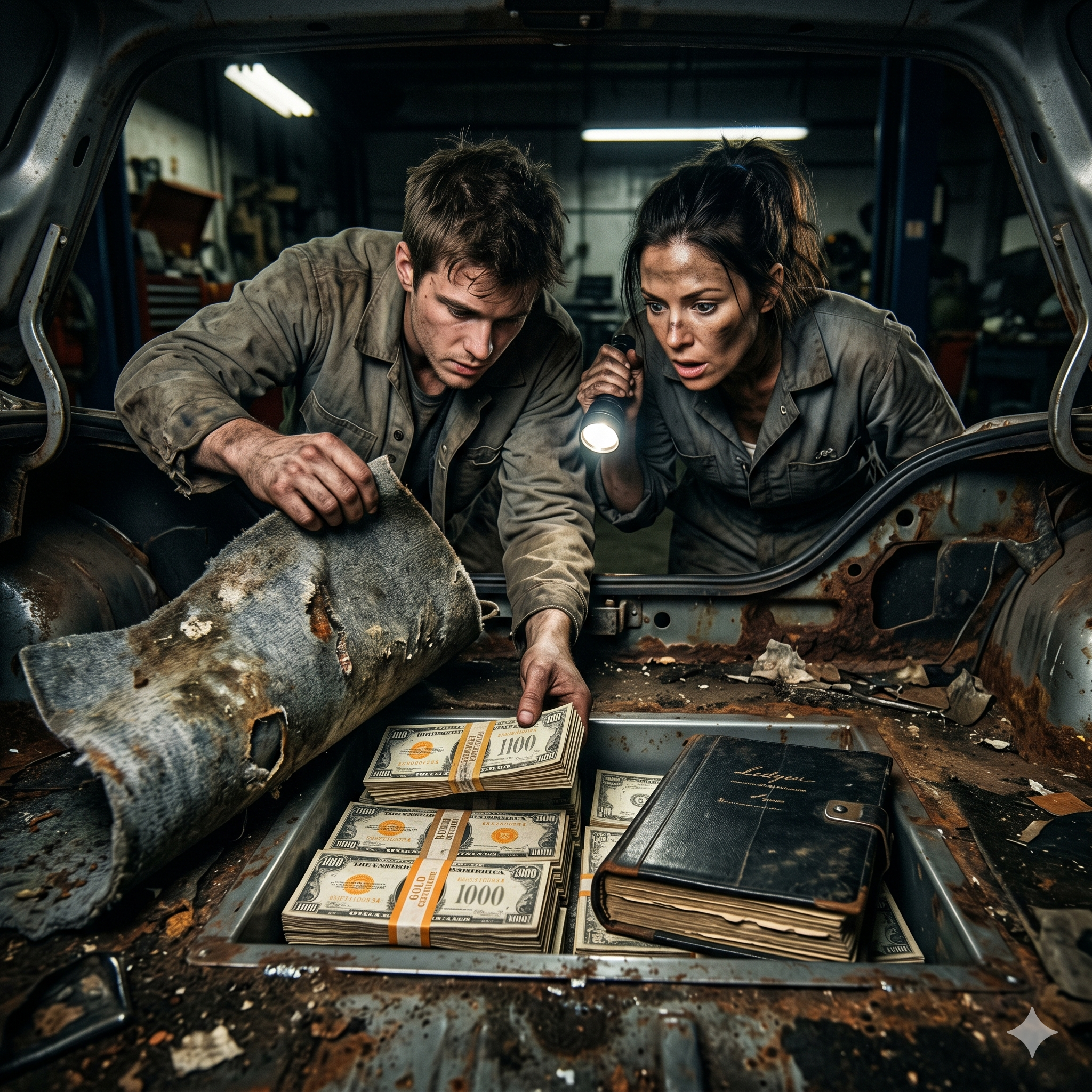
Finally, the tumbler glowed cherry red and popped loose. She used the tip of a screwdriver to pry the heavy steel plate upward. It swung open on hidden hinges. Edmund leaned in. Inside the insulated box, completely protected from the moisture and rust that had consumed the rest of the car, were two items.
The first was a large, heavy bundle wrapped in thick oilcloth canvas, tied with waxed twine. The second was a thick, black, leather-bound ledger, the kind used by accountants decades ago. Edmund reached in. His hands shook violently as he pulled out the oilcloth bundle. It was surprisingly heavy. He set it gently on the trunk lip.
He pulled a pocketknife from his jeans and sliced the thick twine. He peeled back the oilcloth. Sarah gasped, taking a step backward. Holy. Stacked neatly inside, perfectly preserved, were bundles of currency. But they weren’t modern bills. They were larger, thicker, and featured bright orange seals.
Edmund picked up the top stack. The bill read, “$10,000 gold certificate, series of 1928.” There were dozens of stacks, hundreds of bills. Edmund’s mind went blank. Gold certificates of that denomination were exceptionally rare. A single bill could fetch 10 times its face value at auction. He was holding what looked like millions of dollars in historical, untraceable currency. “Edmund.” Sarah breathed.
“Whose car was this?” Edmund didn’t answer. He reached into the compartment and pulled out the black leather ledger. The leather was pristine, practically humming with age. He opened the heavy cover. The pages were filled with neat, handwritten columns of numbers, dates, and names. His eyes scanned the first page, trying to make sense of the accounting.
But as he reached the bottom, the blood ran cold in his veins, and the world seemed to stop spinning. There, signed off at the bottom of a massive transaction involving a shipping union in 1988, was a signature he recognized instantly. It was a signature he had seen on family portraits, on the bronze plaque of the corporate headquarters, and heavily analyzed in business school.
Theodore Wellington. His grandfather. The founder of Wellington Global Logistics. Edmund stared at the ledger, the impossible reality crashing down on him. This wasn’t just a random abandoned car. This was a ghost from his family’s past. The fortune in his hands was undeniable, but the ledger was something far more dangerous.
It was the absolute unscrubbed truth of how the Wellington empire had been built, and Edmund suddenly knew exactly how he was going to destroy his father. The silence in Sarah’s back lot was absolute, broken only by the sharp, stinging gusts of wind that rattled the chain link fence. Edmund remained on his knees, his hands gripping the black leather ledger as if it were a live wire.
Edmund, Sarah said, her voice dropping an octave, losing all its usual sarcastic bite. Who is Theodore Wellington? Edmund swallowed hard, his throat dry as sandpaper. My grandfather. He founded Wellington Global Logistics. The company my father the company I used to work for. Sarah looked from the ledger to the stacks of gold certificates, then down at Edmund’s cheap thrift store jacket.
The math wasn’t adding up in her head. And the terrifying reality of what they had just uncovered was beginning to set in. We need to get this inside, Edmund said, suddenly hyper aware of the dark street beyond the fence. Right now. They hastily stuffed the bundles of currency back into the oil cloth, Edmund clutching the ledger against his chest.
They locked the garage doors, pulled down the heavy metal security shutters, and retreated into Sarah’s cramped upstairs office. It smelled of motor oil and stale coffee, but to Edmund, it felt like a bunker. He cleared a space on her cluttered desk, pushing aside spark plugs and invoices, and laid the ledger flat under the harsh glare of a fluorescent desk lamp.
Sarah stood over his shoulder, a half-empty mug of cold coffee forgotten in her hand. Edmund turned the heavy, yellowed pages. The entries dated back to 1000 982. At first glance, it looked like standard corporate accounting tonnage, fuel costs, maritime union dues. But Edmund possessed a master’s degree in finance, and had spent 5 years navigating the labyrinth of Wellington Global’s modern books.
He knew how to read between the lines. Look at this. Edmund pointed to a column dated October 1000 987. These aren’t union dues. Local 412 Pacific route clearances. My grandfather wasn’t paying dues. He was paying bribes. Hundreds of thousands of dollars in unmarked cash to keep the docks quiet. He flipped further.
The numbers grew exponentially larger. The entries became darker. Here. Miller Transit dissolution. It’s listed as a $3 million expenditure, Edmund muttered. His eyes tracking the neat cursive script. But the official company history states we acquired Miller Transit for pennies after they went bankrupt in ’88.
So, where did the 3 million go? Sarah asked, squinting at the page. To the people who made them go bankrupt, Edmund whispered, a cold sickness settling in his stomach. The ledger meticulously detailed payments to known organized crime syndicates in New York and New Jersey. Sabotaged freighters, intimidated union bosses, arson at competitor warehouses.
Theodore Wellington hadn’t built a logistics empire through business acumen. He had built it with fire and blood. But the most damning entry was on the very last filled page, dated just weeks before Theodore’s sudden fatal heart attack in 1989. Edmund’s breath caught in his chest. The handwriting changed.
It was no longer Theodore’s careful cursive. It was a sharp, aggressive scroll. A handwriting Edmund had seen on a hundred termination notices and corporate mandates. It was Charles’s. The entry detailed the liquidation of several offshore accounts into untraceable bearer bonds and physical currency, the gold certificates currently sitting in Sarah’s oil cloth bundle.
Beside the massive withdrawal was a single chilling note written by Charles. Asset reallocation complete. Bagman secured in vehicle four. TP handled. TP? Sarah said softly. Theodore Wellington. Edmund leaned back in the creaky office chair, rubbing his face with his calloused hands. My father didn’t just inherit the company. He killed my grandfather for it.
Or at the very least, he orchestrated his death to cover up this liquidation. This car this Ford Crown Victoria was vehicle four. It belonged to the bagman who was supposed to transport the cash. But the bagman must have hidden it, or died before he could deliver it to Charles. The car ended up in a barn, forgotten for 30 years, while my father searched for the missing millions.
Edmund, Sarah said, stepping back, her arms crossed tight against her chest. This isn’t a winning lottery ticket. This is a death warrant. If your father is half the monster this book says he is, and he finds out you have this, he will kill us both. Edmund looked at the mountain of gold certificates. He thought about the freezing walk in the rain.
He thought about the roaches in his motel room. The burn marks on his hands. And the smug, victorious smile on his brother Conrad’s face. He’s not going to find out, Edmund said, his voice hardening into something sharp and unfamiliar. Not until it’s too late. My father told me I was made of glass. He told me I didn’t understand the machinery of his world.
Edmund placed his hand flat on the ledger. He was wrong. He just handed me the blueprints. The first step was capitalization. Edmund couldn’t fight a billionaire logistics mogul with a few hundred dollars in a rusted Ford. He needed liquidity, and he needed it without triggering any alarms in the modern banking system. On a rainy Tuesday, Edmund took a bus to Manhattan.
He carried a battered leather briefcase Sarah had lent him. Inside, resting between the pages of a cheap paperback novel, was a single, pristine $10,000 gold certificate. He didn’t go to a bank. He went to the diamond district, slipping into a high-end, heavily fortified numismatic dealership owned by a man named Silas Sterling.
Silas was an 80-year-old appraiser who catered to the ultra-wealthy, a man who valued discretion as highly as the rare coins and currency he traded. Edmund sat across from Silas in a velvet-lined private viewing room. He slid the paperback across the mahogany desk. Silas raised an eyebrow, donned a pair of white cotton gloves, and opened the book.
When he saw the bright orange seal of the 1928 certificate, his breath hitched. He spent 20 minutes examining it under a jeweler’s loupe, checking the serial numbers, the paper weave, and the microprinting. Mr. Wellington, Silas said, looking up, his voice hushed. He had recognized Edmund’s name, but true to his profession, asked no questions about his recent public fall from grace.
This is an extraordinary specimen. Graded, it could fetch nearly $200,000 at auction. But auctions leave paper trails, and they take time. I don’t have time, Silas, and I don’t want a paper trail, Edmund said evenly. I want a private sale, today. Silas steepled his fingers. Without providence, taking on this kind of liability, I can offer you 140,000.
Wire transfer to a secure offshore holding, or a certified cashier’s check. Make it a cashier’s check, Edmund said. Two hours later, Edmund walked out of the dealership with more money in his pocket than he had seen in months. It was a fraction of his former wealth, but it was enough to start a war. He immediately went to work.
He bought a tailored charcoal gray suit, not flashy, but armored. He checked into a secure boutique hotel. He bought three burner laptops and a heavy-duty safe. But his most important purchase was a man named Gregory Langdon. Langdon was a brilliant, notoriously aggressive forensic accountant and corporate attorney. He had built his career tearing down corrupt hedge funds, but he had a personal vendetta against Wellington Global.
10 years ago, Charles Wellington had ruthlessly crushed a smaller logistics firm owned by Langdon’s brother, driving the man to bankruptcy. Langdon was a shark waiting for a drop of blood in the water. Edmund met Langdon in a dimly lit steakhouse in Brooklyn. He didn’t bring the ledger, but he brought high-resolution photographs of specific pages loaded onto a secure tablet.
Langdon scrolled through the images, his steak growing cold. As he read the entries, his eyes widened, and a slow, predatory smile spread across his face. This is the holy grail, Langdon whispered. This establishes a continuous pattern of RICO violations dating back to the ’80s. Extortion, wire fraud, money laundering. And this signature Charles’s authorization of the bagman, it proves he knew about the capital flight.
If we hand this to the SEC and the DOJ, they won’t just find Wellington Global. They will dismantle it down to the studs. They’ll seize every warehouse, every truck, every offshore account. I don’t want to just hand it over, Edmond said, taking a sip of his sparkling water. If we blindside him, his lawyers will tie this up in federal court for a decade. He’ll find a fall guy.
He always does. We need to make him panic. We need him to make a mistake, to try and destroy the evidence. That’s what the FBI needs to catch him dead to rights. So, what’s the play? Langdon asked, leaning in. We bait the hook, Edmond replied. We let them know the ghost of Theodore Wellington has come back to collect.
The following afternoon, Conrad Wellington sat in his corner office overlooking the Manhattan skyline. He was nursing a slight hangover, scrolling through quarterly projections, completely comfortable in his position as the uncontested heir to the empire. His private, unlisted cell phone buzzed. It was a text message from an unknown number. Conrad frowned and opened it.
It was a single, high-resolution image. It was a photograph of the final page of the black leather ledger. The page detailing the liquidation. At the very bottom, perfectly in focus, was Charles Wellington’s signature and the chilling note, Asset reallocation complete. Bagman secured in vehicle four. T P handled.
Beneath the image was a short line of text, I found vehicle four. Conrad felt the blood drain from his face. The glass of water on his desk suddenly seemed to vibrate. He knew about the missing money. It was the great, dark secret his father had drunkenly ranted about for years, the missing millions that were supposed to cement their empire, lost when the bagman vanished in ’89.
But no one outside the family knew about vehicle four, and absolutely no one was supposed to have written proof of Theodore’s murder. Conrad’s hands shook violently as he dialed the unknown number. It rang twice before clicking open. Who is this? Conrad demanded, his voice cracking. Hello? Conrad? Edmond’s voice floated through the speaker, calm, measured, and terrifyingly cold.
I hope you and Dad haven’t spent my trust fund yet, because you’re going to need it for bail. Edmond hung up, snapped the burner phone in half, and dropped it into a storm drain. The war had officially begun. Panic is a foreign currency to men like Charles Wellington. For 30 years, he had operated with the cold, mechanical certainty of a predator at the absolute top of the food chain.
When problems arose, he didn’t fret. He bought them, buried them, or broke them. But when Conrad burst into his father’s study, the very same room where they had exiled Edmond months ago, the air in the room instantly turned toxic. Conrad didn’t say a word. He simply slid the shattered screen of his personal phone across the polished oak desk.
Charles looked at the photograph. The color drained from his face, leaving him looking suddenly, violently old. His eyes locked onto the handwritten note at the bottom of the ledger page, the ghost of his own handwriting screaming back at him from the past. Edmond, Charles whispered, the name tasting like ash on his tongue. He called me.
Conrad said, his voice trembling, the smugness entirely stripped from his features. He said he found vehicle four. Dad, what is he talking about? What is this ledger? Charles stood up, pacing toward the window overlooking the manicured grounds. 35 years ago, right before your grandfather died, he liquidated an emergency fund.
Unmarked cash. He was paranoid. The feds were closing in on the union payoffs. I arranged the transport. The bagman, a low-level enforcer named Dominic, was supposed to drive the cash to a private airstrip in a blue Ford. But Dominic vanished. I spent a decade tearing the East Coast apart looking for that car.
And the note? Conrad asked, pointing a shaking finger at the screen. T handled. Charles turned around, his eyes dead and unblinking. Your grandfather was weak. He was going to turn state’s evidence. I did what was necessary to protect the Wellington legacy. And now, your idiot brother has somehow stumbled onto the only piece of physical evidence that can put me in a federal penitentiary for the rest of my life.
What do we do? Conrad asked, pacing frantically. We pay him off. Whatever he wants. Give him his trust fund back. Don’t be a fool, Charles snapped. Edmond doesn’t want money. He wants blood. If he has the ledger, he has all the leverage. But he’s arrogant. He called you to gloat. He wants us to sweat. We use that.
Charles picked up his desk phone and dialed a three-digit internal extension. Get me Hayes and Miller. Tell them we have a pest control issue. Top priority. I want every digital footprint Edmond Wellington has made in the last 48 hours tracked and traced. And get the jet fueled. While Charles mobilized his corporate army, Edmond was sitting in a dimly lit conference room in the Brooklyn field office of the FBI.
Gregory Langdon had not exaggerated his influence. Within 24 hours of seeing the ledger photographs, Langdon had arranged a meeting with special agent Thomas Harris, the head of the white-collar crime division. Harris had been hunting Charles Wellington for 15 years, constantly hitting dead ends and scrubbed servers.
Edmond sat across from the seasoned agent, the tension in the room thick enough to cut with a knife. He hadn’t brought the real ledger. It was locked in a biometric safe welded to the floor of Sarah’s shop, guarded by Sarah herself and a heavily armed private security contractor Langdon had hired. You’re asking for a lot, Mr. Wellington, Agent Harris said, tapping a pen against a stack of printed photographs.
You want me to authorize a sting operation based on pictures of a book, targeting one of the most powerful CEOs in the country, and you won’t even give me the physical evidence. If I give you the physical evidence now, Charles’ lawyers will file 50 injunctions by midnight, Edmond replied smoothly, leaning forward.
They will claim the ledger is a forgery. They will drag this out until I’m dead or discredited. You know how he operates, Agent Harris. And your alternative? Harris asked, narrowing his eyes. We let him prove it’s real, Edmond said. He knows the ledger is authentic, and he knows that to survive, he has to destroy it and kill me. We set a meeting.
I offered to trade the ledger for a massive cash payout and my reinstatement into the company. It’s exactly the kind of greedy, spineless move he expects from me. When he shows up, he won’t bring lawyers. He’ll bring his fixers. He will admit to the crimes because he thinks I’m about to disappear forever. Langdon nodded from the corner of the room.
We wire Edmond. We wire the location. We catch Charles Wellington on tape conspiring to murder a witness and destroy evidence of a federal crime while explicitly confirming the contents of the ledger. It bypasses years of litigation. It’s an instant checkmate. Harris stared at Edmond for a long, calculating minute.
If he brings his fixers, they are going to try to kill you, Edmond. If our tactical team is even a second too slow, you will die in that room. I’ve been dead for months, Edmond said, his voice flat and resolute. I’m just finally coming back to life. Let’s set the trap. The bait was dropped at exactly 8:00 p.m. on a Thursday.
Edmond used a prepaid burner phone to call his father’s direct private line. Edmond, Charles answered on the first ring. His voice was smooth, betraying none of the panic from two days prior. I’ve been expecting your call. Cut the garbage, Dad, Edmond said, channeling every ounce of bitter entitlement he could fake. I have the book.
I have the gold certificates. I know about grandpa. You have a highly active imagination and a stolen antique, Charles countered calmly. But you also have my attention. What is your price? 10 million dollars in unmarked bearer bonds, Edmond demanded. And my shares in the company restored. Unfrozen.
Charles let out a low, patronizing chuckle. You always did think too small. Fine. We can negotiate. But I want the physical ledger. I want it verified in person before a single dime changes hands. Pier 44, the old Wellington maritime storage yard in Red Hook, Edmond said. Tomorrow night, midnight. Come alone. I’ll see you there, son, Charles said.
Edmond hung up. He looked at Agent Harris, who was monitoring the call. He agreed too easily, Edmond noted. He’s bringing a hit squad. So are we, Harris replied, racking the slide of his service weapon. Friday night in Red Hook was a symphony of industrial decay. The rain was falling in sheets, hammering against the corrugated steel roofs of the abandoned warehouses.
Pier 44 had been defunct for a decade, a sprawling labyrinth of rusted shipping containers and broken floodlights. Edmond stood in the center of the main warehouse floor. The cavernous space was illuminated only by a single, flickering halogen work light he had plugged into a portable generator.
In his hand, he held a black leather book, indistinguishable from the real ledger in the dim light. Hidden in the catwalks above, behind rusted ventilation grates, and concealed in the shadows of the shipping containers, were two dozen heavily armed FBI SWAT operatives. Agent Harris sat in a mobile command center parked three blocks away, monitoring the high-definition audio and video feeds beaming from a micro camera hidden in the button of Edmond’s coat.
At exactly midnight, the heavy metal doors of the warehouse groaned open. Headlights cut through the gloom. A sleek, black SUV rolled into the warehouse, its tires crunching over broken glass and debris. The engine cut off and the doors opened. Charles Wellington stepped out. He was wearing a cashmere overcoat, looking entirely out of place in the industrial filth.
Behind him stepped Conrad, looking pale and nervous, and flanking them both were Hayes and Miller, the two fixers who had escorted Edmund out of his old life. They kept their hands deep in their coat pockets, their eyes scanning the dark corners of the warehouse. “You look terrible, Edmund.
” Charles said, his voice echoing off the high ceilings. “I told you that you weren’t built for the real world.” “I survived.” Edmund said, holding up the black book. “Which is more than Grandpa did when he got in your way.” Charles walked forward slowly, stopping 10 ft from Edmund. He didn’t look at the book. He looked at his son’s eyes.
“You think you’re clever. You think you’ve cornered the lion. Where is the money, Edmund? The gold certificates?” “Safe.” Edmund lied. “Do you have my bonds?” Charles smiled a cold, terrifying bearing of teeth. “Did you really think I would hand you $10 million, Edmund? Did you really think you could blackmail me with the sins of the past and walk away wealthy?” “You signed the authorization, Dad.
” Edmund pushed, needing the verbal confirmation for the tape. “You ordered Dominic the bagman to move the cash, and you killed Theodore to take control of the logistics routes. It’s all written down right here.” “Yes.” Charles said plainly, the word dropping like an anvil. “I did. The old man was a coward. He was going to let the federal prosecutors dismantle the empire he built because he suddenly found religion in his old age.
I did what had to be done. I solidified our routes. I made us untouchable. And I would do it again.” In the command center, Agent Harris leaned forward. “We have the confession. Stand by, tactical.” “You’re a monster.” Edmund said. His voice shaking not from fear, but from the adrenaline of victory. “I am a CEO.” Charles corrected.
He nodded subtly to Hayes and Miller. The two fixers pulled silenced pistols from their coats, leveling them at Edmund’s chest. Conrad gasped, taking a step back. “Dad, wait. You didn’t say we were going to be” “Shut up, Conrad.” Charles barked. He looked back at Edmund. “Hand over the ledger. You can die quickly, or you can die screaming.
The choice is yours.” Edmund didn’t flinch. He looked down at the black book in his hands, then tossed it casually onto the wet concrete floor at his father’s feet. Charles frowned. He nudged the book with the toe of his Italian leather shoe. The cover flipped open. The pages were completely blank. “It’s a prop, Dad.” Edmund said softly.
“The real ledger is already with the federal government, but thank you for the confession.” Charles’s eyes widened in sudden, horrifying realization. He looked up at Edmund, then frantically scanned the dark upper levels of the warehouse. “Kill him!” Charles screamed, his composure finally shattering.
Before Hayes could pull the trigger, the warehouse erupted into blinding, agonizing light. A dozen high-intensity tactical spotlights snapped on from the catwalks, pinning Charles and his men in pools of brilliant white. The deafening screech of a bullhorn shattered the silence. “Federal agents, drop your weapons. Drop them now.” Flashbang grenades detonated near the warehouse doors, the concussive blasts dropping Conrad to his knees in terror.
Red laser sights painted the chests and heads of the two fixers. Realizing they were hopelessly outgunned, Hayes and Miller slowly lowered their weapons and kicked them away, raising their hands in surrender. Agent Harris and his team swarmed the floor, heavily armored and moving with ruthless efficiency.
They slammed the fixers against the SUV, slapping handcuffs on their wrists. Charles Wellington stood frozen in the center of the light. He didn’t run. He didn’t fight. He just stared at Edmund, his empire crumbling into dust in the space of 30 seconds. An FBI agent grabbed Charles roughly by the shoulder, spinning him around and cuffing his hands behind his back.
“Charles Wellington, you are under arrest for conspiracy to commit murder, racketeering, wire fraud, and a litany of other federal charges.” Agent Harris recited, walking up to the fallen titan. As they dragged Charles toward the door, he locked eyes with Edmund one last time. “You destroyed your own family.
” “No.” Edmund said, his voice ringing clear and steady over the chaos. “I just took out the trash.” The fallout was biblical. By Monday morning, the news of Charles and Conrad Wellington’s arrest dominated every major network. The stock of Wellington Global Logistics plummeted by 80% in 3 hours. The board of directors desperately tried to salvage the company, but when Gregory Langdon officially submitted the black ledger to the Department of Justice, the federal hammer fell.
The company’s assets were frozen, its warehouses raided, and its executives subpoenaed. The Wellington empire was dead. Edmund did not return to the penthouse. He did not ask for his old job back. He had no desire to rule over the ashes of his father’s corruption. Instead, he worked closely with Silas Sterling and Gregory Langdon.
They carefully, legally navigated the authentication and sale of the gold certificates, paying the exorbitant taxes required to legitimize the windfall. Even after the IRS took its massive cut, Edmund was left with a fortune of over $12 million clean, untainted, and entirely his own. Six months later, on a bright, crisp spring morning, Edmund pulled into a massive, newly paved commercial lot near the New Haven docks.
He wasn’t driving a rented car. He was driving a beautifully restored dark blue 1987 Ford Crown Victoria. The rust was gone, the chrome gleamed in the sunlight, and the massive V8 engine purred like a contented lion. He parked in front of a sprawling, newly renovated building. The sign above the massive bay doors read, “Wellington and Jenkins Custom Auto Restoration.
” Sarah walked out of the garage, wiping grease off her hands with a clean rag. She wore a pristine set of coveralls with the new company logo stitched over the breast. “You’re late, boss.” She smirked, admiring the Crown Vic. “And you’re driving the company mascot. I thought we agreed that car belongs in the showroom.
” “It needed to stretch its legs.” Edmund smiled, stepping out of the car. He looked around the lot, at the rows of classic cars waiting to be restored, at the legitimate, honest business he had built from the ground up with the woman who had saved his life. He didn’t have a corner office in Manhattan anymore. He didn’t wear bespoke suits or attend charity galas with people who would sell his soul for a tax break.
His hands were still calloused, and he still smelled faintly of motor oil. Edmund Wellington had lost everything he thought mattered. But as he walked into the garage, greeted by the sounds of pneumatic drills and the smell of fresh paint, he knew the truth. He had finally found his fortune. Sometimes, the universe strips everything away from you not to punish you, but to clear the path for who you are truly meant to become.
Edmund’s story is a testament to the fact that your worth isn’t defined by the name on your bank account, but by the grit in your soul and the courage to stand up against the darkness, even when it comes from your own blood. He traded a corrupt empire for a rusted junker, and in the process, found his true fortune, his true family, and his freedom.






