There are moments that arrive without ceremony. No music, no warning, no way to know in the instant they happen that they are the kind of moment a person will carry for the rest of their life. Cole had learned this the hard way — that the things that changed everything looked, at first glance, exactly like nothing. A folded bill. A smudge of blue ink. Two words in a child’s handwriting on a one-dollar bill passed through the hands of a gas station clerk who didn’t bother to read it.
He almost didn’t read it either.
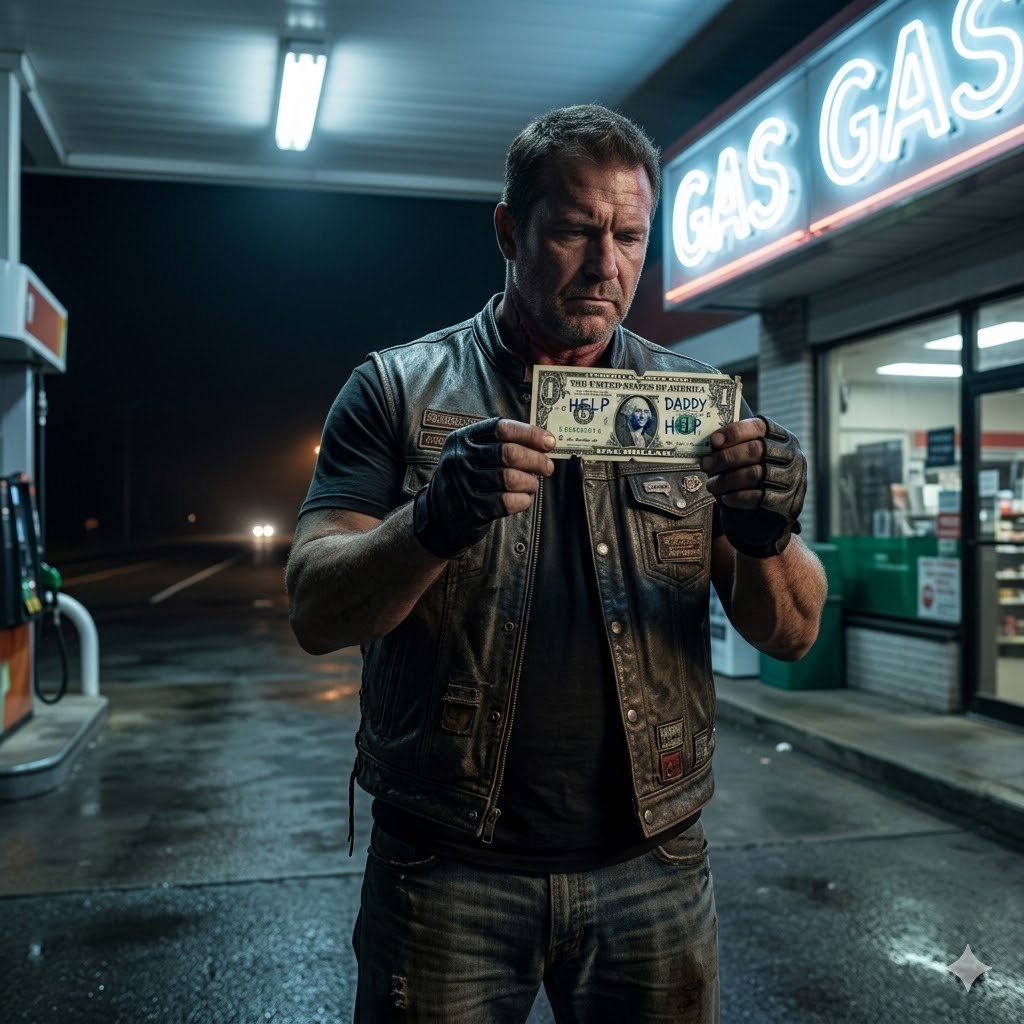
He had counted his change under the fluorescent hum of the Shell station off Route 47, three fives and four ones, stuffed them in his vest without looking, bought the cigarettes, and was already halfway to the door when something made him stop. He didn’t know what. He pulled the bills back out and counted them again, slowly this time, and when he reached the last one he turned it over.
Blue ink across Washington’s face. Two words. Uneven letters. The E smudged where a small hand had dragged across it before the ink dried.
Help me.
He stood under the parking lot lights for a long time with the bill in his hand and the highway dark in both directions, and he didn’t leave.
—
The clerk was mid-twenties, thin, leaning on the register with his phone in his hand when Cole came back in and set the bill on the counter.
“The girl who gave you this,” Cole said. “Where’d she go?”
The clerk looked up, looked at the bill, shrugged. “Some guy brought her in. Bought her a candy bar. They left.”
“What guy?”
“Tall. Sunglasses. Didn’t say much.”
“Car?”
“Didn’t see it. I wasn’t paying attention.”
Cole looked at him for a moment. “You see what’s written on this?”
The clerk glanced at the bill. Read the words. Looked away. “That’s messed up,” he said. “I handle like 300 bills a night. I don’t read them.”
The security camera in the corner was a cracked black dome with no light inside it. Broken for a year, the clerk said. Cole asked everything there was to ask and got everything there was to get, which wasn’t much, and then he stood in the middle of the gas station while the clerk went back to his phone and let the information settle into what it was.
She had been here. She had handed this bill to a stranger in a busy gas station at ten o’clock at night and pressed the pen hard enough into the paper that the letters were visible from three feet away. She had done it deliberately. She had wanted someone to find it.
“She looked scared,” the clerk said, when Cole was almost to the door.
Cole stopped. Looked back.
The clerk was still looking at his phone. “Yeah,” he said quietly. “She did.”
Cole walked out into the parking lot and called Hank.
—
They arrived in fifteen minutes. Three bikes, headlights cutting through the dark, pulling into the lot single file and killing their engines in a line. Hank was off first, gray beard and patches and the specific unhurried movement of a man who had been in enough situations to know that rushing before you understood the shape of something was how people made mistakes. Two more behind him — the one they called Bear, thick through the shoulders with tattoos running to his collar, and a younger one, shaved head, scar across his eyebrow, who everyone called Regan.
Hank held the bill under the parking lot light and read it without speaking. Handed it to Bear. Bear handed it to Regan.
“When?” Hank asked.
“Twelve minutes after she left, by the time I got it,” Cole said. “She was here with a man. Tall. Sunglasses. Clerk didn’t see the car.”
“Could be nothing,” Hank said.
“It’s not,” Cole said.
Hank didn’t argue. He looked down the highway in the direction Cole had already been looking. The dark stretched out empty in both directions.
“She wrote this for a reason,” Cole said. “She didn’t drop it. She handed it to the clerk at the register. She wanted it found. If she wanted it found here, she might still be close.”
Regan spoke. “There’s a motel two miles east. The Pines. People go there when they don’t want to be seen.”
Hank looked at Cole.
Cole nodded.
They rode dark, no headlights once they cleared the gas station, running down the two-lane highway in the wet night air. The Pines appeared after a mile and a half, set back behind a gravel lot — single story, ten rooms, half the bulbs above the doors burned out. They parked at the far end near the dumpster and cut their engines and sat in the dark, looking at the office window.
Cole went in alone.
The woman behind the desk was middle-aged, bleached hair, a cigarette burning in an ashtray, watching a small television. She looked up when the door chimed.
Cole set the dollar bill on the counter.
She read the words. Her hand stopped halfway to the cigarette.
“Room six,” she said. “Checked in forty minutes ago. Cash.”
—
Room six had the curtains drawn and a sliver of light underneath the door. No sound from inside. Hank knocked three times. Nothing. He knocked again. A voice, muffled.
“Who is it?”
“Need to talk to you.”
“About what?”
“About the girl.”
The silence that followed was the particular silence of a man recalculating. Then footsteps. The lock turned. The door opened on a chain. A face appeared in the gap — late thirties, unshaven, bloodshot eyes, sunglasses gone now.
“I don’t know what you’re talking about,” he said.
“Yeah, you do,” Hank said.
The man moved to close the door. Cole put his boot against the frame. “We’re not leaving,” he said. The man looked at Cole, then at Hank, then at Bear and Regan standing behind them in the dark. His jaw worked.
“She’s my daughter,” he said.
“No, she’s not,” Cole said.
Hank pushed the door — not hard, just steady pressure. The chain snapped. The door swung open. The man stumbled back. And there on the bed, small and still in a torn red hoodie, was the girl. Blonde hair pulled into a messy ponytail. Hands folded in her lap. She looked up when the door opened and her eyes found Cole’s and she didn’t say anything and she didn’t have to.
—
Her name was Lily.
Nine years old. She gave it in a voice barely above a whisper, like a word she wasn’t sure she was allowed to use. She sat on the bed with her hands pressed together in her lap, not looking at the man against the wall, not looking at the door, looking at the floor while she answered questions in short, careful sentences.
She had met him at a park in Denver. He had told her he knew her mother. That her mother had sent him to get her. She had been alone at the park for two days because her mother had left and hadn’t come back, and she had been hungry and frightened and he had been the first adult who spoke to her, and he had said the words she most needed to hear.
He lied.
Cole stood in the center of the room with the dollar bill in his vest and the man pressed against the wall behind him and a nine-year-old girl sitting on the edge of a motel bed four hours from the park where she’d been found, and he understood the shape of what had almost happened here with a clarity that sat cold and heavy in his chest.
Regan found the notebook in the duffel bag. Spiral-bound, cover bent, pages filled with handwriting. Twelve names. All girls. All under twelve. Ages, addresses, handwritten notes beside each one.
Robert Finch said he was a social worker. Cole told him to shut up. Hank called the police.
The officers arrived in two patrol cars, lights off, and moved into the room and read Robert Finch his rights and put him in the back of a car and took the notebook. A younger female officer crouched beside Lily and spoke to her in a quiet, careful voice. Lily barely answered.
They took her to the patrol car. She stopped when she passed Cole. She looked up at him — nine years old, red hoodie, clean blonde hair that the drizzle was already beginning to reach.
“Thank you,” she whispered.
“You’re going to be okay,” Cole said.
She didn’t look like she believed him. The door closed. The car pulled out of the lot. Red and blue light swept across the wet trees and faded down the highway until there was nothing left.
Cole and Hank stood in the gravel lot and watched it go.
“She’s not going to be okay,” Cole said.
“I know,” Hank said.
They got on their bikes and rode back into the dark.
—
Three days later, Cole was in a diner off Route 31 with cold coffee in front of him when an unknown number called. A woman’s voice, professional and tired in equal measure, introduced herself as Karen Delgado, CPS, Summit County.
“Lily asked me to call you,” she said. “She wanted me to tell you she’s okay.”
“Is she?”
“She’s safe.”
“That’s not the same thing.”
“No,” Karen said. “It’s not.”
She was in temporary foster care. The mother was missing, officially now. Father not in the picture. An aunt in Nebraska not yet returning calls. Lily wasn’t eating much. Wasn’t talking much. The foster family were good people. It wasn’t making a difference.
“She asked if you could visit,” Karen said.
Cole didn’t answer for a moment. “I’m not family,” he said. “I’m nobody.”
“You’re someone she trusts. That counts for something.”
—
The house had pale blue siding and a chain-link fence and a woman in her fifties watching him carefully from the kitchen doorway when he came in. Karen walked him through to the living room. Lily was on the couch, hands in her lap, wearing jeans and a pink t-shirt, her hair clean and brushed into a braid. She looked up when he came in and her eyes went wide.
They talked for twenty minutes. Cole asked if she was eating, if they were treating her well, if she was sleeping. She answered with small nods and short words. Then she said the thing she had brought him here to say.
“I wanted to say thank you,” she said quietly. “Because for one night, someone actually cared. And I know you’re going to leave and I’ll never see you again. But that night mattered. That mattered.”
Cole didn’t have the words for what was happening in his chest. He looked at her — nine years old, abandoned twice, passed through the hands of a man who had lied to her in the specific way that children are most vulnerable to, sitting in a stranger’s living room in someone else’s clothes, delivering a speech of gratitude to a man she’d met three days ago because she had decided to make sure he knew it counted before the chance was gone.
“You’re right,” Cole said. “I’m going to leave. You might not see me again. But that doesn’t mean nobody cares.”
“Why not?”
“Because you’re still here. You wrote on that dollar. You fought to get help in a gas station at ten at night when nobody was looking. That takes something most people don’t have.”
“I don’t feel strong,” she said.
“You don’t have to feel it. You just have to be it.”
She looked at him for a long time. Then: “Can I hug you?”
He said yes.
She stepped forward and wrapped her arms around his waist and held on, and he put one hand carefully on her back, and she held on a moment longer than she probably meant to before she let go.
“Goodbye,” she whispered.
“Take care of yourself, Lily.”
He walked out to the curb. Karen followed him.
“She’s going to be okay,” Karen said.
“You believe that?” Cole asked.
She paused. “I have to.”
He looked at her. “What happens now?”
She told him. Keep looking for family. If nothing turns up, foster care until something does. If nothing ever did, she’d age out at eighteen. He counted the years.
“That’s seven years,” Cole said.
“I know the system’s broken,” Karen said. Her voice had the specific exhaustion of someone who had been saying that sentence long enough to have stopped expecting it to change anything. “But it’s what we have.”
Cole pulled his keys out. “Robert Finch. What’s happening with him?”
“Charged with kidnapping and suspected trafficking. The notebook connected him to two other cases. He’s not getting out.”
“The other twelve names in that notebook,” Cole said.
Karen nodded once, the nod of someone who was already working it and didn’t need to say so. He got on his bike and left.
—
Hank was outside the clubhouse with a cigarette when Cole got back, sitting on the bench in the long late-afternoon shadows. Cole sat beside him. They didn’t speak for a while.
“You did what you could,” Hank said eventually.
“I know.”
“That’s all anyone can do.”
Cole pulled the dollar bill from his vest. He’d kept it. Three days later, the fold was still in the same crease. The ink still visible. He looked at the two words in a child’s handwriting and thought about the twelve names in the notebook and the ones that weren’t in any notebook that anyone had found yet. He thought about how many bills had been written and dropped and handed to people who didn’t read them.
“She said everyone just walked past,” Cole said. “At the gas station. At the park in Denver. She said she’d tried before. Nobody listened.”
Hank smoked and didn’t say anything.
“Is it enough?” Cole said. “One kid.”
Hank took a long drag and let the smoke out slow. “It has to be,” he said.
Cole folded the bill along the same crease and put it back in his vest. It wasn’t the answer he wanted. It was the only honest one.
—
Two weeks later, Karen called again.
They had found the aunt. Nebraska. Clean background, stable home, willing to take Lily. It was a good placement.
“Lily wanted you to know,” Karen said. “She also wanted me to tell you something else.” A pause. “She said she’s going to be okay. She doesn’t know how yet. But she’s going to try.”
Cole closed his eyes.
“Tell her I believe her,” he said.
He meant it.
After he hung up, he pulled the dollar bill out one last time. Held it under the lamp on his nightstand. The ink had faded slightly at the edges, the paper soft now from being folded and unfolded too many times. The E in help was still smudged. The letters still uneven, still carrying in their pressure and their angle the urgency of a child writing as fast and clearly as she could in a gas station at ten o’clock at night while a man in sunglasses waited by the door.
She had believed someone would find it.
She had been right.
Cole folded the bill one last time, put it in the drawer of his nightstand, and closed it. He went outside, started his bike, and rode into the dark with the road stretching out ahead of him and the town receding behind him. Somewhere behind him, a nine-year-old girl was packing a bag to go to her aunt’s house in Nebraska. She would wake up in a strange bedroom and eat breakfast at a table with people she didn’t know and she would be afraid and it would be hard and she would figure it out anyway, because that was already the kind of person she was.
She had written on a dollar bill. She had handed it to a stranger. She had sat in a motel room and waited to see what the world would do with her message, and the world had sent a man with a scar on his neck and a vest with patches and a bike parked outside in the dark.
It wasn’t what she asked for.
It was enough.
THE END