There is a rule in New York City that gets passed down the way most important rules get passed down — not written anywhere, not spoken directly, but absorbed through proximity and repetition until it becomes instinct. The rule is simple. You hear something, you heard nothing. You see something, you saw nothing. Getting involved is a luxury reserved for people who can afford the consequences, and most people in this city cannot.
Clara Bennett had been following that rule for twenty-four years. She had followed it through two jobs and a mounting pile of debt she couldn’t climb out of, through a mother’s slow death and the medical bills that outlived her, through every late-night walk from the back door of the Morning Grind to her apartment three blocks over, head down, eyes forward, invisible by design.
She was very good at following that rule.
Until the night she heard the sounds coming from the alley behind Veritas.
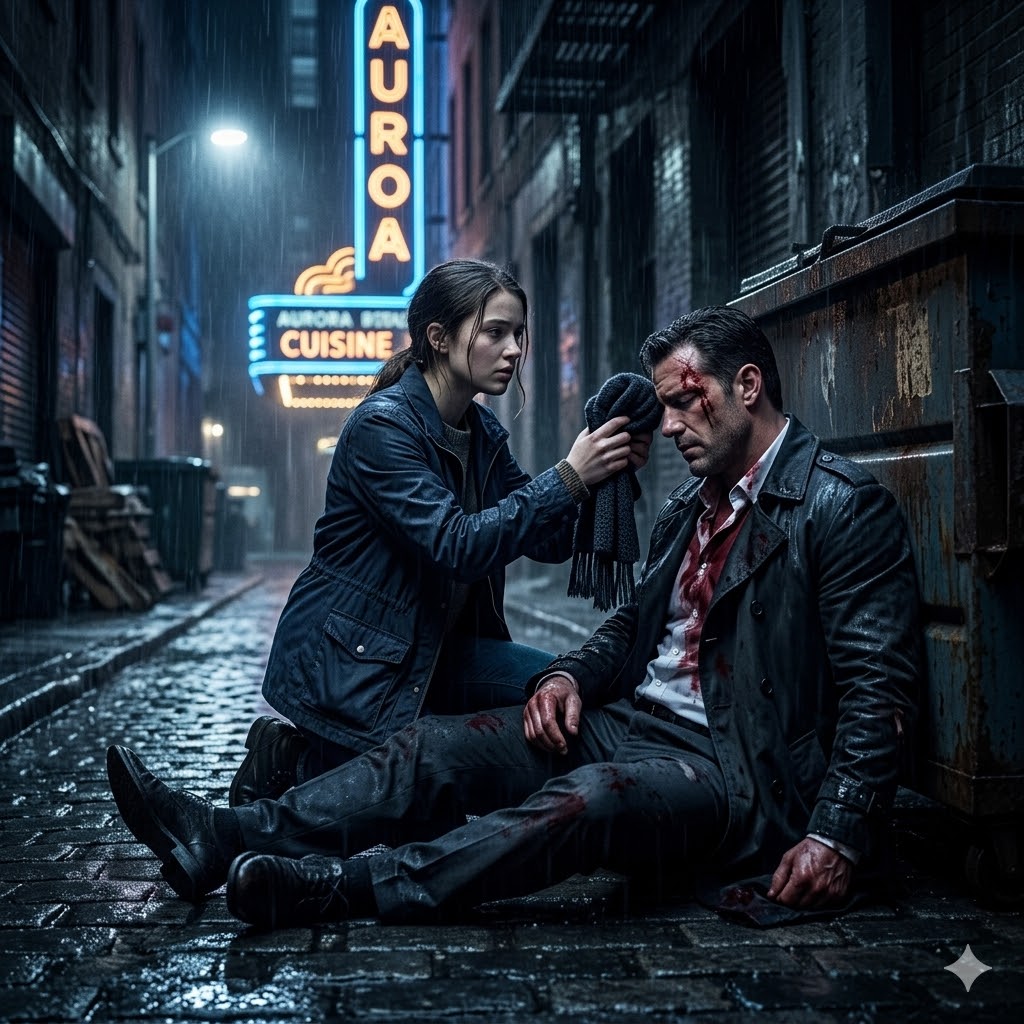
It was 2:17 a.m. and the rain had been falling since midnight, the kind of persistent, cold New York rain that found every gap in your clothing and made the air smell of concrete and something older underneath. Clara zipped her jacket to the throat and cut through the alley the way she did every night, moving fast through the shadows, not looking at anything she didn’t need to look at.
The sounds stopped her before her mind caught up with what they were. A wet, heavy impact. A grunt of pain, swallowed too quickly, the sound of a man trying not to let it out. Then again. And again.
Her body went still. Her mind ran the calculation in about half a second: leave now, keep moving, don’t look, this is not your problem, this is never your problem.
She looked.
Three men in tailored dark suits stood over a fourth man who was on his knees in the alley behind the restaurant. The man on the ground wore an expensive jacket that had been torn at the shoulder, his white shirt stained the spreading dark red of something serious. His face was turned away from her, but his posture — the way he held himself even on his knees, the controlled tension in his spine, the fact that he hadn’t begged — told her things about him before she knew his name.
“You thought you could negotiate with Petrov behind our backs, Alessandro?” one of the attackers said. He had a thin, cruel face and delivered the question with a kick to the ribs that bent the man on the ground nearly double.
Alessandro. She didn’t need a last name. Even a barista who kept her head down knew that name. Alessandro Salvatore. The Salvatore family allegedly owned half the city’s shipping, sanitation, and construction. And, according to the kind of rumor that passed in a whisper and was never repeated twice, one hundred percent of its fear.
He was supposed to be untouchable.
The man with the thin face grabbed Alessandro by the hair and forced his head up. “This is from Petrov. He owns this port now. You’re just a memory.” He nodded to the others. They were professional about it. This was not anger — it was completion. They worked with the detached efficiency of men finishing a job, and when they were done, they stepped back, straightened their suits, and walked to a sedan idling at the end of the alley without looking back.
Alessandro didn’t move. What was left of him was crumpled against the base of the dumpster, his breathing audible from where Clara stood — wet and labored, the sound of something trying to keep itself going by sheer mechanical persistence.
A couple rounded the corner from the street. They saw everything in a single, freezing glance — the man on the ground, the blood on the pavement, the retreating sedan. The woman’s hand went to her mouth. Her partner grabbed her arm. “Don’t look,” he said, pulling her back toward the main street. “Let’s go.”
They disappeared.
Clara stood in the shadow of the dumpster with the city’s rule running on a loop in her head: This is not your problem. He is a monster. Let monsters eat each other. You cannot afford the consequences. You have enough problems. Walk away, Clara. Walk away right now.
She thought of her mother in a hospital bed, her breathing shallow and mechanical, the doctors who had walked away from her the moment they calculated she wasn’t worth the fight. She thought about what it meant to be left alone at the end.
“Damn it,” she whispered.
Her feet moved. Not toward home.
She dropped to her knees beside him on the wet concrete, her bag spilling open, her hands finding his face before she’d finished deciding to touch him. Up close the gash at his temple was bleeding heavily, the kind of wound that needed pressure immediately. His airway was compromised by his position. She had been two semesters from a nursing degree before her mother got sick and tuition became something she spent on hospital bills instead. Those two semesters came back to her now in a clean, automatic sequence that her hands followed without consultation.
She ripped her scarf off and pressed it hard against the gash. She rolled him carefully onto his side, clearing his airway. His breathing shifted — still wrong, but less desperate, the gurgling quality receding. She checked his pulse with two fingers at his neck. Present. Uneven. But present.
She fumbled her phone out with blood-slicked fingers and dialed.
“911. What’s your emergency?”
“There’s a man in the alley behind Veritas in TriBeCa. He’s been beaten badly. He needs an ambulance immediately.” Her voice came out higher than she intended, stripped of everything identifying.
“Ma’am, what’s your name—”
She hung up.
She knew she should run. The sirens would bring questions she had no answers for. But she stayed on her knees in the rain with her ruined scarf pressed to his head and her heart slamming against her ribs, because she couldn’t make herself leave him alone on the pavement. She just couldn’t do it.
His eyelids moved.
His eyes opened. Dark, unfocused, glazed with pain and something else — the specific disorientation of a person trying to locate themselves in a situation they can’t fully process. His gaze found her face. She saw him see her — brown eyes, cheap jacket, kneeling over him in the rain like she had no business being anywhere near this situation, which was entirely accurate.
Then the eyes closed again.
The sirens were close. Clara pulled her scarf back and stood up. She backed into the shadow at the alley’s edge and then she ran — three blocks, her breath tearing, her blood-stained hands shoved into her pockets, her mind producing nothing except the same three words on repeat: What have you done. What have you done. What have you done.
She bolted her door. Threw her jacket in the trash. Scrubbed her hands until the skin was raw. But the feeling of his blood didn’t wash off, and neither did the image of his eyes opening and finding her face in the dark.
She had saved the life of the most dangerous man in New York City.
And he had seen her.
Alessandro Salvatore did not wake up in a hospital. He woke in a private clinic buried in the subbasement of a Salvatore-owned building, surrounded by equipment that didn’t appear on any public record and staff who would not appear in any public record either. Leo Moretti, his consigliere, stood in the corner with the patience of a man accustomed to waiting.
Two broken ribs. Fractured cheekbone. Severe concussion. Twenty-eight stitches. Alessandro absorbed this information the way he absorbed most information — without visible reaction, filing it into the category of things that had happened and could not be unhappened and therefore required only the calculation of what came next.
What came next was Petrov. What came next was the rat inside his organization who had known his schedule, his route, the precise timing of when his primary security detail would be positioned elsewhere.
But first — there was something else.
Something at the edge of memory, persistent despite the concussion trying to blur it. Someone in the darkness after the attackers left. Someone who had turned him onto his side, who had pressed something warm and firm against the wound at his temple. Someone with terrified brown eyes who had knelt over him in the rain like she was the last person on earth who was going to let him die alone.
Leo told him there had been no witnesses. He dismissed it as concussion. But Alessandro opened his right hand, which had been closed since he woke, and looked at what he’d been holding.
A small button pin, two inches across. A cartoon coffee bean with a disgruntled expression and the words: Don’t talk to me before this.
He turned it over once. Turned it back.
She was real.
“Find her,” he told Leo. “Check every coffee shop within ten blocks of that alley. Find the woman who wears this pin. And when you find her — you bring her to me. Unharmed.”
Leo looked at the pin for a long moment. “To thank her?”
Alessandro’s fingers closed around it. “To find out what she is to me.”
Clara had been running on anxiety for a week when he walked into the Morning Grind.
She heard his voice before she turned — low, smooth, the kind of voice that took up space without needing to try — and the chill that moved down her spine told her everything before her eyes confirmed it. She turned from the espresso machine.
Alessandro Salvatore stood in the middle of her café. He wore a black suit that had no business existing in the same world as her worn-out apron. The only evidence of what had happened to him was a faint scar disappearing into his hairline and a shadow of bruising under one eye, expertly managed but not entirely gone. He was looking directly at her with the focused, appraising attention of a man who has already identified what he came for.
“What can I get you?” Clara said. Her hands gripped the counter.
He moved toward her slowly, reading her name tag. “Clara.” He said it like he was testing it. Like it was information he already had but wanted to verify. “A black coffee.”
She turned to make it, her back to him, hands moving through the familiar motions while her mind ran calculations that had no clean answer. It was dark. You were a shadow. He had a concussion. He can’t know for certain. She slid the cup onto the counter. “Three fifty.”
He placed something on the counter and slid it toward her.
Her pin. The grumpy coffee bean.
Clara’s hands went cold.
“I believe this is yours,” Alessandro said. His voice was careful and precise, the voice of a man who has chosen each word specifically. “A friend of mine had a very bad night near Veritas recently. Someone helped him. Someone called 911, stopped the bleeding, stayed until they heard the sirens.” He held her gaze. “Was that you, Clara?”
She couldn’t move. A nod was a confession. A denial was a lie he had already seen through, or he wouldn’t be here.
“Don’t be afraid,” he said, his voice dropping slightly. “If I wanted to hurt you, you wouldn’t be making me coffee.”
“I don’t know what you’re talking about,” she said, but her voice cracked on the last word.
“Yes, you do.” He leaned slightly on the counter, his voice quiet enough that the old man in the corner heard nothing. “I saw your eyes. I’ve been seeing them every night since.”
“I should have walked away,” she said, tears rising from somewhere she hadn’t expected them to, from the sheer accumulated stress of a week of waiting for this exact moment. “I didn’t see anything. I swear. I just — I couldn’t let you die.”
He studied her face for a long time. The cheap uniform. The genuine fear mixed with something else, something stubborn that refused to fully capitulate. He had expected a liability. He had expected someone frightened enough to be managed or bought. He had found something that didn’t fit either category.
“Why?” he asked. “Everyone else ran.”
Clara met his eyes and something inside her stopped calculating. “Because you were dying,” she said, her voice shaking but direct. “And no one deserves to die alone in an alley bleeding on the concrete. I don’t care who you are.”
The silence lasted exactly long enough to change something.
“Name your price,” he said. “Money. A new apartment. Whatever you need. The Salvatore family pays its debts.”
The fear that had been running through her crystallized into anger so fast it surprised her. She pushed the pin back across the counter. “I don’t want your money. I didn’t do it for a reward. I did it because it was the right thing to do. Take your coffee and leave. I don’t want any trouble.”
Alessandro Salvatore, a man who had not been told no by anyone who mattered in thirty years, went quiet. He looked at this woman who had just refused him with her hands still shaking and her chin lifted and her eyes blazing, and something in his expression shifted from the cold appraisal of a predator to the unguarded surprise of a person encountering something genuinely unexpected.
He pushed the pin back to her. “Keep it.” He picked up the coffee. “You’re a terrible liar.” He placed a hundred-dollar bill on the counter. “And you’ve created a debt by refusing mine. In my world, that’s an insult — whether you intended it or not.” He turned toward the door, then paused. “I’ll find a way to repay this. Whether you like it or not.”
The bell jingled. He was gone.
Clara sat down on the stool behind the counter with her legs no longer willing to hold her. She looked at the hundred-dollar bill and the pin and had the very clear understanding that her life had just changed, and she had not been given a vote.
The check arrived two weeks later. Slipped under her apartment door, thick cream envelope, her name in sharp calligraphy. Inside: a cashier’s check for $150,000. Memo line: Paid.
Clara stood in her kitchen holding more money than she had ever seen and felt something closer to rage than gratitude. He had taken the one moment in her life when she had acted without calculation, without agenda, without any thought except that a human being was dying and she could do something — and he had put a price on it. He had reduced it to a transaction. He had made it his.
She put the check in her pocket and went to find him.
She waited outside Veritas for an hour in the cold before the black sedan arrived. Leo Moretti stepped out first. Then Alessandro, in a charcoal suit and silver tie, looking like every inch of him belonged to a world that cost more than she would ever earn. He saw her immediately. He didn’t look surprised. He looked like a man whose calculation had included this possibility.
She crossed the pavement and shoved the check against his chest. “I told you. I don’t want it.”
“It’s not a reward,” he said, not taking it. “It’s a transaction. The books are balanced.”
“My life isn’t a ledger,” she said. Her voice was shaking but she didn’t care anymore. “You think you can throw money at the woman who pulled you out of the gutter and she disappears? I am not a problem you can pay away. I saved your life because you were a human being. Take it back.”
He looked at her for a long moment. The controlled, impenetrable expression he wore with everyone else was doing something different now — not softening exactly, but becoming something less managed. Something genuinely engaged.
He took the check. A slow, real smile moved across his face, the first one she had seen, and it transformed him in a way that was somehow more unsettling than anything that had come before. “You,” he said, “are fascinating.” He tucked the check away. “By refusing my payment, in my world, you’ve created an insult. Which means you now owe me.”
“That’s insane.”
“That’s business. You’ll repay the debt by having dinner with me. Tonight. Here.”
“I’m not dressed. I don’t have—”
“You’re with me.” He offered his arm. It was a lifeline and a trap in equal measure, and she understood both things simultaneously. She was already in his world. She had stepped into it the moment she knelt in that alley. The door she had walked through that night had no handle on the inside.
She took his arm.
The dinner was extraordinary and surreal in equal parts — the alcove at Veritas, the waiters who moved like ghosts, the food she couldn’t eat because her stomach was wound too tight to accept anything. But Alessandro across the table was not what she expected. He was precise and direct and he listened with the focused attention of a man who considered listening a form of intelligence-gathering, which it was, and he asked questions about her nursing school and her mother and her life that no one had asked her in years. In return he told her about his grandfather who had come from Sicily with nothing, his father who had built the empire, the weight of legacy that had no off switch.
He was showing her the man deliberately. She knew that. She watched it happening and knew it and couldn’t stop herself from seeing it anyway.
Later, outside, Leo transferred the briefcase to Alessandro. A man named Ricardo, Salvatore’s accountant, followed, and behind him a tall figure with a long scar running from eye to jaw who tried to remain inconspicuous in the restaurant doorway.
Clara’s blood went cold.
She had been here before. Earlier that evening, weeks ago, picking up day-old pastries from the Veritas kitchen. She had seen that face. That scar. In the service alley, hours before the attack.
“Him,” she said.
Alessandro turned. His entire body changed register in a single motion. “Where do you know him?”
“The night of the attack. Hours before. He was in the service alley with Ricardo. They were arguing. Ricardo gave him an envelope.” She watched the understanding move through Alessandro’s face like a current. “Ricardo is your rat.”
The accountant bolted. Leo had him before he reached the third step. The scarred man went for a weapon. Alessandro was already on him — fast, brutal, practiced, the weapon on the pavement and the man’s wrist broken before Clara had time to process that she was watching it happen. Alessandro straightened his tie. Looked down at Ricardo weeping on the sidewalk.
Then he looked at Clara.
She hadn’t run. She hadn’t screamed. She was pale and shaking and completely present, holding his gaze with the same stubbornness that had put her on her knees in that alley.
“Get in the car, Clara,” he said quietly.
The warehouse smelled of salt and old rust and the Salvatore name faded on the exterior wall. Ricardo in the chair under the bare bulb confessed everything — five years of skimming, Petrov’s people finding out, the deal he’d made to erase his debt to them by handing Alessandro over to be killed. “They said just to rough you up,” he sobbed. “Just to scare you. Not—”
“You set me up to be murdered,” Alessandro said, his voice flat as a closed ledger.
“Clara.” Her own voice surprised her. “Stop. He’s pathetic. He’s not a threat. Let him go.”
Alessandro turned and looked at her with an expression she couldn’t fully read — something between fury and something else, something that had no name in the vocabulary of this room.
He looked back at Ricardo. “You’re a disgrace. Leo — book him cargo to Buenos Aires. Tonight. He leaves with what he’s wearing. If I hear his name again, this conversation resumes.” He looked at the scarred man. “You go back to Petrov. You tell him exactly what happened. You tell him I know. And that I’m coming.”
Outside, walking to the car, Alessandro said: “You should have been disgusted.”
“I was disgusted,” Clara said. “You let him go.”
“Exile isn’t forgiveness.”
“It’s not a bullet in the head.”
He said nothing. She looked at him. “You did it for me. You didn’t want me to see you do that.”
Alessandro stared out at the water. He didn’t deny it.
At her door, with the new steel lock he had already replaced, he said: “You’re safe now. Petrov will be watching his back. You can go back to your life.”
The words landed wrong. She had wanted them for weeks, and they landed wrong.
“Is the debt cleared?” she asked.
He looked at her for a long time — at the woman who had saved his life, who had identified his traitor, who had stood in a warehouse that could have ended her life and chosen pity over terror. He reached out slowly, his fingers brushing her cheek with a care that had no precedent in anything else about him.
“I can’t,” he said. “In all my life, Clara — you are the only person who has ever actually seen me. The one in the alley. The one in that warehouse. Both of them. And you’re still here.” His voice dropped. “Tell me to go. Say the word and I walk. But if you don’t — I will not be able to leave you alone. Not again.”
Her mind told her everything it was supposed to tell her. He was a killer. He was a criminal. This was a life of darkness with no visible exit. She knew all of it. She had known all of it since the moment she knelt on the wet pavement and looked at the open vulnerability of his hand lying palm-up in the rain.
She rose on her toes and kissed him.
—
Six months later, Alessandro stood her in front of his ten capos — the ten most powerful and dangerous men in the Salvatore organization — and told them what had happened. The attack. The anonymous 911 call. The woman who had stayed. And the pin.
“What you don’t know,” he said, “is that when I was hunting for the rat among you, it was not my organization that found him. It was her. Her memory. Her eyes. She saw what we were all too close to see.” He placed his hand on the small of her back. “Clara Bennett is not here as my guest. She is my most trusted counsel. She sees what we cannot. She has the word of the Salvatore family.” He raised his glass. “You will show her the respect you show me.”
Eleven glasses rose.
Clara stood in a black dress in a room full of men who had spent their lives making other people afraid, and she understood that she had arrived at the place her life had been building toward since the moment she refused to keep walking. Not because she had sought it. Because she had done the one thing that this world, in all its darkness, had never expected.
She had stepped forward.
THE END