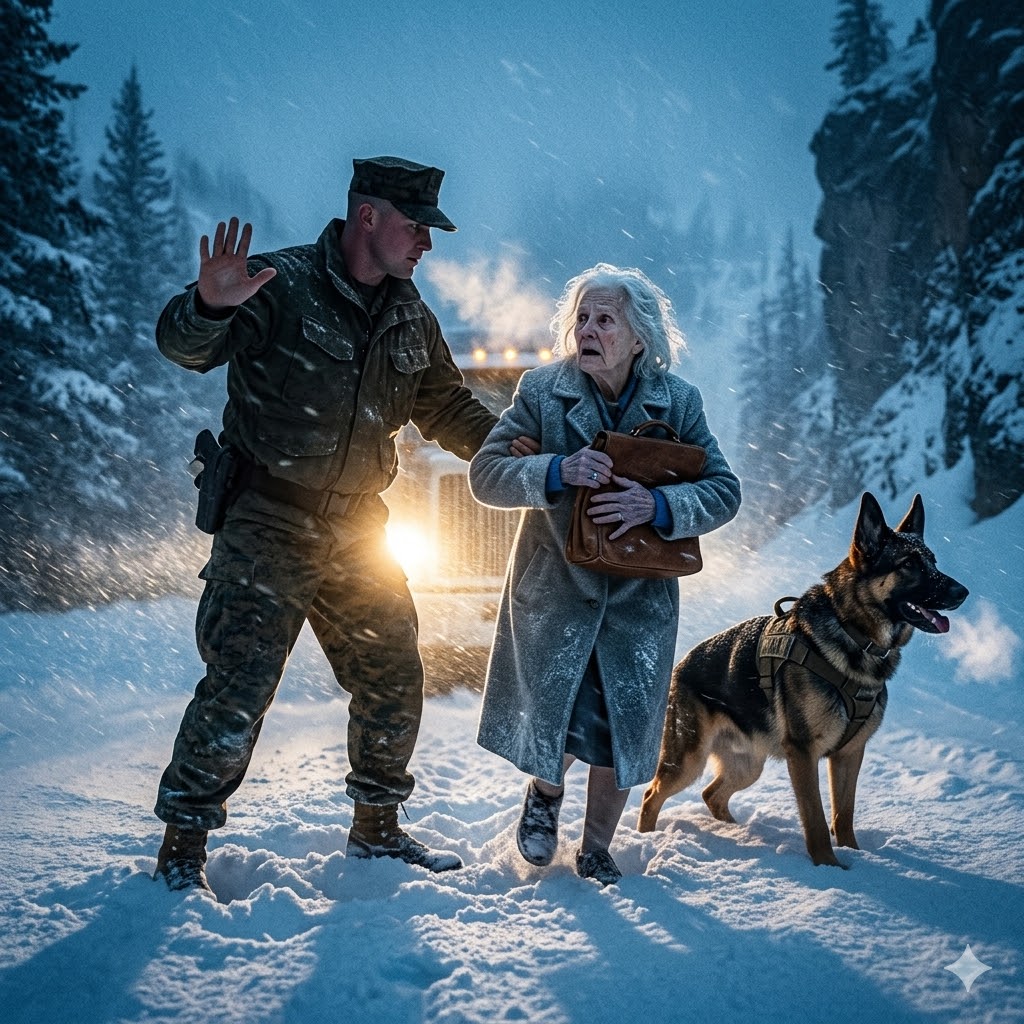
The storm had been building since noon, and by the time Staff Sergeant Caleb Ward turned onto the mountain pass north of Clearwater Valley, Idaho, it had become the kind of weather that doesn’t negotiate. The wind came sideways across the road in sheets, the headlights carving maybe thirty feet of visibility through the whiteout before the darkness swallowed everything beyond. The truck held the road because Caleb held the truck — both hands on the wheel, body tilted slightly forward, reading the surface through the tires the way men learn to read dangerous terrain when the cost of misreading it is something they can’t afford.
Beside him, Atlas was still.
Not the relaxed stillness of a dog at rest. The rigid, absolute stillness of a dog who has found something.
Caleb knew the difference. Four years of working together had turned Atlas’s posture into a language he understood better than most words. The German Shepherd’s ears were locked forward, his chest barely moving, his amber eyes fixed on something beyond the headlights that Caleb couldn’t see yet. A low sound built in his throat — not aggressive, not warning exactly, something deeper. Something that said: there is a person out there, and that person is in trouble.
Caleb’s foot came off the gas.
The truck slowed. He leaned closer to the windshield, eyes narrowing. The headlights swept across the road’s edge, and then — movement. A shadow, low and unsteady, barely distinguishable from the blowing snow, moving along the shoulder with the fragile determination of something that has been going longer than it should have been able to.
Atlas barked once. Sharp, definitive.
Caleb braked hard. The truck slid, caught, stopped.
He was out the door before the vehicle fully settled.
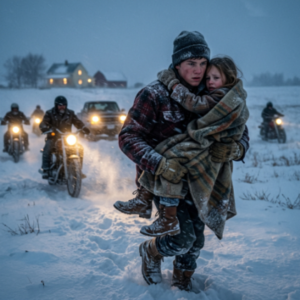
The wind hit him like something physical, punching through his jacket and finding the skin underneath in the same motion. He moved toward the figure without running — running in this terrain, in this wind, was how people fell — but he moved fast, closing the distance in long controlled strides until the headlights behind him lit the scene and he saw her clearly for the first time.
An old woman. Eighty, perhaps, though the cold had a way of making people look older than they were. Her coat was thin gray wool, never designed for temperatures like this, the fabric stiffened with ice, the collar open where the wind had torn it back. Her white hair was plastered to her face in frozen strands. Her skin was pale in the way that was not pallor but the first stage of something worse, a faint blue beginning at the lips. Her feet, in shoes that were wrong for snow, broke through the surface crust with every step, and each step was smaller than the one before it.
She was failing. But she was not stopping.
Caleb registered all of this in the first three seconds. What he registered in the fourth was the thing that changed how he read the situation entirely.
She wasn’t looking forward. She was looking back.
Every few steps, her head turned over her shoulder, her eyes scanning the darkness behind her with the specific, practiced vigilance of someone who has been checking that direction for a long time. It wasn’t the disorientation of a lost person. It was the awareness of a person who knows exactly where she is and exactly what is behind her and has decided that whatever lay ahead in the storm was preferable.
She heard him coming and stumbled backward, her hands rising defensively, eyes wide with a fear that outpaced the cold in its urgency. She had been running from something. His appearance had not resolved that fear. It had added to it.
Caleb stopped. Raised both hands, palms out. Snow hammered the back of his head and neck.
“I’m not here to hurt you,” he said. His voice steady, low, the tone that cut through noise without needing to rise above it — a tone he had used in evacuation zones, in hostile terrain, in situations where trust had to be built in seconds or not at all.
She didn’t move toward him. But she didn’t run either. Her eyes were moving across him — his hands, his posture, his face — making the rapid calculations of someone who had learned to assess threats quickly and trusted her own assessment.
Behind Caleb, Atlas came to his side. The dog’s body angled slightly — not toward the woman but past her, toward the darkness behind her, his attention fixed on something beyond the visible range of the headlights.
Caleb followed that attention briefly. The storm revealed nothing. But Atlas was reading something he couldn’t, and the dog had not moved his focus since they stopped.
“If you stay out here,” Caleb said, his voice carrying through the wind, “you have maybe twenty minutes.” He didn’t soften it. People in real danger didn’t benefit from softened truths. “Whatever you’re running from — I’ll deal with it. But right now you need to get out of this cold.”
Her lips moved. Something came out that the wind took before it reached him. Then her knees buckled.
He was already moving.
He caught her before she reached the ground, her weight against him shockingly light, her body rigid with cold, her fingers locked around the strap of a leather satchel that she had not released despite everything. He lifted her. She struggled once — reflex more than resistance, the last firing of an instinct that had been keeping her upright through sheer force — and then stopped, because she had nothing left to fight with.
“I’ve got you,” Caleb said.
He carried her to the truck. Atlas moved ahead, clearing the path, his body low and alert, his attention still partly directed behind them. When Caleb pulled the passenger door shut and the heat from the cab rolled over both of them, he sat for a moment with his hand on the door handle and his eyes on the mirror.
The road behind them was white and empty.
But Atlas hadn’t stopped watching.
Caleb put the truck in gear. “We’re getting out of here,” he said quietly. He didn’t say: I think we were alone out there. Because Atlas had not yet decided they were.
—
The cabin sat at the end of a half-mile private track off the main road, built from rough timber with a stone fireplace and the particular kind of utilitarian warmth that comes from a place designed for function over aesthetics. Caleb had been using it between postings for three years. He knew every inch of it and moved through it now without turning on lights he didn’t need, his actions efficient and purposeful — fire built up, water set to boil, wool blanket from the cedar chest wrapped around her shoulders as he settled her into the chair nearest the hearth.
The woman sat rigid at first, shivering in waves that shook her whole frame, her hands still clamped around the satchel despite everything. She scanned the room continuously — doors, windows, corners — her eyes never fully at rest.
Atlas settled on the floor between her and the entrance, not pressed against the door but positioned with deliberate awareness, his body angled to cover both the entrance and her chair. He was not suspicious of her. He was watchful on her behalf.
Caleb placed a metal mug of hot water in her hands. “Drink,” he said.
She looked at the mug. Looked at him. Looked at Atlas. The steam rose between her face and the ceiling. Then, slowly, she brought the cup to her lips.
Minutes passed. The shivering gradually subsided. The blue at her lips faded into something closer to normal. She drank the water in small, careful sips, and Caleb sat across from her and waited without filling the silence.
“Margaret Doyle,” she said finally. Her voice was thin but had found its edges again. “My name.”
“Caleb Ward.”
She studied him. The deliberate economy of his movements, the way he sat without fidgeting, the way his attention stayed in the room without being aggressive about it. “Marine,” she said. Not a question.
He didn’t confirm or deny. The silence held.
“You weren’t lost out there,” he said.
Her fingers tightened on the satchel. Then, slowly, she set it on the table between them. She opened it with the careful movements of someone handling something that had kept her alive, and she began placing documents on the table one by one, their edges yellowed and worn, some sealed in plastic, others folded and refolded so many times the creases had gone soft.
“My husband was an engineer,” she began. “Land surveys in Boon County, Missouri. Development planning.” Her finger traced the edge of one page without quite touching it. “He found a pattern in the records. Fake transfers. Land moved through shell companies, signatures that didn’t match, documents that existed in some files and not others. Not one mistake. A system.”
Caleb watched her face. Not the documents — her face, because a person’s face told you whether they believed what they were saying, and everything in Margaret Doyle’s face said she had been carrying this for a very long time and was finally allowing herself to put it down somewhere.
“He tried to report it,” she said.
Caleb said nothing.
“He died two weeks later. Heart attack.” The words came out flat and deliberate, each one placed with the care of someone who has chosen them specifically because they are not the words they believe. “That’s what they wrote.”
The fire shifted and cracked. Atlas raised his head briefly, then settled.
“You kept the documents,” Caleb said.
“I didn’t understand all of it at first. But I understood enough to know I couldn’t give them to anyone.” Her hand pressed against the satchel. “So I hid them.”
She told him the rest without drama. The years of quiet watching. The moment she recognized the same pattern, the same land, the same shell company names, in her son’s business. The conversation where Victor had stopped asking and started controlling. The doors that began to stay locked. The visitors who were no longer permitted. The plan for a facility, quiet and isolated, where she would no longer be anyone’s problem.
“I left before dawn,” she said. “Took the documents. Took what I could carry.” She looked at him directly, steadily. “I didn’t think about where I was going. I thought about getting away.”
“That was the right call,” Caleb said.
He picked up one of the documents and began reading. Atlas raised his head.
Caleb’s hand stopped moving on the page.
He read the name again. Slowly. The way you read something a second time not because you misread it the first time but because the first reading was correct and you needed a moment before you accepted it.
Colonel Richard Ward.
His father’s name. His father’s handwriting in the margins — the sharp, controlled strokes he had known his entire life. Annotations. Corrections. Not the signature of someone participating in the scheme. The marks of someone systematically documenting it, flagging each discrepancy, building something methodically and quietly. Building a case.
His father had died in a single-car accident on a wet highway ten years ago. No witnesses. No complications. No questions officially raised. Caleb had accepted it. He had put it away the way he put everything away — in a compartment that didn’t interfere with function. He had never questioned the accident because he had never been given a reason to.
He had a reason now.
“He wasn’t part of it,” Caleb said. His voice had changed slightly — not broken, but different, the way a surface changes when pressure is applied to the underside. “He was tracking it.”
Margaret looked at him. The realization moved across her face in layers. “Your father.”
Caleb set the document down. “Her husband found it first,” he said, more to himself than to her. “My father followed. Different states, different years. Same pattern.” He looked up. “Both of them died before they could take it anywhere.”
The fire burned. Outside, the storm continued its assault on the cabin walls.
Margaret’s voice came quietly. “I told myself for years I might be wrong. That maybe it was coincidence.” She paused. “You weren’t wrong,” Caleb said.
She nodded, a single slow motion, absorbing a confirmation she had always known she didn’t need but had needed to hear anyway.
Atlas stood up. All the way up, fully, in a single motion — his body stiff, his ears locked forward, a growl building from somewhere deep in his chest.
Then they both heard it.
An engine. Faint, but steady, patient, moving through the storm with the deliberate precision of something that knew where it was going.
Margaret’s hand found the satchel. Her voice dropped to a whisper. “He found me.”
Caleb didn’t move toward the door. He didn’t reach for anything. He simply sat for a moment while his mind ran through everything the situation had become — the documents, his father’s name, the woman across from him, and the engine sound growing gradually clearer through the howling wind.
Then he stood. His posture settled into something that had nothing to do with fear and everything to do with decision.
“Let him come,” Caleb said.
—
Two days later, the storm was gone and the SUV arrived in clear morning light.
Victor Doyle stepped out looking exactly like what he was — a man who had spent thirty years learning to make control look like composure. Tall, lean, precise, his dark hair neat despite the cold, his expression assembled with the care of someone who understood that expressions were instruments and deployed them accordingly. He assessed the cabin, the yard, and Caleb in that order, and then produced a version of reasonableness that had been calibrated for situations exactly like this one.
“I’m here for my mother,” he said. “She’s not well. She’s confused.”
“She’s not going with you,” Caleb replied.
The two men who had ridden with Victor shifted their weight. The third — a narrow man in a careful suit carrying a briefcase — stayed near the vehicle and watched proceedings with the expression of someone keeping track of what would be needed later.
Victor’s composure held, but Caleb had been watching people manage their composure under pressure for a long time, and what he saw behind Victor’s expression was not confidence. It was calculation. The specific calculation of a man who was used to being the most prepared person in any given room and was not certain, for the first time in a while, that he was.
When the broader of Victor’s men took a half-step toward the cabin’s door, Caleb closed the distance between them in a single controlled motion, caught the arm, redirected the momentum downward, and applied enough pressure to make further movement impractical. No strike. No aggression. Just physics, efficiently applied. The man understood and stopped.
Victor’s mask slipped by exactly one expression. He found it again quickly.
Then the sirens came.
Sheriff Laura Bennett’s vehicle pulled into the clearing with the unhurried certainty of someone who had received enough information in advance to know what she was arriving at. She stepped out — mid-fifties, compact, carrying the grounded authority of someone who had spent twenty years being the most prepared person in difficult situations — and surveyed the scene.
“What’s happening here?” she asked.
The door to the cabin opened. Margaret stepped out onto the porch. Her posture was straight, her voice steady. “I’m not going anywhere with him,” she said. Those six words rearranged everything.
Inside, at the table, the documents told the story that Margaret had carried for decades. Laura Bennett listened without interrupting. She asked two questions, both of them precise. She closed the folder and looked at Victor Doyle across the table with the expression of someone completing a very long calculation.
“This goes to the state,” she said.
Victor said nothing. Because there was nothing to say that wasn’t already visible in the documents in front of him.
—
The Idaho State Courthouse was pale and cold in the morning light when Caleb took his seat in the small gallery, Atlas settling at his feet with the quiet patience of a dog who understood that some situations required waiting. Margaret stood at the front of the room with a steadiness that would have been unrecognizable to anyone who had only seen her in that blizzard — her posture upright, her white hair pulled back neatly, her voice when she spoke carrying the particular weight of truth that has been waited on for a very long time.
She placed each document on the surface before her with deliberate care. She spoke without hesitation or performance. She said what had happened because what had happened was sufficient.
Victor sat at the defense table with his composure present but pressured, the edges of his control showing in small, habitual ways — the tightness of his jaw, the stillness he was working to maintain rather than simply inhabiting.
Judge Eleanor Price presided with the authority of someone who had heard many versions of many stories and had developed a finely calibrated sense for which ones were built on something solid. She listened to Margaret’s testimony, examined the documentation, and addressed the room with a directness that left no room for misinterpretation.
“These records demonstrate a consistent pattern of fraudulent land transfers,” she said, “supported by documentation spanning over two decades.”
She turned the page.
“There is additional evidence indicating that Colonel Richard Ward identified and attempted to report these irregularities prior to his death. The documentation suggests that his findings were not acted upon, and that his death occurred under circumstances warranting further review.”
The words were plain. They were stated without drama or emphasis. They were enough.
Caleb sat entirely still.
His father had not been part of it. His father had stood against it. He had done it alone, quietly, through the same kind of steady methodical documentation that had always defined him — the sharp handwriting in the margins, the careful notation of every discrepancy, the building of a case that no one had ever received. He had died at the point where the truth became dangerous, the same way Margaret’s husband had died, and the same forces had arranged both endings and walked away from both.
The knowledge did not heal what had been between them. The distance of those years, the difficulty of a relationship built more on structure than warmth, was not something a courtroom revelation could reach. But it did something more enduring than healing. It restored the shape of a man Caleb had never fully known — showed him that his father’s silence had not been absence but protection, that the controlled, careful life Richard Ward had lived had been pointed toward something real at its end.
He had died doing the right thing. Caleb had not known that. Now he did.
When the hearing concluded, he made his way to Margaret as she stepped down from the front of the room. She looked at him with the specific quiet of two people who have carried adjacent grief without knowing it.
“It’s done,” she said.
“It’s begun,” Caleb said.
She considered the difference. Nodded.
Outside, the air was cold and clear, the storm long gone, the courthouse steps empty in the morning light. Margaret stood with her hands folded, looking out at a landscape that held nothing familiar, nothing she was required to return to.
“There’s nothing left for me back there,” she said.
Caleb walked to the truck. He opened the passenger door and paused, his hand on the frame, looking back at her.
“You don’t have to go back,” he said. “You don’t have to run.”
She stood at the top of the steps for a long moment. The cold air moved between them. Then she came down.
—
The cabin changed the way things change when they are meant to — not all at once, but in the accumulation of small, deliberate adjustments that add up, over days, to something different from what was there before. A second chair moved to the fire. Two cups set out instead of one. Blankets folded by different hands. Spaces that had been sized for one person’s silence gradually reshaping themselves around the presence of two.
Caleb worked outside as he always had, splitting wood, repairing what winter had damaged, building what spring would require. He came inside differently now — with less of the quality that had always defined his returns, that sense of a man walking back into a space he occupied without quite inhabiting it. The cabin felt like something. He hadn’t realized it hadn’t before.
Margaret moved through the rooms with the quiet purposefulness of someone who had spent too long in spaces that weren’t hers and was learning, carefully, what it felt like to belong somewhere. She didn’t try to change what was already there. She added to it gently, in ways that transformed without erasing.
Atlas moved between them, always. Sometimes near the door, sometimes by the fire, often positioned between them in a way that suggested connection rather than separation — as if some deeper canine intelligence had recognized that these two people had been missing something specific and had decided to hold the space between them until they figured it out.
One evening, as the sun went down behind the trees and threw long shadows across the snow, Caleb stood on the porch and looked out at the land that had always been his and had never felt entirely like it. Behind him, the cabin glowed. Margaret came to stand beside him.
Neither of them spoke. They had said what needed saying. What remained was simply the fact of where they were and who they were standing next to — two people whose fathers had died for the same truth, who had found each other in a blizzard on a mountain pass in Idaho, who had walked through something together that neither of them had expected to survive intact.
The past, for the first time in longer than either could precisely measure, was not chasing them.
They stood still and let it stay behind them where it belonged.
THE END