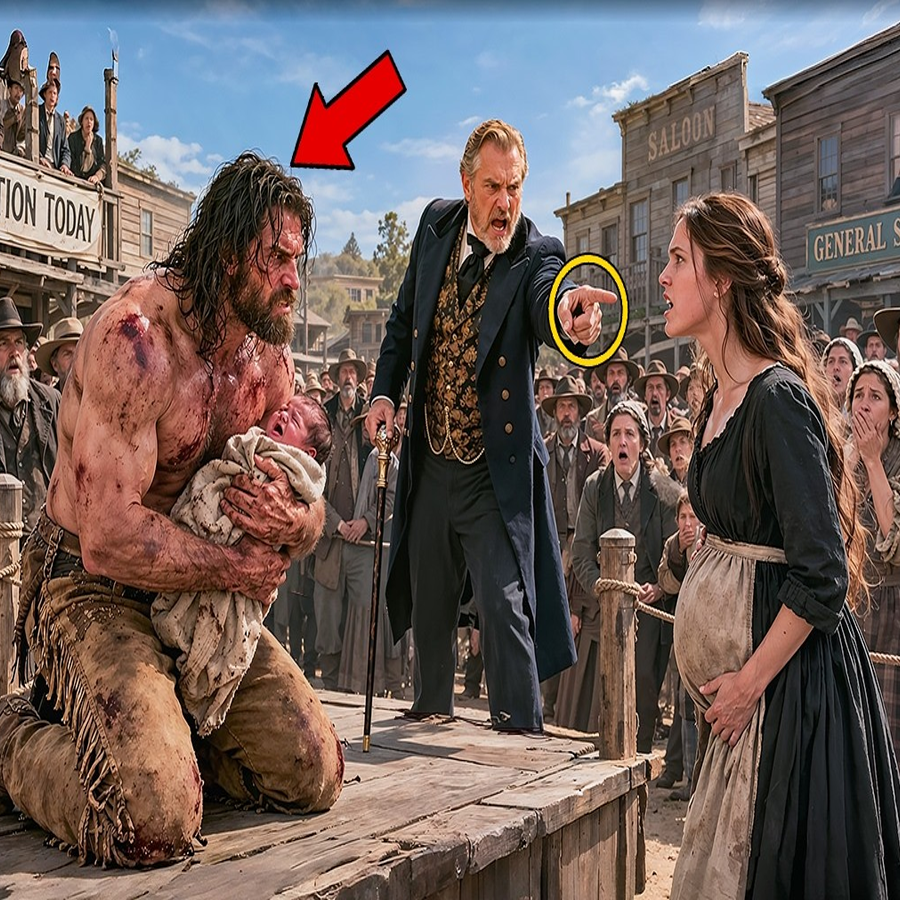
There are moments in a person’s life that cannot be explained by logic or reason or the careful calculation of cost and benefit. Moments where something deeper than thought takes over — something that lives below the mind, in the part of a person shaped by loss and love and the particular stubbornness that survives when everything else has been stripped away. Eleanor Higgins had $100 to her name, a baby growing in her belly, a half-finished ranch that winter was going to destroy, and no plan that made any sense. What she had instead was the sight of a giant of a man standing on an auction block in the August heat of Bitter Creek, Wyoming, holding a newborn against his chest like she was the last thing in the world worth protecting. That was enough. That was everything.
She raised her hand and changed both their lives.
The summer of 1883 had baked the Wyoming territory into something brutal and unforgiving. The mud streets of Bitter Creek had cracked into terracotta under an August sun that showed no mercy, and the town square on the afternoon of the auction smelled of dust and sweat and the particular cruelty that gathered when men with nothing to lose watched someone else lose everything.
Samuel Montgomery stood on the block like a mountain that had been asked to apologize for existing.
He was enormous — six foot four of muscle and bone and hard-won endurance, his broad shoulders wrapped in worn buckskin, his face hidden behind a beard that had gone untrimmed since the worst night of his life three weeks prior. His hands were scarred from a decade of working against the land and occasionally against other men, and his eyes, a pale and storm-gray that seemed to belong to a different altitude entirely, were fixed somewhere past the crowd with the controlled blankness of a man holding himself together by sheer force of will.
Against his chest, wrapped in a piece of threadbare wool, was a newborn girl.
She was crying. Had been crying, by the sound of it, for most of the morning. The crowd’s reaction to the combination of the man and the infant ranged from discomfort to outright contempt. A strong back was one thing. A strong back attached to a squalling liability was something entirely different.
Samuel’s name was on the auction block because three weeks ago he had done what any man would do for a woman he loved in a desperate situation: he had ridden through a blinding squall to bring the town doctor to their mountain cabin while his wife Sarah labored. To secure the doctor’s immediate departure, he had signed a promissory note to Arthur Pendleton — the wealthiest and most ruthless land baron in the territory — promising to pay whatever the fee required. The doctor had arrived too late. Sarah had bled to death in the same bed where she had slept every night of their married life, leaving Samuel with an impossible debt, a daughter who had never known her mother, and a grief so large it had no shape yet.
When Samuel couldn’t meet the interest payments, Pendleton had invoked a localized debtor’s statute and moved with the efficiency of a man who had done this before. Samuel’s land was seized. His labor was to be sold. Five years, indentured, to the highest bidder.
“All right, gents.” Mayor Jebidiah Hayes mopped his forehead with a handkerchief and regarded the block with the expression of a man who wanted to be anywhere else. “Strong back. Good for logging, hauling, or mining. Five-year contract. Bidding starts at forty dollars.”
The crowd stayed quiet. A man like Samuel was worth far more than forty dollars under ordinary circumstances. But the baby changed the arithmetic.
Arthur Pendleton stood at the front in a tailored broadcloth suit that had no business being worn in August in Wyoming, a silver-tipped cane in one hand and a cigar clamped between his teeth. He surveyed Samuel with the detached assessment of a man purchasing livestock.
“Fifty,” Pendleton said. He pointed the cane at the newborn without looking at her. “But I’m buying the man. The infant goes to the county orphanage in Cheyenne. I’m not operating a nursery.”
The crowd shifted. Some looked away. Some watched with the particular attention of people who know they’re witnessing something they’ll think about later.
Samuel’s head came up slowly. His gray eyes found Pendleton with the kind of focus that made the distance between them feel shorter than it was. “You touch my daughter,” Samuel said, his voice like stones grinding together deep underground, “and I will tear your throat out with my bare hands.”
Sheriff Bill Rollins stepped forward, his hand resting on his revolver with the practiced ease of a man who used that gesture the way other men used words. “Mind yourself, Montgomery. You belong to the county.”
“Fifty dollars, going once,” Hayes called, his voice rising with the anxiety of a man who wanted this transaction completed before the large man on the block did something irreversible. “Going twice—”
“Sixty.”
The voice came from the back of the square. Soft and steady, the kind of voice that didn’t need to be loud because it had already decided it was going to be heard.
The crowd turned.
Eleanor Higgins stood near the mercantile porch, a faded sunbonnet shading a face that was pale with the heat and set with a resolution that had nothing to do with optimism. She was twenty-six years old and looked like she had lived forty of the hardest years available. The black morning dress she wore hung simply from her frame, and it concealed nothing about the fact that she was seven months pregnant.
Three months earlier, her husband Thomas had been crushed beneath a falling timber he was using to raise the barn on their homestead. He had died quickly, which the neighbors said was a mercy, and which Eleanor had decided she did not have the time or the energy to form an opinion about. She had a half-finished ranch, an approaching winter, and a child coming whether the world was ready or not. She had come to town for supplies. In her corset, folded inside a leather pouch against her skin, was the last one hundred dollars she and Thomas had ever managed to save together.
She stepped into the sunlight.
Arthur Pendleton looked at her with the slow, contemptuous thoroughness of a man who classified people on sight and had already classified Eleanor as something negligible. “Go home, Mrs. Higgins. What are you going to do with a mountain savage and a screaming infant?”
“Put him to work,” Eleanor replied, her chin rising a fraction. “Seventy, Mayor.”
Pendleton’s face colored. He had not been publicly outbid by a widow in a sunbonnet before, and his response to novel experiences was invariably to pay more money. “Eighty. And the baby goes to Cheyenne.”
Eleanor looked at the man on the block. Samuel looked back at her. In his eyes, which were the color of a sky just before a storm breaks, she saw something she recognized without being able to name it — the specific devastation of a person who has lost so much that they have arrived at a place where they are no longer afraid of losing anything else, because there is nothing left. She had been in that place for three months. She recognized the address.
“Ninety,” Eleanor said. Her voice was perfectly steady. Her hands, hidden in the folds of her dress, were shaking so hard she could feel it in her wrists. “And the contract specifies that the child remains with her father. Unseparated. That is my condition.”
The silence that followed was the kind that comes when a crowd realizes it has witnessed something that cannot be undone.
Pendleton spat tobacco into the dirt. “You’re a fool, Eleanor Higgins. You’ll be dead before the first snow.”
“Sold,” said Mayor Hayes, and brought the gavel down before anyone could reconsider anything.
Eleanor counted out the notes and coins at the sheriff’s desk with hands she could not quite make stop trembling, folded the contract into her apron pocket, and walked across the square to where Samuel still stood beside the block as if he hadn’t yet received permission to step off it.
“Mr. Montgomery,” she said, looking up at him — which required some looking. “My wagon is at the livery. Let’s go home.”
The ride out of Bitter Creek was quiet in the way that spaces between two people who do not yet know each other are quiet — full of things being measured and assessed and tentatively set aside. Samuel sat beside her on the wagon bench, his presence making the boards creak, his daughter cradled against his chest with a tenderness that had no business existing in hands that scarred. He had dipped a rag into the canteen and was letting the infant suckle the moisture from it, his gray eyes soft with a grief so private and so large that Eleanor looked away from it reflexively, the way you look away from something that belongs entirely to someone else.
“Her name is Abigail,” Samuel said eventually. It came out like something startled loose.
“It’s a beautiful name,” Eleanor said.
A long pause. Then: “You bought me.”
“I bought your debt,” Eleanor corrected, her voice firm without being unkind. “I’m not a slaver, Samuel. My husband left the homestead unfinished. The roof is failing. There’s firewood that needs splitting before November and fences that need rebuilding before the coyotes find the livestock. I cannot do it alone.” She rested one hand over her belly, a gesture she made without thinking now, the constant unconscious acknowledgment of the life inside her. “You’ll work off the debt. You’ll be treated as a man. And Abigail will be safe.” She paused. “I have a goat in milk at the farm. Better for the baby than water.”
Samuel turned his head and looked at her. Actually looked, the way he hadn’t since the auction — not the assessment of a man trying to understand his situation but the attention of a man seeing another person for the first time. He saw the dark circles beneath her eyes, the particular exhaustion of a woman who has been holding everything together alone for months and has run out of the energy to pretend otherwise. He saw that she had spent nearly every dollar she possessed to prevent his daughter from being sent to Cheyenne, and he understood that she had done it not because she was sentimental but because she was the kind of person who could not watch a family be torn apart without doing something about it, even when doing something about it cost her everything.
“Why?” he asked.
Eleanor kept her eyes on the trail. When she finally answered, her voice was barely above the sound of the wheels. “Because I know what it is to lose your whole world in an afternoon,” she said. “And I couldn’t stand by and watch it happen to someone else.”
The Higgins homestead arrived at dusk, the mountain peaks behind it going gold and then purple, the modest log cabin sitting near a rushing creek with weeds at the garden and half the barn roof missing and the kind of beautiful loneliness that frontier land had when there was no one to witness it but the people who were fighting to survive on it.
That first night, Eleanor made a fire and warmed the goat’s milk and poured it into a glass bottle and handed it to Samuel, who sat in the rocking chair by the hearth and fed his daughter with the careful deliberateness of a man performing a task he does not trust himself with but refuses to stop doing. As Abigail’s frantic cries subsided into soft, contented sounds, Samuel closed his eyes. His chest rose and fell in a long, unsteady exhale. He was safe. More importantly, she was safe.
The storm came at nine o’clock without announcement.
One moment the night was quiet. The next, lightning split the sky directly overhead and thunder detonated so completely that the floorboards shook. Eleanor, cutting bread at the kitchen table, dropped the knife. It clattered to the floor. When Samuel looked up, she was gripping the edge of the table with both hands, and her face had gone the color of fresh plaster.
“Miss Higgins.”
Eleanor looked down. The puddle at her feet told him everything.
“Oh God,” she breathed. “No. It’s too early. Seven months. He’s too—” A contraction took the rest of the sentence from her, and her legs buckled.
Samuel crossed the room in two strides. He caught her before she reached the floor and carried her to the bed with the careful speed of someone who has learned that urgency and gentleness are not opposites. He settled her against the pillow and looked at her face and felt the cold, familiar grip of the worst night of his life try to close around his throat.
He had been here. He had done everything right. He had ridden through the storm. He had gotten the doctor. He had held Sarah’s hand and told her she was going to be fine and believed it with his whole body, and she had died anyway. The memory of her blood was something he had been carrying every waking hour since, a weight that had no bottom.
Eleanor’s hand found his sleeve. Her grip was surprisingly strong for a woman in this much pain. “Samuel.” Her eyes were wide and terrified and completely present. “The doctor is twenty miles away. You have to help me. I cannot lose this baby.”
Samuel looked at her. He looked at the woman who had stood in a town square and spent her last dollar to keep his daughter from being taken from him. He looked at the absolute trust in her face, the trust that made no logical sense given that she had known him for less than a day, and he made a decision. He set the ghost of Sarah aside. He set his fear aside. He rolled up his sleeves.
“I’m right here, Eleanor,” he said, his voice dropping into the steady, low register he hadn’t used since his deployment years, the voice that was for situations where panic was a luxury no one could afford. “I’m not going anywhere. Breathe.”
He stoked the stove. Boiled water. Sterilized his hunting knife and his hands with whiskey that burned. The thunder outside rattled the windowpanes and the lightning made the room flash white, and Samuel worked through all of it with the focused efficiency of a man who had decided that this particular fight was not one he intended to lose.
When he found that the baby had turned transverse — the same complication that had preceded Sarah’s death — the cold dread that moved through him was something he recognized and refused to follow. “Eleanor,” he said. His voice did not shake. “The baby is turned sideways. I have to reach in and move him. It will be the worst pain you’ve ever felt. You have to be still.”
Eleanor met his eyes. She bit down on the leather strap he handed her and nodded once.
What followed was the longest twenty minutes of Samuel Montgomery’s life. He moved with agonizing care, feeling for the infant’s position through each contraction, working against the body’s resistance with hands that could swing an axe through a pine trunk but were managing now to be as gentle as anything he had ever done. Sweat soaked his shirt. Eleanor’s muffled cries cut through him like a blade. He did not stop. He did not flinch. He kept moving, kept adjusting, kept talking to her in a low steady voice that said nothing in particular but meant: I am here. I am not leaving. We are going to do this.
“He’s turned,” Samuel said finally, the words coming out on a breath of pure relief. “Eleanor. Push.”
The infant came into Samuel’s hands small enough to fill them, silent and blue and entirely still.
Eleanor lifted her head. Her voice broke on the question before she could finish it. “Why—”
Samuel did not answer. He clamped the cord with boiled twine, cleared the airways, wrapped the baby in warm wool, and began to rub the tiny back with a firm, rhythmic pressure. He breathed warm air over the small face. He kept his voice low and continuous — come on, little fighter, don’t you dare — until the silence stretched so long that Eleanor wept without sound, believing it was already over.
Then a gasp. Small and stuttering and real. Another, deeper. And then a sound — thin and reedy and furious and miraculous — that filled the cabin completely.
Samuel sat back on his heels, and the tears that ran down his face mixed with the sweat and he didn’t bother with either of them. He wrapped the boy and carried him to his mother. Eleanor took her son against her chest, her entire body shaking, and looked up at Samuel with something in her eyes that had no name and needed none.
“Levi,” she whispered. “His name is Levi.” She held his gaze. “You gave me my life back.”
Samuel looked at his daughter sleeping peacefully through the chaos in her crate by the fire. He looked at the woman in the bed and the son in her arms. He had paid a debt tonight that had nothing to do with Arthur Pendleton. He had paid it to his own conscience, and for the first time in three weeks, the weight of it had shifted into something he could carry differently.
“Rest, Mrs. Higgins,” he said softly, stepping back. “The storm is passing.”
Autumn transformed the homestead under Samuel’s hands. He worked with the relentless, systematic energy of a man who had found his purpose again — felling timber for the barn roof, splitting firewood until there was enough to build a wall, repairing the fences post by post against the coming coyotes and the coming cold. Inside, a rhythm established itself that neither of them designed and both of them came to depend on. Abigail grew round and contented on the goat’s milk. Levi, impossibly small but furiously determined, thrived in the warmth his mother and the hearth provided.
In the evenings, Samuel sat by the fire and whittled with his hunting knife — small animals, rounded shapes that would fit in an infant’s hand — and Eleanor rocked both children and said little, and neither of them spoke of their losses but carried them together in the shared silence of people who no longer needed to explain their grief to be understood.
Eleanor no longer saw a brute. She saw a man of immense, quiet dignity who treated his daughter’s wellbeing as the axis around which all other decisions turned. Samuel no longer saw a desperate widow. He saw a woman made of something harder and more lasting than the circumstances that had been thrown at her.
Then, in mid-October, Arthur Pendleton came back.
Eleanor saw the horses from the clothesline — three riders, Pendleton at the center in his tailored suit with Boyd Miller on one side and Gideon Cobb on the other, both of them the kind of men whose purpose in life was to make other men regret having a spine.
Pendleton pulled up near the porch and looked down at Eleanor with the specific patronizing warmth of a man who has already decided how the conversation ends. He had paperwork. A lien, allegedly signed by Thomas just days before his death. The railway wanted the valley grade. The first frost had come that morning, which meant, according to the forged document, the property defaulted to Pendleton immediately.
Eleanor told him it was a forgery. Boyd Miller dismounted with his hand on his revolver. The situation narrowed toward something irreversible.
Then a voice came from the treeline like an avalanche breaking loose.
Samuel stepped out of the aspens with a mule deer carcass over one shoulder and his Winchester in his right hand, already cocked, aimed at Boyd Miller’s chest with the steadiness of a man who has had this conversation before and has already calculated every version of how it ends. He set the deer down. He moved to stand between Eleanor and the riders.
“She told you to get off her land,” Samuel said.
Gideon Cobb moved his hand toward his holster. Samuel’s eyes went to him without the rest of him moving. “I only need one shot for you, Cobb. I can close the distance to Miller before he clears leather. Pendleton will run.”
The silence in the crisp autumn air was the silence of men doing mathematics.
Boyd Miller was the first to recalculate. “Arthur,” he said quietly, backing his horse a step. “This isn’t the time.”
Pendleton wheeled his horse, his face purple with a fury he couldn’t spend here. He pointed a shaking finger. “I’ll be back with the sheriff and a judge’s order, Eleanor. And when I take this land, I’m sending you to the poorhouse and having him flogged in the town square.”
He rode away. They all watched him go.
Eleanor was shaking when Samuel turned to her. Not from fear, exactly — from the accumulated weight of everything the last months had asked of her. Samuel put one hand on her shoulder, large and steady, and she did not step away from it.
“They’re coming back,” she said. “If the lien is forged, the judge is already in his pocket. We have nothing to fight it with.”
“Not yet,” Samuel said.
Two days later, when Eleanor opened the hidden compartment in the bottom of Thomas’s old trunk, she found a leather-bound ledger and a folded piece of parchment that changed everything. Thomas had written to the territorial governor two days before the timber fell on him. He had detailed Pendleton’s bribery of county surveyors, the threats made against his life, and the specific act of sabotage — Boyd Miller, on Pendleton’s orders, had sawed halfway through the support beams of the new barn. Thomas had named it plainly: if I am found dead, it is not an accident. It is murder.
Samuel read the letter once. He set it down. The temperature in the room seemed to drop.
“He murdered Thomas,” Samuel said. His voice had gone very quiet, the way a fire goes quiet just before it takes everything. “The accident was arranged.”
Eleanor wept. Samuel put on his coat, checked his rifle, and looked at her steadily. “Lock the door,” he said. “Don’t open it for anyone but me.”
He rode into the storm.
What happened in the Golden Nugget Saloon that night became the kind of story that Bitter Creek would tell for thirty years, embellishing it each time until Samuel Montgomery was eleven feet tall and had defeated twelve men, though the truth was nearly sufficient on its own. He kicked the doors off their hinges. He laid the ledger on Pendleton’s poker table. He announced the contents to the room in a voice that left no space for misinterpretation. When Gideon Cobb went for his gun, Samuel’s rifle butt put him through a table. When Boyd Miller panicked and fired, Samuel’s return shot took him in the collarbone and dropped him into the sawdust. When Pendleton scrambled backward onto his knees, Samuel’s rifle rested between his eyes and his voice dropped to something that was somehow more frightening than everything that had come before.
“Sheriff,” Samuel said, without moving his gaze from Pendleton’s face. “Pick up the ledger. Read it. Arrest him for murder and land theft, or I pull this trigger, and there is not a single man in this room who will testify against me.”
Sheriff Rollins looked at the crowd. He set down his whiskey. He picked up the handcuffs.
—
The storm broke just before dawn. The sun came over the Absaroka range and painted the snow-covered valley in pink and gold, and Eleanor had been awake all night with Levi in one arm and Abigail in the other, watching the door.
When the boots finally crunched through the snow and the door opened and Samuel stood in the frame — exhausted, bruised, entirely alive — she felt something release in her chest that she hadn’t known she was holding.
He crossed to the fire. He pulled the indentured contract from his pocket and held it over the flames and let it burn.
“Pendleton is in irons,” he said. “The deed is clear.” He looked at her. “You don’t own me anymore, Eleanor.”
Eleanor watched the last of the paper curl into ash. Then she reached out and laced her fingers through his scarred, heavy hands.
“I never wanted to own you, Samuel,” she said. “I just wanted a family.”
He leaned forward and rested his forehead against hers, this broken mountain man who had been auctioned and delivered a child and faced down hired killers and carried a grief the size of a mountain range, and for the first time since Sarah died, the weight of everything he carried settled into something that felt like home.
Outside, the snow covered the valley in clean, unbroken white. Inside the cabin, two infants slept by the fire. And the two people watching over them had found, in the wreckage of everything they had lost, something neither of them had thought to look for.
THE END






