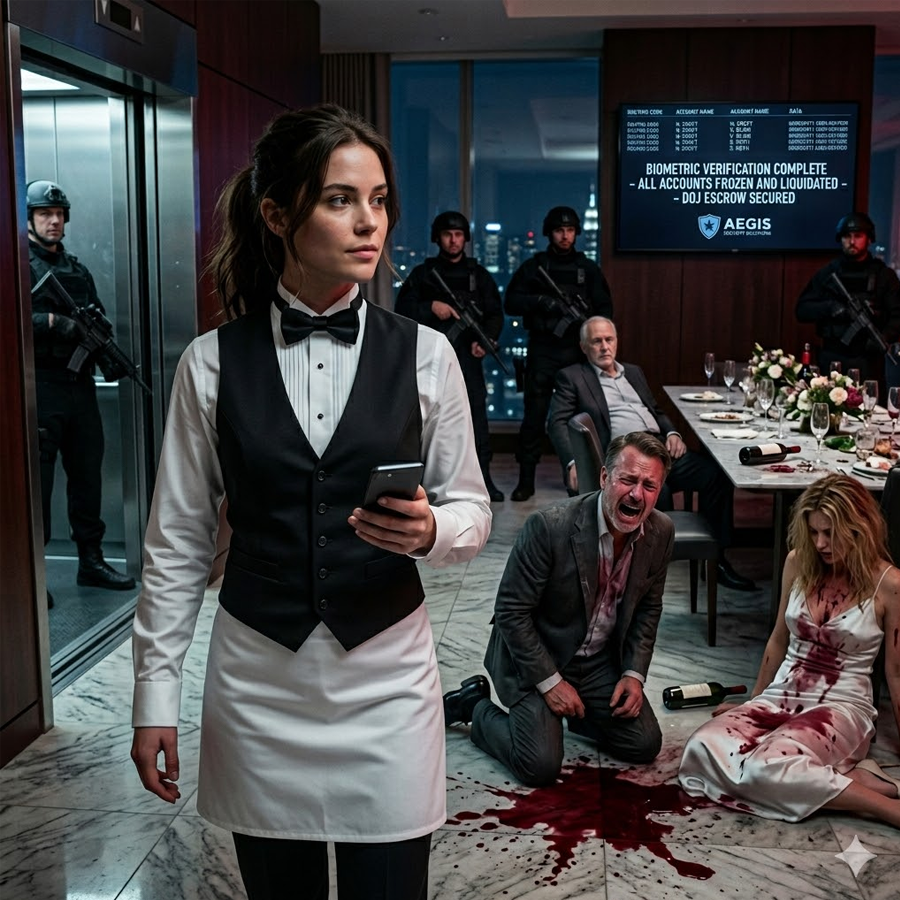
There is a specific kind of cruelty that lives in rooms like this one. It doesn’t need to raise its voice. It doesn’t need to make a scene. It simply exists in the way a hand gestures toward an empty glass without making eye contact with the person expected to fill it, in the way a conversation continues unbroken as a human being moves through it carrying a tray, invisible by design, useful by function, nothing more.
Chloe had been inside the penthouse for two hours and seventeen minutes. In that time, not a single person in the room had looked at her face.
That was fine. That was the point.
The $80 million residence at the top of a Central Park South tower smelled like white truffles and money so old it had stopped needing to announce itself. The chandeliers overhead were Baccarat crystal, each one commissioned individually, each one throwing light across the room in a way that made everything below it look like it belonged in a painting. The floors were marble. The art on the walls was the kind that didn’t have price tags because price tags were for people who needed to ask. Outside the floor-to-ceiling windows, the city spread in every direction, a grid of lights belonging to ten million people whose rent was abstract to everyone currently inside this room.
Chloe moved through it in the black-and-white uniform of Lumiere event staffing, a silver tray balanced on her fingertips, hair pulled back into a bun so severe and anonymous it was practically a costume. She was exactly what she appeared to be: invisible. A mechanism for delivering champagne to people who had already forgotten what it felt like to pour their own.
Near the grand piano, Nathaniel Croft held court.
He was the host, the CEO of Croft Capital, a man who wore his net worth the way other men wore cologne — aggressively, at close range, without asking if anyone in the vicinity wanted to smell it. He was broad across the shoulders with silver hair kept short and a jaw that had been photographed enough times to develop its own gravity. His voice carried across every room he entered not because he was loud but because he had never once considered the possibility that someone might not want to hear him.
“The SEC is completely blind to it,” he said, swirling the amber liquid in his crystal glass with the satisfaction of a man describing a particularly elegant trap. “We route the secondary assets through the Cayman Monetary Authority, wash it through the Luxembourg entities, and it bypasses the Swift network entirely. It’s untouchable.”
Chloe paused beside Simon Roth, offering him a flute of Dom Perignon 2012. Simon was a hedge fund manager whose most recent achievement had been shorting a pharmaceutical company into collapse, erasing ten thousand jobs in the process, and then celebrating the resulting profit margin at a dinner in the Hamptons. He took the glass without looking at her.
“What about the encryption?” Simon asked, his eyes on Nathaniel. “FinCEN is tightening on offshore ledgers. We have over four billion sitting in the Aegis Gateway. If that firewall drops, we’re all looking at federal indictments.”
“Aegis is impenetrable.” Victoria Blair spoke from across the room, her voice carrying the particular flatness of someone who had never been told no often enough for it to register. She was a tech heiress and venture capitalist wearing a white silk gown that cost more than the median American household earned in a year. She snapped her fingers in Chloe’s direction and pointed at an empty plate without completing the gesture into actual communication. Chloe moved to clear it.
“We acquired the root architecture two years ago,” Victoria continued. “Ousted the founder, took the code, locked it behind biometric multi-signature keys. Voice authorization from three board members to unlock the master terminal. Nobody is getting in.”
Chloe picked up the plate. Her hands were steady. Her heart rate was exactly what it always was. She kept her eyes lowered in the manner expected of someone earning fifteen dollars an hour, which she was not earning, and had not earned in quite some time.
Her full name, on the corporate registry of the startup Victoria had just described with such casual ownership, was Chloe Jenkins. Founder and architect of Aegis Security Solutions. The woman these three people had spent eighteen months systematically destroying through fabricated litigation, manipulated venture capital structures, and a fraudulent negligence claim that had cost her the company she built from nothing in a studio apartment in Queens.
They had taken everything. They thought.
What they had not taken — what they could not take because they did not know it existed — was the sleeper protocol Chloe had embedded in the deepest layer of the Aegis kernel before they locked her out. A backdoor invisible to every cybersecurity team money could hire. Dormant, patient, waiting for a single condition to be met.
The live, simultaneous, uncompressed voice prints of Nathaniel Croft, Victoria Blair, and Simon Roth. Captured in the same acoustic environment. Recorded under conditions of elevated stress to rule out synthesis.
Beneath the stiff white collar of her uniform, pinned to her bra strap, a directional microphone the size of a shirt button was recording everything. Every boast, every confession, every unique vocal inflection was being digitized in real time and fed to a secure cloud server. On the cheap digital watch on her left wrist — which was not a watch — a tiny green light blinked once every few seconds.
Compiling. Not yet complete. She needed more.
She moved silently to the next cluster of guests and let the room continue talking about itself.
—
Victoria spent twenty minutes complaining, at a volume designed to carry, that the wait staff lowered the aesthetic of the room. “Honestly, Nathaniel,” she said, her voice drifting across the marble floors with the easy cruelty of someone who had never once suffered a consequence for how she spoke about other people. “Where do you find these people? She looks like she just crawled out of a subway grate.”
The laughter that followed was polished and brief, the kind that people in rooms like this produced automatically, the social reflex of people who had long ago stopped questioning whether a thing was actually funny and simply responded to the signal that laughter was expected.
Chloe was in the hallway refilling her tray. She heard every word. She smoothed her apron, adjusted the watch on her wrist, and checked the green light.
Still compiling.
She took a breath. Stepped back in.
The dinner began at nine. The mahogany table stretched twenty feet across the room, candelabras at intervals, elaborate floral centerpieces that had been delivered that afternoon by a florist in the West Village who had no idea what the people who ordered them were celebrating. The guests found their seats with the unhurried confidence of people who had never once been told where they could and could not sit.
Nathaniel had saved the crown jewel of his wine cellar for the dinner: a 1945 Romanée-Conti. There were bottles of this vintage that had sold at auction for over half a million dollars. He had three. He opened two. The ritual of pouring it fell to the servers, of which Chloe was one, and the weight of the bottle in her hands was significant not just physically but in every other sense. Dropping it would be the financial equivalent of a car accident. She did not intend to drop it.
What she did not control was Simon Roth’s elbow.
Simon was holding court on the subject of the working class, which was a subject he returned to with the regularity of someone who had built an entire self-image on the premise that his wealth was evidence of superiority rather than circumstance. “They simply lack the genetic drive,” he announced, gesturing broadly with his fork. “People complain about the wealth gap, but look at the service industry. No ambition. No intellect. They’re content to carry our plates because they cannot conceive of something more.”
He threw his arm backward to emphasize the point. His elbow connected with Chloe’s forearm at exactly the moment the bottle was tipped to pour.
The Romanée-Conti left the bottle in a heavy, dark arc. It missed Simon’s glass completely. It crossed the table in what felt, to everyone watching, like slow motion. It landed on the bodice of Victoria Blair’s white silk gown in a deep, spreading stain the color of a wound.
The silence that followed was the kind that had physical weight.
Then Victoria’s face changed.
“You stupid, clumsy wretch.” The words came out at a pitch that bounced off the marble and the crystal and the floor-to-ceiling glass. She was on her feet before the sentence finished, her chair crashing backward, her hands pressing a linen napkin against the stain in the frantic, smearing motion of someone who has not yet accepted that the thing is already ruined. “Look what you’ve done. Do you have any idea what this dress costs?”
“I apologize, ma’am,” Chloe said. “Mr. Roth’s arm—”
“Do not blame him.” Nathaniel’s voice came from the other end of the table, low and controlled in the way of a man who understood that restraint was more frightening than volume. He stood slowly, deliberately, the way people stand when they want the act of standing to be its own statement. “I want to know something. Do you understand who you are standing in front of right now?”
He came around the table. He was taller up close, broader, and he moved into Chloe’s space with the practiced ease of a man who had spent decades using physical proximity as a tool. He stopped close enough that she would have had to step back to create distance, and he watched to see if she would.
She didn’t.
“You are going to get on your knees,” Nathaniel said. His voice had dropped to something quiet and precise, shaped for the room to hear without appearing to be performing for it. “You are going to scrub the floor where that wine dripped. Then you are going to beg Victoria’s forgiveness. And if you choose not to, I promise you — I will make sure you never work in this city again. I have lawyers who will bury you in litigation until you are sleeping in the street.”
The other servers in the room had gone very still. The guests watched with the particular attention of people who have just been given something more interesting than the entertainment they paid for.
“I want her arrested,” Victoria said, her voice shaking now, not from grief but from the specific fury of someone who has decided that pain inflicted on a person with less power than them is an acceptable response to their own discomfort. “Destruction of property. I want her completely destroyed.”
Simon Roth smiled. It was the smile of a man watching something small get stepped on and finding the experience affirming.
Chloe looked at Nathaniel. She looked at Victoria. She looked at Simon.
On her wrist, the watch vibrated. Three short pulses.
The biometric system required extreme emotional resonance — elevated stress, authentic vocal inflection, the specific acoustic signature of real, unmanufactured anger — to rule out synthesis. Their rage had provided it perfectly. All three prints captured. Verified. The master override was unlocked.
The sleeper protocol was live.
Chloe stood there for one more moment, wearing the posture she had worn all evening — the careful smallness of someone who has learned to occupy as little space as possible in rooms that do not want them. She had worn it deliberately, maintained it precisely, because it had been necessary. Because two years of careful, silent preparation had required it.
That posture had served its purpose.
She let it go.
The change was not dramatic. She did not raise her voice. She did not make a speech. She simply straightened. The slump left her shoulders. The careful blankness left her face. She stood in the middle of the room at her full height, and the shift in her presence was so immediate and so complete that Nathaniel, who had been in the process of repeating his threat, stopped speaking mid-sentence.
“No,” Chloe said.
Her voice was not the voice of the woman who had been carrying their drinks. It was calm, authoritative, and entirely without apology.
Nathaniel blinked. In thirty years of business, nobody had said that word to him in that tone. “Excuse me?”
Chloe reached up and pulled the pin from her bun. Her hair fell around her shoulders. She untied the apron at her waist and let it fall to the marble floor with a soft, deliberate sound that landed in the silence like a period at the end of a sentence. From her pocket, she produced a phone — matte titanium, custom-milled, nothing available on any commercial market.
“I said no, Nathaniel.” She looked at the screen, her thumbs moving across it with a speed and confidence that had nothing to do with checking messages. “I won’t be wiping anything up. But you’re all going to want to sit down, because you’re about to have a very expensive night.”
—
The room did not process what it was seeing. The guests nearest the door took half steps backward without deciding to. The security guards by the elevator exchanged a look. Victoria opened her mouth.
“Security—”
“I wouldn’t,” Chloe said, not looking up from the screen. “Unless the personal accounts your guards keep at UBS go on the list with everything else. They can stand exactly where they are.”
The guards stopped. Looked at Nathaniel. Nathaniel was staring at the phone in Chloe’s hands with an expression that was changing in real time, something behind his eyes beginning to shift from anger into something it took him a moment to identify as dread.
“You’re a waitress,” Simon said. The sneer was still there but it was working harder than it needed to. “You don’t have access to anything.”
“Don’t I, Simon.” It was not a question. Chloe glanced at him over the top of her screen. “You’re routing your short sale profits through a BlackRock subsidiary shell. Account number ending in 884 Bravo. You bypassed SEC compliance protocols using the Aegis Gateway’s backdoor ledger. The position you opened last Tuesday — the one your own compliance team doesn’t have documentation for — is sitting in a Cayman routing node that I have been able to read for the last fourteen months.”
The color left Simon Roth’s face in a single motion, like water draining from a glass.
“Who are you?” Nathaniel said. His voice had changed completely. The authority was gone. What replaced it was something rawer, something that had not been in it for a very long time.
Chloe tapped one more sequence on her phone. Behind Nathaniel, the hundred-inch OLED screen that had been running a silent Bloomberg feed flickered, went black, and then ignited with a white logo — a shield overlaid with a digital biometric wave. A logo that Nathaniel, Victoria, and Simon all recognized. A logo they had paid a great deal of money to own.
The Aegis Security Solutions logo.
“My name,” Chloe said, letting the words carry through the room at the same volume she had used all night, which was to say clearly and without performance, “is Chloe Jenkins.”
Victoria stumbled. Literally stumbled, the silk of her gown tangling around her ankles as she took a step backward. “No. No, she was bought out. She was exiled. She signed the—”
“I signed documents you manufactured,” Chloe said. “Under legal duress created by a litigation strategy your firm deployed specifically to exhaust my financing before I could mount a defense. You used seventeen months of continuous legal pressure to force me out of the company I built, and then you used my own encryption architecture to hide four billion dollars of fraudulent market activity.” She looked at Victoria directly. “You didn’t buy me out. You just made me invisible. And you forgot the difference.”
“Shut it down!” Nathaniel was gesturing at the screen, at his own security team, at anyone within range. “It’s a bluff. The biometric lock requires three simultaneous vocal prints. She can’t have—”
“I know exactly what it requires, Nathaniel.” The smile on Chloe’s face was not warm. “That’s why I’ve been serving you champagne since seven o’clock. You really do love the sound of your own voices. Especially when you’re confessing to federal crimes in a room you think is private.”
On the OLED screen, a waveform appeared — three channels, color-coded, labeled with their names. The building’s surround sound system carried a synthetic voice, precise and indifferent: “Biometric verification complete. Vocal prints confirmed. Croft, Nathaniel. Blair, Victoria. Roth, Simon. Stress patterns verified. Artificial synthesis ruled out. Decrypting master ledger.”
The screen filled with data. Routing numbers, offshore banking codes, shell company chains, equity transfers buried under seventeen layers of corporate structuring. Two years of illegal activity rendered suddenly, completely, irrevocably visible. The people in the room who had not known exactly what Croft Capital had been doing — the minor investors, the peripheral guests — backed toward the walls, reading the room the way animals read a storm.
“You’re a dead woman,” Simon said. His hands were shaking. He had his phone out but he wasn’t dialing anyone, he was staring at it like it had already stopped working. “I have judges. I have the best lawyers in the country. You are going to prison for cyber terrorism.”
“I’m not hacking you, Simon.” Chloe’s voice was patient. The patience of someone who has waited two years for a conversation and has prepared for every version of it. “I’m logging in with my own administrative credentials. Credentials your IT team was too incompetent to locate and scrub from the root architecture when you removed me. I built the foundation. You put doors on it. You just didn’t know I already had a key.”
She tapped the screen again.
The accounts on the display changed. Green text — Active — flickered, shifted, and turned a hard, pulsing red.
Account frozen.
Account frozen.
Account frozen.
Nathaniel moved. Not with authority — with desperation, crossing the room at a pace that sent him sliding on the wine-wet marble, one hand catching the edge of the mahogany table to keep from going down. He reached Chloe’s side and stopped there, breathing hard, his face a color that had no good name. “Stop,” he said. The voice that had threatened her sixty seconds ago was gone entirely. “Please. I’ll give you back the company. Fifty percent of my personal equity. Everything. Just stop the transfer.”
“Fifty percent of zero,” Chloe said, “is still zero.”
On the screen, the numbers began to move.
$2.4 billion. $1.2 billion. $600 million. $200 million.
Zero.
The transfer destination appeared in white text at the bottom of the display: United States Department of Justice Asset Forfeiture Fund. Secondary: SEC Whistleblower Recovery Node.
Victoria was on the floor. She had not chosen to sit — her legs had simply stopped holding her up, and she had gone down slowly against the side of the table, the ruined white gown spreading around her on the marble, the wine stain dark across her chest like a map of somewhere she could not come back from. Her phone was on the floor beside her, the line to her private wealth manager still open, the voice on the other end saying words she was no longer processing: total freeze, API rejection, no liquidity, nothing can move.
Simon Roth sat in his dining chair with the stillness of a man who had just done the math and found that the answer was catastrophic. His hedge fund was structured on leveraged debt secured by assets that were currently being transferred to federal custody. By the time the market opened tomorrow morning, he would not simply be bankrupt. He would owe billions he did not have. The criminal liability alone would take years to fully inventory.
Nathaniel was on his knees on the marble floor and was not getting up.
From the street, forty floors below, the sound of sirens began. Faint at first, then multiplying, then unmistakable — federal vehicles converging on Central Park South with the particular urgency of agencies that have been waiting on a data packet and have just received it.
The security guards left through the service exit without a word.
Chloe walked to the elevator. She did not look back at the room — at the three people who had spent two years trying to make her into nothing, who had laughed at her in this exact space two hours ago, who had told her to get on her knees. She pressed the button for the lobby. The doors began to close.
Nathaniel’s voice reached her from across the marble floor. It was not a threat. It was not a name. It was just a sound — the specific sound of a person who had believed entirely in their own invulnerability arriving at the moment they understand what they built their life on.
The doors closed.
Chloe watched the floor numbers descend. Her breathing was even. Her pulse was what it always was. She reached into her pocket, pulled out a plain elastic, and tied her hair back into a practical ponytail. The lobby was bright and ordinary and full of people who did not know what had just happened forty floors above them.
She walked through the revolving door. Outside, the Manhattan night was cool and sharp, the kind of air that felt clean after hours in a room that had not been. Federal vehicles screeched to the curb and agents moved past her into the building without a glance. She was nobody to them. A woman in a dark jacket, heading somewhere, not worth a second look.
She adjusted her collar, stepped off the curb, and merged into the crowd on the sidewalk. The city closed around her in the way cities do — indifferent, enormous, full of ten million ordinary lives continuing regardless.
She had been invisible all evening.
She intended to stay that way.
THE END






