For twenty years, Marcus Reed had believed his father was dead. Not missing. Not gone. Dead. That was the word his stepmother had used, and she had used it with the kind of quiet finality that left no room for questions. He was a criminal, she told him. A man who destroyed everything he touched and then disappeared before anyone could make him answer for it. She hadn’t said it bitterly. She had said it the way you state a fact about weather — simply, without drama, as if the truth of it was so settled that grief would be a waste of energy.
Marcus had believed her. He was fifteen. He had just lost his mother. He had nothing else to hold onto except the version of reality that the one remaining adult in his life was offering him, and so he took it. He carried it through high school, through enlistment, through two deployments and one transfer and three years of work that required him to trust his instincts above almost everything else.
He had never once questioned it.
Until the evening he walked into a park in Pensacola with his dog and Rex stopped moving for a reason Marcus couldn’t immediately explain.
That was how it began. Not with a phone call, not with a revelation, not with any of the ways a person imagines their entire understanding of their own life being dismantled. It began with a German Shepherd going still beside a bench where an old man sat alone, and Marcus, who had learned over five years to trust that dog’s judgment more than most people’s words, stopped walking and actually looked.
The Pensacola waterfront in late afternoon held a particular kind of quiet. The Gulf breeze came in steady and salt-heavy, moving through the nearly empty park with the unhurried patience of something that had been doing this for a very long time and intended to keep doing it long after everyone present had gone. The sky was fading from gold toward amber at the edges, the water catching the color and scattering it in loose, shifting pieces.
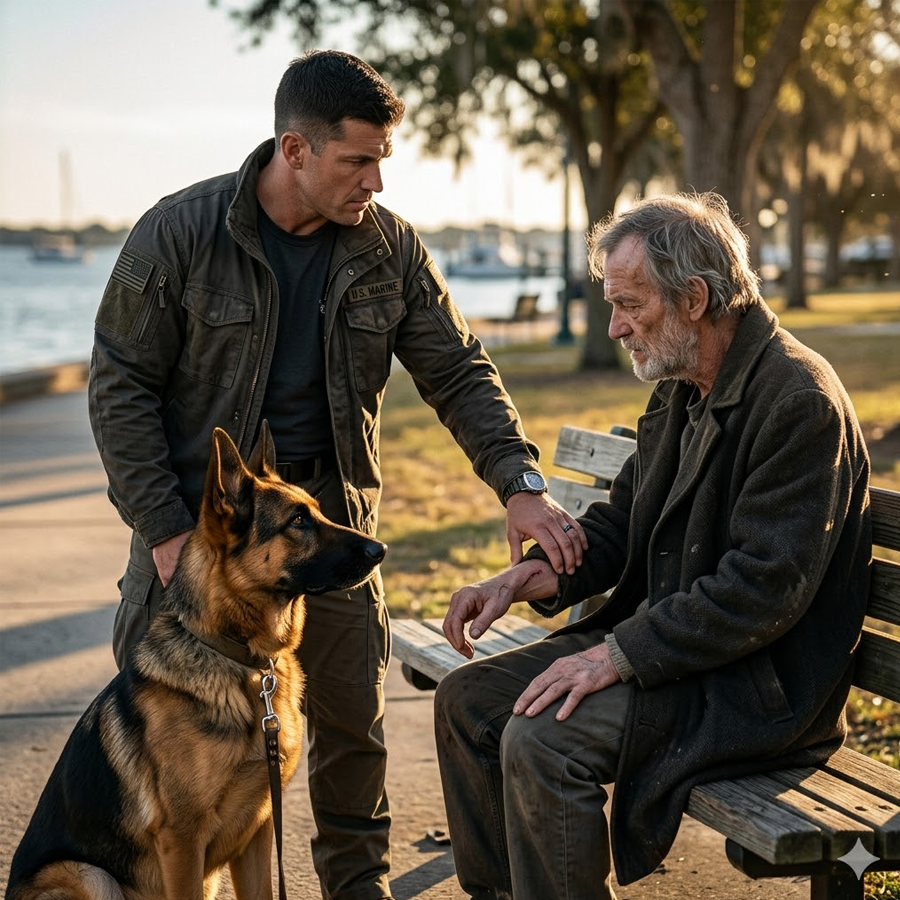
Staff Sergeant Marcus Reed walked the path at the measured pace of a man who was technically on leave and had not yet worked out what that was supposed to feel like. At thirty-five, he carried himself with the compact, grounded authority that came from years of physical discipline continued well past the point where it became habit — broad through the shoulders, economical in movement, his face trained into a baseline expression of neutral attention that people occasionally mistook for coldness and was actually just the absence of performance.
He hadn’t planned to come back to Pensacola. Leave had been mandatory after the last rotation, which meant Pensacola had been the default, the place he still had a storage unit and a partial mailing address and enough history to constitute something resembling a home. He had told himself it was temporary. He was telling himself a lot of things that week.
Rex moved at his left knee with the easy confidence of a dog who had been in enough difficult places to find a quiet waterfront park genuinely undemanding. Four years old, eighty-five pounds of focused amber and black, ears rotating in small adjustments to the ambient sounds of the park — birds, distant traffic, the soft percussion of water — without landing on anything that required more than passive attention.
He was not a nervous dog. He was a thorough one.
Which was why, when he slowed without a command and the muscles along his shoulders tightened beneath his coat, Marcus noticed immediately.
“Rex.” Low, controlled.
The dog didn’t respond. That alone brought Marcus’s full attention forward. Rex did not ignore commands. Not in five years, not once, not unless something mattered more than the command. It wasn’t defiance. It was priority, and whatever the dog had found on that bench ahead had ranked above everything else in the immediate environment.
Marcus followed the line of sight.
An old man sat alone on the bench nearest the water, slightly hunched forward, his figure thin beneath a coat that had once been substantial and was now loose in every place it used to fit. His hair was gray and uneven, his beard untrimmed, his posture carrying the specific kind of fatigue that had nothing to do with a single bad night and everything to do with an accumulated weight spread across too many years. But there was something else in him, something that contradicted the surface. A containment. A control that didn’t match the worn coat or the untrimmed beard or the thinness of the shoulders beneath them.
Rex took one slow step forward. Not the forward lean of threat assessment. Something quieter. Something Marcus had seen the dog do once before, in a medical tent outside Kandahar, when a soldier on the other side of the space had been working very hard to look like he was fine and the dog had gone to him anyway and simply lain down beside him without being asked.
Marcus let the leash go slack and moved closer.
“Sorry,” he said, stopping a few feet from the bench. “He doesn’t usually do this.”
The old man lifted his head slowly. His eyes moved to Marcus, registered him briefly with a sharpness that came and went too fast, then settled somewhere just short of direct contact. “It’s all right,” he said. His voice was dry and rough in the way of someone who didn’t use it often. “Dogs notice things.”
Marcus didn’t respond to that. He was watching the man more carefully now, doing it the way he’d been trained — not obviously, not intrusively, just registering. The way he held his hands, loose but controlled, on his knees. The stillness in him that wasn’t the stillness of peace. The way his eyes had moved, briefly, to the tree line at the park’s edge before returning. Checking. Habit checking.
Rex had reached the bench. He lowered himself to the ground beside it, not sitting, lying fully down, in the particular way he went to the ground when he had decided something was worth staying for.
Marcus reached into his jacket pocket. “You need anything? I can—”
The man lifted one hand slightly, the gesture of someone accustomed to declining before the offer was complete. The sleeve of his coat shifted back two inches with the movement.
Marcus stopped.
On the man’s wrist, pale against weathered skin, was a scar. Curved, clean in its original line, faded with age — the kind of mark left by a fast, precise cut from the edge of a metal tool, the kind of wound that happened in an instant and healed without drama because the person it happened to treated it like it was nothing even when it clearly wasn’t.
Marcus had seen that scar once in his life. He had been fifteen years old, standing in a garage that smelled like motor oil and metal shavings, watching his father pull his hand away from a lathe too late. The cut had bled more than his father let on. He had said it was nothing. He had pressed a shop rag against it and kept working.
Marcus remembered thinking, even at fifteen, that his father’s relationship with pain was something he would never entirely understand.
The man noticed Marcus’s stillness. His hand moved, pulling the sleeve back down. Deliberate. Practiced. He had covered that scar before.
“Name’s Hank,” he said. His voice was steady but his eyes had dropped to the ground.
Marcus lowered his hand slowly from his pocket. His mind was moving fast and he was not letting it show. The scar alone wasn’t confirmation. He knew that. He was not the kind of man who operated on single data points. But it wasn’t just the scar. It was the stillness, the checking, the control living underneath the surface of a man who appeared, on the outside, to have lost all of it. It was the way he had given a name without being asked, which meant he had been ready to give a name that wasn’t his.
“You been here long?” Marcus asked.
“Long enough,” the man replied.
Marcus sat down on the far edge of the bench. He rested his forearms on his knees, eyes directed toward the water rather than the man beside him. People talked more when they didn’t feel watched. He had learned that long before the Marines, but the Marines had refined it.
“My old man had a garage,” Marcus said, his tone easy, almost indifferent. “Behind the house. You could smell the oil before you even opened the door. Got into everything — his clothes, his hands. He said if something worked it didn’t need to look clean.” He let the words sit for a moment. “Used to call me kid when I was almost as tall as him. Never stopped.”
Beside him, barely perceptible, the man’s breathing changed rhythm.
Marcus continued, voice quieter now. “I used to think it was annoying.” He paused. “I’d give a lot for it now.”
The silence that followed was different from the one before it. Fuller. Under pressure from something that hadn’t been said yet.
Marcus finally turned his head.
The man who called himself Hank was staring at the ground, his hands clasped tightly on his knees, the tremor in them more visible than before. His lips were pressed together with the effort of holding something in that had been held for a very long time.
“No one else ever called me that,” Marcus said quietly.
The man’s shoulders dropped. Just slightly. Just enough.
His lips parted and closed once before the word came out. “Marcus.” Rough, barely assembled, the sound of a name that hadn’t been spoken in two decades by the one person who had any right to use it that way.
Marcus went completely still. He did not let what he felt reach his face. He turned fully on the bench, and for the first time, he looked at the man without any filter of uncertainty or professional neutrality. He looked the way you look when you allow yourself to actually see.
The age was there, undeniable. The beard, the thinness, the coat. But underneath it, in the structure of the jaw, in the line of the brow, in the particular shape of the eyes that were now, for the first time, meeting his directly — it was there. Time didn’t erase the architecture of a face. It just built over it.
“Say it again,” Marcus said.
The man’s throat moved. “Marcus.” Steadier this time, though it cost him visibly. “You shouldn’t be here. You need to leave.”
“I spent twenty years thinking you were dead,” Marcus said. His voice was even. Controlled. The control cost him something. “I think I deserve a little more than that.”
The man — Daniel Reed, because Marcus already knew, had known since the scar, had simply needed the rest of him to catch up — shook his head sharply. The movement was different from everything that had come before, faster, tighter, edged with something that took Marcus a second to identify as panic.
“You don’t understand,” Daniel said, his voice rising slightly. “You have to go. Right now.”
“I’m not going anywhere.”
“They’ll see you.” His eyes moved to the tree line again, to the path behind them, to the parking area at the park’s edge. Not random. Systematic. A man who had been scanning his surroundings for twenty years and had not once stopped long enough to feel safe.
“Who?” Marcus asked.
Daniel looked at him. In his eyes was the specific combination of fear and exhaustion that belonged to a person who had been carrying something heavy for so long that they had forgotten what it felt like not to. “Your stepmother,” he said quietly. “Victoria.”
—
They left the park as the last light left the sky, walking without conversation through streets that thinned gradually as they moved away from the waterfront and toward the outer edges of the city, where the ground softened and the roads narrowed and the sounds of the water came back in a different register — lower, darker, the sound of the marsh rather than the bay.
Daniel led without being asked to lead. His steps were slower than they once had been, more deliberate, but there was still structure in them. Pattern. The way a man moves when he has learned to make himself small in a space without losing his awareness of it.
Rex stayed close, adjusting to Daniel’s pace without any signal from Marcus, occasionally lifting his head to read the air, then settling back into the rhythm of the walk.
The shelter, when they reached it, was not a house in any definition that required generosity. It was a structure built from necessity and maintained by determination — mismatched boards, gaps where the night air moved through, a door that was really a panel of wood set carefully into a frame. Inside: a narrow bed, a thin blanket, a plastic container, a small rusted stove. Everything with a function. Nothing else.
Marcus stepped inside and took it in without a word.
Daniel moved to the bed and crouched with visible effort, reaching beneath it and withdrawing a small wooden box, its surface worn smooth from years of handling. He held it without opening it for a long moment, and in that moment Marcus could see what the box cost him, the exposure of it, the act of making something private into something witnessed.
Daniel lifted the lid.
Inside, bound with a thin piece of string, was a stack of envelopes. The paper had yellowed, the edges curled slightly from humidity. Beneath them, folded newspaper clippings, some worn thin at their creases from being opened too many times.
“I wrote one every year,” Daniel said, his voice quieter in the enclosed space. “On your birthday.”
Marcus reached for the top envelope. His name on the front — not rank, not formal — just Marcus, written in handwriting that hit him somewhere below the sternum and stayed there.
He opened it carefully. The writing inside was simple. Direct. No elaborate explanations, no layered apologies. Just a few lines imagining where Marcus might be, what he might be doing, who he might be becoming. And at the bottom, the same sentence, repeated: I’m still here.
Marcus held the paper and did not speak for a long time. When he looked up, Daniel was watching him with the careful attention of someone who has waited a very long time for a reaction and isn’t sure they’ve earned the right to want one.
“Why?” Marcus said. “If you were alive — why?”
Daniel exhaled slowly. “About six years after I left, I sent one letter. Just one. I thought enough time had passed.” He stopped, jaw tightening. “They found me two days later. Didn’t touch me. Just made clear they knew exactly where I was.” His eyes met Marcus’s. “And where you were.”
Marcus’s chest tightened.
“I stayed gone because staying gone was the only way to keep you clear of it,” Daniel said. “Victoria had built everything on control. Money was part of it. People were the rest. If my name was connected to yours — your enlistment, your record, your career — she had leverage. Against both of us.” He looked at his hands. “Disappearing was the only move that cost her nothing and cost you nothing either.”
“Except a father,” Marcus said quietly.
Daniel didn’t answer that. Because there was no answer to it. Only the truth of it, which both of them were sitting inside now, in a shack at the edge of a marsh, twenty years too late and exactly when it needed to happen.
Marcus picked up one of the newspaper clippings. A photo of himself in uniform, younger, sharper, standing straight at a graduation. Another clipping, a promotion announcement. Another, a brief mention of his unit. All of them carefully cut, carefully folded, handled so many times the paper had gone soft.
He looked at Daniel.
“You kept track,” he said.
“As much as I could,” Daniel replied. “It was enough.”
Rex shifted from his position by the door and moved slowly to Daniel’s side, settling against him with the quiet certainty of a dog who has decided where he’s needed. Daniel’s hand moved to the dog’s back, uncertain at first, then steadier, fingers moving through the thick fur in a way that looked like someone relearning what it felt like to touch something that didn’t require anything from him in return.
Marcus watched that. Watched his father’s hands stop shaking for the first time since the park.
“You’re not staying here,” Marcus said.
Daniel didn’t argue. He just sat with Rex against his side and the box open in his lap and two decades of undelivered letters stacked between them, and he nodded once.
Morning came pale and quiet over the Gulf. Marcus drove without the radio, his mind moving through everything Daniel had told him, laying it alongside twenty years of memory and testing the fit. It held. Every piece of it held, because the things that never made sense about his stepmother’s version of the past were suddenly not gaps anymore — they were intentional spaces, carefully maintained.
He settled Daniel in a motel room in Destin under the care of a woman behind the counter who understood, from a single look at the two of them, that questions were not what was needed. He left Rex with his father — gave the command and watched Rex settle immediately against Daniel’s leg, present and steady — and drove back to Pensacola alone.
Victoria’s house was exactly as it had always been. Clean lines. Trimmed edges. Nothing out of place. She opened the door quickly, which told Marcus she had been near it.
“Marcus,” she said. Composed. Measured. “You’re back.”
“I need to talk about Daniel,” he said.
The pause before her response was small but absolute. “That part of your life is finished,” she said.
“I spoke to him yesterday,” Marcus replied.
Something moved behind her eyes and disappeared. “You’re mistaken,” she said.
Marcus looked at her for a long moment. “No,” he said. “I’m not.” Then he turned and walked back to his car. He didn’t need her confession. He needed evidence, and he knew where to find it.
Arthur Pinhalagan answered his door like a man who had been expecting the knock for years and had made his peace with it finally arriving. He was sixty-eight, thin through the frame, gray and worn in the specific way of someone who had been carrying a secret that belonged to someone else and had never been able to put it down.
He led Marcus to a filing cabinet in the back room and stepped aside. “The files are there,” he said. “I never destroyed them. I told myself I would. I never could.”
Marcus went through them methodically. At first glance, everything was clean. Balanced numbers, proper signatures, standard transfers. But Marcus had learned, in five years of work that required him to find what people had worked hardest to hide, that surfaces were for audiences. He was looking for pattern.
His finger stopped on a signature page.
“Altered,” Arthur said from behind him, before Marcus said it.
“The transfers,” Marcus said. “Split across multiple accounts.”
“Small enough to avoid attention,” Arthur replied. “Consistent enough to build.”
“And Daniel found it.”
“Daniel found it,” Arthur confirmed. “And before he could take it to anyone, she had already built the alternative version. His name on the documents. Her narrative in place. She didn’t give him time to defend anything. She just made sure the architecture of the accusation was there before the accusation was ever made.”
Marcus set the file down and looked at the documents beneath it. A planned asset transfer — property, accounts, holdings — most of it designated to Marcus. Dated weeks before his enlistment.
He understood everything now. If Daniel had stayed, if he had fought it, if his name had become publicly connected to the investigation, Victoria would have had leverage over Marcus’s military future before it began. She had not just removed Daniel from Marcus’s life. She had used Marcus as the instrument of Daniel’s removal.
Marcus gathered the copies he needed, straightened, and looked at Arthur. “Thank you,” he said.
Arthur nodded, the relief of someone finally setting something down.
The memorial park was quiet in the early morning, the sky wide and pale above rows of engraved stone, the flags along the pathway moving slowly in a Gulf breeze that smelled of salt and distance. People had begun to arrive in ones and twos — veterans, families, a few local figures — gathering with the particular restraint of people who understood that some places required it.
Marcus stood near the edge of it, Rex at his side, Daniel a few steps behind him wearing clean clothes and a stillness that looked different from the stillness at the bench in the park. That had been the stillness of a man diminishing himself to avoid notice. This was something else. Something that hadn’t been there two days ago and was fragile enough that Marcus was being careful not to look at it too directly.
“You don’t have to do this,” Marcus said quietly.
“Yes I do,” Daniel said. His voice was not strong. But it did not waver.
Marcus turned toward the podium near the center of the gathering and waited while the crowd settled. Then he spoke — not loudly, not with performance — just evenly, letting the words carry their own weight. He talked about the difference between men who walk away and men who step back to protect what walking away would cost someone else. He talked about stories that were easier to believe than the truth, and how the easier version often survived long past the point when someone with enough courage could have corrected it.
When he turned and looked toward Daniel, the crowd followed his gaze.
Daniel stood still for a long moment. Twenty years of silence had its own gravity, and stepping out of it required something Marcus couldn’t provide and hadn’t tried to. He had simply made space. The rest was Daniel’s.
When Daniel stepped forward, it was not dramatic. It was deliberate. Each step measured, as if he was reclaiming ground rather than crossing it. When he reached the podium and stood beside Marcus, he looked out at the gathering with eyes that were tired and clear and no longer apologizing for existing.
“I didn’t leave,” he said.
Three words. Marcus placed the documents on the podium beside them — copies, organized, readable. Bank records, signature analyses, the paper trail of a structure built to keep a man invisible. No speech attached to them. The truth didn’t need one.
At the edge of the gathering, Victoria stood. She had come, which told Marcus something. She was composed, dark hair neat, posture controlled, everything exactly as it had always been. But the certainty that had always lived in her expression was no longer entirely intact. She looked at the documents, then at Daniel, then at Marcus. She said nothing. She didn’t try to interrupt.
She simply watched the version of events she had constructed for twenty years quietly stop holding together, and she did not make a scene of it, which was the most honest thing Marcus had ever seen her do.
Marcus didn’t look at her again. He put his hand briefly on Daniel’s shoulder, then stepped back and let his father stand there, in the light, in front of people who were beginning to understand what they were seeing.
It was enough. It was more than enough.
The house near the coast was not finished. Weeks later, tools still lay scattered across the porch, wood still needed sanding along the window frames, and the front steps were solid but unpainted. It was a work in progress in the most literal sense, which suited both of them in ways neither had said out loud.
Marcus worked with his sleeves rolled and his movements precise, the same focused attention he brought to everything. Rex lay nearby in a patch of afternoon sun, watching the open water with the easy contentment of a dog who had decided this place was good. Occasionally he shifted to check on Daniel, who moved through the interior of the house with increasing ease, each day a fraction steadier than the one before.
Daniel came to the doorway and stopped there, watching Marcus work. He didn’t say anything for a long moment. Then: “You didn’t have to build all this.”
Marcus didn’t look up. “I know.”
Daniel nodded slowly. He stepped out onto the porch and stood beside him, both of them looking out toward the water, the sound of it constant and indifferent in the way of things that predate all human difficulty and will outlast it.
Between them, something that did not have a name yet was taking its first careful steps toward becoming something that did. Not what had been lost — twenty years didn’t give back what they took. But something adjacent to it. Something that grew in the space where the truth had finally been allowed to stand.
Rex got up from his patch of sun, crossed the porch, and lay down between them.
Neither man moved away.
THE END