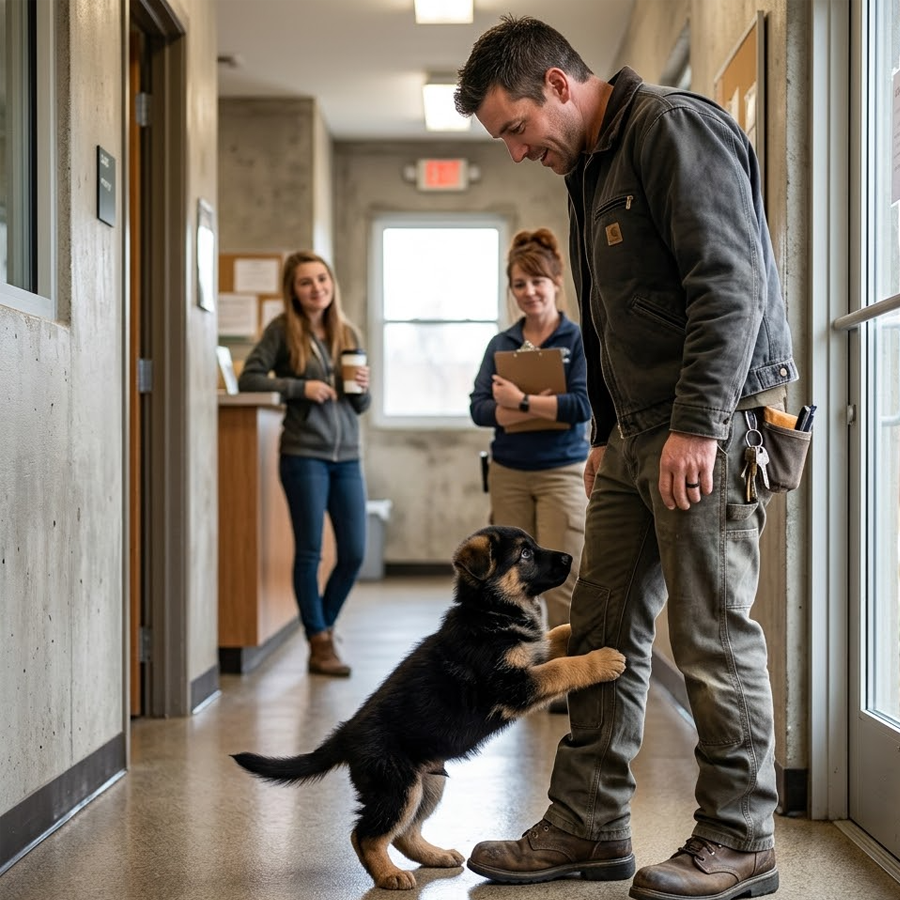
Nobody warned Caleb Roark that the most disarming thing he would ever face in his life wouldn’t be a mission. It wouldn’t be a locked door in a hostile building, or a split-second call made in total darkness. It would be a five-week-old German Shepherd with paws too big for his body, sliding across a polished floor, heading straight for a man who had spent years making sure nothing could reach him.
But that’s how it started. Not with a dramatic decision. Not with a moment of surrender. Just a small animal that didn’t ask permission and a man who didn’t move fast enough to stop it.
Caleb had been out of the Navy for three years by then. Long enough that people stopped looking at him like he had just landed. Long enough that the silence inside his apartment no longer felt temporary. He had a routine, a shift schedule, a small notebook with license plates and delivery times, and a security job at a construction site outside Ashford, Montana that required very little from him except his eyes and his presence.
That was exactly what he wanted. Work that didn’t follow him home.
It was his younger sister Lily who broke the routine, the way she always had. Her car was in the shop. She needed a ride to the animal shelter outside town to ask questions about the kitten she had adopted the week before — questions about feeding schedules and why it had apparently launched a campaign against her laundry basket. She asked Caleb the night before, casual and easy, the way she asked everything, like the answer was already yes and she was just letting him know in advance.
He said yes. Because saying no to Lily always cost more energy than it saved.
The morning was cool and gray, the kind of April weather that still carried winter in the wind even though the grass had started pushing through the mud. Caleb drove with the window cracked an inch, one hand on the wheel, eyes on the road out of habit rather than need. Lily sat beside him with a coffee cup in both hands and a story already in motion about the kitten’s latest offense against the household.
He nodded where it seemed right. Let her talk. That was how it worked between them.
The shelter was smaller than he expected. Bright. Clean floors. A faint layered smell of soap, warm animal blankets, and kibble that somehow didn’t feel unpleasant. Lily moved toward the front desk with the easy confidence of someone who had already been here before, already knew the staff’s names, already had opinions about which dogs were underrated.
Caleb drifted down the hallway without a destination.
He stopped at the small dog section near the far end. There was a bench against the wall beside the window — solid surface behind him, clear sight line to the entrance reflected in the glass, nothing at his back. He sat without thinking about why.
His body still made those calculations before his mind caught up. Some things didn’t leave, even after the uniform did.
That was where Clara found him.
She came around the corner with a clipboard held against her hip, moving the way people move when they’re used to managing noise without adding to it. Mid-thirties, chestnut hair pulled into a loose knot at the base of her neck, clear brown eyes, and a kind of stillness about her that didn’t feel passive — it felt deliberate. Like she had decided long ago not to waste anything on impressions.
“You’re with Lily?” she asked.
“Just driving,” Caleb said.
“Just waiting,” she corrected, glancing at the bench. Not unkindly.
He almost cut the conversation short right there. Instead, something about the way she had said it — without judgment, without warmth either, just accurate — caught him slightly off balance. He heard himself say something he hadn’t planned to say.
He told her about a man from his old team. A guy named Hatch who used to brew coffee so strong the rest of them started calling it engine cleaner. It wasn’t a story worth telling. That was why he told it — low stakes, something to fill three minutes and then stop.
Clara didn’t smile politely and look away. She laughed at the right moment. Asked if anyone had actually drunk it voluntarily. Asked what Hatch did after he got out.
She wasn’t humoring him. She was listening.
“My dad used to say that military coffee had one purpose,” she said. “Not to taste good. To keep people upright.”
Caleb looked at her differently then. “Your dad served?”
“Army. Two tours. He could fix any engine, any fence line, any piece of broken equipment.” She paused. “Never did figure out his own sleep though.”
Something in Caleb settled a fraction. “Yeah,” he said. “That sounds familiar.”
The silence that came after was not uncomfortable. It simply existed between them without needing to be filled.
Clara shifted the clipboard to one arm. “Would you like to meet one of our puppies?” she asked.
Before Caleb could answer, a kennel door clicked open behind her.
What came through that door was not what anyone would call a graceful entrance. Five weeks old, maybe less. Black and tan, with the dense soft fur of a German Shepherd still growing into itself, ears that couldn’t decide whether they were going up or staying folded, and paws that were already disproportionately large for the rest of him. The puppy hit the polished floor running, skidded sideways, corrected with impressive stubbornness, and came straight toward Caleb without hesitation.
No sniffing around. No uncertain circling. Straight line, direct approach.
It planted both front paws against Caleb’s boot, grabbed the ring of keys hanging from his belt loop, and began pulling with all the force its small body could produce.
The keys did not move.
The puppy braced harder. Slid back half an inch. Tried again with the full seriousness of a creature that had decided this was important work.
A laugh came out of Caleb before he could stop it. Real and short and rougher than he expected, like something that had been stored too long in a dry place.
From the front desk, Lily turned her head so fast her coffee nearly spilled. “Caleb?” she called down the hall. “Was that you?”
Clara was smiling in a way that reached her eyes without asking anything in return. “His name is Milo,” she said. “He tends to skip the introductions.”
Caleb looked down at the puppy, who had now given up on the keys and was using his wrist as a stepping stone toward his jacket pocket. “Puppies do this with everyone,” he said.
The words sounded reasonable. The puppy’s absolute certainty did not.
By the time Lily was done at the desk and came back down the hall, Caleb had already collected himself. He thanked Clara, nodded once, and headed for the front door. Clean exit. Nothing unusual. Just a strange five minutes with a small animal that would forget him by tomorrow.
He was almost there.
Then something grabbed his pant leg.
He looked down.
Milo had followed him the full length of the hallway. Both front paws were wrapped around the fabric of Caleb’s work pants, not biting, not crying, not performing. Just holding on. Quiet and immovable, with the particular determination of something that has already decided and is simply waiting for the other party to catch up.
Caleb stood there. The dog at his boot. The exit six feet away.
He stood there for longer than made sense.
The drive home felt stretched. Lily talked about her kitten, about the laundry basket situation, about something a coworker had said that morning. Caleb answered when she left room for it. Short answers. The kind that kept things moving.
But he wasn’t in the car.
Every red light, every slow turn, he kept coming back to a grip that shouldn’t have mattered. A puppy holding onto a stranger’s pants. It wasn’t complicated. Animals did things like that. It didn’t mean anything.
“You’re not listening,” Lily said.
“I am.”
“What did I just say?”
He said the first thing available. “That it’s aggressive.”
“It’s a kitten, Caleb. Not a threat assessment.”
He didn’t answer. Lily studied him the way she sometimes did when she thought she understood something before he did. Then she leaned back in her seat.
“That dog picked you,” she said.
“It’s a puppy. It does that with everyone.”
“Mm.” She didn’t argue. She just let it sit there.
He dropped her off, waited until she was inside, and drove on. The construction site came up the way it always did — familiar shapes, the same gravel lot, the same heavy smell of concrete and cut steel. He checked the perimeter, logged the delivery, ran his usual route without incident.
Around 9:30, sitting in the gate office with his notebook open and nothing requiring his attention, his phone rang. Unknown number.
He answered on the second ring.
“Caleb. It’s Clara.”
He said nothing for a second.
“You walked out with one of our markers,” she said. Her tone was light. “Center name on it. I figured you’d want to return it before I get written up for losing inventory.”
He looked at the table. The marker was there. He had no memory of picking it up.
“I’ll bring it back,” he said.
“I figured.” A pause. “Also — I thought you should see this.”
A photo came through. Milo with his entire head inside a food bowl, one paw resting on the rim like he was claiming it for later. Clearly not eating. Clearly not sure what he was doing.
Caleb stared at the image longer than he should have.
He does that, Clara said. Starts something, forgets the point, then commits anyway.
Caleb typed back without planning to. That position doesn’t look efficient.
Three dots. Then: It’s not. He’s still figuring out most things.
A second photo arrived. Milo curled next to the same bowl, asleep. Like the effort of not eating had been genuinely exhausting.
Caleb set the phone face down. Picked it up again a minute later. How much is he eating?
Not enough, Clara replied. We’re trying different things.
He locked the screen. Unlocked it. Looked at the photo of the sleeping puppy one more time. Something in his chest was doing something he didn’t have a name for, and he didn’t try to name it. He just noticed it was there.
The rest of the shift passed slower than usual. He marked a plate number twice. Missed a camera rotation by four minutes. Nothing serious. Nothing anyone else would have caught. But he caught it, and the fact that he caught it irritated him more than the mistakes themselves.
The next morning, driving to the site, he came to the intersection at the edge of town. Left went to work. Right went toward the shelter.
The light turned green.
He turned right.
His phone buzzed before he’d made it half a mile. Denny. His supervisor. He answered without slowing down.
Where are you?
Running late. Personal errand.
We’ve got a delivery waiting.
I’ll be there.
He ended the call. Pulled into the shelter lot. Sat for a moment in the truck, the engine ticking down.
He had already decided, somewhere between the intersection and the parking lot, that this wasn’t about the marker.
Clara looked up when he walked in. “He didn’t eat much this morning,” she said.
That was all she said. No question behind it. Just information, offered quietly, like she already knew it would be enough.
It was.
Caleb followed her back to the small room where Milo was pacing in tight, uneven circles. The puppy stopped the moment he saw Caleb. No hesitation. Same direct line as before, same absolute certainty about where he was going.
Caleb crouched down. One hand on his knee.
“You’re supposed to be eating,” he said, more out of habit than expectation.
Milo ignored this entirely. Instead, the puppy nosed at Caleb’s jacket pocket, located a folded construction receipt, and pulled it free with focused efficiency. Then he ran.
Not far. Just far enough to make it a game. Paws sliding, tail moving with a seriousness that didn’t match the absurdity of what he was doing. The receipt dragged behind him across the floor like a flag he had rightfully claimed.
Caleb stood there and watched.
Then something broke loose inside him — a laugh, real and unguarded, the kind that doesn’t check itself before leaving. It came out loud in the small room and surprised him as much as it surprised anyone.
Clara didn’t say anything. She just watched it happen.
Caleb crossed the room and reached down. This time, Milo let go without a fight, as if whatever needed proving had already been proven. Caleb folded the receipt and put it back in his pocket.
“What is it with you and paper?” he said.
“Progress,” Clara said. “Yesterday it was keys. Today it’s receipts. He’s advancing.”
Caleb exhaled slowly. His phone rang again. Denny.
He stepped aside and answered.
You were supposed to be here forty minutes ago.
I know. I’m not coming in right now.
What?
Taking the morning. Personal.
You serious? There’s a driver waiting.
I’ll make up the hours. Log it however you need.
A long silence. Then: This better not become a pattern.
It won’t.
The line dropped. Caleb lowered the phone and turned back.
Clara hadn’t moved. She wasn’t pretending she hadn’t heard.
“You’re going to have to deal with that eventually,” she said.
“I always do.”
She nodded once, then leaned lightly against the wall beside the enclosure. “My dad used to repair fences for hours,” she said. “Not because they needed it. Because it gave him somewhere to be without being asked anything.”
Caleb looked at the floor. “I’m not hiding.”
“I didn’t say you were.” She met his eyes easily. “You’re just very good at choosing places where no one expects to find you.”
He didn’t answer. He looked down instead. Milo had settled near his boot. Not demanding anything this time. Not climbing, not pulling, not playing. Just there. Warm and still against the side of his shoe.
Something in Caleb’s chest shifted again, and this time he didn’t push it back.
“What do I need to sign?” he said.
Clara went quiet for a second. Then: “You mean that?”
“Yeah.”
She walked to the desk without making it into anything more than it was. “All right,” she said. “Let’s start the paperwork.”
—
The forms were straightforward. Caleb signed without hesitating. By the time everything was done, Milo had installed himself against Caleb’s foot like he’d been doing it for years.
Clara handed over a small packet — feeding schedule, vet contacts, emergency numbers. Caleb took it.
“You sure about this?” she asked.
He looked down at the puppy. Then back at her. “I wouldn’t have signed if I wasn’t.”
She held his gaze for a moment, then gave a small nod.
Caleb picked Milo up carefully, still adjusting to the weight, and turned toward the door.
He stopped at a supply store on the way out of town. Walked in with the puppy settled in the crook of his arm and came out with two steel bowls, a blanket, a chew toy, and puppy formula the clerk said he’d need. At the register, when the total came up, he didn’t hesitate.
“First one?” the clerk asked.
Caleb considered. “Something like that.”
“They’re a lot,” the man said.
“I’m just fostering,” Caleb replied.
The clerk gave him a look that suggested he had heard that particular sentence many times before and had stopped believing it around the third time.
Caleb didn’t explain further. He walked out, put Milo in the passenger seat, and sat for a second before starting the engine.
The puppy looked at him with total unconcerned confidence. Already at home. Already certain.
Caleb started the truck and pulled out of the lot.
Milo came into the house like he had been sent to evaluate it.
Not wild. Not uncertain. Just methodical. He sniffed Caleb’s work boots first, then moved to the old radio on the low shelf, then to the jacket hanging by the door. Then he located a sock half hanging from the laundry basket, tugged it free with complete dignity, attempted to carry it toward the living room, missed the small step between the rooms, and tipped forward into the floor.
He stood back up immediately. Still holding the sock. Still absolutely unbothered.
Caleb laughed again. It came easier this time.
The first evening passed in small, undramatic discoveries. Milo learned that shoelaces moved when pulled and chair legs didn’t. He ate a little, drank some water, and eventually circled himself down into a clumsy heap near the couch. Caleb watched longer than he meant to.
When the house went quiet and dark, he expected the puppy to settle on the blanket he had laid out near the heating vent. Instead, after one slow patrol down the hallway, Milo sat down in front of the one door Caleb had not opened in over a year.
And stayed there.
Caleb watched from the hallway.
“No,” he said.
He brought the chew toy. He tapped the blanket. He offered both options with more patience than he usually had for anything.
Milo looked at each offer carefully and then returned to the door.
Caleb stood in the hall for a long time. The dog hadn’t moved. The door hadn’t changed. The room behind it hadn’t either — he knew that without opening it. He’d left it the same way for a reason.
Near midnight, he gave up.
He turned the handle.
The room smelled like cardboard and still air. Boxes against one wall. A folding chair near the window. A few things from an earlier version of his life pushed back here and left undisturbed long enough to collect their own quiet.
Milo walked in without ceremony and climbed onto the chair.
Caleb stood in the doorway. Then he crossed the floor, sat down beside the nearest box, and lifted the lid.
He didn’t excavate everything. He didn’t need a ceremony. One open box was enough. One decision to stay in the room instead of turning back was enough.
The days after that changed gradually, which made them easier to trust.
Clara came by more than once — always with an excuse that had very little to do with Milo and very much to do with lingering in the kitchen a little longer than necessary. Cornbread one visit. Waffles another. Once, a bag of dog treats she insisted were borderline insulting for a dog of any discernment.
Caleb told her she was undermining him in his own house.
Clara said Milo seemed emotionally equipped to handle it.
Their conversations stretched without being forced. Caleb told her about the construction site — about the men who acted hardened around heavy equipment and fell apart over spreadsheets, about how quiet the nights got when wind moved through unfinished beams. Clara told him more about her father, about the habits he came home carrying without names, about her mother who used to say that brave men were often fine in every crisis except the quiet ones.
Caleb didn’t answer that immediately. He looked at Milo, who was chewing the corner of a blanket with absolute moral confidence, and said: “That seems unfair.”
“Probably,” Clara said. “Doesn’t make it less true.”
What changed in Caleb didn’t announce itself. There was no single morning he woke up different. But he noticed, slowly, that he had stopped finding reasons to stay late at the construction site. He stopped reviewing footage no one had asked him to review, stopped finding another lock to test before leaving, stopped constructing small unnecessary tasks to hold the evening off a little longer.
He finished his shift. He came home.
Home had started to mean something again.
One evening he came back with dust on his jacket and a slow headache sitting behind his eyes. He dropped to the kitchen floor without making dinner, too tired to decide what came first. Milo crossed the room, climbed into his lap, turned once, and settled. Caleb rested his hand along the puppy’s back.
“I still don’t know why you picked me,” he said.
Clara was in the doorway, holding a paper bag from the bakery, the spare key Lily had insisted on pressed in her hand. She had heard the question.
“Maybe,” she said simply, “you were the one who needed finding.”
Caleb looked at Milo. Then at her. And for the first time in a long time, he stopped trying to understand something before letting it matter.
A few days later, Lily came by and found Clara at the kitchen counter, Milo asleep in the middle of a pile of unfolded laundry like a small king who had declared victory over domestic order.
She looked at Clara. Looked at Caleb. Looked at the dog. And smiled with the satisfaction of someone who had quietly known how this would go from the beginning.
“I meant to introduce you to a shelter,” she said. “I didn’t think I’d have to introduce you to a whole life.”
Caleb shook his head. “You overdid it.”
But he was already smiling when he said it.
For a long time, Caleb had believed that Milo had chosen wrong. A man who lived by schedules and careful distances and locked rooms was not the obvious candidate for something that needed warmth. Not the obvious candidate for anything that needed staying.
But the longer Milo lived in that house — dragging socks across the floor, sleeping against boots, refusing to move from a door that should have stayed shut — the clearer it became that the puppy hadn’t miscalculated at all.
He had gone straight to the part of Caleb that had been standing still for years. And somehow, without force, without fanfare, without asking for permission, he had found the one door Caleb hadn’t known how to open on his own.
Not every change comes loudly. Some of the most real ones arrive soft and small, in moments we almost dismiss, through things we almost walk away from.
Caleb thought he was just giving a dog somewhere to sleep.
What he didn’t know, standing in that shelter hallway with a puppy locked around his pant leg, was that something had already begun — something that would carry him, slowly and steadily, back toward the version of himself he had stopped believing was still there.
THE END






