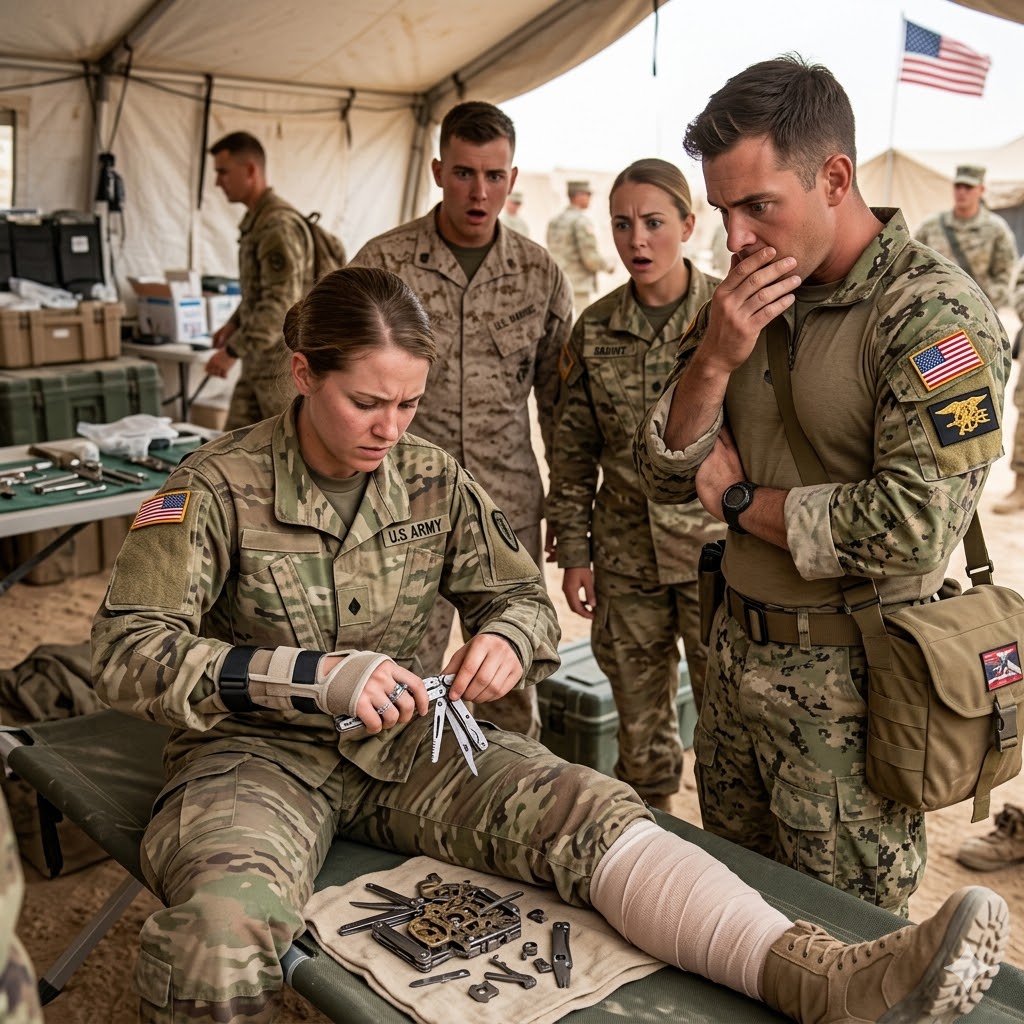
Injured yet undefeated her hidden training astonished the SEAL medic and everyone around.
Maya had always been the kind of person who moved like water. As a child, she climbed trees before she could tie her shoes. In high school, she ran cross country and lifted weights in her garage because her family couldn’t afford a gym membership. By 22, she was a certified personal trainer and an aspiring obstacle course racer.
Her dream was simple. Compete in the toughest endurance race in the country, a 50-mi militaryra challenge called the Iron Mantle. But life does not care about dreams. One rainy evening while cycling home from work, a delivery truck ran a red light. Maya swerved, but the rear wheel caught the curb and she flew over the handlebars.
The truck’s bumper clipped her left leg. She remembers the sound, a dull crack like stepping on a thick branch. Then the world spun when she woke up in the hospital and her mother was crying. A surgeon in blue scrubs held an X-ray up to the light. The tibia and fibula in her left leg had shattered in three places. The knee joint was dislocated and the anterior cruciate ligament was torn completely.
“You may never run again,” the surgeon said. “Not competitively, not without a limp.” Maya said nothing. She stared at the ceiling. For 3 days, she did not speak. Her mother brought soup. Her father sat in a chair by the window, reading the newspaper, but not turning the pages. Friends sent flowers that wilted on the nightstand.
Everyone offered sympathy. Everyone expected her to grieve. But on the fourth morning, Maya asked for a pen and a notebook. She wrote one sentence. They say I’m defeated. I say I’m just injured. The first month after surgery was brutal, and she could not put any weight on her left leg. The doctors installed an external fixator, a metal cage of pins and rods screwed into her bone, sticking out through her skin.
Every movement hurt. Showering required a plastic bag and tape. Sleeping was a series of short, sweaty naps between waves of pain. The physical therapist came twice a week and moved her ankle in tiny circles to prevent stiffness. “Don’t expect miracles,” the therapist said. “Your quadriceps will atrophy. That leg will look like a stick.
” Maya nodded politely. Then, as soon as the therapist left, she started her own secret work. She lived in a small apartment on the ground floor. Her bed faced a blank wall. She propped her phone against a water bottle and watched videos of elite athletes training, not to depress herself, to study them. She noticed how they breathed, the how they shifted weight, how they used their core to stabilize when one limb was weak.
Then she began her hidden training. She could not walk, but she could sit. She tied a resistance band to the bed post and did seated rows until her back burned. She did hundreds of crunches, careful not to jostle her leg. She did leg lifts with her right leg only, then isometric holds with her left, just flexing the muscle without moving the joint.
The pain was sharp, like broken glass under her skin. But every time she wanted to stop, she remembered the surgeon’s face. You may never run again. That sentence became her fuel. Her family thought she was just watching TV. Her friends thought she was depressed because she stayed in her room.
Nobody saw the sweat soaking through her pillowcase, and nobody heard her counting reps under her breath. At 2:00 in the morning, she kept a log book hidden under her mattress. Day one, 50 crunches, 20 seated rows, 10 isometric quad flexes. Day 30, 200 crunches, 100 rows, 50 flexes, plus arm push-ups off the edge of the bed.
Her upper body grew strong. Her right leg became a piston. Her left leg trapped in its metal cage wasted away visibly, but invisibly the muscles deep around the bone were fighting to stay alive. 6 weeks after the accident, the external fixator came off. The leg looked thin and scarred. The doctors put her in a walking boot and said she could try to stand with crutches.
The first time she put weight on it, tears shot out of her eyes. It felt like stepping on a lit match. But she did not cry out or she gritted her teeth and stood for five seconds, then 10, then 30. That night, she wrote in her log book, “Pain is just information. It says, “You are still alive.” By week eight, she was walking with one crutch.
The physical therapist was surprised. “Your recovery is ahead of schedule,” he said. Maya smiled and said nothing about the midnight crunches, the secret rouse, the isometric hell she had put herself through. The therapist gave her a list of approved exercises, gentle stretches, balance work, pool walking. Maya took the list home and doubled every number.
She also added her own moves. Single leg Romanian deadlifts on her right leg while holding a gallon of water in each hand. Wall sits with her left leg barely touching the floor. Plank holds that lasted 3 minutes. See, she did not tell anyone that she had already registered for the Iron Mantle race. The registration was non-refundable.
She had paid with her credit card 3 days before the accident. The race was 9 months away. Everyone would have told her she was crazy, so she kept it secret. The only witness was her old dog, a gray muzzled pitbull named Gus. He would lie on the rug and watch her sweat, occasionally thumping his tail.
3 months after the accident, Maya ditched the crutches completely. She walked with a limp that was noticeable but not severe. The surgeon cleared her for light jogging on a treadmill with a brace. “10 minutes maximum,” he said. “If you feel any sharp pain, stop immediately. Maya went to a 24-hour gym at midnight when no one she knew would be there.
She wore long pants to hide the scars. She set the treadmill to the slowest jogging speed. The first step felt like a betrayal of every bone in her leg. But after 3 minutes, something strange happened. The pain turned into warmth. The warmth turned into rhythm. She ran for 10 minutes. Then she walked for five. Then she ran for another 10.
By the end, she was crying and laughing at the same time. Her leg was not healed. It would never be healed the way the surgeon meant, but it was strong enough to move. That was enough. She increased her secret training. She bought a used pull-up bar and installed it in her doorway. She did pull-ups until her hands blistered.
She bought a sandbag and carried it up and down the stairs of her apartment building at 5:00 a.m., dragging her left leg behind her like a dead weight, forcing it to work. She practiced crawling on all fours, uh, then crab walks, then bear crawls. She did box jumps onto a stack of phone books, then onto a low stool, then onto a chair.
Every week the height increased. Every week her limp got a little smaller. Her mother noticed she was losing weight. “Are you eating okay?” she asked. Maya said she was just stressed about work. Her father noticed she was always tired. “You need to rest,” he said. Maya nodded and then as soon as he left did 50 burpees with a modified landing, catching herself on her right leg first.
By month six, she could run three miles without stopping. Her left leg was still visibly thinner, but the muscles around the knee had rebuilt themselves into a tight cableike structure. The scar looked like a lightning bolt down her shin. She stopped hiding the scar. She wore shorts to the grocery store. People stared. She stared back.
The Iron Mantle race was 3 months away. She had not told a single soul. Not her mother, not her father, not her best friend. The only one who knew was Gus, and he could not speak. She began training in the woods behind her town on trails that were uneven and muddy. She fell many times. Each fall she got up faster than the last. She practiced carrying a weighted backpack, climbing over fallen logs, crawling under barbed wire fences on private land with permission from a farmer who thought she was just hiking.
She did not use a GPS watch or a heart rate monitor. She used pain as her guide. If it was a sharp stabbing pain, she stopped. If it was a deep burning ache, she kept going. That was her only rule. One night while doing pull-ups on a tree branch, a jogger passed by with a headlamp and he stopped and asked if she was okay.
“Just training,” she said. He looked at her leg, the scar, the slight bow in her shin where the bone had healed imperfectly. “You should be careful,” he said. “That leg looks like it’s been through a lot.” Maya dropped from the branch, landed on both feet, and said, “It has, but it’s not done yet.
” She went home and wrote in her log book, “Day 180. Running 4 m, pull-ups 15, crawling 500 m, leg, angry, but working. 3 months to go.” The eighth month after the accident was when Maya’s hidden training became something closer to obsession. She had stopped thinking of herself as injured. Instead, she began to think of herself as rebuilt.
The distinction mattered. An injured person waits to heal. A rebuilt person constructs themselves out of whatever remains. But Maya’s left leg was not the same as before. It never would be. The tibia had a slight curve now, like a branch that had broken and regrown. The knee clicked when she bent it past 90°.
The ankle had less range of motion on the left side, but those were just facts. She learned to work around them. She discovered that her left leg was actually stronger in certain positions. Because the bone had calcified extra tissue around the fracture site, it could bear compressive loads better than before.
The weakness was in the tendons and the smaller stabilizer muscles. So, she designed exercises specifically for those. She stood on one leg, the bad one, while brushing her teeth. At first, she could only manage 10 seconds. By the end of month eight, she could stand for two minutes while balancing a book on her head.
She did toe yoga, lifting each toe individually, retraining the neural connection from her spine to her foot. The physical therapist had never prescribed any of this. She had invented it herself based on YouTube videos of ballet dancers recovering from ankle breaks. At night, she iced her leg and massaged the scar tissue with a lacrosse ball.
It hurt so much that she sometimes bit a towel to keep from screaming. But the next morning, the leg would move more freely. The stiffness would be a little less. She learned to love the pain of the lacrosse ball because it meant progress. She also changed her diet without telling anyone. No more junk food, no alcohol. She ate eggs, chicken, sweet potatoes, spinach, and lots of bone broth, partly for the collagen, partly because it felt symbolic.
She drank water constantly as she stopped using sugar in her coffee. Her mother noticed she looked leaner and asked if she was sick. “I’m fine,” Maya said. “Just eating clean.” That was technically true. She did not mention that she was eating clean to carry a 40 lb pack over 20 m of rocky terrain. The Iron Mantle race was a two-day event.
Day one was a 30-m obstacle course through mountains with mud pits, rope climbs, cargo nets, and a mileong stretch of barbed wire that you had to crawl under. Day two was a 20-mile ruck march with a mandatory 40lb pack followed by a series of military-style drills, ammunition can lifts, sandbag carries, and a casualty drag where you had to pull a 150lb dummy for 100 m.
The race was designed by a former Navy Seal named Commander Eric Vale, and only about 60% of finishers completed both days. The average competitor was a crossfitter, a marathoner, or active duty military. Maya was a 23-year-old personal trainer with a crooked leg and a secret. She had not told Commander Vale or anyone on his staff about her injury.
The registration form asked only for emergency contact information and a waiver. There was no medical screening. That was intentional. The race prided itself on being open to anyone willing to try. But Maya knew that if they saw her leg, they might pull her out for safety reasons. So she planned to wear compression tights and long socks.
She would not limp during the race. She had trained herself to walk, run, and crawl without any visible hitch in her gate. It had taken thousands of repetitions as she would practice walking in front of a mirror for an hour, adjusting the angle of her hip, the timing of her foot strike until the limp disappeared.
Then she would do it again the next day. Her family still thought she was just recovering normally. Her father had started making jokes about her bum leg. He meant it affectionately, but the words landed like small knives. Maya smiled and laughed along. Then she would go to her room and do one-legged squats on the bad leg until her quadriceps trembled.
She kept the log book hidden under the mattress. The entries had become sparse but intense. Day 210. Ran 8 mi on trail, left ankle held up, no brace, crawled under a fallen tree, scraped my back but didn’t stop. Gus watched from the car. He looked worried. Gus was her only companion. The old pit bull had arthritis in his hips.
I so he couldn’t run with her anymore, but he would sit in the passenger seat of her beat up sedan while she trained in the woods. He would watch her through the window, his head tilted. When she came back covered in mud and sweat, he would lick her hand. She talked to him sometimes. They think I’m broken, Gus. But I’m not broken. I’m just different.
Gus would wag his tail. That was enough. One afternoon, two months before the race, Maya went to a public park to practice climbing ropes. There was a permanent obstacle course there installed by the city. She had never used it before because there were usually children around. But on a rainy Tuesday, the park was empty.
She walked to the rope climb, a thick manila rope hanging from a metal frame 20 ft high. She had practiced rope climbs at the gym. They But those ropes were padded and close to the wall. This one swung freely. She grabbed it, jumped, and wrapped her legs around the rope. That was when she realized her problem. Climbing a rope requires you to clamp the rope between your feet.
The standard technique is to wrap the rope around one foot and step on it with the other. But Maya’s left ankle did not have the same flexibility as her right. She could not get the necessary angle. She tried three times. Each time she slid down after two feet. The third time she fell and landed on her back.
The impact shot pain through her spine. She lay there in the rain, staring up at the gray sky, and for the first time in months, she felt genuine fear. What if she couldn’t do this? What if the surgeon had been right? She lay there for 5 minutes. Then she sat up and she thought about her log book.
She thought about the sentence she had written on day four. I’m just injured. No, that was wrong now. She was not injured anymore. She was undefeated. There was a difference. An injured person finds excuses. An undefeated person finds solutions. She studied the rope. Instead of using the standard foot clamp, she experimented with using only her arms and her right leg, letting her left leg dangle.
It was slower, but it worked. She climbed 3 ft, then five, then 10. By the time she reached the top, her forearms were on fire and her right hip was screaming, but she made it. She tapped the metal crossbar and slid down, burning the skin off her palms. She did it again and again, six times. On the sixth climb, she did it without stopping.
She stood at the bottom, rain plastering her hair to her face. The ant laughed out loud. The park was empty. No one heard her. That made it better. That night, she wrote in her log book, “Rope climb conquered. Left ankle is a liability. Solution: don’t use it. Use arms and right leg only. Everything else is fine. 2 months.
I’m coming for you, Iron Mantle. The next week, she received an email from the race organizers. It was a routine check-in asking all competitors to confirm their medical readiness and to list any pre-existing conditions. Maya stared at the screen for a long time. She could tell the truth. She could say, “I shattered my leg 7 months ago, and my knee is held together with scar tissue and spite.
” But if she did that, they would almost certainly ask for a doctor’s note. The doctor would say no. The surgeon would say absolutely not. And the race would refund her money and tell her to try again next year. But next year did not exist. Next year was a lie people told themselves to make failure feel softer.
She typed, “No pre-existing conditions ready to compete.” She hit send before she could change her mind. Then she went outside and ran 10 mi on a gravel road. Her left leg held. Her limp did not appear until mile 8, and even then it was barely noticeable. She finished the 10 mi in 1 hour and 42 minutes, slow by marathon standards, but she was not running a marathon.
She was running a 30-m obstacle course followed by a 20-m ruck. She needed endurance, not speed. and she had endurance. She had built it in secret, one midnight rep at a time. Her mother called that evening. “You sound different,” her mother said. “Are you seeing someone?” “A a boyfriend?” Maya laughed. “No, Mom. Just training.” “Training for what?” Maya paused.
She almost said it. The words were on her tongue. The iron mantle. The race. the thing I’ve been doing while you thought I was lying on the couch, but she swallowed them. Just training to get stronger, she said. That’s good, her mother said. But don’t push yourself too hard. You’re still healing. Maya looked down at her leg.
The scar was now a pale silver line. The muscle around it had grown back, not perfectly, but enough. She flexed her quadriceps and watched the muscle jump. I’m not healing,” she said quietly after her mother had hung up. “I’m already healed. I’m just getting ready.” She went to bed early that night. Tomorrow, she would start her final month of training.
She would run with a weighted vest. She would practice crawling for miles. She would drag a tire behind her through a field. And she would do it all in secret because the moment you tell people your dream, they start giving you reasons why it can’t happen. Maya had learned that lesson in the hospital bed with the metal cage screwed into her bone.
The only person who needed to believe in her was herself. And she believed. The final month before the iron mantle was when Maya’s hidden training turned into something almost spiritual. She stopped thinking of it as exercise and started thinking of it as a conversation between her body and her will.
Every morning at 4:00, she woke up before the sun. She drank black coffee, fed Gus, and drove to a different location, a different kind of terrain. On Mondays were for hills, a steep gravel pit on the edge of town where she ran repeats carrying a 40lb sandbag. Tuesdays were for mud, a creek bed behind an abandoned farm where she crawled through freezing water and slippery clay.
Wednesdays were for strength, pull-ups, push-ups, pistol squats on her right leg, assisted pistol squats on her left. Thursdays were for rucking, a 20-m walk with the weighted pack, sometimes through the night because the race did not stop for darkness. Fridays were for rest, except she never really rested. On Fridays, she practiced the specific obstacles, rope climbs, wall jumps, balance beams, and the dreaded monkey bars that spanned a 30-foot water pit.
Her hands became a map of calluses and torn blisters. Her feet developed thick yellow pads on the soles. Her left knee clicked constantly now, but the click was not painful, just a reminder. She learned to interpret every sensation. A sharp twinge behind the kneecap meant slow down. A dull ache in the shin meant keep going.
A burning sensation in the quadriceps meant push harder. She had become an expert on her own body more than any doctor could be because she lived inside at every second. She also began to prepare mentally. The iron mantle was not just a physical challenge. It was a psychological trap. Many competitors dropped out not because they were too weak, but because they convinced themselves they were.
Commander Eric Vale, the race designer, had written a short book about the event. Maya had read it six times. In the book, Vale said something that stuck with her. Your body will quit long before your muscles fail. At the quit happens in your head. If you can control your thoughts, you can control your race. Maya tested this during her long rucks.
She practiced positive self-t talk. When her left leg started to drag, she said out loud, “You are not tired. You are just getting started.” When the pack straps cut into her shoulders, she said, “This is just pressure. Pressure makes diamonds.” When she wanted to stop and sit down, she said, “The finish line is not here. Keep moving.
” She felt ridiculous at first, talking to herself in the woods. But after a while, it became natural. The words became armor. One night, 2 weeks before the race, she was rucking through a state forest after midnight. The trail was dark and she was using a small headlamp. She had been walking for 14 miles.
Her left hip was throbbing. There she sat down on a rock to adjust her pack. That was when she saw a pair of eyes glowing in the darkness, a coyote. It was maybe 30 ft away, staring at her. Maya’s first instinct was fear. Her second instinct was to stand up slowly. She did not run. She did not shout.
She just stood, looked the coyote in the eyes, and said, “I’m not afraid of you.” The coyote tilted its head, then turned and walked away. Maya watched it go. Then she laughed. Even the coyotes know, she said. She shouldered her pack and walked the remaining six miles. She finished at 3:00 in the morning.
Gus was asleep in the car. She woke him up, drove home, and collapsed into bed. The next morning, she woke up at 4:00 again. No rest, not yet. Her social life had disappeared completely. Friends had stopped inviting her to things because she always said no. and her best friend, a woman named Jenna, left a voicemail that said, “Maya, I don’t know what’s going on with you, but you’ve become a ghost. Call me back.
” Maya did not call back. She felt guilty, but the guilt was a small price to pay. She would explain everything after the race. If she finished, and if she did not finish, then there would be nothing to explain. She also stopped going to physical therapy. The therapist had been helpful in the beginning, but now he was just giving her generic exercises.
She had surpassed his expectations months ago. When she called to cancel her final appointment, the receptionist asked why. I’m done, Maya said. Done with what? The receptionist asked. Done with being a patient? Maya said and hung up. The week before the race, she did something she had never done before.
Like she drove to the starting line. The Iron Mantle began at a remote military training base 3 hours from her town. She wanted to see the terrain with her own eyes. The base was closed to the public, but she parked on a nearby dirt road and walked along the perimeter fence. She could see the first obstacle, a 10-ft wall made of rough plywood.
Beyond that, a series of cargo nets. Beyond that, a field of mud. She stood there for an hour studying every detail. She visualized herself climbing the wall. She visualized her left foot slipping on the mud. She visualized herself getting up. She visualized the finish line, a giant inflatable arch with the words iron mantle printed on it.
She did not visualize herself winning. Winning was not the goal. The goal was to finish, to prove that the surgeon, the physical therapist, and the well-meaning family members, and the little voice in her own head that said, “You’re broken.” were all wrong. She drove home in silence. That night, she wrote her final log book entry.
Day 270, tomorrow I rest. The day after, I race. I have done everything I could. My leg is not perfect. It will never be perfect, but perfect is not required. Only finished is required. See you on the other side. She hid the log book in a drawer. Then she took Gus for a slow walk around the block.
He hobbled beside her, his gray muzzle brushing her knee. One more adventure, old man, she said. Then we rest. The night before the race, she could not sleep. She lay in bed and listened to her own heartbeat. She thought about the accident. She thought about the metal cage. She thought about the midnight pull-ups and the secret sandbag carries and the coyote in the forest.
She thought about Commander Vale’s words. The quit happens in your head. She decided right then that she would not quit no matter what. Even if her leg broke again, even if she had to crawl the last 10 miles on her hands and knees, she would not quit. At 4:00 in the morning, she got up. She ate a plain bagel and two hard-boiled eggs.
She drank water until her stomach felt tight. She put on her compression tights, a long-sleeved shirt, and a pair of trail running shoes that she had broken in over 200 m. She packed her mandatory gear, a headlamp, a whistle, a space blanket, a first aid kit, and three energy gels. She double checked everything. Then she looked at herself in the mirror on the scar.