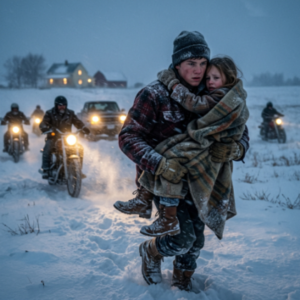
“Just a Kid Soldier,” They Laughed Until Viper 9 Wiped Out the Entire Kill Zone
The boy had no birth certificate that anyone could remember. In the scattered villages along the borderlands where the red dirt stained everything it touched, children were born and children disappeared and the world kept spinning. His name was given to him by an old woman who found him wrapped in a torn flower sack outside a burnt out market.
She called him Abiomi, which in the old tongue means bringer of joy. It was a cruel joke because nothing about his early years brought joy to anyone, least of all to him. By the time he was seven, Abbyomi had learned that the world was split into two types of people. Those who held the guns and those who got shot.
He had been on the wrong side of that equation when his village was raised for the third time. The raiders were not soldiers from any real army. They were boys, too, only a few years older than him, high on crushed leaves, and the kind of power that comes from an AK-47 that weighs almost as much as they do. They laughed when they saw him hiding under a collapsed chicken coupe.
A boy with a scarred cheek and eyes that looked like to hard pebbles dragged Abiomi out by his ankle and threw him into the back of a pickup truck. “Look at this one,” another said, spitting a brown stream onto the dirt. “Just a kid soldier. He’ll be dead by morning.” They all laughed.
That was the first time Abiomi heard the phrase that would later come back to haunt every single one of them. He was not a soldier yet. He was a hostage, a mule, a pack animal who carried ammunition boxes and cleaned the rust off barrels while the older boys slept. But he watched everything. He watched how they held their weapons wrong, how they left the safety catches on during ambushes, how they celebrated too early and mourned till late.
He memorized the lay of the land, every dried riverbed, every termite mound that could hide a prone body, every patch of thorn scrub that could swallow a crawling man. The other child’s soldiers mocked him for being quiet. They called him the ghost because he never laughed and never cried.
He just watched and he waited. Three years passed and Abby grew tall and wirethin like a fence post that had been left in the sun too long. He was 10 now, though he did not know it. The warlord who commanded the raiders had noticed the boy’s silence. The warlord’s name was Commander Tooth, a name he had given himself after he filed his front teeth into sharp points.
He was a man who enjoyed fear the way others enjoyed food. One night around a drum of burning diesel, Commander Tooth pointed a grease stained finger at Abiomi. “You, the mute one, can you even fire a rifle?” The boys around the fire snickered. They had seen Abiomi handle ammunition, but never shoot. They thought he was too gentle, too broken.
One of them, a brute called Big Man because he was large and stupid, stood up and shoved an old boltaction rifle into Aomi’s hands. “Go on, ghost,” Big Man said. Shoot that bottle over there. Or are you just a kid soldier who’s too scared to make noise? Abiomi did not raise the rifle to his shoulder. Instead, he knelt, checked the action, felt the wind direction on the back of his neck, and fired from the hip in one smooth motion.
The bottle exploded 50 m away. The fire went silent. Commander Tooth leaned forward, his pointed teeth catching the orange light. He had seen something rare, a child who did not flinch, who did not close his eyes before a shot, who treated a rifle like an extension of his own bones. From that night, Abiomi was no longer a mule. He was given a weapon of his own, a short-barreled carbine that smelled of oil and old blood.
But he was still not a soldier in their eyes. They gave him the worst jobs. Night century duty in the swamps where the mosquitoes carried fever and the point position on mines swept roads where the first step was often the last. They still laughed. Just a kid soldier, they said. Whenever he was given a suicidal task.
If he dies, we won’t miss him. What they did not know was that Abayomi had been mapping their weaknesses for 3 years. He knew which guards fell asleep after midnight. He knew which ammunition dumps were left unguarded. He knew that Commander Tooth was afraid of the dark and slept with three loyal men around him at all times.
He also knew something they had all forgotten that a quiet boy who has lost everything is the most dangerous thing in the world because he has nothing left to lose. The mission that changed everything came on a rain soaked Tuesday. The government had finally grown tired of Commander Tooth’s raids on civilian convoys.
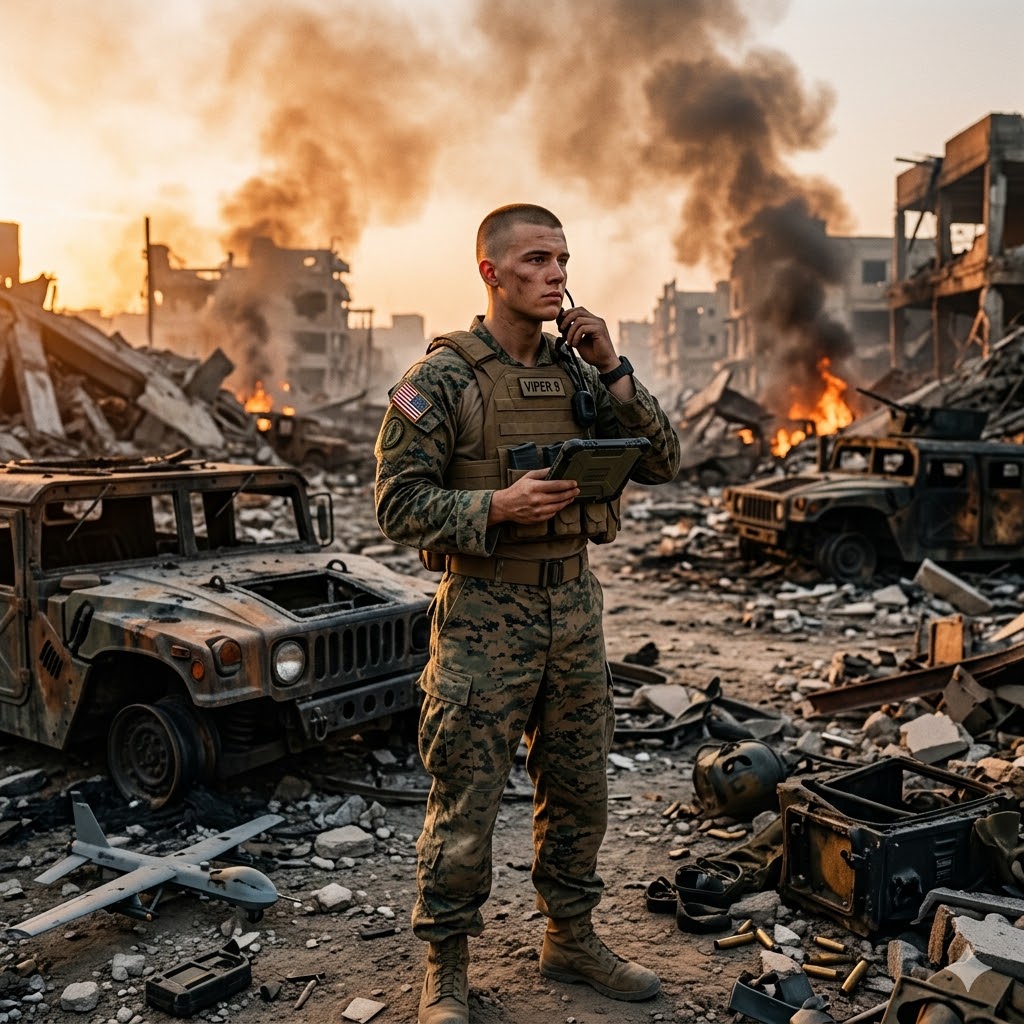
A real army unit, battleh hardened and well supplied, had been dispatched to clear the region. They called themselves the Viper Brigade, and their reputation was written in the blood of a dozen warlords who had come before. Commander Tooth assembled his fighters in the old mission church, its roof long gone, its walls pockmarked with bullet holes.
He gave a speech that Abbyomi did not listen to. The words were always the same. Glory, revenge, the weakness of the enemy. What mattered was the map. The commander unrolled a torn piece of canvas showing a narrow valley called the kill zone. It was a natural funnel to steep ridges on either side. A single muddy road running through the bottom.
The government convoy would have to pass through it. Tooth’s plan was simple. Place fighters on both ridges, trapped the convoy in a crossfire, and wipe them out. Abby studied the map for a long time. Then he looked at the real terrain outside the church windows. He had walked every meter of that valley during his 9th century duties.
He knew that the ridges were not identical. The eastern ridge had thick brush at the top, perfect for hiding. But the western ridge was bare rock that would turn into a skating rink in the rain. He also knew something the commander refused to see. The government army had drones now. They had thermal imaging. They would see every fighter on those ridges long before the convoy arrived.
When Abiomi tried to explain this, Big Man backhanded him across the mouth. Shut up, kid soldier. Big man growled. What do you know about war? The others laughed again, but this time Abbyomi did not lower his head. He looked at each laughing face and memorized it. That night, while the camp slept, he slipped away from his post and walked barefoot through the rain to the edge of the kill zone.
He did not go to warn the government. He had no love for them either. They had burned his village just like the rebels had. Instead, he found a small hollow in the eastern ridge, a place where the rock curved inward like a cuped hand. It was invisible from above and from below. He crawled inside and waited. The rain fell harder. Thunder rolled across the valley like distant artillery.
And Abiomi, the so-called kid soldier who was supposed to be dead by morning, began to prepare a lesson that no one had taught him the lesson of how one person in the right place at the right time can change the fate of everyone. Dot. Dawn came gray and wet. The government convoy rolled into the kill zone exactly on schedule.
Just as Commander Tooth had predicted, 10 armored vehicles, their engines whining in the low gear of the muddy road, the rebels on the ridges could barely contain their excitement. They had been waiting all night, drenched and shivering, but the thought of the loot inside those trucks kept them warm. Big man was on the eastern ridge, directly above a Bayomi’s hidden hollow.
He did not know the boy was 10 m below him, pressed against the cold rock, counting. Abiomi was counting seconds. He had watched enough ambushes to know that the first minute of any firefight was chaos. After that, patterns emerged. The rebels would fire until their barrels glowed, then pause to reload.
The government soldiers would take cover, then return fire in controlled bursts. The battle would become a grinding match of attrition, and the side with more ammunition would win. But Abiomi had noticed something else. The government convoy had not sent 10 vehicles. They had sent 15. The last five were different flatbed trucks carrying something covered in tarpollins.
When the first shots rang out from the rebel positions, those tarpolins were ripped away mortar. Three of them set up on the truck beds, aimed not at the ridges, but at the valley exits. The government had not come to fight an ambush. They had come to trap the trappers. Commander Tooth realized his mistake too late.
He screamed into his radio for the fighters to fall back, but the mortar had already zeroed in on the escape routes. The kill zone became exactly what its name promised. Bodies fell from both ridges. The bare rock of the western ridge turned slick with blood and rain, and fighters slid down the slope into the open where government snipers picked them off one by one.
On the eastern ridge, Big Man tried to rally his men, but a mortar round landed directly in their midst. The explosion threw Big Man off the ridge. He tumbled down the slope, his rifle lost, his leg broken, and landed in a heap of mud and pain right in front of a Baomi’s hollow. He looked up and saw the boy he had backhanded the night before.
“Help me,” Big Man whispered. Abiomi did not move. He watched Big Man’s face as the light left it, not with hatred, but with a strange calm. Then he turned away and crawled deeper into the hollow. The battle raged for another 40 minutes. When it was over, the kill zone held 87 dead. Not a single rebel fighter escaped.
Commander Tooth’s body was found at the northern exit, his filed teeth shattered by a bullet that had entered through his left eye. The government soldiers swept through the valley at noon, collecting weapons and checking for survivors. They found Abbyomi still in his hollow, sitting cross-legged with his carbine across his knees.
He did not raise it when they approached. He did not run. He simply looked up at the soldiers with the same patient, waiting expression he had worn for years. The soldiers were confused. He was too young to be a fighter to calm to be a victim. A lieutenant with a clean shaven face and new boots squatted down in front of him.
“Who are you, boy?” Abiomi pointed at the dead rebels scattered across the valley. “I was with them,” he said. The lieutenant’s hand went to his sidearm. Are you one of Tooth’s men? No, Abbyomi said. I was never one of them. I was just a kid soldier. They laughed at me. The lieutenant looked around at the destruction, the mortar, the trapped rebels, the perfect execution of the government’s trap.
He had been in the army for 10 years, and he had never seen a battle this one-sided. The rebels had walked into a killing ground with no warning, no escape, no chance. That was not luck. That was intelligence. Someone had known exactly where the rebels would position themselves. Someone had fed information to the government’s planning officers.
The lieutenant looked back at the boy at those old patient eyes. “Was it you?” he asked. “Did you tell us where to put the mortar?” “Abiomi did not answer directly. Instead, he stood up, brushed the mud off his thin arms, and said, “They called me a ghost.” Ghosts don’t fight fair. Ghosts watch and wait, and when the time comes, they make sure no one is left to laugh.
The lieutenant did not arrest him. He did not shoot him. He did something stranger. He gave Abbyomi a piece of bread and a canteen of clean water. Then he radioed his commanding officer and said, “Sir, you’re going to want to see this. We found the asset who sent the coordinates. He’s 10 years old.” Word of the kill zone spread fast, not just through the army, but through the villages, the markets, the refugee camps.
People told the story differently depending on who was listening. Some said Abbyomi was a demon who had sold his soul for revenge. Others said he was an angel sent to punish the wicked. The truth was simpler and more terrible. He was a boy who had been called worthless so many times that he had stopped believing in worth altogether. He had not acted out of patriotism or morality.
He had acted because the laughter of the rebels had been the only music of his childhood and he wanted it to stop. The government tried to recruit him officially. They offered him a uniform, a rank, a salary. They wanted to put him in a training camp where he could teach other child soldiers how to think the way he thought.
Abby refused, not because he was afraid, but because he was tired. He had spent for years surrounded by violence. And the only thing he had learned was that violence solved nothing. But it did end things. It ended the laughter. It ended Commander Tooth. It ended Big Man and all the others who had ever called him just a kid soldier.
He walked away from the army camp one morning before dawn. The same way he had walked away from the rebel camp. He took nothing but the clothes on his back and a small knife for cutting fruit. The last anyone saw of him, he was heading east toward the great river, where the mangrove swamps begin, and the war had not yet reached.
A fisherman on a perog claimed he saw a thin boy waiting into the water, washing the mud and the blood off his skin, then disappearing into the green tunnel of the trees. No one knows if Abbyomi is alive or dead today. But the story of Viper 9 and the Killzone is still told around evening fires.
Old fighters, the ones who survived other battles, still lower their voices when they mention his name. They do not laugh. No one laughs anymore because somewhere out there in the silence between the gunshots, a ghost may still be watching. And ghosts, as everyone has finally learned, do not forget.
They wait and when the time comes they wipe out the entire kill zone.