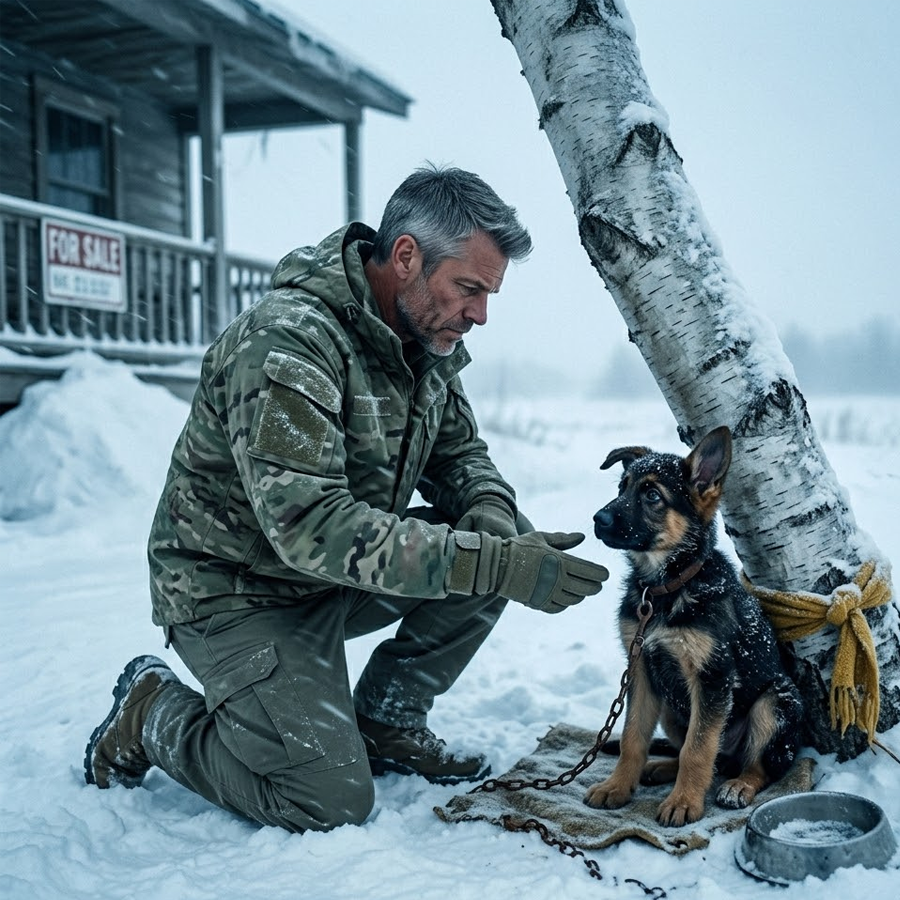
The town of Silver Pines did not wake up quickly. It never had. Mornings there moved slowly, as if the cold itself resisted change, holding everything in place just a little longer than it should. Snow covered the rooftops in thick, uneven layers, and the roads remained quiet except for the occasional sound of a truck engine struggling against the frost. It was the kind of place where silence wasn’t just absence of noise, it was something heavier, something that settled into people over time.
Gideon Vale had become part of that silence.
At fifty-five, the retired Navy SEAL lived in a small wooden cabin at the edge of town, where the trees grew dense and the wind carried fewer reminders of other people. His days followed a pattern so repetitive it barely felt like living. He woke before sunrise, worked with his hands fixing whatever winter had broken, and returned home before the light disappeared again. He spoke rarely, and when he did, his words were brief, functional, and carefully limited.
Three years earlier, everything had been different.
A single night, a single road, a single moment of loss had taken his wife and daughter from him, leaving behind a silence that no amount of discipline or strength could contain. Gideon had spent a lifetime surviving extreme conditions, facing danger with precision and control, but nothing had prepared him for the kind of emptiness that follows when there is nothing left to fight for. Since then, he had chosen distance. Distance from people, from memories, from anything that might require him to feel more than he was willing to carry.
That morning, like many others, began without expectation. The cold was sharper than usual, biting through layers of clothing and settling deep into the bones. Gideon was halfway through splitting firewood when he heard it. A faint sound, almost lost in the wind, something between a whimper and a cry.
He stopped.
At first, he thought it might be an animal in the distance, something caught or injured somewhere deeper in the woods. But the sound came again, weaker this time, closer. Gideon set the axe aside and followed it, moving carefully through the snow, each step deliberate.
What he found stopped him in place.
A small German Shepherd puppy, barely more than a few months old, was chained to a tree. The chain was too short, forcing the animal into a tight, unnatural space. Its fur was matted with ice, its body thin enough that every rib was visible, and its breathing came in shallow, uneven bursts. Someone had left it there, not recently, but long enough that survival had become a matter of hours, not days.
For a moment, Gideon simply stood there.
There were reasons to walk away. Logical reasons. The cost, the effort, the responsibility. He had spent three years building a life that required as little attachment as possible. Saving the animal would mean breaking that distance, stepping back into something unpredictable.
The puppy let out another weak sound.
That was enough.
Gideon moved quickly, kneeling beside it, his hands steady despite the cold. The chain was frozen at the clasp, resistant to movement, but years of training had taught him patience in situations where force would fail. He worked it loose carefully, freeing the puppy without causing further harm. When he lifted it, the weight—or lack of it—was shocking.
Too light.
Far too light.
He wrapped it inside his coat and carried it back to his truck without another thought.
The drive into town was longer than usual, not because of the roads, but because of what sat beside him. The puppy made no sound now, its small body barely moving, its presence fragile in a way Gideon had not allowed himself to feel in years. He kept one hand near it as he drove, not touching, but close enough to feel that it was still there.
The veterinary clinic was already open when he arrived. Dr. Mara Ellis met him at the door, her expression shifting instantly from routine professionalism to quiet urgency as she saw what he was holding. There were no unnecessary questions. She took the puppy immediately, moving with practiced efficiency, calling for assistance as she disappeared into the back.
Gideon stood in the waiting area, unsure of what to do with himself.
Time passed differently there. Slower. He watched the clock, listened to distant sounds from behind closed doors, and felt something unfamiliar begin to settle under his ribs. Not fear exactly. Something closer to anticipation, something that required him to care about the outcome.
When Mara returned, her tone was measured but not without weight.
“It’s bad,” she said. “But not beyond saving.”
Gideon nodded once. That was all.
Then came the part he had expected.
The cost.
He didn’t have enough.
Not anymore.
Without hesitation, he reached into his pocket and removed the one thing he had kept untouched for twenty years. A watch, worn but carefully maintained, a piece of his past that he had never considered parting with. He placed it on the counter between them.
“This will cover it.”
Mara looked at the watch, then at him. She understood what it meant without asking. After a moment, she nodded, not out of agreement with the transaction, but out of respect for the decision.
The puppy survived the night.
And the next.
And slowly, over the following weeks, it began to change.
Gideon named him Talon.
It was a name that carried weight, something sharp, something that held on.
As Talon recovered, something else shifted too. Not suddenly, not dramatically, but in small, almost unnoticeable ways. Gideon found himself leaving the cabin more often. He returned to the clinic for check-ups, stayed a little longer each time, spoke a few more words than necessary.
People began to notice.
A boy named Eli was the first to approach him. Quiet, hesitant, carrying his own kind of loneliness, Eli found something in Talon that made it easier to stay. Gideon didn’t push him away. He didn’t invite him either. He simply allowed him to exist there, the same way Talon had once been allowed to exist in his space.
Others followed.
Norah Bellamy brought food one evening, claiming she had made too much. Gideon knew better, but he accepted it anyway. Mara continued to check on Talon, but her visits became less clinical over time, more conversational, more human.
What had once been a closed life began to open, not through effort, but through presence.
Then came the discovery.
It was Talon who found it.
An abandoned cabin, half-buried in snow, something about it wrong in a way animals recognize before people do. Inside, Gideon found documents, records, evidence of something larger than neglect. A pattern. Money taken from people who had little to lose. Heating funds diverted, contracts manipulated, entire families left in the cold while someone else profited from their silence.
The name connected to all of it was Damon Creel.
The confrontation came during a storm.
A blizzard that erased visibility and turned the world into something unrecognizable. Eli had followed them that day, closer to the lake than he should have been. The ice gave way without warning.
The sound was immediate.
The kind that leaves no time for thought.
For a single second, Gideon saw two paths. One leading toward the man responsible for everything, the other toward a boy disappearing beneath freezing water.
He didn’t hesitate.
He ran.
The cold hit instantly, cutting through layers, slowing movement, but not enough. Talon was already there, barking, circling, refusing to step back. Together, they pulled Eli from the water, inch by inch, the effort raw and unforgiving.
When it was over, Gideon sat in the snow, Eli breathing beside him, Talon pressed against both of them.
For the first time in three years, the feeling that had followed him since the accident shifted.
He hadn’t been too late.
Not this time.
Spring came slowly to Silver Pines.
The snow melted in uneven patches, revealing ground that had been hidden for months. Gideon stood at the graves of his wife and daughter, not with the same weight he had carried before, but with something quieter, something steadier.
He wasn’t healed.
Not completely.
But he wasn’t frozen anymore.
Talon stood beside him, calm, present, exactly where he needed to be.
Gideon had thought he was saving a dog that morning in the snow.
What he hadn’t understood then was that some rescues move in both directions.
And sometimes, the one you pull from the cold is the one who teaches you how to live again.
THE END






