The rain had already started before sunrise, a quiet, steady rain that didn’t demand attention but slowly soaked everything it touched. It blurred the edges of the city and softened the harsh outlines of glass buildings and concrete streets, turning the morning into something slower, heavier. Inside a small grocery store on 8th Street, the fluorescent lights hummed faintly overhead, casting a pale, almost lifeless glow across shelves that would soon be crowded with customers who never noticed the silence before the day truly began.
Arthur stood at his usual position near the entrance, exactly where he had stood for nearly thirty-five years. His uniform had faded from navy blue to a dull gray, worn thin at the collar and elbows, but still clean, still carefully maintained. He didn’t stand stiff like a guard trying to prove authority, and he didn’t lean like someone tired either. He simply existed there with quiet awareness, the kind that came from decades of watching people without ever needing to be seen himself.
Most customers walked past him without a second glance. To them, he was part of the store, no different from the sliding doors or the security cameras mounted in the corners. But Arthur noticed everything, especially the things people tried not to show. That morning, he noticed the boy the moment he stepped inside.
The kid moved differently from everyone else. He didn’t browse or wander casually. He moved carefully, almost calculating each step, as if trying not to disturb the air around him. His clothes were too thin for the cold, his sneakers worn down so badly the edges had begun to peel away. But it wasn’t the clothes that held Arthur’s attention. It was the boy’s eyes. They weren’t curious or distracted like a child’s should be. They were focused, tense, and carrying something far heavier than they should have at that age.
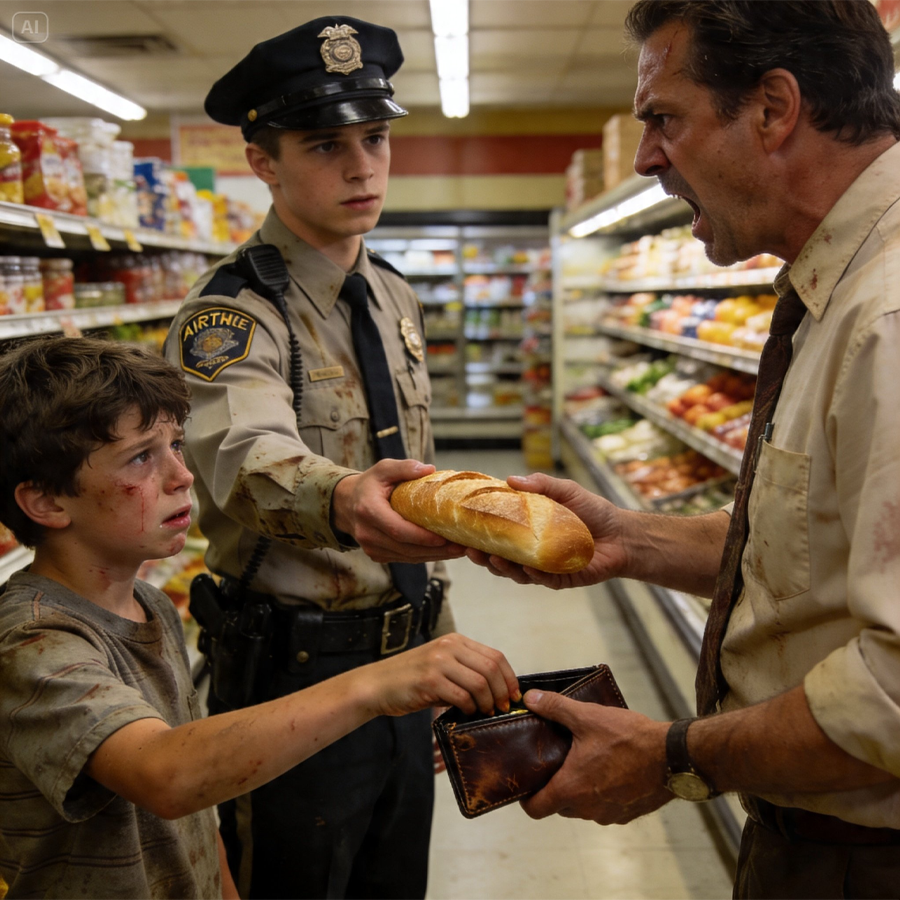
Arthur didn’t approach him right away. He simply watched as the boy circled the bread aisle once, then again, each time moving a little slower. The hesitation was clear. The internal argument was visible in every small movement. Then finally, the boy reached out, grabbed a loaf of bread in a quick, almost desperate motion, and slipped it under his jacket.
It wasn’t skillful. It wasn’t practiced. It was the kind of mistake someone makes when they’ve run out of options.
Arthur took a step forward, ready to intervene quietly, but before he could say a word, a sharp voice cut through the store.
“HEY! What do you think you’re doing?”
Mr. Graves had seen everything.
The manager moved quickly across the floor, his polished shoes striking loudly against the tiles, his expression already twisted with anger. It wasn’t controlled anger. It was loud, aggressive, the kind that needed to be seen and heard. Within seconds, a few nearby customers turned their heads, drawn toward the tension unfolding in the aisle.
“Call the police,” Graves snapped. “I want this brat arrested.”
The boy froze. Completely.
For a moment, it felt like time itself had stopped. The air tightened, stretched thin between what had already happened and what was about to follow. Arthur stepped forward and placed himself between them.
“Wait,” he said, his voice calm but firm.
Graves turned on him immediately, irritation flashing across his face. “This is not your decision, Arthur. Do your job.”
Arthur didn’t respond right away. Instead, he looked at the boy up close. The trembling hands. The hollow cheeks. The kind of hunger that went beyond missing a meal. This wasn’t theft driven by greed. This was survival.
Slowly, Arthur reached into his pocket and pulled out his wallet. There was only one bill inside.
Five dollars.
He placed it on the counter without saying anything else. “I’ll pay for it.”
Graves stared at him, disbelief quickly turning into something colder. “That’s your second warning,” he said, lowering his voice just enough to make it more threatening. “One more act like this, and you’re out.”
Arthur didn’t argue. He didn’t defend himself. He simply took the bread, handed it to the boy, and placed the change into his shaking hand. “The world is hard enough,” he said quietly. “Don’t let it make you hard too.”
The boy didn’t speak. He looked at Arthur like he didn’t understand what had just happened, then turned and ran out into the rain, clutching the bread tightly against his chest. Arthur watched him disappear, knowing he might never see him again, but somehow also knowing that the moment would not simply disappear with him.
Years passed in the quiet, unremarkable way they always do. Arthur stayed at the store, working the same position, wearing the same faded uniform, earning the same modest wage. He never complained. He never asked for more. But every week, without fail, he gave something away. Sometimes it was his lunch. Sometimes it was time. Sometimes it was patience in moments where others chose anger.
He fed kids who had nowhere else to go. He spoke to teenagers others dismissed. He once caught a group of boys vandalizing the back wall of the store and instead of calling the police, he handed them brushes and taught them how to paint something better. Most of them left within days. One of them stayed.
His name was Leo.
Leo kept coming back, first for the painting, then for the conversations, and eventually for something deeper that neither of them ever fully explained. Arthur helped him fill out his first college application, sitting at a small table in the back room after closing hours. Leo didn’t think it would change anything. Arthur didn’t try to convince him otherwise. He simply told him to try.
Leo did.
And then life took him somewhere far beyond that store.
Time moved forward, and like everything else, the store changed too. It was bought by a massive corporation called Titan Industries, a company that didn’t see neighborhoods, only numbers. With it came new management, new policies, and a different kind of leadership. Efficiency replaced empathy. Numbers replaced people.
The new regional manager, Sterling, didn’t like Arthur from the moment he arrived.
“You’re too slow,” he said one morning. “Too sentimental.”
Arthur didn’t argue. He simply continued working.
Until the day he couldn’t.
On his 70th birthday, he was handed a cardboard box and a final paycheck. No ceremony. No acknowledgment. Just an ending delivered in the cold language of corporate policy. No pension. No severance. Thirty-five years reduced to a number that no longer mattered.
Arthur left quietly, carrying his box out into a world that had already begun to move on without him.
What followed wasn’t dramatic. It was slow. Quiet. Painful in a way that didn’t attract attention. His savings disappeared into medical bills. Rent became impossible. The structure of his life, built carefully over decades, collapsed piece by piece until there was nothing left holding it together.
Then one rainy afternoon, it finally caught up to him.
Arthur collapsed on the sidewalk outside a towering skyscraper, his hand gripping a cold railing as his chest tightened with unbearable pain. People walked past him. Some stepped around him. Others avoided looking entirely. To them, he was just another invisible man in a city full of them.
Until one car stopped.
A black SUV cut sharply across traffic and came to a halt. A man stepped out and ran toward him without hesitation. He dropped to his knees in the rain, ignoring everything else, and began trying to keep Arthur alive.
“Stay with me,” he said urgently.
The paramedics arrived, but the man didn’t move.
“He didn’t give up on me,” he said. “I won’t give up on him.”
Arthur woke up three days later in a hospital room overlooking the city skyline. For a moment, he didn’t understand where he was. Then he saw the man sitting beside him.
Older. Stronger. Different.
But familiar.
The man held up an old, yellowed receipt.
“The bread,” he said.
Arthur looked at him carefully.
And then he remembered.
Leo.
The boy who had once stolen a loaf of bread.
Now the CEO of Titan Industries.
And the man who had just saved his life.
Leo leaned forward, his voice quieter now. “I bought the company,” he said. “So I could find you.”
Arthur didn’t respond immediately. Not because he didn’t understand, but because the weight of that moment needed time to settle. Leo watched him carefully, then added something that changed everything.
“There’s more,” he said.
Because this wasn’t just a reunion.
It was the beginning of the truth.
And the truth was about to bring everything down.
THE END






