The Army Nurse Was Ordered to Stand Down, But When the Base Came Under Fire, She Grabbed a Rifle
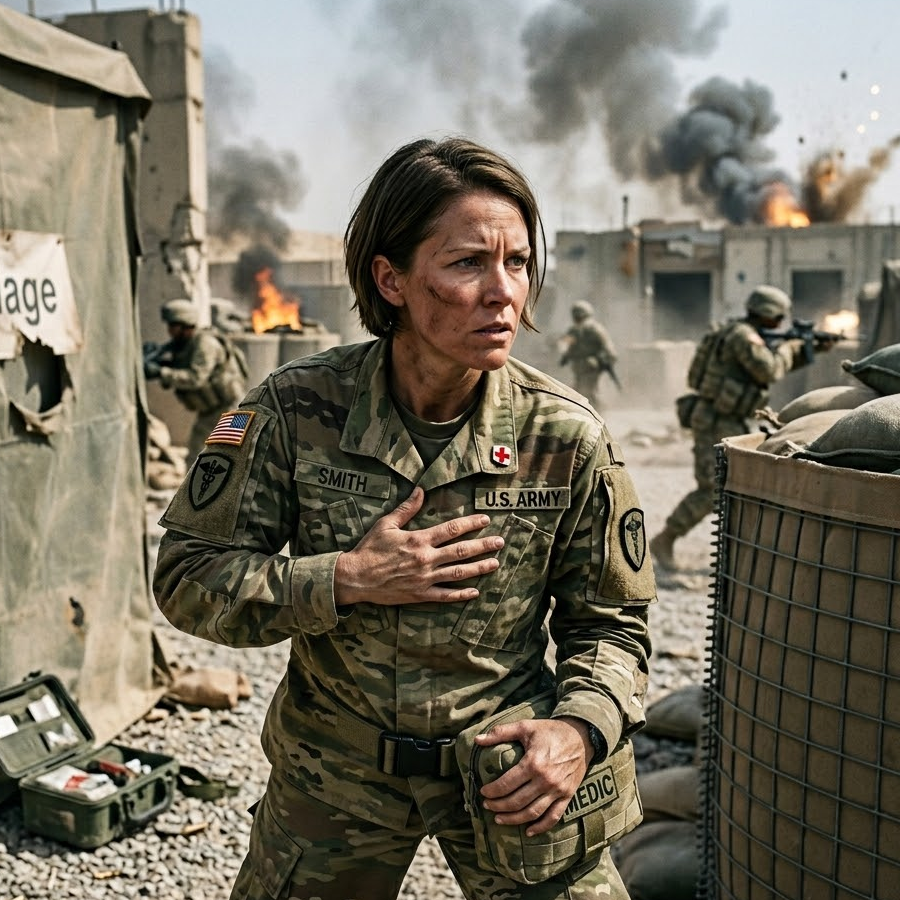
A nurse? With all due respect, Major, this is a live-fire qualification range, not a triage tent. We’re certifying war fighters here. Why don’t you go back to the clinic and make sure the bandages are counted? Leave the weapons to the professionals. The words, dripping with a thick, syrupy condescension, were spoken by Captain Rex Holland.
His voice loud enough to carry across the dusty expanse of the firing line, ensuring maximum audience for his little performance. The small crowd of infantrymen waiting their turn to qualify snickered. They were young, hardened by the sun and the ever-present tension of the remote forward operating base, and they took their cues from the man in charge of the range.
Captain Holland was their gatekeeper to validation, and his arrogance was a currency they were happy to accept. The laughter was a small, sharp burst of sound in the oppressive Afghan heat, a momentary break in the monotony of drills. But the target of the insult, Major Eleanor Vance, offered no reaction. She didn’t flinch.
Her expression didn’t change. Her gaze remained fixed downrange. Her posture a study in placid neutrality. She was a woman of medium height with a frame that seemed more suited to the quiet, sterile halls of a hospital than the gritty, chaotic world of a combat outpost. Her sandy hair was pulled back in a tight, regulation bun, and her face, though etched with the fine lines of someone who’d seen too many long nights, was otherwise unremarkable.
She was, by all appearances, exactly what Holland had pegged her for, a support officer, a healer, a non-combatant completely out of her element. Her silence seemed to confirm his assessment, to validate the crowd’s dismissive amusement. They saw a quiet, unassuming nurse. They saw a box to be checked on a mandatory training roster.
But standing a hundred yards away, leaning against the doorway of the control tower, the base commander, Colonel Matthews, saw something else entirely. He didn’t see a nurse. He saw the stance. It was subtle, almost imperceptible to the untrained eye, but to a man who had spent 30 years watching soldiers, it was as clear as a signal flare in the night.
The way her feet were planted, a perfect balance foundation. The way her shoulders were relaxed, yet aligned. The absolute economy of her movement as she calmly placed her hearing protection on. It was the stance of a shooter, a real one. And as this quiet, profound discrepancy registered in his mind, the first crack of a rifle shot echoed across the range, a sound that would soon be dwarfed by a symphony of genuine, desperate combat.
If you believe that true competence needs no introduction, type silence below. Captain Holland continued his monologue, basking in the attention of his impromptu audience. He paced in front of Major Vance, using his hands to gesture grandly, as if explaining a complex tactical problem to a child. “Look, Major, I get it.
Big Army says everyone has to qualify, from the cooks to the clerks to, well, the nurses. It’s about readiness, about the every soldier a rifleman ethos. It’s a nice sentiment, a great poster. But out here, in the real world, sentiment gets you killed. Precision gets you home. And precision,” he said, pausing for dramatic effect as he tapped the side of his own pristine M4 rifle, “is a perishable skill.
It requires constant, dedicated practice. It requires a certain mindset and aggression that frankly isn’t part of your job description. Your job is to patch people up after people like me are done doing the hard work.” He smiled, a thin, self-satisfied smirk that didn’t reach his eyes.
The infantrymen chuckled again, their deference to his rank and his bluster creating a tight circle of exclusion around the silent major. Vance, for her part, simply picked up the standard-issue rifle from the table. Her movements were fluid, deliberate, and utterly devoid of wasted motion. She didn’t slam the magazine home with the aggressive punch that the younger soldiers favored.
She guided it in with firm, practiced pressure until it seated with a quiet, solid click. Her hands, which the soldiers imagined were only familiar with four lines and sterile gauze, moved with an unsettling familiarity over the weapon’s controls. She checked the chamber. She adjusted the sling. She performed the pre-firing checks with a methodical grace that was jarringly at odds with Holland’s caricature of her.
The Colonel watched, his eyes narrowed in concentration. He saw the way she tested the magazine, not just slapping it, but feeling for the almost imperceptible play that signaled a loose fit. He saw the way her thumb found the safety selector without looking, a pure act of muscle memory. These were not the actions of someone fulfilling a mandatory, once-a-year requirement.
This was the quiet language of a deep and abiding familiarity, a dialogue between a professional and her tools. Holland, however, was blind to these subtleties. He saw only what his prejudice allowed him to see. “All right, Major, let’s get this over with,” he sighed, his voice a theatrical groan of impatience. “Five rounds, 100 m.
Just try to keep them on the paper, if you can. We don’t have the budget to replace the target stands you’re likely to demolish.” He stepped back, crossing his arms, the very picture of condescending authority. He was the gatekeeper, the expert, the one who defined who belonged and who didn’t.
He had made his judgment loud and clear. And in the face of his pronouncement, Major Eleanor Vance simply settled into her firing position, the rifle feeling not like a foreign object, but like a natural extension of her own calm, silent will. The world for her seemed to shrink, the jeers and the arrogance fading away until all that was left was the front sight post, the distant target, and the rhythmic, steady beat of her own heart.
She was a healer, yes, but a person is not defined by a single role, and assumptions, like faulty intelligence, can be a prelude to a devastating surprise. The men around her saw a lamb being led to a procedural slaughter. The Colonel, however, felt a growing sense of premonition. He was watching a lioness patiently ignoring the buzzing of a fly, waiting for the moment to act.
The first distant thump was mistaken for a friendly artillery exercise. It was a common sound, part of the background noise of the FOB. But the second and third thumps followed too quickly, and the high-pitched, menacing whistle that sliced through the air was a sound no one could mistake. The ground erupted 20 yards behind the firing line, a geyser of dirt and shrapnel that sent the smirking soldiers diving for cover.
The air, once thick with arrogance, was now choked with dust and the acrid smell of high explosives. Chaos bloomed in an instant. The laughter died in their throats, replaced by shouts of mortars incoming. The well-rehearsed drills of the infantrymen took over, and they scrambled for the concrete bunkers that lined the perimeter of the range.
Captain Holland, whose entire command presence had been built on the soft foundation of peacetime authority, was frozen for a critical second. His face, just moments before a mask of smug superiority, was now pale with shock. He barked orders, but they were thin, reedy commands lost in the growing cacophony of the attack.
Then, from the ridgeline to the east, the distinct, rhythmic crackle of heavy machine gun fire joined the chorus, tracers of green light stitching patterns across the sky and impacting against the HESCO barriers with brutal, percussive force. This wasn’t a random pot shot. This was a coordinated, complex attack. Major Vance had not moved.
While others scrambled, she had dropped into a low, prone position, the earth shaking beneath her. Her first instinct was professional. She scanned the area not for targets, but for casualties. She saw a young private, one of the very men who’d been laughing at her, clutch his leg, a dark stain spreading rapidly across his fatigues.
He had caught a piece of shrapnel from the first mortar blast. While Holland was still trying to find his voice on the radio, Vance was already moving. But she didn’t run. She moved in a low, efficient crawl, dragging a small medical kit from a pouch on her belt. She reached the wounded soldier, her voice calm and even, a stark contrast to the panic around them. “Look at me.
Breathe. Just breathe.” Her hands were a blur of motion, cutting away the fabric of his trousers, exposing the wound, and expertly applying a tourniquet high on his thigh. She tightened it with swift, powerful twists, her movements precise and economical. She was in her element, a healer amid the chaos.
But as she secured the tourniquet, another burst of machine gun fire ripped through the air, this time impacting the sandbags directly in front of their position, kicking up a blinding storm of dust. The gunner had found their range. From her low vantage point, Vance could see the source, a fortified enemy position on the high ground, a DShK heavy machine gun pinning down the entire western flank of the base.
It was a tactically superior position, and the gunner was chewing through their defenses with terrifying efficiency. She saw the soldiers return fire, wild and suppressed. Their M4s lacking the range and power to effectively challenge the enemy emplacement. They were trapped. It was in that moment that her focus shifted.
She saw a corporal, a designated marksman, get hit. He was thrown backward by the force of the impact, his specialized M210 sniper rifle clattering to the ground beside him. The rifle, a beautiful and deadly instrument of precision, lay there in the dust, its advanced optic glinting in the harsh sun. For a moment, the world seemed to slow down.
Major Vance looked at the wounded private, his life now stabilized. She looked at the panicked, ineffective response of the other soldiers. She looked at the relentless, deadly fire coming from the ridgeline. And then she looked at the rifle. A choice was made, not in a moment of panic, but in a cold, clear-eyed assessment of the tactical reality.
The greatest act of healing she could perform right now was not with a bandage, but with a bullet. With the wounded private safely behind cover, Vance moved toward the fallen M210. It was not a scramble or a dash. It was a fluid, predator-like crawl that kept her silhouette impossibly low to the ground.
The air was alive with the snap and crack of passing rounds, the ground trembling with each new mortar impact. But inside her own mind, there was a profound and unnerving silence. The chaos was external, a storm she could navigate. The internal calm was her anchor, a state of being she had cultivated in environments far more hostile than this.
She reached the rifle. Her hands, the same hands that had so gently applied a tourniquet just moments before, now closed around the cold steel and polymer of the weapon system. There was no hesitation, no fumbling. It was a reunion. She dragged the rifle and the corporal’s discarded pack back to a slightly more protected position behind a stack of sandbags that had been set up for the range.
Captain Holland, who had finally managed to get on the radio, was shouting frantic, contradictory reports into his handset. He saw her with the rifle and yelled, “Major, what in God’s name do you think you’re doing? Get to the aid station. That’s an order.” He was trying to reassert his shattered authority, to force the world back into the neat, hierarchical boxes he understood.
Vance didn’t even look at him. She ignored the order as if it were a whisper in a hurricane. Her focus was absolute. She pulled the rifle’s bolt back, her eyes checking the chamber, her fingers confirming the magazine was seated. She settled the stock into the pocket of her shoulder, the weapon becoming a part of her.
Her left hand found its place on the fore-end, her right on the pistol grip, her index finger resting alongside the trigger guard. It was a posture of perfect union, a symbiosis of flesh and steel. She pulled the pack closer, and her hands moved with practiced efficiency, extracting the laser rangefinder. A quick press of a button, and a number flashed on the small screen. 827 m.
She made a minute adjustment to the elevation turret on the massive scope, the quiet clicks of a knob an intimate sound in the midst of the battle’s roar. Wind. She plucked a pinch of dust from a sandbag and let it drift from her fingers, watching its path. A slight crosswind, left to right, maybe 5 mph.
Another series of clicks on the windage knob. The entire process took less than 10 seconds. It was a ritual, a silent prayer of mathematics and ballistics. To the terrified infantrymen huddled nearby, it was a bizarre, almost insane spectacle. The nurse, the woman their commander had mocked, was now calmly preparing to engage a heavy machine gun from over half a mile away, under direct fire.
Holland stared, his mouth agape. The order he had given dying on his lips. What he was witnessing was so far outside his realm of experience that his brain couldn’t process it. It was like watching a librarian sit down at a concert piano and begin to play a flawless, thundering Rachmaninoff concerto. The dissonance was absolute.
Vance took a breath. She let half of it out, finding the natural respiratory pause. The world through the high-powered optic was clear and stable, the crosshairs settling on the small, dark opening of the enemy emplacement. She could see the silhouette of the gunner, the brass casings ejecting from the side of the weapon, the muzzle flash.
In that moment, there was no Major Vance the nurse. There was only the shooter, the problem, and the solution. Her finger moved from the guard to the trigger. She applied steady, rearward pressure. The world erupted in a controlled, contained explosion, and the rifle bucked against her shoulder, a familiar and almost comforting sensation.
The shot was an acoustic impossibility. Amid the chaotic, full-auto spray of the firefight, the single, sharp, heavy crack of the M210’s 762-mm round was distinct. It was the sound of authority, a single, deliberate word spoken in a room full of panic shouting. For a split second, everyone on the ground seemed to notice it, a sound so different from the others that it momentarily broke through their fear.
Then, 827 m away on the ridgeline, the stream of green tracers from the DShK heavy machine gun abruptly stopped. It didn’t sputter out. It just ceased to exist, as if a switch had been flipped. For a moment, the soldiers on the ground thought the weapon had jammed. They waited for the deadly rhythm to resume, but it never did.
A collective, breathless silence fell over their small section of the perimeter, the absence of the heavy machine gun’s oppressive fire creating a vacuum. A young lieutenant, peering through his binoculars, was the first to speak, his voice a choked whisper of disbelief. “Target down. I I think the gunner’s hit.
” Captain Holland, still fumbling with his radio, lowered it slowly, his eyes wide. He stared at Vance, who was already working the bolt of the rifle with practiced, unhurried grace, the spent casing ejecting in a perfect, gleaming arc. She wasn’t celebrating. She wasn’t even looking at her handiwork. Her eye was already back in the scope, her head canted slightly as she scanned for the next threat. The attack was not over.
Another group of fighters began moving up a dry wash to the south, using the temporary lull in fire to advance on the wire. They were moving fast, a coordinated element of six men. Before anyone could effectively call out the new target, the heavy crack of the M210 echoed again. The lead fighter, the one carrying the radio, stumbled and fell, his forward momentum carrying him into a clumsy, final roll.
A second shot followed a mere 2 seconds after the first. Another fighter, the one carrying what looked like an RPG, dropped without a sound. Four men remained, now confused, exposed, and terrified. They dove for cover, but there was none to be had. A third shot, a fourth, each one a punctuation mark at the end of a life.
Each one delivered with the same metronomic calm as the first. The remaining two fighters broke and ran, scrambling back the way they came. A fifth and final shot from the M210 sent the last one tumbling into the dust. The entire engagement, from the first shot on the machine gun to the last on the fleeing infantry, had lasted less than 30 seconds.
A six-man assault team and a heavy weapon emplacement had been neutralized by a single shooter. The deafening silence that followed was heavier and more profound than any explosion. The remaining enemy forces, their key assets and leadership suddenly and inexplicably eliminated, lost their momentum. The attack faltered, broke, and then melted away back into the hills.
The soldiers on the FOB’s perimeter stared, not at the ridgeline, but the small, sand-colored figure behind the sniper rifle. They looked at Major Vance, the quiet nurse, who was now calmly clearing the weapon, making it safe, her movements as gentle and precise as if she were cleaning a wound. The arrogance and condescension that had filled the air just minutes before had evaporated, replaced by a deep, unsettling, and reverent attack was a surreal landscape of smoke, silence, and disbelief.
The soldiers, emerging slowly from their cover, moved with a new kind of caution, their eyes constantly flicking between the now-quiet ridgeline and the figure of Major Vance. She had placed the M210 rifle carefully on its bipod, its barrel still radiating a faint heat. She was kneeling beside the first soldier she had treated, checking the tourniquet and assessing him for other injuries.
Her transition back to the role of healer as seamless and absolute as her assumption of the role of warrior. Her face was a mask of professional calm, betraying nothing of the lethal precision she had just unleashed. It was into this scene of quiet astonishment that the heavy, rumbling sound of approaching vehicles announced the arrival of the quick reaction force, and with them, the base commander.
Colonel Matthews’ armored vehicle screeched to a halt, and he dismounted before it had even fully stopped, his face a grim mask of concern. He was a tall man with a lean, weathered look of a career officer who had spent more time in the field than behind a desk. His eyes, the color of faded slate, swept across the scene, taking in the impact craters, the wounded soldiers, and the stunned look on every face.
He immediately began issuing orders, his voice cutting through the post-combat haze with practiced authority, directing medics, securing the perimeter, and demanding a situation report. It was then that his gaze fell upon Captain Holland. Holland, his face pale and smeared with dust, approached the colonel, his swagger gone, replaced by a shaky, uncertain deference.
“Sir,” he began, his voice cracking slightly, “we took mortar and heavy machine gun fire from the East Ridge. They attempted to probe the wire from the south. We We repelled the attack.” The colonel’s eyes narrowed. “We repelled the attack, Captain? That’s your report? My command post was listening to your radio traffic. It sounded like you were being overrun.
It sounded like you had lost control.” Then, suddenly, the enemy’s command and control and their primary fire support went completely dark. Explain that discrepancy to me. Holland swallowed hard. He glanced over at Major Vance, who was now helping a medic apply a pressure dressing. “Sir, it was Major Vance, sir.
” The colonel’s gaze followed Holland’s, and for a long moment, he just stared at the nurse. He looked at her calm demeanor, then at the M210 rifle sitting nearby, a silent, potent testament to what had occurred. He walked past Holland without another word, his boots crunching on the gravel, and stopped a few feet from Vance. He didn’t speak to her immediately.
Instead, he knelt down and looked at the rifle. He wasn’t a sniper, but he knew weapons. He saw the subtle custom modifications, the worn-down texture on the pistol grip, the carefully marked settings on the scope turrets, the slight, almost invisible scratches near the ejection port that spoke of thousands of rounds fired.
This wasn’t a standard-issue rack weapon. This was a professional’s tool, as personal and familiar as a surgeon’s scalpel. He stood up and looked at Vance, who had finished with the wounded soldier and now stood to meet his gaze, her expression neutral. “Major,” Colonel Matthews said, his voice quiet but carrying an immense weight, “report.
” Her response was minimalist, devoid of any embellishment. “Sir, we took casualties. The enemy established fire superiority from a fortified position. I identified a designated marksman’s rifle that was not in use. I utilized the asset to neutralize the primary threats.” She delivered the lines as if reading from sterile after-action report.
It was a most profound understatement the colonel had ever heard. He held her gaze, a flicker of something, a memory of recognition dawning in his eyes. He turned to his aide. “Give me Major Eleanor Vance’s full service record. Now, the classified file. Use my authorization.” The aide, sensing the gravity of the moment, scrambled back to the vehicle, his radio already in his hand.
A new kind of tension settled over the range, a tension not of fear, but of imminent revelation. The information came back over the secure radio link in a series of clipped, coded confirmations that only the colonel and his aide could understand. As the aide relayed the data, Colonel Matthews’ expression shifted from curiosity to dawning comprehension, and finally, to a profound and solemn respect.
The silence on the range was now absolute. Every soldier, from the lowest private to Captain Holland, stood frozen, watching the silent exchange, sensing that the world as they knew it on this small base was about to be irrevocably altered. The colonel ended the call and stood for a moment, looking not at Vance, but the faces of the young soldiers around him.
He was preparing to teach a lesson they would never forget. He turned back to Major Vance, and in a voice that was now filled with a deep, resonant authority that commanded the attention of every soul present, he began to speak. “Major Eleanor Vance,” he said, his voice clear and strong, “according to this, you graduated top of your class at the academy.
You declined a commission in the infantry, opting instead for the medical service corps.” He paused, letting that sink in. “A decision that, it seems, has been misinterpreted by some.” His eyes flicked to Captain Holland. A brief, piercing glance that carried the weight of a formal reprimand. He then looked back at Vance. “What your file also states, what very few people on this base or any other are cleared to know, is that your first eight years in the United States Army were not spent in a hospital.
They were spent as a member of a unit that does not officially exist.” The air grew thick with unspoken meaning. The soldiers exchanged confused, wide-eyed glances. Captain Holland’s face had gone from pale to ashen. The colonel continued, his words now like hammer blows, each one dismantling the foundation of their assumptions.
“Your file lists you as a logistical support analyst for those eight years. But I’m now looking at your real service record. Unit designation, classified. Mission portfolio, direct action, special reconnaissance, counterterrorism. Your specialty,” the colonel said, his voice dropping slightly, filled with a new level of reverence, “was listed as senior assessor for high-value target eradication.
” He let the euphemism hang in the air for a moment before translating it for the stunned audience. “Ladies and gentlemen, what that means is that Major Vance was a Tier One sniper. Not just a sniper. She was attached to the most elite special missions unit in our arsenal. Her file lists over 200 confirmed engagements. It lists the Distinguished Service Cross.
It lists two Silver Stars and a Bronze Star with a V for Valor. It lists mission classifications so secret that I, as your base commander, do not have the clearance to read them.” He took a step closer to Vance. “It also lists the reason for her transfer to the medical corps. A mission in the Korengal Valley.
Her entire team was ambushed. She was the sole survivor, but not before single-handedly holding off an enemy force for 72 hours, protecting her wounded comrades until extraction. After which, it says here, she personally requested a transfer, stating that she felt she could save more lives with a scalpel than with a rifle.
” The revelation washed over the crowd like shockwave. They weren’t just looking at a nurse. They were in the presence of a living legend, a ghost from the secret, violent history of the war, a woman whose true service record was the stuff of whispered, unbelievable stories. The colonel then did something that no one on that range had ever seen him do.
He faced Major Vance, drew himself up to his full height, and rendered a slow, perfect, formal salute. It was not the casual salute between officers. It was a gesture of profound, heartfelt respect from a seasoned commander to a warrior of the highest possible caliber. “Major Vance,” he said, his voice thick with emotion, “your actions today saved the lives of every person on this range.
You are a credit to the uniform this nation. I am honored to serve with you.” The ripple effects of that moment on the firing range spread through the forward operating base with the speed and intensity of a wildfire. The story, passed in hushed and reverent tones in chow lines, in cramped barracks, and over crackling radios, grew with each telling.
It became the legend of the Angel of the East Ridge, the quiet nurse who had single-handedly broken a complex enemy attack with five perfect shots. The M210 rifle was taken out of service, not because of any defect, but because it was now regarded as something of a relic. The armorer mounted it on a simple wooden plaque inside the command post, right next to the tactical maps.
Underneath it, a small brass plate was engraved with the date and five simple words: Competence is a quiet virtue. The spot on the range where she had taken her position, the simple stack of sandbags, was unofficially christened Vance’s Perch. Young soldiers would walk by it, touching the rough burlap of the bags as if seeking to draw some of her calm, her precision, into themselves.
It became a landmark, a physical reminder that the most dangerous weapon on any battlefield is a calm mind. Captain Rex Holland was, in a word, broken. His public humiliation was absolute and complete. His authority, built on a foundation of bluster and arrogance, had been pulverized into dust. Colonel Matthews did not officially reprimand him. He didn’t have to.
The silent, judging eyes of the very soldiers who had once laughed at his jokes were a far more potent punishment. Holland was reassigned a week later to a dreary logistical post back at Bagram Airfield, a man stripped of his pride and forced to confront the toxic consequences of his own prejudice.
But the story doesn’t end there. Two months later, a convoy carrying medical supplies was hit by an IED just outside the FOB. The situation was chaotic with multiple casualties in an ongoing firefight. Major Vance, leading the medical response team, was at the center of the storm. As she worked to stabilize a critically wounded soldier, a young lieutenant fresh out of officer school and terrified, froze under the pressure.
He was unable to effectively direct his men’s fire. His commands lost in a panic stutter. It was then that a figure emerged from one of the supply trucks, Captain Holland. He had volunteered for the convoy duty, a humbling assignment he had taken without complaint. He saw the lieutenant faltering.
He saw Major Vance, covered in blood and dust, working with impossible calm amidst the flying bullets. He moved to the lieutenant’s side, not with arrogance, but with a new found quiet authority. “Son,” he said, his voice steady. “Look at her. Look at the major. That’s what calm looks like. Find it in yourself. Your men need you.
” He then helped the young officer coordinate a defensive perimeter. His actions efficient, his words encouraging. He had learned the lesson of the firing range not as a story, but as a deep transformative truth. He had learned that leadership wasn’t about being the loudest voice in the room, but the calmest.
After the firefight was over and the wounded were evacuated, Holland approached Major Vance. He didn’t offer a flowery apology. He simply looked her in the eye and said, “Thank you, Major. You taught me something.” Vance merely nodded, her focus already on her next patient. For her, the past was the past. The only thing that mattered was the task at hand, the life that needed saving.
The transformation of the base’s culture was subtle, but profound. The story of Major Vance became more than just a piece of gossip. It became institutional folklore, a foundational myth that was used to instruct newcomers. Whenever a new soldier, full of unearned confidence, would boast or belittle someone they perceived as weaker, a grizzled sergeant would pull them aside and quietly ask, “You ever hear the story about the nurse and the M210?” The tale became a powerful antidote to the poison of assumption, a constant reminder that true strength
often resides where it is least expected. The quiet professionals on the base, the mechanics who could diagnose a faulty engine by its sound, the intelligence analysts who could find a needle of truth in a haystack of data, the cooks who could make a gourmet meal out of MREs, felt a new sense of validation. Their silent, often thankless, competence was now seen not as a weakness, but as the bedrock upon which the entire outpost was built.
The base became more efficient, more cohesive, more respectful. The lesson had been absorbed into its very DNA. Judge by actions, not by appearances. Respect is earned through demonstrated skill, not demanded by rank or volume. Major Vance, for her part, remained unchanged by her new found fame. She deflected every attempt to praise her, often responding with a simple, “I was just doing my job.
” She continued her work in the clinic with the same quiet dedication as before. The soldiers who came to her for treatment, however, saw her differently. They looked at her steady hands changing a dressing or suturing a wound and saw not just a healer, but a guardian. They spoke to her with a reverence previously reserved for legendary sergeants major or decorated commanders.
They found that her calm was infectious, a source of strength that they could draw upon during their own recovery. They came to understand that the same precision that could guide a bullet over 800 m could also guide a needle through delicate tissue. But the same focus that could analyze a complex battlefield could also diagnose a complex injury.
They realized that her core identity was not sniper or nurse, it was professional, the ultimate master of her chosen craft, whatever that craft might be at any given moment. Her legacy was not one of violence, but of competence. She had saved the base with a rifle, yes, but she continued to save it every day with her skill, her dedication, and her profound unshakable silence, which spoke more eloquently than any speech Captain Holland had ever given.
Her worth was not in the medals she kept locked away, but in the lives she touched and the standards she set without ever speaking a word about them. A year passed. The dust of the Afghan plains still swirled around the FOB, but the atmosphere within its walls had settled. A new group of replacements had recently arrived.
Among them a young, eager to impress captain assigned to oversee base operations, the same role once held by Rex Holland. On his second day, this new captain was striding across the compound, pointing out minor uniform infractions and loudly critiquing the placement of sandbags, establishing his authority in the most superficial way possible.
He passed the clinic and saw a woman in medical scrubs meticulously sweeping the entrance. “You there,” he called out, his tone sharp. “Find something better to do. We’ve got local contractors for that kind of work. An officer should be managing, not sweeping.” The woman stopped, leaned the broom against the wall, and looked at him. It was Major Vance.
Before she could speak, a massive figure emerged from the shadows of the command post doorway. It was the command sergeant major, a man whose face was a roadmap of three decades of hard service. He walked over and placed a hand on the young captain’s shoulder that felt like an anchor. “Captain,” the sergeant major said, his voice a low, dangerous rumble.
“Let me tell you a story. It’s about this very spot. It’s about assumptions.” He then proceeded to recount the legend of the angel of the Easter Ridge, his words painting a vivid picture of the arrogance, the chaos, and the impossible quiet competence that had saved them all. The young captain’s face went through several shades of red before settling on a ghostly white.
He looked from the sergeant major to the unassuming major who had simply picked up her broom and resumed her task, her work a form of quiet meditation. He had almost made the exact same mistake as his predecessor. He approached Vance, his posture now humbled and deeply respectful. “Major, Mom, I apologize. I I didn’t know.
” Vance paused her sweeping and looked at him, her eyes offering not judgment, but a simple, profound piece of wisdom. “Captain,” she said, her voice soft but clear. “The most important part of any job is doing what needs to be done. Right now, this porch needs to be clean.” She offered nothing more. She didn’t need to. The lesson was complete.
The young captain understood. It wasn’t about rank or job title or appearances. It was about seeing a need and meeting it with quiet professional competence. It was about the work itself, not the glory attached to it. That was her legacy, a living principle that now guided the culture of the entire base. True legacy isn’t a story carved in stone.
It is a lesson absorbed into the bloodstream of an institution. It is not what you leave behind in a display case, but what continues to move forward in the actions and decisions of others. Major Eleanor Vance would eventually leave that dusty FOB. Her departure is quiet and unremarkable as her arrival. She left behind no statues, no monuments bearing her name.
But her true legacy was far more enduring. It lived in the humble silence of the new captain who learned to listen more than he spoke. It lived in the respectful diligence of the soldiers who learned to look for worth in the quiet corners of the base, not just on the grand stages. It lived in the institutional memory, a permanent cautionary tale against the seductive poison of assumption.
The story of that day became a teaching tool, a parable told to every new arrival, ensuring that the lesson paid for in blood and humility would never be forgotten. They learned that the most profound strength is often silent, that the most skilled hands are often the most gentle, and that true respect is a currency that can only be earned through the undeniable proof of action.
Major Vance never fired a rifle in combat again. She went on to become one of the army’s most respected trauma surgeons, her hands performing miracles of healing in sterile operating rooms far from the grit and dust of war. Yet, the two skills were never separate in her mind. They were merely different expressions of the same core principle, a relentless dedication to precision, a deep well of calm under pressure, and a profound understanding that in moments of ultimate crisis, it is not the loudest voice that saves you, but the steadiest hand. Her life was a testament
to the quiet professional, a living embodiment of the idea that character is not defined by the noise you make, but by the competence you demonstrate when everything is on the line. Her silence was never sign of absence, but a mark of complete and total presence, a focus so absolute that it required no external validation.
For more stories where quiet competence triumphs over loud assumption and where silent professionalism defines true worth.