There wasn’t anyone to take care of me. He was quiet for a moment. You’ve got people now, he said. She looked at him. Then at Victoria in the doorway, then back at the ceiling. Okay, she said. She was worse by midnight. The fever had climbed despite the Tylenol 104.1 when Ethan checked it at 11:30 with Sophie shaking under the blankets and her breath coming faster than he wanted to hear.
He called the after hours nurse line and ran through the symptoms and the nurse told him to get the fever down with a cool cloth and watch her breathing and go to the ER if it went above 105 or if she had trouble breathing. He did the cool cloth and sat beside her bed and watched her chest rise and fall.
Victoria came in at 1:00 a.m. with a bowl of cool water and a fresh cloth to replace the one that had warmed. She sat down on the other side of the bed without being asked. They stayed like that, Ethan on one side, Victoria on the other, Sophie between them shaking and half asleep and not quite fully absent, the way people are with high fevers, present but blurred.
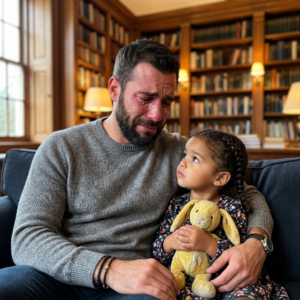
At about 2:00 in the morning, Sophie opened her eyes. She looked at Ethan. She looked at Victoria. She looked at the ceiling. Are you going to go home?” she said. Her voice was rough with fever. “When I’m sick, are you going to We’re right here,” Ethan said. “But when it’s really bad,” she said. “When things are really hard.
Are you going to?” She couldn’t finish it, but he knew what the end of the sentence was. He’d known since the day Karen Reeves had called him. he’d known since the courtroom, since the foster home in Eugene, since the night in the kitchen at 3:00 in the morning when she’d told him she’d sat with her dying mother because she was scared of being taken away.
She was asking the question she’d been carrying since the beginning. Just now, with her defenses down and her fever up, and Humphrey pressed against her side, she couldn’t hold it in anymore. “I’m not going anywhere,” he said. “Not when things are hard, especially not then.” She looked at him with those fever bright eyes for a long moment.
Promise? She said he’d been careful about promises. He’d been careful because promises were things you had to keep and he didn’t make them lightly. And he understood that Sophie didn’t use the word lightly either, that she’d probably heard it before from other people in other rooms and had learned that the word and the thing it represented were not always the same.
Yeah, he said. I promise. She looked at Victoria. Victoria held her gaze steadily. I’m here, she said. That was all. Not a promise because Victoria didn’t make promises she wasn’t certain of. But I’m here in the particular way she said it, clear and unhedged, with her dark eyes steady and her hand resting near Sophie’s on the blanket, was something better than a promise.
It was a fact stated in present tense in the middle of a hard night by someone who had stayed. Sophie closed her eyes. The fever broke at 4:00 a.m. She slept after that. Real sleep, heavy and slow. The sleep of someone whose body has finally stopped fighting and started healing. The breathing evened out. The shaking stopped.
The room was quiet except for the heater and the winter wind finding the old gaps in the old house the way it always did. Ethan sat in the chair beside her bed and didn’t leave. Victoria was asleep in the other chair. She’d fallen asleep sitting up somewhere around 3, and she looked sleeping younger than she did awake and less guarded with her hair loose and her hands open in her lap.
He looked at her for a moment in the dark. this woman he’d married for reasons that had nothing to do with love, who had shown up anyway, who had stayed when she didn’t have to, who had helped build something in this house that he hadn’t had the imagination to picture before it existed. He looked away out the window at the winter dark.
He didn’t examine the feeling. Not that night. That night was for Sophie, for the watching and the waiting and the staying, for the practice of the thing he’d promised. Dawn came in slowly, the sky lightning from black to gray to the pale and uncertain blue of a February morning, and Sophie slept on, and the farm was quiet.
And somewhere in the house, the coffee maker clicked on. Victoria had set it up the night before, Ethan realized, without being asked, the way he had always set it up for himself. And the smell of coffee moved through the cold air of the house, like something ordinary and good, like a small sign that morning had arrived, and they were all still in it.
Sophie recovered from the fever in the way children recover from fevers, with a speed that made adults feel vaguely cheated, as if the crisis should have taken longer to undo itself in order to justify the terror it had caused. By Saturday morning, she was sitting up in bed eating toast and asking if she could work on her drawing.
By Sunday afternoon, she was complaining that she was bored, which Ethan recognized as a fundamentally healthy sign. By Monday, she was back at school. Humphrey observing the road from the front pocket of her backpack. The whole episode receding in her rear view with the efficiency of a child’s immune system and a child’s memory.
What didn’t recede was what had happened in that room at 2:00 in the morning. Ethan thought about it in the days that followed. The quality of that question she’d asked, “Are you going to go?” The fever thinness of her voice, the the way she’d looked at him afterward. He’d made a promise. He didn’t regret it. He just understood more clearly now than before the weight of it, not as obligation, as choice, repeated daily in the small things and the large things both.